
MELU-203 · Lesson 4 of 12 · 18 min
The exam format and the references allowed
▶ Video coming soon A video version of this lesson is on the way.
Lupe had taken plenty of tests in her apprenticeship, but she had never sat a licensing exam, and she wanted to know exactly what she was walking into. Arizona's two exams are different in almost every way. The Statutes and Rules Exam is an online, open-book exam on contractor law, taken after a training course. The trade exam is a proctored exam on electrical knowledge and the National Electrical Code, given by PSI at a test center or online. This lesson sets out what each exam covers, what you may bring or use, how scoring works and how to plan your time. Lupe and Theo, who was thinking about qualifying his own solar company one day, went through it together at lunch over two weeks.
The Statutes and Rules Exam
The SRE tests Arizona contractor law: who must be licensed, the classifications, the qualifying party's role, bonds and the recovery fund, contracts and advertising, grounds for discipline, the complaint process and the penalties for unlicensed contracting. It is built around a training course, and the exam follows the course. Training providers describe it as an open-book exam. The permitted references are the statute, Title 32, Chapter 10 of the Arizona Revised Statutes; the rules, Title 4, Chapter 9 of the Arizona Administrative Code; and the ROC's glossary for the exam. A score of at least 70 is required.
Open book does not mean easy. The questions reward a candidate who knows where things are in the statute and rules, because looking up every answer from scratch takes too long. Lupe printed the statute and rules, put tabs on the sections on classifications, qualifying parties, bonds, the recovery fund, contracts and discipline, and read each section twice during the course. She also kept a one-page list of numbers to remember: the four years of experience, the score of 70, the ninety-day life of a background check and the two-year license period.
The trade exam
The electrical trade exam tests electrical theory, calculations and the National Electrical Code as applied to the classification. PSI's bulletin says each exam has a content outline that lists the number of questions in each subject area and the time allowed, and that five to ten unscored experimental questions may be included and count against the exam time. The outline, not this course, is the authority on how many questions there are and how long you have. Read it, and plan your study by its subject weights.
The bulletin's list of electrical references names the National Electrical Code, the American Electricians' Handbook and Ugly's Electrical References. That list appears in PSI's store section, and the bulletin's security rules prohibit outside materials during the exam, so do not assume a book may be brought in just because PSI sells it. Check the content outline for whether the exam is open book, which edition of the NEC it is based on, and what calculators are allowed. Training providers have described the Arizona electrical exams as open book in the past; confirm the current rule in writing before test day.
The ROC also accepts the NASCLA electrical examination in place of the state trade exam for the C-11, R-11 and CR-11. The NASCLA exam has its own candidate bulletin, references and format, so a candidate choosing it should study from that bulletin rather than the PSI outline.
What the trade exam covers
Although the outline sets the exact weights, an electrical contractor trade exam usually draws on the same topics the core courses covered: general wiring requirements, branch circuits and feeders, services, overcurrent protection, wiring methods and conductor sizing, grounding and bonding, motors and transformers, special occupancies and equipment, load calculations, and electrical theory and math. Arizona candidates should give extra attention to two topics that come up constantly in the state's work: photovoltaic systems, because of the volume of solar work, and the effect of high ambient temperatures on conductor ampacity, because of rooftop and attic installations in the desert heat.
| Exam | Delivered by | References | Passing score |
|---|---|---|---|
| Statutes and Rules Exam (SRE) | Online through the ROC's provider | A.R.S. Title 32, Ch. 10; A.A.C. Title 4, Ch. 9; ROC glossary | At least 70 |
| Electrical trade exam | PSI, test center or online | As listed in the PSI content outline (NEC edition and other books) | At least 70 |
| NASCLA electrical exam (alternative) | NASCLA's testing provider | As listed in the NASCLA bulletin | Per NASCLA bulletin |
Pacing
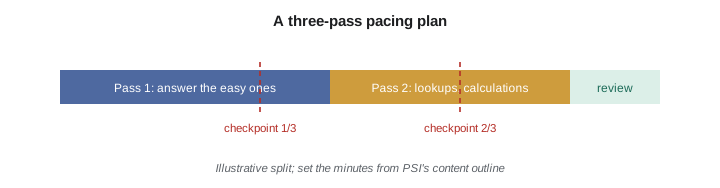
Whatever the number of questions, the arithmetic of pacing is the same. Divide the time by the number of questions to get an average budget per question, then plan three passes. On the first pass, answer every question you can answer quickly from memory and mark the rest. On the second pass, work the lookups and calculations. Leave the last part of the time for a review of marked questions and a check that every question has an answer, since an unanswered question cannot score. Set checkpoints at one third and two thirds of the time and compare them with how many questions you have answered.
# A pacing plan from the numbers in the content outline (example values only)
questions = 80        # read the real number in the PSI content outline
minutes = 240         # read the real time limit in the outline

per_question = minutes / questions
print(f"Average budget: {per_question:.1f} minutes per question")
for share in (1/3, 2/3):
    t = round(minutes * share)
    q = round(questions * share)
    print(f"Checkpoint at {t} min: about {q} questions answered")
review = round(minutes * 0.15)
print(f"Keep about {review} minutes for review")Average budget: 3.0 minutes per question Checkpoint at 80 min: about 27 questions answered Checkpoint at 160 min: about 53 questions answered Keep about 36 minutes for review
The values in the calculator are placeholders, not the real exam numbers. Lupe ran it again with the numbers from her content outline and wrote the checkpoints on an index card to memorize, since she could not bring the card into the exam room.
Using the code book
If the outline allows the NEC in the exam, speed with the book matters more than anything else. Tab it by article, highlight the key tables you use most, and practice finding answers through the index. Know which tables you will need for conductor ampacity, temperature correction, adjustment for the number of conductors, conduit fill, box fill, grounding conductor sizing and motor full-load currents. Check the outline's rules on tabs and highlighting; testing companies often allow permanent tabs and highlighting but not loose notes or written-in answers. Practice with the same edition the exam is based on, because article and table numbers change between editions.
Booking and preparing for the testing center
Candidates register for the trade exam through PSI's system for Arizona contractor exams, online or by phone, and choose a testing center and time. The bulletin sets the rules for rescheduling and canceling, including how far ahead a change must be made to avoid losing the fee, and the rules on identification. The name on the identification must match the registration. Read those sections the week you book, not the night before, because a mismatch or a late cancellation costs both money and time.
The bulletin also sets what may be brought into the room. References that meet PSI's rules may be used for the trade exam; personal notes, loose papers and electronic devices generally may not. Check the rules on calculators, because some testing programs allow only certain models. Testing centers usually inspect books at check-in, so books with notes written in the margins or pages added can be refused.
| When | Task |
|---|---|
| When booking | Read the bulletin sections on identification, rescheduling and permitted materials |
| Two weeks before | Finish tabbing; take a full timed practice session |
| The week before | Confirm the date, time and address; check identification |
| The night before | Pack the references, identification and permitted calculator |
| Exam day | Arrive early and allow time for check-in and book inspection |
Reading code questions
Code questions on a trade exam tend to follow a few patterns. Some ask for a minimum or maximum value from a rule or table. Some describe an installation and ask whether it complies. Some require a short calculation using a table value. In each case, the first step is to identify exactly what is asked and in what units, the second is to find the right article, and the third is to read the whole rule, including exceptions, before choosing. Exceptions are a common source of wrong answers, because a candidate who stops reading at the first number may miss the condition that changes it.
Lupe practiced by writing the article number she expected to use beside each practice question before she opened the book. When she was wrong, she noted where the answer actually was. Within a few weeks her first guesses were right most of the time, and her lookups were faster because she was opening the book to the right chapter.
Worked problem
Planning study time by weight
Lupe's content outline divides her exam into subject areas. Suppose (as an example) that calculations and load analysis carry a quarter of the questions, wiring methods and materials a fifth, services and grounding a fifth, special occupancies and equipment a fifth, and general requirements and theory the rest. She has forty hours to study. How should she divide them?
Show solution
- A quarter of forty hours is ten hours for calculations and load analysis.
- A fifth of forty hours is eight hours each for wiring methods, services and grounding, and special occupancies.
- That leaves forty minus ten minus twenty-four, or six hours, for general requirements and theory.
- She adjusts after a timed practice test, adding hours to any area where she misses the most questions.
Answer: About 10, 8, 8, 8 and 6 hours, then adjust by practice results.
Practice materials
Good practice questions are written to the content outline, cover each subject area in proportion to its weight, and come with explanations that point to the reference where the answer lives. Many exam preparation providers sell question sets and timed practice tests for Arizona contractor exams; choose ones that are current with the code edition PSI lists, because questions written for an older edition can teach the wrong answer. Use practice tests in two ways. Early on, work untimed with the book open and focus on learning where things are. In the last weeks, take full timed sessions under exam conditions and review every miss. Keep score by subject area, not just in total, because a total can hide a weak area that the real exam will find. Lupe found that her total looked fine while her motor questions lagged, and two evenings of focused practice fixed it before the real exam.
Finally, treat the practice sessions as rehearsals for the whole day, not just the questions. Take them at the same time of day as the real exam, with the same books, the same calculator and the same breaks you plan to take. A candidate who has rehearsed the routine has one less thing to think about at the testing center, and can give full attention to the questions in front of her.
Common mistakes
MistakeAssuming every book PSI sells may be brought into the exam.
InsteadRead the content outline and security rules; only the references the outline permits are allowed.
MistakeStudying the wrong NEC edition.
InsteadUse the edition named in the content outline; table and section numbers change between editions.
MistakeTreating the open-book SRE as a formality.
InsteadTab the statute and rules and know where each topic is; looking up everything from scratch takes too long.
MistakeLeaving questions blank at the end.
InsteadKeep review time and make sure every question has an answer.
Summary and key terms
- The SRE is an online, open-book exam on Arizona contractor law using the statute, the rules and the ROC glossary.
- The trade exam is administered by PSI; its content outline sets the number of questions, time and subject weights.
- PSI may include five to ten unscored experimental questions that count against the exam time.
- Only references the outline permits may be used; check the NEC edition and the rules on tabs and calculators.
- Plan three passes with checkpoints, and practice with the same NEC edition as the exam.
- Content outline
- PSI's document listing the questions by subject area, the time allowed and the permitted references for an exam.
- Open book
- An exam on which listed references may be used during the test.
- Experimental questions
- Unscored questions being tested for future use, which count against exam time.
- Checkpoint
- A planned point in the exam at which to compare elapsed time with questions answered.
- NASCLA electrical exam
- A national exam the ROC accepts in place of the state electrical trade exam.
Practice problems
Work each problem on paper first, then reveal the answer to check.
Which three references do providers describe as permitted for the SRE?
Show answer
A.R.S. Title 32, Chapter 10; A.A.C. Title 4, Chapter 9; and the ROC glossary.
Where do you find the number of questions and time limit for the electrical trade exam?
Show answer
In PSI's content outline for that exam.
An exam has 100 questions in 300 minutes. What is the average budget per question?
Show answer
Three minutes.
Lesson quiz · 5 questions
Score 60% or more to complete this lesson.
Create a free account to save your progress, take quizzes and earn a certificate.