
MELU-203 · Lesson 11 of 12 · 18 min
Renewal and continuing education
▶ Video coming soon A video version of this lesson is on the way.
Two years after Lupe's name went on Sonoran Line's license, the renewal notice arrived in Brenda's inbox. Gil had renewed the license thirteen times, and his advice was short: "Renewal is easy if you've kept everything current the whole time, and miserable if you haven't." A license that lapses stops the permit desk, can void bids and contracts, and leaves the company unable to legally contract for work. This lesson covers the Arizona license period, what renewal involves, the fees and bond adjustments that come with it, what happens when a license lapses, and the place of continuing education and training in a state where the ROC's published requirements are built around the business rather than classroom hours.
The two-year license period
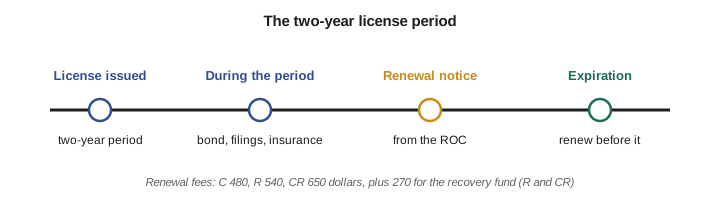
Arizona contractor licenses are issued for a two-year period. The ROC's fee page lists both new license fees and renewal fees for each license type on a two-year basis. The license expiration date appears on the license record, which anyone can look up on the ROC's website, and owners, general contractors and building departments do look. Renewal must be completed before the expiration date to keep the license continuously active; the ROC sends notice ahead of time, but the licensee is responsible for renewing whether or not the notice arrives.
The license and the qualifying party are tied together, but renewal is the licensee's job. For Sonoran Line, that meant the LLC renewed its license, kept its bond in force, paid the recovery fund assessment for its residential side and confirmed that Lupe was still the qualifying party. Lupe's own exams did not need to be repeated, because her qualification stayed attached to the license as long as she remained in the role.
Renewal fees
The ROC's fee page lists renewal fees that are lower than the fees for a new license. A commercial license renews for 480 dollars, a residential license for 540 dollars, and a dual license for 650 dollars. Residential and dual licensees also pay the 270-dollar recovery fund assessment at renewal, unless they have posted the alternative 200,000-dollar bond. The amounts are for the two-year period; check the fee page before renewal in case they have changed.
| License type | New license fee | Renewal fee | Recovery fund at renewal |
|---|---|---|---|
| Commercial (C) | 580 | 480 | None |
| Residential (R) | 720 | 540 | 270 |
| Dual (CR) | 850 | 650 | 270 |
# Two-year renewal cost for each license type (amounts from the ROC fee page)
renewal = {"C": 480, "R": 540, "CR": 650}
fund_renewal = {"C": 0, "R": 270, "CR": 270}

for kind in ("C", "R", "CR"):
    total = renewal[kind] + fund_renewal[kind]
    print(f"{kind:>2}: renewal {renewal[kind]} + recovery fund {fund_renewal[kind]} "
f"= {total} dollars every two years, about {total / 24:.0f} dollars a month")C: renewal 480 + recovery fund 0 = 480 dollars every two years, about 20 dollars a month R: renewal 540 + recovery fund 270 = 810 dollars every two years, about 34 dollars a month CR: renewal 650 + recovery fund 270 = 920 dollars every two years, about 38 dollars a month
For Sonoran Line's dual license, the renewal came to 650 dollars plus the 270-dollar assessment, or 920 dollars for two years. That is small next to the company's payroll, but it shows why holding a dual license when the company does no residential work is a cost without a benefit. Gil had once considered dropping the residential side; he kept it because residential service upgrades and solar were a third of the company's work.
Adjusting the bond at renewal
Renewal is also the one time a licensee may reduce its bond. The ROC's bond page says a bond can be increased at any time but decreased only at renewal, for the following year. A licensee whose volume has dropped below a band edge can lower the bond amount at renewal, saving premium. A licensee whose volume has grown should already have increased the bond during the period, because the bond must match the volume the licensee actually does.
Sonoran Line's commercial work had grown past 5 million dollars in Lupe's second year, and Brenda had raised the commercial side of the bond to 37,500 dollars as soon as the forecast passed the band edge. At renewal she checked the forecast again with Lupe: 650,000 dollars residential and 5.4 million dollars commercial. The bond stayed where it was, 7,500 plus 37,500, or 45,000 dollars.
Keeping the business in good standing
A license renewal is only as good as the business records behind it. An LLC or corporation must stay in good standing with the Arizona Corporation Commission by filing its required reports and keeping its statutory agent current. A trade name should stay registered as the law requires. Owners, officers and the qualifying party listed with the ROC must match reality. A renewal application that reveals a mismatch, such as an officer who left a year ago or a business name that no longer matches the state records, can delay the renewal while the records are corrected.
| Item | Who maintains it | When to check |
|---|---|---|
| Corporation Commission annual report and statutory agent | The company | On the Commission's schedule |
| Trade name registration | The company | When registered and when it expires |
| License bond | The company and its surety | Before the bond's expiration, and when volume changes |
| Owners, officers and qualifying party on the ROC record | The company | Whenever there is a change |
| Workers' compensation and liability policies | The company and its broker | Before each policy renewal |
When a license lapses
A license that is not renewed by its expiration date is no longer active. The ROC's rules allow a licensee to renew within a limited period after expiration, generally with a late fee, and after that period the license is canceled and the business must apply for a new one, with the qualifying party meeting the requirements in force at that time. The exact grace period and fees are set by the statute and rules; read them before counting on a late renewal.
While a license is expired, the business cannot legally contract for work that requires a license. Contracting without an active license can expose the business to penalties, make it harder to enforce payment through the courts and lien process, and prevent it from pulling permits. Sonoran Line's rule was to submit the renewal at least thirty days before expiration and to confirm on the ROC's website that the new expiration date appeared before celebrating.
Inactive status
A licensee that plans to stop contracting for a time may be able to place its license on inactive status rather than letting it lapse, keeping the right to reactivate later by meeting the requirements for reactivation, such as posting the bond again. While inactive, the business may not contract. Check the ROC's current rules on inactive status and reactivation if a business is winding down, being sold or waiting for a qualifying party.
Continuing education and training
Many states require license holders to complete continuing education hours at each renewal. The ROC's published license fee and renewal information lists no continuing education requirement for Arizona contractor license renewal, and the ROC's licensing requirements focus on the qualifying party's experience and exams, the bond, the recovery fund and the business records. Confirm the current requirements on the ROC's website and the renewal notice, because rules can change.
No required hours does not mean no training. Each new edition of the NEC adopted in the cities where a company works brings changes, and the company that learns them before the first inspection saves money. Sonoran Line sent Lupe and its foremen to a code update class whenever Mesa, Phoenix or another major customer city adopted a new edition, and it paid for apprentices' related instruction as part of their training. Theo kept his solar certifications current because manufacturers and customers required them. NFPA 70E training must be refreshed at intervals set by the standard, and OSHA-related training follows the company's safety program.
City-level requirements can also matter. Some Arizona cities have had their own registration, certification or licensing arrangements for individual electricians or for contractors working within city limits. Where a city has such a requirement, it may set its own renewal and training rules. Check the rules of each city where the company works rather than assuming the ROC license is the only credential involved.
A renewal calendar
The companies that renew without trouble treat renewal as the last step of a two-year calendar. Brenda's calendar for Sonoran Line listed the license expiration, the bond renewal date, the Corporation Commission filing dates, each insurance policy renewal and the dates of code adoptions in the cities where the company worked. Three months before the license expired, she pulled the renewal requirements from the ROC's website and compared them with the last renewal, so any change was caught early.
When the qualifying party plans to leave
Renewal is also a natural time to think about the qualifying party. If the person on the license plans to retire, move or start a company, the transition should be planned well ahead of the renewal date, so the successor can pass the exams and the change can be filed without a gap. Gil's retirement plan worked because he and Lupe started a year early. A company that loses its qualifying party without warning faces a deadline to name a replacement, and a candidate who has not yet passed the exams may not be ready in time.
Worked problem
Planning the renewal
Sonoran Line's dual license expires on June 30. Its forecast for the coming year is 650,000 dollars residential and 5.4 million dollars commercial. What should Brenda's renewal checklist include, and what will it cost?
Show solution
- Confirm the Corporation Commission filings, owners, officers and qualifying party on the ROC record are current.
- Check the bond: 7,500 dollars for residential volume of 375,000 dollars or more, plus 37,500 dollars for commercial volume between 5 million and 10 million dollars, or 45,000 dollars in all.
- Pay the dual renewal fee of 650 dollars and the 270-dollar recovery fund assessment, a total of 920 dollars.
- Submit at least thirty days before June 30 and confirm the new expiration date on the ROC's website.
Answer: Records checked, a 45,000-dollar bond, 920 dollars in fees and assessments, submitted by about May 31.
Staying current on rule changes
The statute, the ROC's rules, the fee schedule and the forms all change from time to time, sometimes through legislation and sometimes through rulemaking. A licensee that relies on what was true at its last renewal can miss a change that affects bonds, contracts or advertising. Check the ROC's website for news and updates at least a few times a year, read any notices the ROC sends to licensees, and follow the trade associations that track legislation affecting contractors. Lupe set a reminder each January to read the ROC's updates and the list of new laws that took effect, and she shared anything relevant with Brenda and the foremen. Most years there was little to change, but the habit meant that when something did change, Sonoran Line learned about it before a customer or an inspector pointed it out.
Common mistakes
MistakeWaiting for the renewal notice before acting.
InsteadThe licensee must renew on time whether or not the notice arrives.
MistakeTrying to lower the bond in the middle of the period.
InsteadBonds can be decreased only at renewal; increase them whenever volume grows.
MistakeLetting Corporation Commission filings lapse.
InsteadKeep the business entity in good standing; mismatched records delay renewal.
MistakeAssuming no required hours means no training.
InsteadKeep current with code editions, safety training and city requirements.
Summary and key terms
- Arizona contractor licenses run for two years and must be renewed before the expiration date.
- Renewal fees are 480 dollars (C), 540 dollars (R) and 650 dollars (CR), plus the 270-dollar recovery fund assessment for R and CR licenses.
- Renewal is the only time a bond may be decreased; increases can happen at any time.
- A lapsed license cannot be used to contract; late renewal is limited, after which a new application is needed.
- The ROC's published renewal requirements list no continuing education hours; confirm current rules and keep training current anyway.
- Renewal
- The process of extending a license for another two-year period before it expires.
- Lapse
- The status of a license that was not renewed by its expiration date.
- Inactive status
- A status that keeps a license on record while the business does not contract.
- Good standing
- The status of a business entity that has filed its required reports with the Corporation Commission.
- Code update class
- Training on changes in a newly adopted NEC edition.
Practice problems
Work each problem on paper first, then reveal the answer to check.
What is the two-year renewal cost for a residential license, including the recovery fund assessment?
Show answer
540 + 270 = 810 dollars.
When may a licensee reduce its bond amount?
Show answer
Only at renewal, for the following year.
Name two records to check before renewal.
Show answer
Corporation Commission filings and the owners, officers and qualifying party on the ROC record (also the bond and insurance).
Lesson quiz · 5 questions
Score 60% or more to complete this lesson.
Create a free account to save your progress, take quizzes and earn a certificate.