
MELU-203 · Lesson 8 of 12 · 18 min
Contractor licensing, insurance and bonding
▶ Video coming soon A video version of this lesson is on the way.
Every spring, when Sonoran Line's renewal paperwork comes around, Brenda spends an afternoon on the phone with the company's surety agent and insurance broker. The license itself depends on some of those papers, and the company's ability to win work depends on the rest. This lesson covers the financial side of an Arizona contractor license: the license bond and its amounts, cash deposits, the Residential Contractors' Recovery Fund, and the insurance an electrical contractor needs even where the ROC does not require it. Lupe sat in on the call this year, because once she was qualifying party, she would need to understand all of it.
The license bond
Every Arizona contractor license must be supported by a license bond or an equivalent cash deposit. The bond is a promise by a surety company that, if the licensee violates the contractor statute in a way that harms someone protected by the bond, the surety will pay valid claims up to the bond amount. The licensee then owes the surety whatever it pays out. A license bond is therefore not insurance for the contractor; it is protection for owners and others, backed by the contractor's own credit.
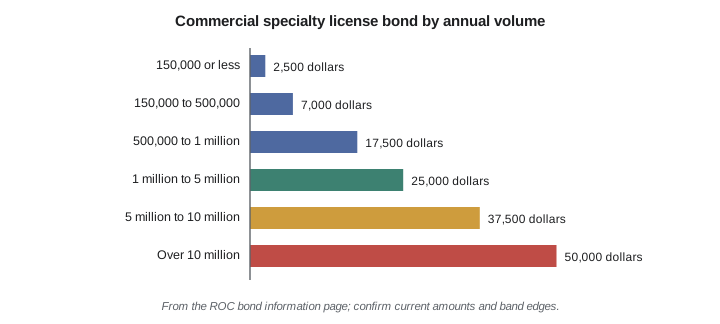
The amount of the bond depends on whether the license is residential, commercial or dual, whether it is a general or specialty classification, and the licensee's expected annual volume of work. The ROC publishes the amounts. For residential licenses there are two volume bands; for commercial licenses there are six. Electrical classifications are specialty licenses, so they use the specialty amounts.
| License and annual volume | Bond amount (dollars) |
|---|---|
| Residential specialty, under 375,000 | 4,250 |
| Residential specialty, 375,000 or more | 7,500 |
| Commercial specialty, 150,000 or less | 2,500 |
| Commercial specialty, 150,000 to 500,000 | 7,000 |
| Commercial specialty, 500,000 to 1 million | 17,500 |
| Commercial specialty, 1 million to 5 million | 25,000 |
| Commercial specialty, 5 million to 10 million | 37,500 |
| Commercial specialty, over 10 million | 50,000 |
A dual license posts the sum of the residential amount and the commercial amount for its volumes. Sonoran Line expected about 600,000 dollars of residential work and 3.2 million dollars of commercial work in the coming year, so its dual license needed 7,500 dollars for the residential side plus 25,000 dollars for the commercial side, or 32,500 dollars in all.
# Bond amount for a specialty license (amounts from the ROC bond page)
def residential_specialty(volume):
    return 4250 if volume < 375_000 else 7500

def commercial_specialty(volume):
    bands = [(150_000, 2500), (500_000, 7000), (1_000_000, 17500),
             (5_000_000, 25000), (10_000_000, 37500)]
    for limit, amount in bands:
        if volume <= limit:
            return amount
    return 50000

res_volume, com_volume = 600_000, 3_200_000      # Sonoran Line's forecast (illustrative)
total = residential_specialty(res_volume) + commercial_specialty(com_volume)
print("Residential side:", residential_specialty(res_volume))
print("Commercial side:", commercial_specialty(com_volume))
print("Dual license bond:", total)Residential side: 7500 Commercial side: 25000 Dual license bond: 32500
The band edges in the calculator are simplified; check the ROC's table for exactly how a volume that falls on a boundary is treated. The more important lesson is that the bond follows the forecast. A contractor whose volume grows past a band must increase the bond, and the ROC's page notes that a bond can be increased at any time but decreased only at renewal, for the following year.
Cash deposits
Instead of buying a surety bond, a licensee can post a cash bond, either money deposited with the ROC or a certificate of deposit from a bank operating in Arizona. A cash deposit avoids the surety's premium but ties up the money. The ROC's page says it keeps a cash bond until two years after the license ends, and releases it then only on application if no claims are made. For a new business short of cash, a surety bond is usually more practical; for an established business with spare cash and weak credit, a deposit can be the better choice.
The Residential Contractors' Recovery Fund
Residential and dual licensees must also meet a consumer-protection requirement. Most do it by paying an assessment into the Residential Contractors' Recovery Fund, which the ROC administers. The fund compensates homeowners who suffer actual losses from certain violations by residential licensees, up to limits set in the statute. The alternative is to post a separate surety or cash bond of 200,000 dollars. Commercial-only licensees pay no assessment.
The ROC's fee page lists a recovery fund assessment of 370 dollars with a new residential or dual license and 270 dollars at each two-year renewal. When the fund pays a homeowner because of a licensee's violation, the licensee's license is suspended until the fund is repaid, so the fund is not free insurance for the contractor. It protects the homeowner and then looks to the contractor.
| Item | Commercial (C) | Residential (R) | Dual (CR) |
|---|---|---|---|
| Recovery fund assessment, new license | 0 | 370 | 370 |
| Recovery fund assessment, renewal | 0 | 270 | 270 |
| Alternative to the assessment | Not applicable | 200,000 bond | 200,000 bond |
Insurance
The ROC's application checklist centers on the bond and the recovery fund, not on liability insurance. That does not make insurance optional in practice. Arizona law requires employers to carry workers' compensation insurance for their employees, as Lesson 10 explains. General contractors, property owners, public agencies and lenders almost always require a subcontractor to carry commercial general liability insurance, commercial auto insurance and often an umbrella policy, with certificates naming them as additional insureds. A contractor without those policies cannot win most commercial work.
Lupe learned during the broker call that the insurance terms in Sonoran Line's contracts were as important as the policies themselves. A Chandler general contractor's subcontract required limits higher than the company's policy, a waiver of subrogation and primary and non-contributory coverage. The broker could add the endorsements, but only if someone read the contract before signing it. From then on, Brenda sent every subcontract's insurance section to the broker before Lupe signed.
Bonds for projects
Do not confuse the license bond with project bonds. Public projects and many large private projects require performance and payment bonds that guarantee the contractor will finish the job and pay its subcontractors and suppliers. Those bonds are written for each project, often for the full contract amount, and the surety underwrites them on the contractor's finances and experience. Lesson 9 returns to payment bonds, because on public projects they take the place of mechanics' liens.
Buying a surety bond
A surety company underwrites a license bond much as a lender reviews a loan. It looks at the owners' credit, the company's finances and its history, and it usually requires the owners to sign an indemnity agreement promising to repay any claim. The premium for a license bond is usually a small fraction of the bond amount, and it depends on credit; strong credit buys a lower rate. Because the bond amounts for electrical specialty licenses are modest, the premium is rarely the hard part. The indemnity agreement is what deserves careful reading, because it can make the owners personally responsible.
Claims against the bond
A person harmed by a licensee's violation of the contractor statute may make a claim against the license bond, within the limits and procedures the statute sets. When the surety pays a claim, the bond amount available for other claims is reduced, the licensee must repay the surety, and the licensee must restore the bond to the required amount or face suspension. A licensee that receives notice of a claim should respond quickly, work with the surety and resolve the underlying problem, because an unpaid claim can lead to both a lawsuit and a licensing problem.
Choosing a business structure
The license is issued to the business, so the choice of business structure matters. A sole proprietorship is simple but gives the owner no separation from the business's debts. A limited liability company or corporation, registered with the Arizona Corporation Commission, can limit the owners' personal exposure for many business obligations, although owners who sign personal guarantees or bond indemnity agreements remain responsible for those. Danny chose an LLC on the advice of his accountant, and his first filing was with the Corporation Commission, before anything went to the ROC, because the license application asks for the entity's state records.
The insurance program
Beyond workers' compensation, an electrical contractor's insurance program usually includes several policies. The broker's job is to fit the program to the company's work and contracts, and the contractor's job is to tell the broker what the company actually does, including solar, design-build or work on occupied buildings.
| Policy | What it generally covers |
|---|---|
| Commercial general liability | Injury to others and damage to their property from the company's work |
| Commercial auto | Vehicles used in the business |
| Workers' compensation and employer's liability | Injuries to employees |
| Umbrella or excess liability | Additional limits above the underlying policies |
| Tools and equipment (inland marine) | Tools, equipment and materials in transit or on jobs |
| Professional liability | Design errors, where the company designs systems |
Certificates of insurance show which policies and limits are in force and who is named as an additional insured. General contractors usually require a certificate before a subcontractor starts work and will stop payments if a certificate lapses. Brenda kept a list of every certificate the company had issued, so that when a policy renewed she could send updated certificates to every customer that needed one.
Worked problem
Choosing the bond for Danny's new license
Danny's Tucson company will hold an R-11 and expects about 300,000 dollars of residential work in its first year. What license bond and recovery fund obligations will it have, and what changes if volume reaches 450,000 dollars in year two?
Show solution
- Residential specialty volume under 375,000 dollars requires a 4,250-dollar license bond.
- As a residential licensee, the company pays the 370-dollar recovery fund assessment with the new license, or posts a 200,000-dollar bond instead.
- If volume reaches 450,000 dollars, the bond must rise to 7,500 dollars; the company can increase it at any time.
- At renewal, the company pays the 270-dollar renewal assessment unless it posts the alternative bond.
Answer: A 4,250-dollar bond and the recovery fund assessment now; increase the bond to 7,500 dollars when volume passes 375,000 dollars.
Reviewing the program each year
A bond and insurance program set up once and never reviewed drifts away from the company's real work. Volume grows past a bond band, a new solar line of business is not reported to the insurer, a vehicle is added without being scheduled on the auto policy, or a contract requires a limit the company does not carry. Once a year, and whenever the company enters a new kind of work, sit down with the surety agent and the broker and compare the program with the forecast and the contracts in hand. Sonoran Line did this each spring, and the meeting usually took an hour. In Lupe's first year it caught one gap: the company had begun installing battery systems, and the broker confirmed that the general liability policy covered that work before the first large job started.
Keep the results of the review in writing: the forecast used for the bond, the policies and limits in force, and any changes made. When a general contractor's prequalification form asks about bonding capacity, insurance limits and loss history, the answers are then ready, and the company can respond in a day instead of a week. Prequalification forms are often the first step toward the larger commercial jobs a growing contractor wants.
Common mistakes
MistakeTreating the license bond as insurance for the contractor.
InsteadThe bond protects others; the contractor repays the surety for any claim it pays.
MistakeForgetting that a dual license needs both bond amounts.
InsteadAdd the residential and commercial amounts for a dual license.
MistakeExpecting to lower the bond in mid-year.
InsteadBonds can be increased any time but decreased only at renewal.
MistakeSigning subcontracts without checking insurance terms.
InsteadSend insurance requirements to the broker before signing.
Summary and key terms
- Every license needs a bond or cash deposit sized by license type, classification and annual volume.
- Specialty amounts run from 4,250 to 7,500 dollars (residential) and 2,500 to 50,000 dollars (commercial); a dual license posts both.
- A cash deposit is held until two years after the license ends.
- Residential and dual licensees pay the recovery fund assessment (370 new, 270 renewal) or post a 200,000-dollar bond.
- Workers' compensation is required by law; general liability and auto insurance are required by most contracts.
- License bond
- A surety bond, required for every license, that pays valid claims arising from violations of the contractor statute.
- Surety
- The company that issues a bond and is repaid by the contractor for claims it pays.
- Cash bond
- Money or a certificate of deposit posted with the ROC instead of a surety bond.
- Residential Contractors' Recovery Fund
- A fund administered by the ROC that compensates homeowners for certain losses caused by residential licensees.
- Payment bond
- A project bond guaranteeing payment of subcontractors and suppliers, common on public work.
Practice problems
Work each problem on paper first, then reveal the answer to check.
What bond does a commercial specialty licensee with 800,000 dollars of annual volume need?
Show answer
17,500 dollars.
When can a licensee reduce its bond amount?
Show answer
Only at renewal, for the following year.
What happens to a licensee's license when the recovery fund pays a homeowner on its account?
Show answer
It is suspended until the licensee repays the fund.
Lesson quiz · 5 questions
Score 60% or more to complete this lesson.
Create a free account to save your progress, take quizzes and earn a certificate.