
MELU-203 · Lesson 12 of 12 · 24 min
Practice exam review and test-day strategy
▶ Video coming soon A video version of this lesson is on the way.
Ten weeks after she decided to qualify Sonoran Line's license, Lupe sat at the conference table in the Mesa office on a Saturday morning with her code book, a calculator, a timer and a practice set of questions. Gil had insisted she take at least one full practice session under exam conditions before booking the trade exam. "You've wired buildings for fourteen years," he said. "Now find out what it's like to answer questions about it against a clock." This lesson pulls the course together: a study plan for both exams, a review of the topics most likely to appear, worked practice questions from the technical and the business and law material, and a plan for exam day and the steps that follow.
Two exams, two kinds of preparation
Arizona's path has two exams for the qualifying party. The Statutes and Rules Exam, taken online and open book, tests knowledge of the contractor statute and the ROC's rules. The trade exam for the electrical classification, given by PSI, tests technical knowledge with the references PSI allows. Each requires a score of at least 70. They call for different preparation. The SRE rewards a candidate who has read the statute and rules and knows where things are in them; the trade exam rewards speed with the code and accuracy with calculations.
Lupe took the SRE first, in the second week of her plan, after reading the statute and rules with this course's Lessons 1, 2, 7, 8 and 9 beside her. That left the remaining weeks for the trade exam, where her risk was higher. Danny, studying for his own R-11 in Tucson at the same time, did the same, and the two traded practice questions by text in the evenings.
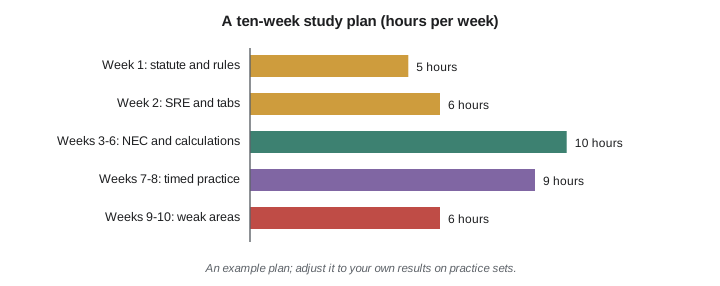
| Weeks | Focus | Output |
|---|---|---|
| 1 | Read the contractor statute and ROC rules with this course | Notes and a page map for the SRE |
| 2 | Take the SRE; obtain and tab the trade exam references | SRE passed; tabbed books |
| 3-6 | NEC: general requirements, wiring methods, services, feeders, grounding, motors, special occupancies, calculations | Calculation notebook and timed lookups |
| 7-8 | Full timed practice sessions | Scores by content area and a miss log |
| 9-10 | Weak areas, final tab changes, rest before exam day | Confidence and a test-day plan |
The Statutes and Rules Exam
The SRE is the easier of the two for most candidates, but it is not a formality. Its questions follow the subjects of the statute and rules: who needs a license, the classifications, the qualifying party, bonds and the recovery fund, contracts, advertising, complaints, discipline and the ROC's procedures. Because it is open book, the challenge is finding answers quickly and reading the questions carefully. The ROC's guidance says the exam is purchased and taken through its testing provider, and that each purchase allows one attempt; read the current instructions before buying.
Lupe's method for the SRE was to read the statute once from start to finish, then make a one-page map of where each subject sat, by section number. During the exam she used the map to go straight to the right section. She finished with time to spare and passed comfortably, and she kept the map, because the same sections came up in her daily work as qualifying party.
The trade exam
PSI's content outline for the electrical trade exam lists the subject areas and the number of questions in each, the time allowed and the references permitted. The bulletin names references such as the NEC and electrical handbooks; candidates bring their own copies unless the bulletin says otherwise, and the books must meet PSI's rules on tabs and markings. Across the outline, the same calculations come up again and again: Ohm's law and power, single-phase and three-phase current, voltage drop, conductor sizing with correction and adjustment, motor branch circuits, transformer current, box and conduit fill, and dwelling and commercial load calculations. The master electrician core courses covered each one in detail.
# Quick practice: transformer current and voltage drop (illustrative values)
import math
kva = 75
for volts in (208, 480):
    amps = kva * 1000 / (math.sqrt(3) * volts)
    print(f"{kva} kVA at {volts} V three-phase: {amps:.1f} A")

# Single-phase voltage drop with the approximate formula (illustrative K for copper)
load_amps, length_ft, cmil, volts = 40, 150, 10380, 240
vd = 2 * 12.9 * load_amps * length_ft / cmil
print(f"Voltage drop: {vd:.1f} V, or {vd / volts * 100:.1f} in every 100 volts")75 kVA at 208 V three-phase: 208.2 A 75 kVA at 480 V three-phase: 90.2 A Voltage drop: 14.9 V, or 6.2 in every 100 volts
About 208 amperes on the 208-volt side of a 75 kVA transformer and about 90 amperes on the 480-volt side are numbers worth knowing by heart, because they let you check transformer questions quickly. The voltage drop example uses the common approximate formula with an illustrative constant and conductor area; on the exam, take conductor properties from the references and apply the method the question asks for.
Arizona heat gives one topic extra weight in practice, even though the exam follows the code rather than the climate. Ambient temperature correction for conductors in hot locations, and the adjustments for raceways exposed to sunlight on rooftops where the adopted code calls for them, are worth practicing until they are automatic, because they matter on Arizona jobs as much as on the exam.
Worked practice questions
Worked problem
Which license?
A homeowner in Queen Creek asks Danny, whose company holds only an R-11, to add circuits for a small detached workshop at her home, and her neighbor asks him to wire a new commercial bakery. May he take both jobs?
Show solution
- The R-11 is a residential electrical classification, so work on a residence is within it.
- A commercial bakery is commercial work, which requires a commercial or dual electrical license.
- Bidding or contracting for the bakery would be contracting outside the license.
Answer: He may take the residential workshop job but not the commercial bakery.
Worked problem
Lien deadline
Sonoran Line's labor on a permitted Tempe project stopped on August 10. The final inspection and the owner's written acceptance came on August 20, and no notice of completion was recorded. What is the general deadline for recording a lien?
Show solution
- Completion is the earlier of thirty days after final inspection and acceptance (September 19) or sixty days after labor stopped (October 9).
- The earlier date, September 19, is completion.
- Add 120 days: about January 17 of the next year.
Answer: About January 17; confirm the count and the facts with a lawyer before relying on it.
Worked problem
Bond amount
A commercial-only electrical licensee expects 800,000 dollars of volume next year. What bond does it need, and when may it be lowered if volume falls?
Show solution
- Commercial specialty volume between 500,000 dollars and 1 million dollars requires a 17,500-dollar bond.
- The bond can be increased at any time but decreased only at renewal.
Answer: 17,500 dollars, reducible only at renewal.
Worked problem
Reporting an injury
An apprentice is hospitalized overnight after a fall from a ladder on a Gilbert job. What reports should the company plan?
Show solution
- An in-patient hospitalization must be reported to the safety agency within 24 hours under the federal rule that ADOSH follows; confirm ADOSH's current procedure.
- Record the case on the injury log.
- Report the injury to the workers' compensation carrier promptly as the rules require.
Answer: Report to ADOSH within 24 hours, record it and notify the carrier.
Reviewing a practice session
A practice session is only as useful as the review that follows it. After her first full session, Lupe scored 72 on the practice set, which felt like a pass until Gil asked her to sort the misses. She had lost points on grounding and bonding, on motor calculations and on load calculations, and nearly all of her misses came from slow lookups, misread questions and arithmetic slips rather than from not knowing the material. That breakdown changed her plan for the next two weeks more than the score did.
| Cause of miss | What it looks like | Fix |
|---|---|---|
| Did not know it | No idea where to look | Study the topic, then retest it within a week |
| Slow lookup | Found the answer but ran out of time | Add or move tabs; practice timed lookups |
| Misread the question | Answered a different question than the one asked | Underline the ask; restate it before calculating |
| Arithmetic slip | Right method, wrong number | Write each step; check the result for reasonableness |
| Changed a right answer | First choice was correct | Change only with a specific reason found in the references |
Keep a running log of every practice miss with its cause, where the answer lives in the references, and the time it took. Over several sessions the log shows patterns: a chapter that always takes too long, a kind of question you misread, a formula you keep inverting. Those patterns are where the last weeks of study pay off most. A candidate who moves from the low seventies to the low eighties on practice sets usually does it by fixing lookups and reading habits, not by learning large amounts of new material.
Using the references efficiently
Treat the references like tools on a truck: each has a place, and the hand goes to it without searching. Permanent tabs are generally allowed, while loose notes and inserted pages generally are not; check PSI's current bulletin for the exact rules before tabbing, because books that do not meet them may be refused at check-in. Lupe used one tab color for NEC chapters, another for the tables she used most and a third for the handbook sections on calculations. She kept the number of tabs manageable, because a book with too many tabs is as slow as a book with none. Learn the index too: many questions are answered fastest by going to the index with a key word, then to the article, then to the section.
Exam day
Book the exam through PSI's registration system for Arizona contractors, and read the bulletin's rules on identification, rescheduling and what may be brought into the testing room. Prepare the night before: books in a bag, identification that matches the registration exactly, a permitted calculator, the testing center address in your phone. Sleep matters more than a last evening of cramming. Arrive early, check in calmly and let the staff inspect the books. Use the tutorial to learn the screen. Set your checkpoints in the first minute, work steadily, flag slow questions and leave the last part of the time for the flagged ones. Answer every question, because a blank cannot score.
PSI may include unscored experimental questions that count against the time, so a question that seems strangely worded or outside the outline should not shake your confidence. Mark it, make your best choice and move on. Lupe's practice sessions had shown her that her accuracy dropped late in the session, so she planned a short pause at each checkpoint to stretch, look away from the screen and reset.
After the exam
Lupe walked out of the testing center in Phoenix with a passing score. Brenda already had the qualifying party change paperwork assembled: the SRE and trade exam results, Lupe's background check, the experience documentation and the forms the ROC required. Gil stayed on the license until the ROC approved the change, then took his first full summer in Pinetop in twenty-eight years. Theo asked Lupe what it would take for him to qualify a license of his own one day, and she handed him her tabbed code book.
If you do not pass on the first try, read the score report by content area, adjust the plan and retake the exam after the waiting period in PSI's bulletin. The bulletin also limits how often an exam can be retaken in a short time, with a longer wait after repeated attempts; check the current bulletin, since its wording has changed. Many good contractors passed on their second try; what matters is the plan you follow afterward.
Common mistakes
MistakeDoing practice questions without a timer.
InsteadPractice under exam conditions, including at least one full timed session.
MistakeTreating the SRE as a formality.
InsteadRead the statute and rules and map where each subject sits.
MistakeLeaving flagged questions until there is no time left.
InsteadSet checkpoints and reserve the last part of the time for review.
MistakeCramming the night before.
InsteadPack the night before, sleep well and arrive early with matching identification.
Summary and key terms
- Arizona's qualifying party passes the Statutes and Rules Exam and the electrical trade exam, each with a score of at least 70, or qualifies for a trade exam waiver.
- Take the open-book SRE early; spend most of the plan on the trade exam's code and calculations.
- Practice the recurring calculations until they are fast, including ambient correction for hot locations.
- Know the Arizona points: classifications, the qualifying party, bonds, the recovery fund, lien deadlines, ADOSH and renewal.
- On exam day, set checkpoints, flag slow questions, answer everything and stay calm about unscored items.
- Timed practice
- Practice questions answered under exam time limits with the references.
- Miss log
- A record of each practice miss, its cause and where the answer lives.
- Statutes and Rules Exam
- The ROC's open-book online exam on the contractor statute and rules.
- Content outline
- PSI's document listing subjects, question counts, time and references for an exam.
- Score report
- The exam result showing performance by content area.
Practice problems
Work each problem on paper first, then reveal the answer to check.
What is the three-phase current of a 45 kVA transformer at 208 volts, to the nearest ampere?
Show answer
45,000 / (1.732 x 208) = about 125 amperes.
What minimum score is required on each of the two exams?
Show answer
70.
Which exam should a candidate usually take first, and why?
Show answer
The SRE, because it is shorter to prepare for and leaves the remaining weeks for the trade exam.
Lesson quiz · 5 questions
Score 60% or more to complete this lesson.
Create a free account to save your progress, take quizzes and earn a certificate.