
MELU-203 · Lesson 10 of 12 · 18 min
Workplace safety law and OSHA for electrical contractors
▶ Video coming soon A video version of this lesson is on the way.
In July the temperature on a Tempe warehouse roof can reach well past what the thermometer at the airport says, and Sonoran Line's crews start at five in the morning to finish the hardest work before noon. Safety in Arizona electrical contracting means the same hazards found anywhere in the trade, shock, arc flash, falls, trenches and struck-by hazards, plus heat that can disable a worker in an afternoon. As qualifying party, Lupe would answer for how the company runs its work, and the safety program is part of that. This lesson covers who enforces workplace safety in Arizona, the core rules that apply to electrical contractors, recordkeeping and reporting, heat, and workers' compensation.
ADOSH: Arizona's state plan
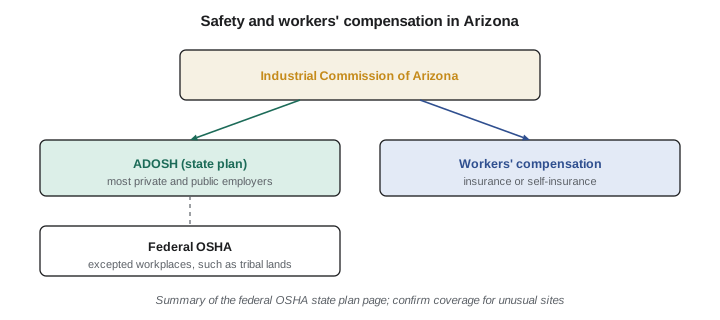
Arizona runs its own occupational safety and health program under a plan approved by federal OSHA. The Arizona Division of Occupational Safety and Health, ADOSH, part of the Industrial Commission of Arizona, enforces workplace safety for most private employers in the state, as well as state and local government employers. Federal OSHA describes the plan as covering private-sector workplaces with several exceptions, such as certain federal-jurisdiction work and work on Indian reservations, where federal rules apply instead. ADOSH has offices in Phoenix and Tucson.
ADOSH adopts the federal OSHA standards by reference and adds some standards of its own, including separate construction and fall protection standards. In practice, an electrical contractor in Arizona follows the federal construction standards in 29 CFR 1926 and general industry standards in 29 CFR 1910 where they apply, as adopted and supplemented by ADOSH. A contractor working on a tribal reservation should check with the tribe and federal OSHA, because the state plan generally does not cover those workplaces.
The electrical hazards
The OSHA construction standards for electrical work cover the safety of installations used on construction sites, ground-fault protection for temporary power, lockout and tagging of circuits, clearances from overhead lines and safe work practices. The core rule for electrical contractors is that work on or near exposed energized parts should be done de-energized whenever possible, with the circuit locked out, tested and grounded where needed. When energized work is truly necessary, it requires qualified workers, an energized work permit or equivalent procedure, insulated tools and the protective equipment called for by the hazard analysis.
NFPA 70E, the consensus standard for electrical safety in the workplace, gives the practical method most contractors use to meet those duties: an electrical safety program, risk assessments for shock and arc flash, approach boundaries, arc-rated clothing and equipment selection, and training for qualified persons. OSHA cites the general duties, and NFPA 70E is widely used to show how they are met. Sonoran Line trains every electrician in its lockout procedure and in 70E, and Lupe insisted that no foreman sign an energized work permit without calling her first.
Falls, trenches and the rest
Electrical contractors face many non-electrical hazards as well. Ladders and lifts account for a large share of injuries in the trade, so ladder inspection, lift training and fall protection on roofs and elevated work matter. Trenching for underground feeders brings excavation rules, including protective systems for trenches of the depth the standards specify. Material handling, struck-by hazards on busy sites and silica from cutting concrete all need controls. A written safety program that covers the company's actual work, with job hazard analyses for unusual tasks, is the backbone.
Heat
Heat illness is a constant concern in Arizona construction. ADOSH has run emphasis programs on heat hazards, and contractors are expected to protect workers through water, rest and shade, acclimatization for new and returning workers, training to recognize heat illness symptoms, and a plan for emergencies. Federal OSHA proposed a national heat standard in 2024, and its status should be checked before relying on any particular rule. Whatever the regulatory status, heat illness can kill, and an employer that ignores it risks citations under the general duty to provide a safe workplace.
Sonoran Line's summer plan was simple and strict. Crews start early and move roof and attic work to the morning, foremen carry water and electrolyte drinks in the truck, new hires work shorter shifts in their first week, every crew has a shaded rest area, and anyone with symptoms stops work and is watched. Theo's rule on the solar crew was blunter: "Nobody works alone on a roof in July."
Recordkeeping and reporting
Employers covered by the recordkeeping rules keep a log of recordable work-related injuries and illnesses, prepare an annual summary and post it at the workplace from February 1 to April 30, and keep the records for five years. Many construction employers above certain size thresholds must also submit data electronically. Serious events must be reported quickly: under the federal rule, a work-related fatality within eight hours, and an in-patient hospitalization, amputation or loss of an eye within twenty-four hours. ADOSH follows that pattern for Arizona employers; confirm ADOSH's current reporting rules and how to report.
# Incident rates from the injury log (illustrative numbers)
hours_worked = 46_000           # total employee hours for the year
recordable_cases = 3
dart_cases = 1                  # days away, restricted or transferred

def rate(cases, hours):
    return cases * 200_000 / hours

print(f"Total recordable incident rate: {rate(recordable_cases, hours_worked):.2f}")
print(f"DART rate: {rate(dart_cases, hours_worked):.2f}")Total recordable incident rate: 13.04 DART rate: 4.35
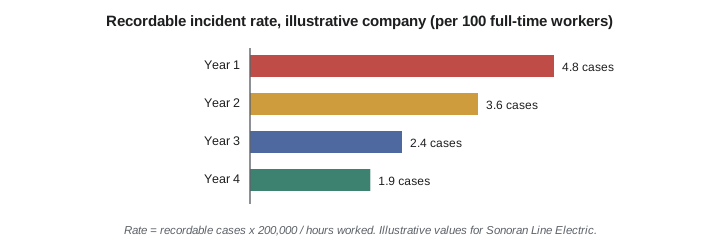
The rate formula uses 200,000 hours, the hours worked by 100 full-time employees in a year, so that companies of different sizes can be compared. General contractors and owners often ask for these rates and for the company's workers' compensation experience modification rate before inviting a bid, so a good safety record wins work as well as protecting people.
| Event | Federal rule (summary) |
|---|---|
| Work-related fatality | Report within 8 hours |
| In-patient hospitalization, amputation or loss of an eye | Report within 24 hours |
| Annual summary posting | February 1 to April 30 |
| Record retention | 5 years |
Workers' compensation
Arizona's workers' compensation system is overseen by the Industrial Commission of Arizona. Employers who have employees must secure workers' compensation coverage, either by buying insurance from an authorized carrier or by qualifying to self-insure. The system pays medical care and wage-loss benefits to injured workers regardless of fault, and in exchange the employer is generally protected from most lawsuits by employees over workplace injuries. An employer without required coverage faces penalties and loses that protection.
Employers must post the required workers' compensation notices, report injuries to the carrier and the Commission within the times the rules set, and cooperate with the claim process. Treat every injury report seriously and file it promptly; a late report can complicate the worker's claim and the company's relationship with its carrier. Questions about whether a particular worker is an employee or an independent contractor should go to a lawyer or the carrier, because treating employees as contractors to avoid coverage is a common and costly mistake.
Building the safety program
A written safety program is not a binder on a shelf; it is how the company actually works. For an electrical contractor, it usually includes the company's safety policy and the responsibilities of owners, supervisors and workers, hazard assessment and job hazard analysis, lockout and tagout procedures, energized work rules under NFPA 70E, fall protection, ladders and lifts, trenching, heat illness prevention, personal protective equipment, first aid and emergency response, incident reporting and investigation, and training records. Some standards also require specific written programs, such as hazard communication for chemicals used on the job.
| Program element | Example for an electrical contractor |
|---|---|
| Hazard assessment | Job hazard analysis for energized troubleshooting or rooftop solar |
| Lockout and tagout | Written steps, locks and tags for each worker |
| Training | Qualified person training, lift operation, heat illness |
| Inspections | Weekly site checks by the foreman |
| Incident investigation | Root-cause review of every injury and near miss |
Lockout and tagout in practice
A lockout procedure for electrical work follows a set sequence. Identify every source of energy, including backfeed from generators, solar and batteries. Notify affected people. Open the disconnecting means, apply each worker's own lock and tag, release or block stored energy, and then verify the absence of voltage with a tester that has been checked on a known source before and after the test. Only then is the equipment treated as de-energized. Removing locks follows its own steps, so that no one is exposed when power returns. Sonoran Line's rule was one worker, one lock, one key.
Training and competent people
Several standards require training before a worker does certain tasks, and some require a competent or qualified person to be present, such as for excavations, scaffolds or work near energized parts. Training should be documented with the date, the topic, the trainer and the workers who attended. Short weekly toolbox talks on a single topic, such as heat, ladders or testing before touching, keep safety in front of the crew and build a training record over time.
When ADOSH visits
Inspections can follow a complaint, a reported injury, a referral or an emphasis program. A typical inspection begins with an opening conference, continues with a walk through the site and interviews, and ends with a closing conference. Be courteous, have a company representative accompany the inspector, take the same photographs and notes the inspector takes, and correct hazards on the spot where possible. If citations are issued, they state the deadline for correcting the hazards and the time allowed to contest them; read them carefully and get advice before that time runs out.
Worked problem
Planning a summer roof job
Theo's crew will install conduit and a solar inverter on a Tempe warehouse roof in July. What safety measures should Lupe expect in the job hazard analysis?
Show solution
- Heat: early start, water, shade, rest breaks, acclimatized workers and a heat illness emergency plan.
- Falls: fall protection at roof edges and openings, and safe access by ladder or lift.
- Electrical: lockout of the circuits being worked, with testing before work, and PV-specific hazards since panels in sunlight produce voltage whenever light falls on them.
- Ambient correction in the design for conductors in rooftop raceways, as Lesson 5 explained.
Answer: Heat, fall, lockout and PV hazard controls, plus correct conductor sizing for rooftop heat.
Investigating incidents and near misses
Every injury and every near miss is a chance to prevent the next one. A good investigation looks for causes, not blame: what happened, what conditions allowed it, what the worker was trying to do and why the controls did not stop it. The fixes that follow should address the causes, such as a missing tester on a truck, a schedule that pushed roof work into the afternoon, or a procedure that did not cover backfeed from a battery system. Share what was learned with every crew, not just the one involved. Sonoran Line held a short review within a day of any incident, and Lupe signed off on the corrective actions. Near misses were reported without penalty, because a crew that hides near misses will eventually have an injury that no one saw coming.
Track the corrective actions to completion. A finding that is written down but never fixed is worse than no investigation, because it shows the company knew about a hazard and left it in place. A simple list with the action, the person responsible and the due date, reviewed at each weekly meeting until every item is closed, is enough for most electrical contractors.
Common mistakes
MistakeAssuming federal OSHA inspects most Arizona private jobs.
InsteadADOSH enforces safety for most private employers in Arizona under the state plan.
MistakeWorking energized to save time.
InsteadDe-energize, lock out and test whenever possible; energized work needs justification and controls.
MistakeTreating heat as a comfort issue.
InsteadPlan water, rest, shade, acclimatization and emergency response.
MistakeCalling employees independent contractors to avoid coverage.
InsteadEmployers with employees must secure workers' compensation coverage.
Summary and key terms
- ADOSH, part of the Industrial Commission of Arizona, enforces workplace safety for most private employers under a federally approved state plan.
- ADOSH adopts the federal standards and adds its own construction and fall protection standards.
- De-energized work with lockout is the rule; NFPA 70E guides electrical safety programs.
- Heat illness prevention is essential in Arizona; check the status of any heat standard.
- Employers with employees must secure workers' compensation coverage through an insurer or self-insurance.
- ADOSH
- The Arizona Division of Occupational Safety and Health, which runs Arizona's state OSHA plan.
- Industrial Commission of Arizona
- The state agency over ADOSH and the workers' compensation system.
- State plan
- A state workplace safety program approved by federal OSHA.
- Incident rate
- Cases per 200,000 employee hours worked.
- NFPA 70E
- The consensus standard for electrical safety in the workplace.
Practice problems
Work each problem on paper first, then reveal the answer to check.
Which agency enforces workplace safety on a private Mesa construction site?
Show answer
ADOSH, under the Arizona state plan.
A company had 2 recordable cases in 80,000 hours. What is its incident rate?
Show answer
5.0 (2 x 200,000 / 80,000).
What are the two ways an Arizona employer can secure workers' compensation coverage?
Show answer
Buy insurance from an authorized carrier or qualify to self-insure.
Lesson quiz · 5 questions
Score 60% or more to complete this lesson.
Create a free account to save your progress, take quizzes and earn a certificate.