
MELU-203 · Lesson 3 of 12 · 18 min
Applying, approval and booking the exam
▶ Video coming soon A video version of this lesson is on the way.
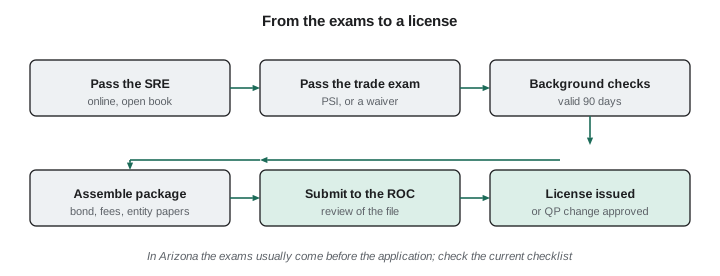
Arizona's process runs in a different order from the one Lupe expected. In many states a board approves the candidate first and only then lets him or her sit the exam. In Arizona the qualifying party normally passes the exams first and sends the original results in with the license application. The ROC then reviews the whole package: exam results, experience, background checks, business records, bond and fees. Brenda drew the sequence on the whiteboard in the Sonoran Line office so that Lupe and Danny, who had stopped by for advice, could see where each piece fit and how long each step might take.
Step one: the Statutes and Rules Exam
The Statutes and Rules Training Course and Exam is delivered online through a testing company the ROC uses, GMetrix, rather than at a PSI test center. The candidate buys the course, works through the training material on Arizona contractor law and then takes the exam online. Training providers report a course fee of 61 dollars, one exam attempt per purchase and a year of access, with a new purchase required after a failed attempt. A passing score of at least 70 is required, and the result must reach the ROC with the application within the time allowed. Check the ROC's page for the current provider, fee and validity period.
Lupe started with the SRE because it was the smaller task and because the business law in it would come up again on the job. She worked through the course in the evenings over two weeks, reading the statute and rules alongside it, and passed on her first attempt. Lesson 4 covers what the SRE tests and how to prepare.
Step two: the trade exam with PSI
The trade exam for the electrical classifications is administered by PSI. Candidates register online through PSI's Arizona contractors page or by phone, choose either a PSI test center or online proctoring, and pay the exam fee. The February 2026 bulletin lists 66 dollars for one exam and 116 dollars for two, with fees nonrefundable and the exam fee valid for one year. A candidate cannot book a new exam on the same day as a test, and must cancel or reschedule at least two days before the appointment to keep the fee. The bulletin says voicemail and email cancellations are not accepted.
On exam day the candidate must bring one valid, unexpired government-issued ID with a photo and signature, in the exact name used to register. The bulletin lists a state driver's license or ID card, a passport, a U.S. military ID or an alien registration card. Arriving with an ID that does not match the registration is one of the easiest ways to lose an exam fee, so Brenda checked Lupe's registration against her driver's license before booking.
Retakes
If a candidate fails the trade exam, the PSI bulletin requires a wait of thirty days before retaking it, with up to three attempts before a longer wait of ninety days. The bulletin's scheduling section describes the ninety-day wait slightly differently, so read the current bulletin carefully if you need a third or fourth attempt. Each retake requires a new fee. For the SRE, a failed attempt means buying the course again.
Step three: background checks and documents
With both exams passed, the candidate completes the background checks for the applicant and the qualifying party. Because the ROC treats a background check as expiring ninety days after completion, the checks fit best near the end of the process, close to the date the application will go in. The applicant gathers copies of government-issued photo ID for each person, the entity documents showing registration with the Corporation Commission or Secretary of State, the original exam results and any supporting forms that apply, such as forms about prior licenses, felony history or earlier unlicensed activity.
Step four: bond and fees
The applicant buys a license bond in the amount set for its license type and expected annual volume, or posts a cash deposit or certificate of deposit instead, and includes proof with the application. A residential or dual applicant also pays the recovery fund assessment or posts the alternative consumer-protection bond. Lesson 8 covers the bond table. The ROC's fee page lists the following amounts for a two-year specialty license.
| License type | Application fee | License fee | Recovery fund | Total, new license |
|---|---|---|---|---|
| Specialty commercial (C-11) | 100 | 480 | 0 | 580 |
| Specialty residential (R-11) | 80 | 270 | 370 | 720 |
| Specialty dual (CR-11) | 100 | 380 | 370 | 850 |
# Estimated up-front cost for Danny's R-11 (fees from the ROC and PSI pages; bond premium illustrative)
roc_fees = {"application": 80, "license": 270, "recovery_fund": 370}
exam_fees = {"SRE course": 61, "PSI trade exam": 66}
bond_amount = 4250            # residential specialty, volume under the threshold
bond_premium_rate = 0.03      # illustrative surety premium rate
bond_premium = bond_amount * bond_premium_rate

total = sum(roc_fees.values()) + sum(exam_fees.values()) + bond_premium
for name, amount in {**roc_fees, **exam_fees}.items():
    print(f"{name:>15}: {amount:6.2f}")
print(f"{'bond premium':>15}: {bond_premium:6.2f}")
print(f"{'total':>15}: {total:6.2f}") application: 80.00
license: 270.00
recovery_fund: 370.00
SRE course: 61.00
PSI trade exam: 66.00
bond premium: 127.50
total: 974.50The bond itself is not a fee paid to the state. The contractor buys it from a surety company and pays a premium that depends on the surety's assessment of the business and its owners, so the premium in the calculator is only an example. Background check costs and entity registration fees add to the total, so Danny budgeted for those separately.
Step five: submitting the application
The ROC accepts applications through its online customer portal, by mail to its post office box in Phoenix, or in person at its office on West Washington Street in Phoenix. The package must be complete: exam results, background receipts, entity documents, bond, fees, identification and signatures, plus any supporting forms. An incomplete package draws a deficiency letter, and an applicant who does not answer it can lose the application. The ROC's page explains that the license fee is refunded if no license is issued, for example if the applicant withdraws or fails to answer a deficiency letter, while the application fee is kept. If the agency exceeds its statutory review time, the application fee is refunded instead.
After submission the applicant receives a receipt with a pending number. When the application is approved, the ROC mails a notice and a licensing representative calls. For an existing license changing its qualifying party, as at Sonoran Line, the ROC updates the license record once the new qualifying party's exams, background check and forms are accepted. Brenda filed Sonoran Line's change on the portal the week Lupe received her trade exam result, so there was no gap between Gil stepping back and Lupe taking over.
Organizing the application package
The ROC's checklist is the guide to what goes into the package, and it changes from time to time, so download the current version for each application. The package typically pulls together items from several sources, and many delays come from one missing piece rather than from any problem with the applicant. Brenda kept a folder for each item and did not submit until every folder was full.
| Item | Where it comes from | Watch for |
|---|---|---|
| Business entity records | Arizona Corporation Commission or other state registration | Names that match exactly across every document |
| Exam results | The SRE provider and PSI, or a trade exam waiver | Results for the right classification |
| Background checks | The ROC's approved process for each person listed | The ninety-day life of each check |
| License bond or cash deposit | The surety or a bank | The right amount for the license type and volume |
| Recovery fund assessment or bond | Paid with fees, or a separate bond | Required for R and CR licenses only |
| Solar warranty form | The ROC's form | Needed when solar work will be performed |
| Fees | The ROC's fee schedule | The current amounts at the time of filing |
Common causes of delay
Most delays fall into a few categories. A business name on the bond that does not match the name on the Corporation Commission record exactly. A background check that expired while other items were being gathered. Experience descriptions that do not show work in the classification applied for. A missing signature or an owner or officer left off the application. Each is easy to avoid with a final review against the checklist, and each can add weeks if the ROC has to send the file back.
A new license or a change of qualifying party
Lupe and Danny were on two different paths. Danny was applying for a new license for a new company, so his package had everything: entity records, owners, bond, fees, the recovery fund and his qualifying party materials. Sonoran Line already held a license, so its filing was a change of qualifying party: Lupe's exams, background check and experience, with the forms the ROC requires to add her and remove Gil. The company's bond and license number stayed the same. Read the ROC's instructions for the kind of filing you are making, because the forms and fees differ.
Whichever path applies, keep copies of everything submitted and note the date it went in. When the ROC asks a question, answer it quickly and completely. The fastest applications are the ones where the applicant has already anticipated what the reviewer will look for.
Worked problem
Planning the timeline
Lupe wants to be listed as qualifying party by March 1. She expects to need six weeks of study for the trade exam and allows four weeks for ROC review after submission. Working backward, when should she complete her background check, given the ninety-day expiry?
Show solution
- Allow four weeks for review before March 1, so the package should be submitted by about February 1.
- The background check must still be valid when the ROC receives the application, so it should be completed no more than ninety days before February 1, that is, no earlier than early November.
- Completing it in January, after both exams are passed, leaves a comfortable margin.
- Study and the trade exam fit in December and early January.
Answer: Complete the background check in January, after both exams, and submit by about February 1.
Keeping the timeline realistic
A realistic plan allows time for each step and for the unexpected. Studying for the SRE might take a week or two, the trade exam several weeks to a few months, and gathering background checks, bond and entity records a few more weeks. ROC review time varies with the season and the completeness of the file. Danny built his plan backward from the date he wanted to start contracting, added a month of cushion, and booked the trade exam early enough that one retake would not push him past his target. Lupe's plan was tied to Gil's retirement date, and the company kept Gil on the license until the ROC approved the change, so a slow review would not leave the company without a qualifying party. Whatever the target, remember that the background checks have a limited life, so time them for the end of the process rather than the beginning, and that fees and forms can change between the day you start and the day you file.
Common mistakes
MistakeWaiting for ROC approval before taking the exams.
InsteadIn Arizona the qualifying party normally passes the exams first and submits the results with the application.
MistakeBooking the PSI exam under a nickname.
InsteadRegister in the exact name on your government-issued ID.
MistakeIgnoring a deficiency letter.
InsteadAnswer it promptly; an unanswered deficiency can end the application.
MistakeTreating the bond as a state fee.
InsteadThe bond is bought from a surety; the premium depends on the business and is separate from ROC fees.
Summary and key terms
- The SRE is taken online through the ROC's provider; the trade exam is booked through PSI, online or at a test center.
- The PSI bulletin lists 66 dollars for one exam, a 30-day wait after a failure and a longer wait after repeated failures.
- Background checks are best completed near the end because they expire ninety days after completion.
- New specialty license fees are 580 dollars (commercial), 720 (residential) and 850 (dual), including the recovery fund where it applies.
- Applications go in through the portal, by mail or in person, complete with exam results, bond, fees, ID and entity documents.
- Deficiency letter
- A letter from the ROC listing missing or incorrect items in an application.
- Pending number
- The reference number on the receipt for a submitted application.
- GMetrix
- The online provider through which the ROC delivers the Statutes and Rules course and exam.
- PSI
- The testing company that administers the ROC trade exams.
- Cash deposit
- Money or a certificate of deposit posted with the ROC in place of a surety bond.
Practice problems
Work each problem on paper first, then reveal the answer to check.
Danny failed the trade exam on April 2. When is the earliest he can retake it under the bulletin?
Show answer
After the 30-day wait, in early May.
What happens to the license fee if an applicant withdraws before a license is issued?
Show answer
The ROC refunds the license fee and keeps the application fee.
What ID should Lupe bring to the PSI test center?
Show answer
One valid, unexpired government-issued ID with photo and signature, in the name she registered under.
Lesson quiz · 5 questions
Score 60% or more to complete this lesson.
Create a free account to save your progress, take quizzes and earn a certificate.