
MELU-203 · Lesson 5 of 12 · 18 min
The NEC as adopted in Arizona and local amendments
▶ Video coming soon A video version of this lesson is on the way.
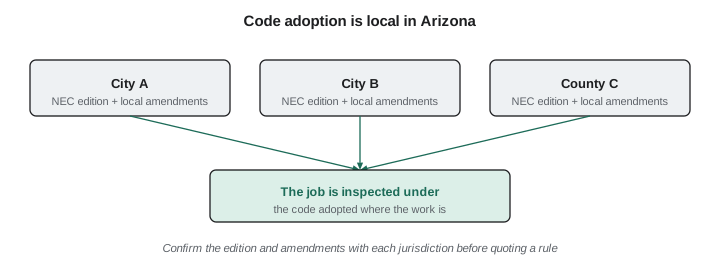
When Lupe asked Gil which edition of the National Electrical Code Arizona uses, he laughed. "Which city?" he said. Arizona does not adopt one electrical code for private construction across the whole state. Each city, town and county adopts its own building codes, usually by ordinance, and decides which edition of the NEC to adopt and which local amendments to make. Sonoran Line works in Mesa, Gilbert, Chandler, Tempe, Queen Creek and unincorporated Maricopa County, and at any given time those jurisdictions may be on different editions. This lesson explains how local adoption works, how to find the edition and amendments that apply to a job, and how that affects the exam.
Local adoption instead of a state code
In states such as Georgia or Texas, a state agency adopts the NEC for the whole state, with state amendments, and local governments enforce it. Arizona's approach is different for most private construction. The state leaves the adoption of building codes to local governments, and each one decides which model codes to adopt, which editions, and what changes to make. Most Arizona cities adopt a package of International Code Council codes for buildings, residences, energy, plumbing, mechanical and fuel gas, together with the National Electrical Code, all updated together every few years. Some update on every code cycle; others skip editions. For most private work there is no set of statewide electrical amendments; when this course speaks of amendments in Arizona, it means the ones each city, town or county adopts with its code.
The practical result is a patchwork. A contractor working in several Valley cities in the same week may wire one job under the 2023 NEC with that city's amendments and another under the 2020 NEC with a different set. Building departments publish their adopted codes and amendments, usually on a codes and ordinances page, and many also publish a summary of what changed. The contractor's job is to know which edition and amendments govern each permit, because inspections are made against the code adopted where the work is located, as of the date the permit was applied for or issued under the city's rules.
An example: Phoenix
Phoenix shows how local adoption works in a large city. The city council adopted the 2024 Phoenix Building Construction Code, which took effect on August 1, 2025, with a grace period for projects already in progress and up to a year for standard plans to comply. The city publishes its amendment documents for each model code, including the National Electrical Code; its published amendments are written against the 2023 NEC. A contractor pulling a Phoenix permit after the effective date should therefore expect the 2023 NEC with Phoenix amendments to apply, subject to the city's transition rules. Confirm the details on the city's codes and ordinances page.
Other cities follow their own schedules. Tucson, Mesa, Scottsdale, Chandler, Gilbert, Pima County, Maricopa County and the rest each adopt by their own ordinances. Brenda kept a one-page table at the permit desk listing each jurisdiction Sonoran Line worked in, the NEC edition it had adopted, the effective date and a link to its amendments, and she updated it whenever a city announced a new code. "Never assume," she told Marco. "Look it up for the job."
| Jurisdiction (example) | Code package | NEC edition | Where to confirm |
|---|---|---|---|
| Phoenix | 2024 Phoenix Building Construction Code, effective Aug. 1, 2025 | 2023 NEC with Phoenix amendments | City codes and ordinances page |
| Another Valley city | Its own adopted package | Check the city's ordinance | City building department |
| Unincorporated county area | County-adopted package | Check the county ordinance | County development services |
Local amendments
Local amendments change, delete or add to the model code. They can make a requirement stricter, relax it, clarify how the city will interpret a section, or add administrative requirements such as when inspections are required. Some amendments in the Valley have dealt with grounding electrodes in desert soils, ground-fault protection requirements, solar installations and service equipment locations, but the content varies by city and by cycle. A contractor should read the amendments for each jurisdiction rather than relying on what another city did.
Amendments matter for the exam in a narrower way. The trade exam is based on the NEC edition named in the PSI content outline, not on a particular city's amendments. When you study for the exam, answer from the model code as published. When you work on a job, follow the adopted code with local amendments. Keeping those two contexts separate avoids a common source of wrong answers.
Utility requirements
Alongside the code, the electric utility sets its own requirements for services and metering. In the Phoenix area most customers are served by Arizona Public Service or the Salt River Project; Tucson Electric Power serves the Tucson area; cooperatives and municipal utilities serve other parts of the state. Each utility publishes service requirements covering meter locations, meter section and service equipment specifications, clearances, service entrance conductor arrangements and the process for connecting new or upgraded services and distributed generation such as solar. These requirements are not part of the NEC, but a service that meets the code and ignores the utility's manual may not be energized.
Desert heat and the code
Arizona's climate turns some ordinary code calculations into everyday concerns. Conductors in attics, on rooftops and in raceways exposed to direct sun can run far hotter than the 30 degree Celsius ambient the NEC's ampacity tables assume. The code requires a temperature correction factor when the ambient is higher, and it contains rules on raceways and cables exposed to sunlight on rooftops; check the exact wording in the edition that applies, because these rules have changed between editions. Equipment ratings, termination temperature limits and the derating of conductors in conduit with many current-carrying conductors all interact with high ambient temperatures.
# Illustrative ambient temperature correction for a hot Arizona attic.
# The correction factors below are example values for study, not NEC table values.
example_factors = {30: 1.00, 40: 0.91, 50: 0.82, 60: 0.71}   # 90 C insulation, illustrative

base_ampacity = 40          # illustrative ampacity from a table at 30 C
for ambient, factor in example_factors.items():
print(f"Ambient {ambient} C: corrected ampacity {base_ampacity * factor:.1f} A")Ambient 30 C: corrected ampacity 40.0 A Ambient 40 C: corrected ampacity 36.4 A Ambient 50 C: corrected ampacity 32.8 A Ambient 60 C: corrected ampacity 28.4 A
The factors in the calculator are illustrative numbers chosen to show the pattern, not values copied from the NEC. The pattern is what matters: as the ambient temperature climbs, the conductor can safely carry less current, and in a summer attic in Mesa the reduction is large. Theo's solar crew checks the ambient correction for every rooftop raceway because a conductor that looks adequate on the table can be undersized on a July roof.
Finding the code in force
Before bidding work in a jurisdiction, find out which code it has adopted. Most building departments post their adopted codes and local amendments on their websites, often on a page about building codes or in the city or county code of ordinances. If the website is unclear, call the building department and ask for the edition of the NEC in force and any electrical amendments. Note the effective dates, because the code that applies to a job usually depends on when the permit application was submitted, and a change in the middle of a bid period can affect the price.
| Question | Why it matters |
|---|---|
| Which NEC edition is adopted? | Sets the rules the inspector will apply |
| Are there local electrical amendments? | May add or remove requirements from the model code |
| What is the effective date of the current adoption? | Decides which edition applies to a given permit |
| Is a new adoption pending, with a grace period? | Affects work bid now and permitted later |
| Which other codes apply? | Energy, building and fire codes can affect electrical work |
Other codes that touch electrical work
The NEC is not the only code an electrical contractor meets. The energy code adopted by a jurisdiction can set requirements for lighting controls, lighting power and certain receptacle controls in commercial buildings. The building code affects penetrations through fire-rated walls and floors, and the fire code adopted locally may set access and pathway requirements for rooftop solar arrays. Utilities publish their own service requirements, as the next section explains. A plan reviewer may comment on any of these, so the company that reads them in advance saves a round of corrections.
Working across the Valley
A contractor in the Phoenix area may work in a dozen jurisdictions in a single month, each with its own adoption cycle. Brenda kept a one-page table of the jurisdictions where Sonoran Line worked, with the adopted NEC edition, the date it took effect, any electrical amendments the foremen should know about and a link to the official page. She updated it whenever a city announced a new adoption. When a foreman asked whether a rule applied in Gilbert or Queen Creek, the table was the first place to look and the building department was the second.
Worked problem
Which code applies?
Sonoran Line has two jobs starting in March 2026: a restaurant remodel in Phoenix with a permit applied for in February 2026, and a house addition in a nearby town that the town says is still on an older NEC edition. Lupe is studying for an exam based on the edition named in her PSI outline. Which code governs each situation?
Show solution
- The Phoenix job is governed by the code Phoenix has adopted for permits applied for after August 1, 2025, which is the 2023 NEC with Phoenix amendments.
- The town job is governed by the town's adopted edition and amendments, even though it is older.
- Lupe's exam answers come from the NEC edition named in the PSI content outline, without local amendments.
- Brenda records both jurisdictions' editions on the permit desk table.
Answer: Each job follows its own jurisdiction's adopted code; the exam follows the outline's edition.
When the code and the plans disagree
Sometimes the approved plans show something the adopted code does not allow, or the code requires something the plans leave out. The contractor should not simply build what is drawn and hope the inspector misses it. Raise the question with the designer and the general contractor in writing, ask for a clarification or a revised drawing, and keep the answer in the job file. If the change affects the price or schedule, handle it as a change order. Inspectors enforce the adopted code, not the plans, and an approved plan does not usually excuse a violation the plan reviewer missed. Lupe's habit was to read each set of plans against the code before the company bid, so that questions came up when they were cheap to answer, and she sent the designer a short list of items to confirm with every bid she submitted.
The same discipline applies to utility requirements and to the energy and fire codes. Each document has an edition and an effective date, and a contractor that quotes the wrong one can be just as wrong as one that ignores it. When in doubt, write down the source of every requirement used in a bid, so the estimate can be checked when the plans examiner or inspector asks where a number came from.
Common mistakes
MistakeAssuming Arizona has a single statewide NEC edition for private work.
InsteadCheck the adopted edition and amendments for each city, town or county.
MistakeAnswering exam questions with a city's amendments.
InsteadAnswer from the NEC edition named in the PSI outline.
MistakeIgnoring the utility's service requirements.
InsteadFollow the utility's manual for metering and service equipment as well as the code.
MistakeUsing table ampacities on a hot rooftop without correction.
InsteadApply the ambient temperature correction and the rooftop rules in the adopted edition.
Summary and key terms
- Arizona leaves the adoption of building and electrical codes for most private work to local governments.
- Each jurisdiction adopts an NEC edition with its own amendments, so the governing code depends on the job location.
- Phoenix's 2024 Phoenix Building Construction Code took effect August 1, 2025, with published amendments to the 2023 NEC.
- The trade exam uses the NEC edition named in the PSI content outline, without local amendments.
- Utilities such as APS, SRP and TEP publish service requirements that apply alongside the code.
- Local adoption
- The adoption of model codes by a city, town or county ordinance for its own area.
- Local amendment
- A change a jurisdiction makes to a model code when adopting it.
- Service requirements manual
- A utility's published rules for services, metering and connections.
- Ambient temperature correction
- The reduction in conductor ampacity required when the surrounding temperature exceeds the table's basis.
- Grace period
- A transition period during which projects may continue under the previous code.
Practice problems
Work each problem on paper first, then reveal the answer to check.
Where would you confirm which NEC edition a Valley city enforces?
Show answer
On the city's building department or codes and ordinances page, or by calling the department.
Do local amendments change the answers on the PSI trade exam?
Show answer
No. The exam uses the NEC edition named in the content outline.
Why do Arizona contractors pay close attention to ambient temperature correction?
Show answer
Attics, rooftops and sun-exposed raceways can be far hotter than the tables' basis, reducing conductor ampacity.
Lesson quiz · 5 questions
Score 60% or more to complete this lesson.
Create a free account to save your progress, take quizzes and earn a certificate.