
MELU-203 · Lesson 6 of 12 · 18 min
Permits, inspections and the inspection authority
▶ Video coming soon A video version of this lesson is on the way.
Brenda's desk in the Sonoran Line office is where every job meets the government. She keeps login accounts for the online permit portals of seven cities and two counties, a binder of utility service request forms, and a whiteboard of inspection dates that changes every day. In Arizona the inspection authority for nearly all private electrical work is the local building department of the city, town or county where the work is located. The ROC licenses the contractor; the building department decides whether a permit is needed, reviews plans when required, inspects the work and approves it for connection. This lesson walks through that process as it typically works in Arizona, using Sonoran Line's jobs as examples.
When a permit is needed
Building departments require electrical permits for new installations, alterations, service changes and most additions of circuits or equipment, with limited exceptions for minor repairs and replacement of like devices that each jurisdiction lists in its code or administrative rules. Service upgrades, new panels, new branch circuits, solar and battery systems, electric vehicle chargers, pool and spa equipment, generators and commercial tenant improvements nearly always need a permit. When in doubt, ask the department before starting work; a call costs nothing, and work done without a required permit can mean fines, double fees and removing finished walls so the inspector can see the wiring.
Applications are now usually filed online. The contractor's license number goes on the application, and the department checks that the license is active and in the right classification. A residential licensee cannot pull a commercial permit, and an expired license stops the permit desk cold. Brenda checks the license status and the bond expiration date on the first of every month for exactly that reason.
Plan review
Commercial work and larger residential projects usually require plans to be submitted and reviewed before the permit is issued. For a commercial tenant improvement, that means electrical drawings showing the service or feeder, panel schedules, load calculations, the one-line diagram, lighting and power layouts and, where required, energy code compliance documents. Many jurisdictions require the drawings to be prepared or sealed by a registered professional engineer above a certain size of project. Smaller residential jobs such as a service upgrade may be permitted over the counter or online with a simple description and a load calculation.
The restaurant on Main Street in Mesa was a good example. The owner's architect hired an electrical engineer to design the service upgrade and kitchen circuits, Brenda submitted the plans through the city's portal with Sonoran Line as the electrical contractor, and the plan reviewer returned two comments: one on the available fault current at the new panel and one on the GFCI protection for the kitchen receptacles. The engineer answered both, the city approved the plans, and the permit was issued two weeks later.
Inspections
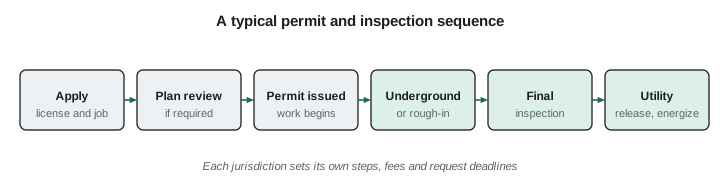
Once work starts, the contractor calls for inspections at the stages the department requires. Typical stages are underground or trench inspection before backfill, rough-in inspection before walls and ceilings are covered, service inspection, and final inspection when the work is complete. Solar, battery and generator installations have their own checklists, and many jurisdictions require specific labels and disconnecting means to be verified at the final. Work must be accessible for inspection; covering work before the inspector has approved it can mean uncovering it at the contractor's cost.
Inspectors write corrections when they find code violations. The contractor fixes the items and requests a reinspection, which may carry a fee. A pattern of failed inspections is expensive in time, fees and reputation, so Lupe expected her foremen to walk each job against the inspector's checklist the day before the inspection. "An inspection is not where we find our mistakes," she told them. "It is where we show the inspector we already found them."
| Stage | What is usually checked | Before |
|---|---|---|
| Underground | Trench depth, raceway, bedding, warning tape where required | Backfill |
| Rough-in | Boxes, cable or raceway, supports, bonding, box fill, protection | Insulation and wall cover |
| Service | Service equipment, grounding electrode system, clearances, labels | Utility connection |
| Final | Devices, covers, labeling, panel schedules, required protection | Certificate or release |
Release to the utility
For new or upgraded services, approval by the building department is only half the job. The department notifies the utility, or issues a release, that the service has passed inspection, and the utility then sets the meter or reconnects service according to its own requirements and schedule. Solar and battery systems also need the utility's interconnection approval before they may operate in parallel with the grid. Coordinating the inspection date with the utility's appointment is one of the main jobs at Brenda's desk, because a customer without power is a customer on the phone.
# Tracking inspections and the utility release for a service upgrade (illustrative dates)
from datetime import date, timedelta

stages = ["underground", "service", "final", "utility release"]
start = date(2026, 4, 6)
typical_days = {"underground": 2, "service": 5, "final": 3, "utility release": 4}
day = start
for stage in stages:
    day += timedelta(days=typical_days[stage])
    print(f"{stage:>16}: target {day.isoformat()}")
print("Customer power restored by about", day.isoformat()) underground: target 2026-04-08
service: target 2026-04-13
final: target 2026-04-16
utility release: target 2026-04-20
Customer power restored by about 2026-04-20The durations in the calculator are examples; real times depend on the jurisdiction's inspection schedule and the utility's workload, and in summer both can stretch. The value of a plan like this is that it lets the office tell the customer a realistic date and see early when a stage is slipping.
Owner-builders and homeowner permits
Many Arizona jurisdictions allow a homeowner to obtain a permit for work on his or her own home, typically as an owner-builder who will do the work personally or hire licensed contractors. The rules for homeowner permits vary, and the ROC's licensing statute has its own provisions about owners who build or improve property for sale or rent. A homeowner's permit does not authorize an unlicensed person to do the work for pay. When a homeowner asks Sonoran Line to work under the homeowner's own permit, Lupe's answer is no: the company pulls its own permit so that the responsibility, the inspection record and the warranty all line up.
Public and special projects
Some work falls outside the ordinary city process. Work on state property, on tribal lands, in certain special districts or on federal sites may be inspected by a different authority or under a different code. Arizona contains many tribal nations with their own governments, and work within tribal lands may be subject to tribal permitting and licensing rules rather than city or county rules. Before bidding work in an unfamiliar place, identify the inspection authority first.
Requesting and preparing for inspections
Most building departments take inspection requests online or through an automated phone line, with a cutoff time for next-day inspections. Requests usually need the permit number, the inspection type and access instructions. In summer, demand can push inspections out, so schedule early and keep the job ready. The inspector needs safe access to the work, the approved plans on site when the department requires them, and someone who can answer questions. Locked buildings, missing ladders and covered work are common reasons for a wasted trip and a reinspection fee.
| Before the inspector arrives | Why |
|---|---|
| Walk the job against the checklist for that stage | Finds corrections before the inspector does |
| Have the permit card and approved plans on site if required | The inspector checks the work against them |
| Provide safe access, ladders and lighting | No access usually means no inspection |
| Label panels and circuits as required | Labels are common correction items |
| Leave work uncovered until approved | Covered work may have to be opened |
When an inspection fails
A correction notice lists the items to fix and usually cites the code section. Read it carefully, fix every item, not just the ones that seem important, and request the reinspection. If a correction seems wrong, ask the inspector politely to explain the requirement, and if the disagreement remains, ask the department about its process for review by a supervisor or plans examiner. Most departments have one. Arguing on site rarely helps, and an inspector who trusts a contractor's work is an asset worth more than winning a single point.
Solar and battery permits
Solar and battery systems are a large part of Arizona permitting. Departments usually require a plan set with the array layout, the electrical one-line diagram, equipment specifications, labels and, for roof-mounted systems, structural information. Inspections check the mounting, the wiring methods, the disconnects, the rapid shutdown arrangements where the adopted code requires them and the labels. The serving utility runs its own interconnection process with its own application, and the system may not operate in parallel with the grid until the utility approves it. Theo's crew never energized a system for the customer before Brenda had the utility's permission in writing.
Expired permits and closeout
Permits do not last forever. Most jurisdictions cancel a permit if work does not start or no inspection is requested within a period set in their administrative rules, and an expired permit may need to be renewed or replaced before work continues. At the end of the job, keep the final approval, the permit record and the panel schedules in the job file. Owners, insurers and future buyers ask for them, and a closed permit is the proof that the work was inspected and accepted.
Worked problem
Planning a service upgrade
A homeowner in Gilbert wants her 150-ampere service replaced with a 200-ampere service and panel before a solar installation. What permits and approvals should Brenda plan for?
Show solution
- An electrical permit from the town for the service upgrade, with a load calculation if the town requires one.
- A service inspection by the town, and coordination with the serving utility to disconnect, release and reconnect the service under its requirements.
- A separate permit and plan review for the solar system, plus the utility's interconnection approval before the system operates.
- Final inspections and any required labels before the customer's project is closed out.
Answer: A service permit with inspection and utility release, then a separate solar permit with interconnection approval.
Working with inspectors
Inspectors are busy public employees who see the work of dozens of contractors each week. The contractors they trust are the ones whose jobs are ready, whose foremen know the code and who fix corrections without argument. That trust is built one inspection at a time and lost the same way. Be on time, be honest about what is and is not ready, and never ask an inspector to approve work that is not complete. If a job will not be ready, cancel the inspection before the cutoff rather than wasting the inspector's trip. When an inspector explains a requirement, listen, because the explanation is free training. Lupe kept notes on the questions each department's inspectors asked most often and shared them with the foremen at the Monday meeting, so that the same correction did not appear twice in the same city.
Over time, these notes become one of the most valuable documents in the office. They show which corrections come up most often, which departments have unusual requirements and where the company's own crews need more training. A contractor that learns from each inspection pays fewer reinspection fees, finishes jobs sooner and earns a reputation that makes every future inspection go more smoothly.
Common mistakes
MistakeStarting work before the permit is issued.
InsteadWait for the permit; unpermitted work can mean fines, double fees and uncovering work.
MistakeCovering work before the rough-in inspection.
InsteadKeep work accessible until the inspector approves it.
MistakeAssuming the final inspection energizes the service.
InsteadThe utility sets the meter or reconnects only after the release and under its own requirements.
MistakeWorking under a homeowner's permit for pay.
InsteadA licensed contractor pulls its own permit for work it is paid to do.
Summary and key terms
- Local building departments are the inspection authority for nearly all private electrical work in Arizona.
- Most new work, alterations, service changes, solar and EV charging require a permit; ask when in doubt.
- Commercial and larger projects require plan review, often with engineered drawings.
- Typical inspections are underground, rough-in, service and final; work must stay accessible until approved.
- Services are energized by the utility after the department's release; solar also needs interconnection approval.
- Inspection authority
- The government body that issues permits and inspects work in a jurisdiction.
- Plan review
- The building department's review of drawings before a permit is issued.
- Rough-in inspection
- An inspection of wiring before walls and ceilings are covered.
- Release
- The building department's notice to the utility that a service has passed inspection.
- Owner-builder
- An owner who obtains permits to build or improve his or her own property.
Practice problems
Work each problem on paper first, then reveal the answer to check.
What should a contractor do before backfilling an underground feeder trench?
Show answer
Call for and pass the underground inspection.
Who decides when a new service may be energized after the final inspection?
Show answer
The serving utility, after the building department's release and under its own requirements.
A job is on tribal land. What is the first question to answer before bidding?
Show answer
Which authority issues permits and inspects there, and under what rules.
Lesson quiz · 5 questions
Score 60% or more to complete this lesson.
Create a free account to save your progress, take quizzes and earn a certificate.