
MELU-203 · Lesson 2 of 12 · 18 min
Eligibility for the Electrical Contractor License (ROC)
▶ Video coming soon A video version of this lesson is on the way.
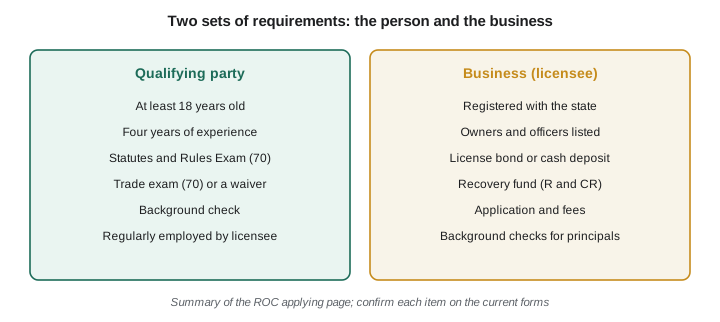
Lupe's first question was the obvious one. "Do I even qualify?" Gil sent her to Brenda, who had handled the company's paperwork with the Registrar for fifteen years. Brenda pulled up the ROC's license classification requirements and the application checklist and walked through them with Lupe at the conference table. Arizona's eligibility rules work at two levels. Some apply to the person who will be the qualifying party: experience, exams and a background check. Others apply to the business that will hold the license: its legal form, its registration with the state, its bond and, for residential work, its recovery fund status. Both sets have to be satisfied before the ROC will issue a license or approve a change of qualifying party.
Who can be a qualifying party
The statute requires every license to name a qualifying party who is regularly employed by the licensee and has the experience, knowledge and skill the classification calls for. The qualifying party can be a sole proprietor, a partner, a member or manager of an LLC, a corporate officer or an ordinary employee. What matters is that the person actually works for the business and is available to oversee the work, not that he or she owns it. All persons listed on an application, including the qualifying party and the owners or officers, must be at least eighteen years old.
A qualifying party can serve more than one license only in limited circumstances. The ROC's guidance allows a qualifying party to serve one additional licensed business when the two businesses share at least a quarter of their ownership, or when one is a subsidiary of the other. The rule prevents one experienced person from lending his or her name to a string of unrelated companies, which would defeat the purpose of requiring a responsible, experienced person on every license.
Four years of experience
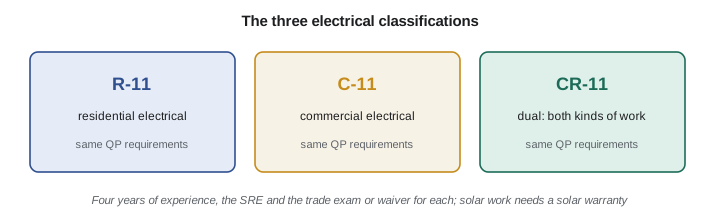
For each electrical classification, the C-11, R-11 and CR-11, the ROC's classification requirements list a minimum of four years of experience for the qualifying party. The experience must be practical, hands-on work in the trade, management of that work, or a combination of the two. It does not have to be four years as a contractor. Years as an electrician, foreman or superintendent working for a licensed contractor count, as does experience gained in another state, provided it is real experience in the kind of work the classification covers.
Applicants document their experience on the ROC's forms, usually with descriptions of the work, dates and the names of people who can confirm it. The ROC may ask for more information if the descriptions are vague or the dates do not add up. Brenda's advice was to write the experience the way an inspector would read it. "Don't write 'electrician, 2012 to 2026,'" she told Lupe. "Write what you did: services, feeders, motor circuits, panel schedules, crews you ran, jobs you supervised. Make it easy for them to see four years of electrical work."
The experience should also match the classification. Someone who has spent four years wiring houses has clear experience for the R-11. For a C-11 or CR-11, the description should show commercial work as well: three-phase services, commercial feeders, lighting control, fire alarm interfaces, tenant improvements. Lupe's record covered both, with residential work in her first years and commercial crews after that.
# Counting documented experience (illustrative dates for Lupe)
from datetime import date

periods = [
    ("Helper, residential tracts", date(2012, 3, 5), date(2014, 6, 30)),
    ("Apprentice, residential and light commercial", date(2014, 7, 1), date(2018, 8, 31)),
    ("Journeyman, commercial crews", date(2018, 9, 1), date(2019, 9, 30)),
    ("Field superintendent, commercial", date(2019, 10, 1), date(2026, 9, 30)),
]
total_days = sum((end - start).days + 1 for _, start, end in periods)
years = total_days / 365.25
print(f"Documented experience: {years:.1f} years")
print("Meets the four-year minimum:", years >= 4)Documented experience: 14.6 years Meets the four-year minimum: True
The calculation is simple, but it is a good habit to do it before filling in the form. Gaps between jobs, overlapping dates and periods of non-electrical work are what draw questions from licensing staff. Lupe had more than fourteen years, far above the minimum, but Brenda still wanted the dates to line up exactly with what her references would say.
The exams
Every qualifying party must complete the ROC's Statutes and Rules Training Course and Exam, known as the SRE. It covers Arizona contractor law: the statute in Title 32, Chapter 10 and the ROC's rules in Title 4, Chapter 9. The qualifying party must also pass the trade exam for the classification, which for the electrical classifications tests electrical knowledge and the National Electrical Code. The ROC's licensing page says both exams must be passed with a score of at least 70, and the original results go in with the application. Lesson 4 covers the format of each exam in detail.
The ROC also lists alternatives for some classifications. For the C-11, R-11 and CR-11, it accepts the NASCLA electrical examination in place of the state trade exam. That route can help a candidate who has already passed the NASCLA exam for another state's license, or who expects to need licenses in several states that accept it.
Trade exam waivers
A candidate who has qualified a license before may not need to retake the trade exam. Under the ROC's rule, the Registrar may waive the trade exam if, within the preceding five years, the proposed qualifying party was the qualifying party on a license in good standing for the same classification in Arizona, or on a comparable license in another state. The applicant asks for the waiver on the ROC's waiver form and supplies proof of the earlier license.
The waiver does not cover the SRE in the ROC's current licensing guidance, which says the Statutes and Rules Exam cannot be waived. Its older classification table describes an SRE waiver for someone named as a qualifying party on an Arizona license in the past five years, so check the current form and instructions before you count on any waiver. For Lupe, the question did not arise: she had never been a qualifying party, so she would take both exams.
| Requirement | Applies to | Summary |
|---|---|---|
| Experience | Qualifying party | At least four years, hands-on or managerial, for C-11, R-11 and CR-11 |
| Statutes and Rules Exam | Qualifying party | Required; passed with at least 70 |
| Trade exam | Qualifying party | Required unless waived; NASCLA electrical accepted as an alternative |
| Background check | Applicant and qualifying party | Receipt submitted; expires 90 days after completion |
| Photo identification | Applicant and qualifying party | Government-issued photo ID |
| Age | All persons listed | At least 18 |
| Entity registration | Business | LLCs and corporations with the Corporation Commission; partnerships with the Secretary of State |
| Bond and recovery fund | Business | License bond; residential and dual also handle the recovery fund |
Background checks and identification
The applicant and the qualifying party must each complete a background check and submit the payment receipt with the application. The ROC's guidance says the background check expires ninety days after it is completed, so timing matters. A candidate who completes the check too early, then takes months to pass the exams, may have to redo it. Each person must also submit a copy of a government-issued photo ID such as a driver's license or passport. The application also asks about criminal history, prior licenses, earlier license cancellations and any history of unlicensed contracting, and supporting forms are required when any of those apply. Answer those questions fully and truthfully; an omission discovered later causes far more trouble than the history itself.
The business
On the business side, a limited liability company or corporation must be registered with the Arizona Corporation Commission and stay in good standing there, including at renewal. A partnership registers with the Arizona Secretary of State. A sole proprietor applies in his or her own name or a registered trade name. The business must also obtain the license bond required for its classification and volume of work, and a residential or dual license must either pay the recovery fund assessment or post the alternative consumer-protection bond. Lesson 8 covers those amounts.
Sonoran Line Electric, LLC was already registered and licensed, so its side of the application was a matter of updating the qualifying party. Danny, starting a new business in Tucson, had more to do. He chose to form an LLC, registered it with the Corporation Commission, obtained an employer identification number and opened a business bank account before applying. "Set up the company first," Brenda told him when he called for advice. "The license is issued to the company, so the company has to exist."
Documenting the experience
Experience is the requirement most likely to slow an application. The ROC's forms ask the applicant to describe the work, the employers and the dates, and to have the experience confirmed by people who can vouch for it, such as employers, supervisors or customers. Read the current form for what counts and how it must be documented, because the ROC can ask for more detail when a description is vague. Experience that was gained in another state or in a related trade may count if it fits the classification, but the burden is on the applicant to show it.
Lupe's file was strong because Brenda had kept it for years without knowing it would matter. Payroll records showed her hours with Sonoran Line since 2012, job lists showed the commercial and residential work she had run, and Gil could confirm her role as superintendent. Danny's file took more work: two of his six years were with a Tucson contractor that had since closed, so he gathered pay stubs, tax forms and a letter from his former foreman. Candidates who expect to qualify a license someday should start keeping that kind of record now, rather than reconstructing it later.
Planning for a successor
A license with one qualifying party is one resignation, illness or retirement away from a problem. Many Arizona contractors plan for a second person who could step into the role, even if only one is named on the license at a time. Sonoran Line had relied on Gil for twenty-eight years, and his decision to retire is the reason Lupe is studying now. Gil's advice to other owners was blunt: start the successor's exams a year before you need them, not a month after.
Worked problem
Checking eligibility
Danny has six years as an electrician, the last two as a lead on residential service work for a Tucson contractor. He has never been a qualifying party. He plans to form an LLC and apply for an R-11. What must he do before the ROC can issue the license?
Show solution
- His six years of hands-on residential work exceed the four-year minimum for the R-11.
- He has never qualified a license, so no trade exam waiver applies; he must pass the trade exam (or the accepted NASCLA alternative) and the SRE, each with at least 70.
- He and the business must complete background checks within ninety days of applying and provide photo ID.
- The LLC must be registered with the Corporation Commission, obtain a license bond and either pay the recovery fund assessment or post the alternative bond.
Answer: Experience is met; he needs both exams, background checks, ID, the LLC registration, a bond and the recovery fund step.
Common mistakes
MistakeAssuming the qualifying party must own the business.
InsteadThe qualifying party must be regularly employed by the licensee; ownership is not required.
MistakeWriting vague experience descriptions.
InsteadDescribe the actual electrical work, dates and responsibilities so four years are easy to see.
MistakeCompleting the background check months before applying.
InsteadThe ROC's guidance says background checks expire ninety days after completion.
MistakeExpecting a waiver to cover every exam.
InsteadThe trade exam waiver depends on recent qualifying-party history; current ROC guidance says the SRE cannot be waived.
Summary and key terms
- The qualifying party must be regularly employed by the licensee and at least 18; ownership is not required.
- The C-11, R-11 and CR-11 each require at least four years of hands-on or managerial experience.
- The qualifying party passes the SRE and the trade exam with at least 70; the NASCLA electrical exam is accepted for the trade exam.
- A trade exam waiver may be available to someone who qualified a license in good standing in the same or a comparable classification within five years.
- The business must be properly registered, bonded and, for residential or dual work, meet the recovery fund requirement.
- SRE
- The Statutes and Rules Training Course and Exam on Arizona contractor law, required for every qualifying party.
- Trade exam
- The exam on trade knowledge and code for a classification, administered through PSI.
- Trade exam waiver
- A waiver the Registrar may grant to a candidate who was recently the qualifying party on a comparable license in good standing.
- Arizona Corporation Commission
- The state body with which LLCs and corporations register.
- Background check
- A check completed by the applicant and qualifying party, with a receipt submitted to the ROC.
Practice problems
Work each problem on paper first, then reveal the answer to check.
Lupe is an employee of Sonoran Line, not an owner. Can she be its qualifying party?
Show answer
Yes. The qualifying party must be regularly employed by the licensee; ownership is not required.
A candidate completed a background check in January and plans to apply in June. What should she watch?
Show answer
The ROC's guidance says the check expires ninety days after completion, so she may need a new one.
Which exam does the ROC accept in place of the state electrical trade exam?
Show answer
The NASCLA electrical examination, for the C-11, R-11 and CR-11.
Lesson quiz · 5 questions
Score 60% or more to complete this lesson.
Create a free account to save your progress, take quizzes and earn a certificate.