
MELU-203 · Lesson 1 of 12 · 19 min
How electrical licensing works in Arizona
▶ Video coming soon A video version of this lesson is on the way.
Gil Navarro started Sonoran Line Electric in a rented bay off Broadway Road in Mesa in 1998, with one van, a used trencher and a dual electrical license from the Arizona Registrar of Contractors. Twenty-eight years later the company employs twenty-two people and works across the East Valley: service upgrades and solar tie-ins on houses in Gilbert and Queen Creek, tenant improvements in Chandler office parks, restaurant fit-outs along Main Street in Mesa and a steady flow of light industrial work in Tempe. Every permit the company pulls, every contract it signs and every bond it carries rests on one license, and that license rests on one person, the qualifying party. For twenty-eight years that person has been Gil.
On a Monday morning in late September, after the weekly safety meeting, Gil asked his field superintendent, Lupe Ortega, to stay behind. "I'm sixty-four," he said. "I want to step back in two years and spend the summers in Pinetop. The company can keep its license, but the Registrar needs a new qualifying party on it, and that person has to pass the state exams. I want it to be you." Lupe had fourteen years in the trade. She had started as a helper on tract homes in Gilbert, finished an apprenticeship while working, and had run commercial crews for Sonoran Line for the last seven years. She had already worked through the master electrician core courses on the National Electrical Code, load calculations, grounding and bonding, motors and transformers, special occupancies, and business and law. This course takes that preparation and applies it to Arizona.
The Registrar of Contractors
Arizona licenses construction contractors through a single state agency, the Arizona Registrar of Contractors, usually called the ROC. The ROC is created by Title 32, Chapter 10 of the Arizona Revised Statutes, and its detailed rules sit in Title 4, Chapter 9 of the Arizona Administrative Code. Unlike states that split construction licensing among several trade boards, Arizona puts general contractors, specialty contractors, residential and commercial contractors under one agency. The ROC receives applications, issues and renews licenses, keeps the bond records, investigates complaints from owners and other contractors, and disciplines licensees who break the law.
For an electrical contractor, the ROC is the agency that decides whether your business may contract for electrical work at all. It does not decide which edition of the National Electrical Code applies on a job, and it does not inspect your installations. Those jobs belong to the local building departments of the cities, towns and counties where you work. Keep the two roles separate: the ROC licenses the business and its qualifying party, and local governments adopt codes, issue permits and inspect.
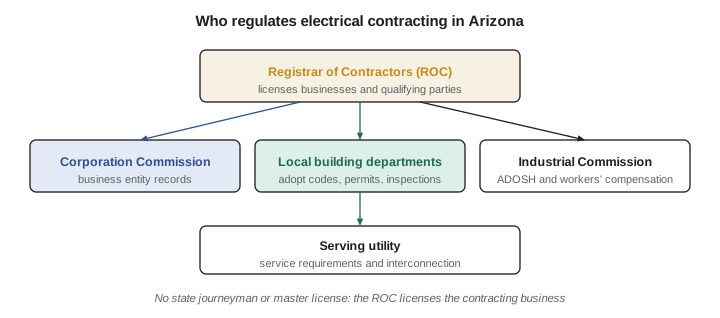
The ROC also gives owners somewhere to turn when work goes wrong. An owner can file a complaint against a licensee, and the agency can investigate, order the licensee to correct poor workmanship, and take disciplinary action that ranges from a warning to suspension or revocation of the license. For residential work, the recovery fund described in Lesson 8 can compensate homeowners who suffer losses from a licensee's poor work. None of that protection reaches an owner who hires an unlicensed person, which is one reason the license itself has value in the market: homeowners, general contractors and public agencies can look a contractor up on the ROC's public license search before they sign anything. Brenda, who runs Sonoran Line's office, checks every subcontractor and supplier the same way before the company signs a contract with them.
Contractors, not electricians
One feature of Arizona's system surprises people who move in from Texas, Colorado or Nevada. The state does not issue a journeyman electrician license or a master electrician license. There is no state exam an individual electrician must pass to work with tools on a job. What Arizona licenses is the contractor: the business that offers, bids or agrees to perform electrical work for others. Electricians who do the work are employees of a licensed contractor and work under its license and its supervision.
That design has practical effects. A skilled electrician can work for years in Phoenix without holding any state license, as long as the work is done for a licensed contractor. The moment that electrician wants to take side jobs, bid work in his or her own name, or start a company, a contractor license becomes necessary. Some cities have at times kept their own registration or certification programs for individuals, so check the rules in each jurisdiction where you work. This course does not assume any city license exists unless you confirm it with that city.
Residential, commercial and dual licenses
Arizona divides licenses by the kind of property worked on as well as by trade. Residential licenses, whose classifications begin with R, cover residential construction. Commercial licenses, beginning with C, cover commercial work. Dual licenses, beginning with CR, cover both. Each license also carries a trade classification, and the electrical classifications are C-11 for commercial electrical work, R-11 for residential electrical work and CR-11 for the dual electrical license. The ROC's classification requirements list all three as specialty licenses, each requiring four years of experience for the qualifying party, the Statutes and Rules Exam and a trade exam.
The split matters for money as well as scope. A residential or dual licensee must either pay an assessment into the Residential Contractors' Recovery Fund or post a large consumer-protection bond, while a commercial-only licensee pays no recovery fund assessment. Bond amounts also differ between residential and commercial licenses, and a dual licensee posts the sum of both. Lessons 8 and 11 cover those numbers.
| Question | Arizona answer (summary) |
|---|---|
| Who licenses electrical contractors? | The Arizona Registrar of Contractors (ROC) |
| Is there a state journeyman or master license? | No; the ROC licenses contracting businesses |
| Who must pass the exams? | The qualifying party named on the license |
| Electrical classifications | C-11 commercial, R-11 residential, CR-11 dual |
| Who adopts the electrical code? | Each city, town or county for its own area |
| Who issues permits and inspects? | Local building departments |
The license, the business and the qualifying party
An Arizona contractor license is issued to a business: a sole proprietorship, partnership, limited liability company or corporation. Every license must name a qualifying party, a regularly employed person who has the experience, knowledge and skill the classification requires. The qualifying party may be an owner, a partner, a member of an LLC, a corporate officer or simply an employee. That person passes the exams on behalf of the license and answers to the ROC for the electrical work done under it. A qualifying party may serve one additional licensed business only when the two share at least a quarter of their ownership or one is a subsidiary of the other.
For Sonoran Line, that structure meant Gil could keep owning the company while Lupe became its qualifying party. The license would stay with Sonoran Line Electric, LLC. When Lupe passed the exams and the ROC approved her, the license record would show her as the qualifying party in place of Gil, and the company's bond, entity registration and recovery fund status would carry on. Lesson 7 looks at what the qualifying party is responsible for once the change is made.
Unlicensed contracting
Contracting for electrical work in Arizona without the required license breaks the law. The statute makes unlicensed contracting a crime, the ROC can pursue civil penalties, and an unlicensed contractor generally cannot use the courts to collect payment for work that required a license. Arizona's statute does allow a narrow exemption for small, minor jobs that are not part of a larger project and need no building permit, with a dollar ceiling set in statute. Electrical work that requires a permit never fits that exemption, and service and panel work almost always requires one. Check the current wording of the exemption in A.R.S. Title 32, Chapter 10 before relying on it.
Gil had a story about this. After a monsoon storm in 2021, a homeowner in north Mesa hired a man with a pickup and a business card to replace a damaged meter section and service panel. The work never went through a permit, the utility would not restore service until the installation was inspected, and the homeowner called Sonoran Line. Gil's crew had to remove most of the work and start again. The homeowner filed a complaint with the ROC, and because the man held no license, she could not turn to a licensee's bond or the recovery fund. "That is what the license is for," Gil told Lupe. "It is the customer's protection, not just ours."
# Which Arizona electrical classification fits each job? (simplified study aid)
jobs = [
    ("Panel upgrade at a house in Gilbert", "residential"),
    ("Tenant improvement in a Chandler office park", "commercial"),
    ("Solar tie-in on a Queen Creek house", "residential"),
    ("Warehouse service in Tempe", "commercial"),
]
licenses = {"R-11": {"residential"}, "C-11": {"commercial"},
            "CR-11": {"residential", "commercial"}}
for job, kind in jobs:
    fits = [name for name, scope in licenses.items() if kind in scope]
print(f"{job}: {kind} -> {', '.join(fits)}")Panel upgrade at a house in Gilbert: residential -> R-11, CR-11 Tenant improvement in a Chandler office park: commercial -> C-11, CR-11 Solar tie-in on a Queen Creek house: residential -> R-11, CR-11 Warehouse service in Tempe: commercial -> C-11, CR-11
The calculator shows why Sonoran Line has always carried the dual license. Its work mixes houses and commercial buildings every week, and only the CR-11 covers both. A shop that does nothing but houses could carry the R-11 alone, and a shop that works only in commercial buildings could carry the C-11 and avoid the recovery fund assessment.
Worked problem
Choosing a classification
Danny Pham, an electrician in Tucson, plans to start a company that will do only service upgrades, remodel wiring and solar tie-ins on single-family houses. Two years later he hopes to add small commercial tenant improvements. Which classification should he apply for now, and what changes later?
Show solution
- All of the planned work in the first two years is residential, so the R-11 covers it.
- Commercial tenant improvements are outside the residential classification.
- When he adds commercial work, the company needs either a separate C-11 or a change to the dual CR-11.
- Either way, the qualifying party must meet the experience and exam requirements for the classification held.
Answer: Start with the R-11; add commercial scope later through a C-11 or the dual CR-11.
The rest of this course
Lesson 2 covers eligibility for the qualifying party and the business, and Lesson 3 walks through the application, the exams and the booking steps. Lesson 4 explains the exam formats and the references allowed. Lesson 5 covers how the National Electrical Code is adopted city by city in Arizona, and Lesson 6 covers permits, inspections and utility requirements. Lesson 7 covers the qualifying party's duties, Lesson 8 bonds, the recovery fund and insurance, Lesson 9 contracts and mechanics' liens, Lesson 10 workplace safety and workers' compensation, Lesson 11 renewal and training, and Lesson 12 a practice review and test-day plan.
Throughout the course you will follow Lupe from Gil's request to the day the ROC lists her as qualifying party, along with Danny on the residential path and the rest of the Sonoran Line team: Brenda Kaye, who runs the office and the permit desk, Theo Begay, a journeyman electrician from Flagstaff who leads the solar crew, and Marco Ruiz, a second-year apprentice. Their jobs include a restaurant on Main Street in Mesa, a dental office in Chandler, a warehouse in Tempe and a run of residential service upgrades in Gilbert and Queen Creek. All the figures, fees and job values in their story are illustrative unless the course says they come from an official source.
Common mistakes
MistakeAssuming Arizona issues a journeyman or master electrician license.
InsteadRemember that the ROC licenses contracting businesses through a qualifying party; check each city for any local rules.
MistakeThinking the license belongs to the qualifying party personally.
InsteadThe license is issued to the business; the qualifying party is named on it and answers for the work.
MistakeTreating C-11 and R-11 as interchangeable.
InsteadResidential and commercial scopes differ; only the dual CR-11 covers both.
MistakeExpecting the ROC to set the electrical code.
InsteadEach city, town or county adopts its own codes and inspects; the ROC licenses.
Summary and key terms
- The Arizona Registrar of Contractors licenses construction contractors under A.R.S. Title 32, Chapter 10 and A.A.C. Title 4, Chapter 9.
- Arizona has no state journeyman or master electrician license; it licenses contracting businesses.
- The electrical classifications are C-11 (commercial), R-11 (residential) and CR-11 (dual), each requiring four years of experience for the qualifying party.
- Every license names a qualifying party, who passes the exams and answers for the work.
- Local governments adopt codes, issue permits and inspect; the ROC does not inspect electrical work.
- ROC
- The Arizona Registrar of Contractors, the state agency that licenses contractors.
- Qualifying party
- The regularly employed person named on a license who meets the experience and exam requirements and answers for the work.
- C-11
- The commercial electrical specialty classification.
- R-11
- The residential electrical specialty classification.
- CR-11
- The dual electrical specialty classification covering residential and commercial work.
Practice problems
Work each problem on paper first, then reveal the answer to check.
A company plans to wire new houses and a small strip center. Which single electrical classification covers both?
Show answer
The dual CR-11.
Who passes the exams for an Arizona contractor license?
Show answer
The qualifying party named on the license.
Theo has worked for licensed contractors for ten years without a state license. Was that lawful?
Show answer
Yes. Arizona licenses contractors, not individual electricians, subject to any local rules where he works.
Lesson quiz · 5 questions
Score 60% or more to complete this lesson.
Create a free account to save your progress, take quizzes and earn a certificate.