
MELU-201 · Lesson 9 of 12 · 19 min
Contracts and mechanics' liens in Alabama
▶ Video coming soon A video version of this lesson is on the way.
The Lay Lake house finished in September. The owners paid the first two progress invoices on time and then stopped answering calls. The last invoice, for the generator, the transfer switch and the boathouse, was 23,400 dollars, and it was thirty days past due. Earl, still at the company part time, called Monique into his office. "Our contract was with the owners, so we are an original contractor," he said. "That gives us six months from the last day we worked to record a lien. But don't wait six months. The longer you wait, the less likely you get paid." He also told her about a job years earlier, when Cahaba River was a subcontractor to a builder who went broke. The company had not sent a notice to the owner before starting, and its lien was limited to what the owner still owed the builder, which by then was almost nothing.
A licensed contractor needs to know how to write a sound contract and how to protect the right to be paid. This lesson covers the main contract terms for electrical work, Alabama's mechanics' lien law in Code of Alabama 35-11-210 and following sections, including the notice to the owner, the recording deadlines and enforcement, and the payment bond claim that replaces a lien on public projects. The rules are technical and the deadlines are strict. Use this lesson to recognize the issues and talk to a construction lawyer about any real claim.
Contracts
A written contract is the contractor's first protection. It should identify the parties and the property, describe the scope of work by reference to drawings, specifications or a detailed list, state the price and the payment terms, and explain how changes are priced and approved. It should set the schedule, state who obtains and pays for permits, assign responsibility for code-required work that the plans missed, describe warranties and their limits, and address delays, retainage, insurance, indemnity and dispute resolution. On a lake house, a farm or any job with an owner who is not a construction professional, plain language and a clear scope prevent most disputes.
Change orders deserve special attention. Most payment disputes start with work that was added or changed without a signed change order. Cahaba River's contracts say that no extra work begins without a written change order signed by the owner or the owner's representative, with the price or the method for pricing it. On the Lay Lake job, the owners added the boathouse lift and extra landscape lighting halfway through. Monique had change orders for both, which later made the lien claim straightforward.
| Contract term | Why it matters |
|---|---|
| Scope of work | Defines what is included and what is extra |
| Price and payment terms | Sets progress payments, due dates and late charges |
| Change orders | Requires written approval and pricing for added work |
| Permits and inspections | States who obtains permits and pays fees |
| Warranty | Defines what is covered, for how long, and what is excluded |
| Retainage | Sets any amount held back and when it is released |
| Dispute resolution | Chooses negotiation, mediation, arbitration or court |
Who can claim a lien
Alabama's mechanics' lien law gives a lien on the property to those who perform work or furnish materials to improve it. Claimants include original contractors with a direct contract with the owner, subcontractors and suppliers who work for a contractor, and journeymen and day laborers. The lien attaches to the improvement and to the land, within the limits of the statute. Public property cannot be liened, which is why public projects use payment bonds instead.
Full-price and unpaid-balance liens
Alabama law has two kinds of lien for a party who does not have a direct contract with the owner. If the subcontractor or supplier gives the owner written notice before furnishing labor or materials, stating what will be furnished and the price, and the owner does not object, the claimant may have a lien for the full price of what it furnished. This is sometimes called a full-price lien. Without that notice before furnishing, the claimant's lien is generally limited to the unpaid balance the owner still owes the original contractor at the time the owner receives notice of the claim. That is often called an unpaid-balance lien. If the owner has already paid the contractor in full, an unpaid-balance lien may be worth little or nothing.
For an unpaid-balance lien, the statute requires the claimant to give the owner notice of the claim before recording the lien statement. The owner then knows to stop paying the original contractor the amount claimed. Earl's old job is the example: Cahaba River, as a subcontractor, gave no notice before furnishing, and by the time it sent notice of its claim, the owner had paid the builder nearly everything. The lien was limited to the small balance left.
| Claimant | Owner notice | Kind of lien |
|---|---|---|
| Original contractor with a direct contract | Not needed; the owner is the contracting party | Lien for the contract amount owed |
| Subcontractor or supplier who gives written notice before furnishing, without objection | Before furnishing labor or materials | Full-price lien |
| Subcontractor or supplier without notice before furnishing | A notice of the claim before recording | Unpaid-balance lien, limited to what the owner still owes |
| Journeyman or day laborer | As the statute requires | Lien for wages owed, with a short deadline |
Recording deadlines
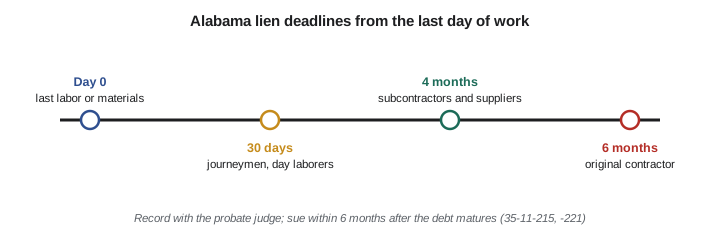
A lien is perfected by recording a verified lien statement in the office of the judge of probate in the county where the property is located. The statement must describe the property, the amount claimed, the owner and the claimant, and meet the statute's form. The deadlines run from the last day the claimant furnished labor or materials. An original contractor has six months. Every other claimant, such as a subcontractor or supplier, has four months. Journeymen and day laborers have 30 days. Missing the deadline loses the lien, though the claimant may still sue on the contract.
Enforcing the lien
Recording the lien statement does not collect the money. The claimant must sue to enforce the lien in the circuit court of the county within six months after the entire debt becomes due. A lien not enforced on time is lost. Many liens are resolved before suit: the owner pays, the parties settle, or the owner bonds off the lien by posting security so the property can be sold or refinanced. When a suit is filed, other lienholders on the same property may join, and the court decides priorities.
Because the deadlines are short and the requirements are technical, a contractor with a real claim should talk to a construction lawyer early, ideally before the recording deadline approaches. A lien statement with the wrong property description, the wrong owner or an inflated amount can be challenged, and a willfully inflated lien can expose the claimant to liability.
# Alabama lien recording deadlines from the last day of work (simplified study aid)
from datetime import date

def add_months(d, m):
    total = d.month - 1 + m
    return date(d.year + total // 12, total - 12 * (total // 12) + 1, min(d.day, 28))

last_day = date(2026, 9, 12)
claimants = [("Original contractor", 6), ("Subcontractor or supplier", 4)]
for who, months in claimants:
    print(who.ljust(28), "record by about", add_months(last_day, months))
print("Journeyman or day laborer".ljust(28), "record within 30 days of", last_day)Original contractor record by about 2027-03-12 Subcontractor or supplier record by about 2027-01-12 Journeyman or day laborer record within 30 days of 2026-09-12
The output shows how quickly the deadlines arrive after the last day of work. Cahaba River's last day at the Lay Lake house was September 12, so as the original contractor it had until about March 12 to record. A subcontractor on the same job would have had until about January 12. Count exact dates with a lawyer, because a single day matters.
Public projects: payment bonds
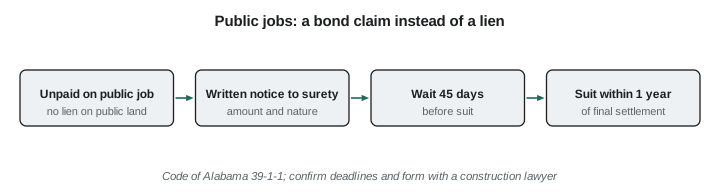
Public property cannot be liened. Instead, Alabama's public works law, Code of Alabama 39-1-1, requires the prime contractor on a public project to furnish a payment bond. A subcontractor, supplier or worker who is not paid can make a claim on the bond. Before suing on the bond, a claimant must give written notice to the surety of the amount and nature of the claim and wait 45 days. Suit on the bond must be filed within one year from the date of final settlement of the contract. Check the bond itself and the statute, because the details, including who counts as a protected claimant, matter.
Retainage and slow payment
Many commercial contracts hold back retainage, a portion of each progress payment kept until the work is complete or accepted. Retainage protects the owner, but it can tie up a large part of a subcontractor's profit for months. Read the retainage clause before signing: how much is held, when it is reduced, and what triggers final release. Track retainage as a receivable, invoice for it promptly at completion and include it in any lien or bond claim if it is not paid. Alabama law has provisions on prompt payment and retainage for some public contracts; check the current law and the contract on public work.
Slow payment is a cash-flow problem before it is a legal one. A contractor that waits sixty days to send an invoice, or that never sends monthly statements, gives owners and general contractors an easy reason to delay. Prompt, accurate invoicing, with change orders attached, is the cheapest collection tool there is.
Lien waivers and getting paid
Owners and general contractors often require lien waivers with each payment. A waiver given in exchange for a payment should cover only the amount actually paid and only work through a stated date, and it should be conditional on receiving the payment. Signing an unconditional waiver for a check that later bounces can leave a contractor without lien rights. Read waiver forms carefully, and do not sign a waiver that covers work not yet paid for.
The best lien is the one never needed. Clear contracts, signed change orders, prompt invoicing, monthly statements and quick follow-up on late payments prevent most claims. On the Lay Lake job, Monique sent the owners a written notice that the company would record a lien if the balance was not paid within fifteen days, attaching the contract, the change orders and the final inspection. The owners paid in full two weeks later.
Worked problem
A subcontract with a builder
Cahaba River is hired as the electrical subcontractor on a new house in Chelsea built by a small builder the company has not worked with before. The builder's contract with the owner is 480,000 dollars, and the electrical subcontract is 38,000 dollars. How should Cahaba River protect its lien rights?
Show solution
- Before furnishing labor or materials, send the owner written notice describing the work and the price, to support a full-price lien.
- Keep the subcontract, change orders and records of each delivery and each day of work.
- Bill promptly and track payments against each invoice.
- If payment stops, record the lien statement with the probate judge in the county within four months of the last day of work.
- Sue to enforce within six months after the debt matures, with a construction lawyer's help.
Answer: Send the notice to the owner before starting so the lien is not limited to the unpaid balance, keep records, and meet the four-month recording and six-month enforcement deadlines.
Common mistakes
MistakeStarting work as a subcontractor without notice to the owner.
InsteadWithout notice before furnishing, the lien is generally limited to the unpaid balance the owner still owes.
MistakeRecording a lien with the wrong office.
InsteadLien statements are recorded with the judge of probate in the county where the property is located.
MistakeThinking a recorded lien is enough.
InsteadSuit to enforce must be filed within six months after the debt matures.
MistakeFiling a lien on a public school project.
InsteadPublic property cannot be liened; claimants use the payment bond under Code of Alabama 39-1-1.
MistakeSigning an unconditional waiver before payment clears.
InsteadUse waivers that cover only amounts paid, through a stated date, conditional on payment.
Summary and key terms
- Clear contracts with written change orders prevent most payment disputes.
- Original contractors, subcontractors, suppliers, journeymen and day laborers may claim mechanics' liens.
- A subcontractor or supplier who gives the owner written notice before furnishing may have a full-price lien; otherwise the lien is limited to the unpaid balance.
- Record the lien statement with the county's probate judge within six months for an original contractor, four months for others and 30 days for journeymen and day laborers.
- Sue to enforce within six months after the debt matures.
- On public projects, claim on the payment bond: written notice to the surety, 45 days before suit and suit within one year of final settlement.
- Mechanics' lien
- A claim against improved property to secure payment for labor or materials.
- Full-price lien
- A lien for the full price, available to a non-contracting claimant who gave the owner notice before furnishing.
- Unpaid-balance lien
- A lien limited to what the owner still owes the original contractor.
- Judge of probate
- The county office where Alabama lien statements are recorded.
- Lien waiver
- A document giving up lien rights, usually in exchange for payment.
Practice problems
Work each problem on paper first, then reveal the answer to check.
How long does an original contractor have to record a lien statement?
Show answer
Six months from the last day of work.
How long does a subcontractor have?
Show answer
Four months.
Where is the lien statement recorded?
Show answer
With the judge of probate in the county where the property is located.
What replaces a lien on a public project?
Show answer
A claim on the contractor's payment bond under Code of Alabama 39-1-1.
Lesson quiz · 5 questions
Score 60% or more to complete this lesson.
Create a free account to save your progress, take quizzes and earn a certificate.