
MELU-201 · Lesson 6 of 12 · 19 min
Permits, inspections and the inspection authority
▶ Video coming soon A video version of this lesson is on the way.
The Lay Lake house was a weekend home on a point lot in the unincorporated part of Shelby County. The owners, a couple from Birmingham, wanted a new 400 A service, a detached garage with a shop panel, a boathouse with a lift and lighting, and a generator with an automatic transfer switch. Monique was running the job while Earl handled the contract. Before bidding, she made three phone calls: to the county's building office to ask whether it issued electrical permits for that address, to the electric utility serving the area to ask about the service drop and meter base, and to the owners' insurance agent to ask whether the insurer needed anything for the generator and boathouse. Each answer changed the bid. "The first question on any job is who permits it," Earl said. "The second is who inspects it. If you can't answer both, you can't price it."
In Alabama, permits and inspections are local. The board licenses contractors and journeymen, but it does not issue permits or inspect jobs. Cities and counties that have adopted codes issue permits and inspect work in their jurisdictions; the state inspects its own buildings and certain regulated types; and some areas have no local permit program at all. This lesson covers how to find the inspection authority for an address, how permits are obtained and closed, how inspections work, how utilities fit in and what to do where no local program exists.
Finding the inspection authority
Start with the address, not the mailing city. A street address that says Pelham may be inside city limits or in the unincorporated county, and the difference decides who permits the work. Most building departments and many county offices have online maps or a phone line that answers the question. Ask three things: who issues the electrical permit for this address, which code edition and amendments apply, and which inspections are required. For state-owned buildings and state-regulated building types, such as public schools, the state's construction management office handles plan review and inspections regardless of the city.
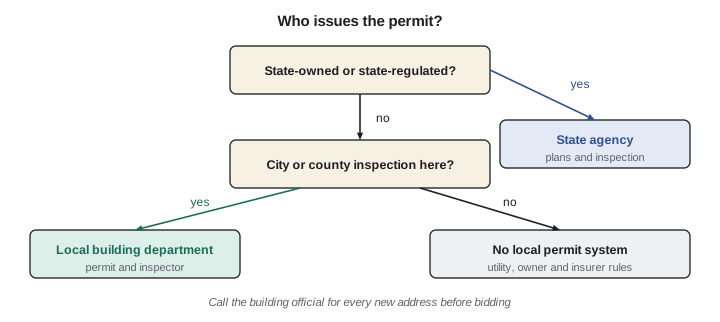
| Location of the work | Permit and inspection | Notes |
|---|---|---|
| Inside a city with a building department | The city's building or inspection department | Local business license and code edition apply |
| Unincorporated area of a county that inspects | The county building or inspection office | Some counties inspect only certain areas or building types |
| State-owned building or public school | The state's construction management office | State plan review; local inspection may not apply |
| Area with no local permit program | No local electrical permit | Utility, insurer, lender and contract requirements still apply |
| Manufactured or modular home setup | Local rules and state requirements for those homes | Board certification required for this work |
Who may obtain a permit
Local governments decide who may obtain an electrical permit, but most require the applicant to be a licensed electrical contractor, often with the state certificate number and a current local business license on file. The statute's provision that a state certificate holder may work in any county or municipality depends on obtaining the local building permit and business license. Many jurisdictions allow an owner to obtain a permit for work on his or her own home under the owner exemption, usually with a signed statement that the owner will do the work personally and live in the home. A journeyman generally cannot obtain a permit in his or her own name; the permit is issued to the licensed contractor who is responsible for the work.
The permit application usually asks for the address, the owner, the scope of work, the service size, the number of circuits or fixtures, the estimated value and the contractor's license and business license information. Commercial work may require plans stamped by an engineer or an architect and a plan review before the permit is issued. Fees are set by each jurisdiction, often as a base fee plus amounts based on service size or the number of outlets.
Inspections
Each jurisdiction sets its own inspection stages, but most follow a familiar pattern. A temporary power inspection comes before the utility connects construction power. A rough-in inspection comes after wiring is installed and before walls and ceilings are covered. An underground or slab inspection comes before trenches are backfilled or concrete is poured over raceways. A service inspection may be required before the utility sets the meter. A final inspection comes when the work is complete, fixtures and devices are installed and panels are labeled. On commercial jobs, there may be additional inspections for fire alarm systems, emergency systems and special equipment.
Request inspections through the jurisdiction's system, which may be online, by phone or through a permit portal. Be ready when the inspector arrives: the permit posted on site, the approved plans available, panels open for inspection, the work accessible and someone on site who knows the job. A failed inspection produces a correction notice listing the items to fix. Correct them, request a reinspection and keep the notice in the job file.
Utilities and the meter
The electric utility is not an inspection authority, but its rules matter. Alabama is served by investor-owned utilities, electric cooperatives and municipal utilities, and each has a service manual that sets requirements for service entrance location, meter bases, clearances, metering equipment and connection procedures. Where a local inspection program exists, the utility usually waits for the jurisdiction's release before connecting a new or upgraded service. Where no local program exists, the utility may require a form or a statement from the contractor before connecting, or may rely on its own field check. Call the utility early, because a meter base in the wrong place or a service riser that does not meet the service manual can delay connection by weeks.
Where no local program exists
In parts of rural Alabama, the county has not adopted building codes and no electrical permit is required for private work. That does not remove the state license requirement: a person who contracts for electrical work still must hold the state certificate. It also does not remove the standards that apply to the work. The board's rules require installations to follow manufacturers' instructions and applicable codes, and the NEC remains the standard of good practice that insurers, lenders, courts and the board look to. Many owners in those areas, especially farms with lenders and insurers, ask for third-party inspections or signed statements of compliance, and the contract should say who arranges and pays for them.
The Cullman County poultry house was in an area like this. The owner's lender required the electrical work to meet the NEC and to be signed off by a third-party inspector before the final loan draw. Monique put that requirement in the contract, scheduled the third-party inspection like a city final and kept the inspector's report in the job file. When the integrator who would buy the birds asked for proof that the generator and transfer switch were installed correctly, she had it.
# Planning inspections for a job (simplified study aid; stages vary by jurisdiction)
stages = ["temporary power", "underground", "rough-in", "service", "final"]
lake_house = {"temporary power": "passed", "underground": "passed",
              "rough-in": "correction notice", "service": "not yet", "final": "not yet"}
for st in stages:
    status = lake_house[st]
    flag = "  <- fix and request reinspection" if status == "correction notice" else ""
    print(st.ljust(16), status + flag)
open_items = [s for s in stages if lake_house[s] != "passed"]
print("Stages still open:", len(open_items))temporary power passed underground passed rough-in correction notice <- fix and request reinspection service not yet final not yet Stages still open: 3
The output shows a simple tracker of the kind Beth Ann keeps for every permitted job. A correction notice at rough-in holds up the walls, so it is the first item to clear. A job is not finished until the final passes and the permit is closed.
Closing the permit
A permit stays open until the final inspection passes. An open permit can block a certificate of occupancy, delay a sale or refinance and leave the contractor responsible for work that the owner may later change. Most jurisdictions expire permits if no inspection is requested within a set time, often six months or a year; an expired permit may need to be renewed or reissued, sometimes with a new fee. Check open permits monthly and close them. Cahaba River's rule is that no final invoice goes out until the final inspection has passed, and the inspection record goes into the closeout package with the panel schedules and warranty information.
Manufactured and modular homes
Electrical work on the setup of manufactured and modular homes has its own rules in Alabama. The board's rules require certification for this work, and other state requirements for manufactured housing apply. A contractor asked to connect a manufactured home should check with the board about the certification requirement and with the local jurisdiction about permits before quoting the job.
The permit file
Every permitted job at Cahaba River has a permit file, paper or electronic, that holds the permit application, the issued permit, the approved plans and any revisions, each inspection request and result, every correction notice and its reinspection, utility correspondence and the final approval. The file answers questions that come up long after the job: an owner who sells the house and needs proof that the generator was permitted, an insurer investigating a fire, a lawyer in a payment dispute or the board responding to a complaint. The board's rules require licensees to provide records to the board on request, and a complete permit file is the easiest record to produce. Keep permit files for years, not months; many contractors keep them at least as long as their liability insurer and their lawyer recommend.
Permit costs also belong in the estimate. A permit fee, a plan review fee, a reinspection fee after a failed inspection and the hours spent waiting for inspectors are all real costs. Monique adds a line to every bid for permits and inspections, based on the jurisdiction's posted fee schedule and the number of inspection trips the job is likely to need.
Worked problem
Permitting the Lay Lake house
The Lay Lake house is in an unincorporated area of a county that issues electrical permits for that area. The job includes a new 400 A service, a detached garage, a boathouse and a standby generator. What permit steps should Monique plan?
Show solution
- Confirm with the county that it issues the electrical permit for the address and ask for the code edition, amendments and inspection stages.
- Apply for the permit in the company's name, with the state certificate number and the county business license.
- Call the utility for its service requirements and coordinate the meter base location and disconnect for the 400 A service.
- Schedule underground inspections for the feeders to the garage and boathouse before backfilling, then rough-in, service and final.
- Confirm any insurer requirements for the generator and boathouse, then close the permit with the final inspection.
Answer: Permit through the county in the company's name, coordinate the service with the utility, schedule each inspection stage and close the permit before the final invoice.
Working with inspectors
Inspectors are the contractor's most frequent contact with local government, and a good working relationship saves time. Be on time, be ready, know the job and know the adopted code. When you disagree with a call, ask the inspector to show you the requirement, listen and, if you still disagree, use the jurisdiction's appeal process rather than arguing on site. Most departments have a chief inspector or building official who decides disputes and a board of appeals for formal challenges. An inspector who learns that a contractor's work is consistently right inspects that contractor's jobs faster.
Common mistakes
MistakeAssuming the mailing city decides who permits the work.
InsteadConfirm whether the address is inside city limits or in the county; the jurisdiction depends on location.
MistakeHaving a journeyman obtain the permit in his or her own name.
InsteadPermits are generally issued to the licensed contractor responsible for the work.
MistakeSkipping the license requirement where no local permit is required.
InsteadThe state certificate is still required to contract for electrical work everywhere in Alabama.
MistakeCovering wiring before the rough-in inspection passes.
InsteadWalls and ceilings stay open until rough-in passes, or the work may have to be uncovered.
MistakeLeaving permits open after the job is finished.
InsteadRequest the final inspection, close the permit and keep the record.
Summary and key terms
- The board licenses people and companies; cities, counties and the state for its own buildings issue permits and inspect.
- Find the inspection authority by the street address, not the mailing city.
- Permits are generally issued to licensed contractors with a local business license; owners may be allowed permits for their own homes.
- Common inspection stages are temporary power, underground, rough-in, service and final.
- Utilities set service requirements and usually wait for the jurisdiction's release before connecting.
- Where no local program exists, the state license and good practice still apply; contracts often require third-party inspection.
- Inspection authority
- The city, county or state office that issues the permit and inspects the work.
- Rough-in inspection
- The inspection of wiring before walls and ceilings are covered.
- Correction notice
- A written list of items an inspector requires to be corrected before approval.
- Service manual
- A utility's document setting requirements for service and metering equipment.
- Third-party inspection
- An inspection by a qualified private inspector, often required by lenders or insurers.
Practice problems
Work each problem on paper first, then reveal the answer to check.
Does the board issue electrical permits?
Show answer
No. Permits come from cities, counties or the state for its own buildings.
Who usually obtains the permit for a commercial job?
Show answer
The licensed electrical contractor responsible for the work.
When must the rough-in inspection pass?
Show answer
Before walls and ceilings are covered.
Is a state certificate needed in an area with no local permit program?
Show answer
Yes. Contracting for electrical work requires the state certificate everywhere in Alabama.
Lesson quiz · 5 questions
Score 60% or more to complete this lesson.
Create a free account to save your progress, take quizzes and earn a certificate.