
MELU-201 · Lesson 4 of 12 · 20 min
The exam format and the references allowed
▶ Video coming soon A video version of this lesson is on the way.
Two weeks after her approval letter arrived, Monique spread four books across the break room table at Cahaba River: a new copy of NFPA 70, the 2023 National Electrical Code; the American Electrician's Handbook, seventeenth edition; the NASCLA Contractors Guide to Business, Law and Project Management; and the Alabama supplement to that guide. Caleb Moore, the senior apprentice, picked up the handbook and whistled at its weight. "You get to bring all of these in?" he asked. "I get to bring them in," Monique said, "and I get five hours. But there are a hundred and ten questions. If I have to look up every one from scratch, I run out of time around question seventy." She opened the Prov bulletin to the page that listed the exam content and started making a tab plan.
An open-book exam rewards a candidate who knows where things are, not just what they say. This lesson covers the format of the Alabama electrical contractor exam as described in the Prov candidate information bulletin of July 22, 2026, the other exams in the same bulletin, the references allowed and the rules for marking them, the calculator rule and a pacing plan built around the time limit.
The contractor exam at a glance
The Alabama Electrical Contractor exam has 110 questions and a time limit of five hours. Ten of the questions are unscored items being tested for future use; they are mixed in with the rest and look the same, so every question should be answered as if it counts. The candidate's score is based on the other 100. The passing score is 75, which means at least 75 of the 100 scored questions must be answered correctly. The exam is given on a computer at a testing center, with one question on the screen at a time and the ability to mark questions for review and return to them before time ends.
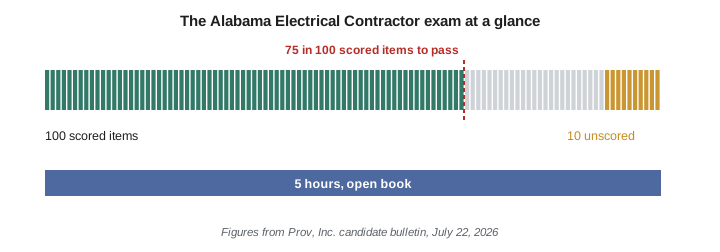
Five hours for 110 questions is a little under two minutes and forty-five seconds per question. That is generous for a question that asks for a definition and tight for a question that needs a load calculation, a table lookup and a correction factor. The pacing plan later in this lesson shows how to use the average without being trapped by it.
The other exams in the bulletin
The same bulletin covers every exam the board uses, and candidates sometimes confuse them. The restricted contractor exam is shorter. The journeyman exam is an installation exam with its own references. The business and law exam is a separate test of Alabama business and legal knowledge, required with the NASCLA route. The NASCLA exams are national exams accepted by Alabama and other states.
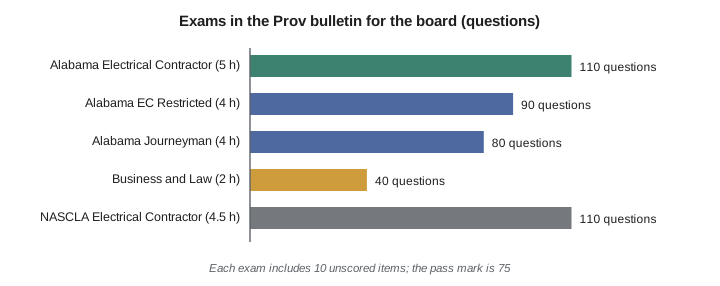
| Exam | Questions | Time | Notes |
|---|---|---|---|
| Alabama Electrical Contractor | 110 | 5 hours | Unlimited contractor credential |
| Alabama Electrical Contractor, restricted | 90 | 4 hours | Narrower credential; check its scope |
| Alabama Journeyman | 80 | 4 hours | Installation exam |
| Business and Law | 40 | 2 hours | Fee paid to Prov; required with the NASCLA route |
| NASCLA Electrical Contractor | 110 | 4.5 hours | National exam accepted by Alabama |
| NASCLA journey-level | 110 | 5 hours | National journeyman-level exam |
The references
The bulletin lists the references for the contractor exam. They are the National Electrical Code, NFPA 70, 2023 edition; the American Electrician's Handbook, seventeenth edition; the NASCLA Contractors Guide to Business, Law and Project Management, with the thirteenth or fourteenth edition listed; and the Alabama supplement to the contractors guide, dated 2014. The bulletin states that older or newer editions are permitted. That flexibility helps a candidate who already owns a recent book, but the questions are written from the editions listed, so a candidate using a different edition should be ready for section numbers or wording that differ from the book on the desk.
Each reference has a job. The NEC answers installation questions: conductor sizing, overcurrent protection, grounding and bonding, wiring methods, special occupancies and the many tables used in calculations. The American Electrician's Handbook explains practice and theory, such as motor data, transformer connections, lighting and the arithmetic behind voltage drop and power factor. The NASCLA contractors guide covers business management, estimating, contracts, insurance, employment law, taxes and project management. The Alabama supplement covers state-specific law, such as licensing, liens and workers' compensation as they stood when it was written. Because the supplement is dated 2014, check any Alabama figure in it against current law in this course, but remember that the exam may still be written from it.
| Reference | What it is used for on the exam |
|---|---|
| NFPA 70, National Electrical Code, 2023 | Installation rules, tables, calculations and definitions |
| American Electrician's Handbook, 17th edition | Theory, practice, motors, transformers and field arithmetic |
| NASCLA Contractors Guide to Business, Law and Project Management | Business management, contracts, insurance, labor law and finance |
| Alabama supplement to the contractors guide (2014) | Alabama licensing, liens, workers' compensation and business rules |
How books may be marked
The bulletin allows permanent tabs and highlighting in the references. It does not allow handwritten notes, loose papers or photocopied pages. Removable sticky notes, taped-in charts and notes written on tabs can lead a proctor to refuse the book. The rule is strict because the exam is about using the references, not bringing a private study guide into the room. A candidate whose book is refused takes the exam without it, which on an NEC-heavy exam is nearly fatal to the score.
Monique's tab plan used permanent adhesive tabs printed with article numbers and short subject names, such as 220 Calculations, 250 Grounding, 310 Ampacity and 430 Motors. She used one color for the NEC chapters, another for the most-used tables, a third for the handbook's motor and transformer sections, and a fourth for the business guide's chapters on liens, insurance, payroll and contracts. She highlighted only the key phrases in sections she had trouble finding quickly. Tabs that are too many or too long stop helping, so she limited herself to about sixty in the NEC.
The calculator rule
Only a basic four-function calculator is allowed. Scientific, programmable and graphing calculators, phones and watches with calculators are not. That rule shapes how a candidate studies. Square roots, such as the square root of three used in three-phase calculations, must be carried as a remembered value: 1.732. Powers and fractions must be done with multiplication and division. Practice with the same calculator you will use on exam day, so that its keys and its memory functions are familiar.
# Pacing the 5-hour, 110-question contractor exam (simplified study aid)
total_min = 5 * 60
questions = 110
avg = total_min / questions
print("Average per question:", round(avg, 2), "minutes")

# Two-pass plan: quick items first, lookups and calculations second
first_pass = 70 * 1.5          # 70 quick items at 1.5 minutes each
second_pass = 40 * 4.0         # 40 harder items at 4 minutes each
review = total_min - first_pass - second_pass
print("First pass: ", first_pass, "minutes for 70 quick items")
print("Second pass:", second_pass, "minutes for 40 lookups and calculations")
print("Left for review:", review, "minutes")

root3 = 1.732
kva, volts = 75, 208
print("Three-phase current for 75 kVA at 208 V:", round(kva * 1000 / (volts * root3), 1), "A")Average per question: 2.73 minutes First pass: 105.0 minutes for 70 quick items Second pass: 160.0 minutes for 40 lookups and calculations Left for review: 35.0 minutes Three-phase current for 75 kVA at 208 V: 208.2 A
The output shows a workable plan: a quick first pass that answers the items you know, a second pass for lookups and calculations, and about half an hour left for review. It also shows a typical exam calculation done with the remembered value of the square root of three, which is all the basic calculator allows.
What the questions look like
The bulletin's content outline divides the contractor exam into subject areas that cover electrical theory and installation, code calculations and business-related topics. Most questions are multiple choice with four options. Some ask for a rule: the minimum size of a grounding electrode conductor for a service of a given size, for example. Some ask for a number from a table, adjusted for conditions. Some ask about business law: what a lien claimant must do, how payroll taxes work or what a contract clause means. The outline in the current bulletin gives the number of questions in each area; spend study time in proportion to it.
Questions are written to be answered from the references, so a candidate who knows where to look can find nearly any answer. The challenge is time. A candidate who looks up every question from the index will run out of time; a candidate who knows the structure of each book can turn to the right article or chapter in seconds.
Worked problem
Turning a question into a lookup
A practice question asks for the ampacity of a given conductor in a raceway with nine current-carrying conductors at a high ambient temperature. How should a candidate approach it?
Show solution
- Identify the steps: base ampacity from the ampacity table, an adjustment factor for the number of conductors and a correction factor for ambient temperature.
- Turn to the tab for Article 310 and find the base ampacity in the correct temperature column.
- Find the adjustment factor for more than three current-carrying conductors in the same article.
- Find the ambient temperature correction factor in the same area.
- Multiply the base ampacity by both factors and compare the result to the answer choices.
Answer: Break the question into lookups, use the Article 310 tab for each, multiply and then choose the closest answer; practice until this takes under four minutes.
Mark and move
The testing software allows candidates to mark a question for review and return to it. Use that feature. If a question will take more than a few minutes, make your best guess, mark it and move on. There is no penalty for a wrong answer, so never leave a question blank. At the end of the first pass, return to marked questions in order. In the last ten minutes, make sure every question has an answer.
Studying the business references
Many electricians prepare thoroughly for the code questions and lose the exam on business and law. The NASCLA contractors guide is a long book about running a construction company: forms of business organization, accounting basics, financial statements, estimating and bidding, contract terms, change orders, insurance and bonds, employment law, payroll taxes, safety programs and project scheduling. The Alabama supplement adds state law on top. Unlike the NEC, which Monique had used every day for years, the business guide was new to her. She read it chapter by chapter over three weeks, tabbing the sections that held lists, deadlines and formulas, such as the parts on depreciation, break-even analysis, payroll withholding and lien deadlines.
Business questions are often easier to look up than code questions, because the guide's chapters are organized by topic and its index is straightforward. They are also easier to miss, because a candidate who has never read the chapter may not know the guide contains the answer at all. A candidate who has read the guide once, tabbed it and worked practice questions from it can usually answer business questions in a minute or two each, buying time for the long calculations.
The night before and the morning of
Pack the books, the calculator, the identification and the confirmation the night before. Check the tabs for anything that looks like a note, such as a formula written on a tab or a loose sheet tucked inside a cover, and remove it. Put a spare battery for the calculator in the bag if the testing site allows it, and check the bulletin for what may be brought into the testing room. Eat a real breakfast, because five hours is a long time to think on an empty stomach, and plan the drive with time to spare for traffic on Interstate 65 or wherever your route runs.
At the testing center, follow the proctor's instructions on storing personal items and having books inspected. Take the short tutorial on the testing software seriously, even if it seems obvious, so that marking and reviewing questions feels natural. When the exam starts, write nothing in the books; use the scratch materials the testing center provides, if any, under its rules.
Common mistakes
MistakeBringing a code book with handwritten margin notes.
InsteadThe bulletin allows permanent tabs and highlighting only; handwritten notes, sticky notes and photocopies are not allowed.
MistakeBringing a scientific calculator.
InsteadOnly a basic four-function calculator is allowed.
MistakeSpending five minutes on every question.
InsteadThe average is under three minutes; quick items must be answered quickly to leave time for calculations.
MistakeIgnoring the business references.
InsteadThe contractor exam includes business and law content from the NASCLA guide and the Alabama supplement.
MistakeTreating the ten unscored items as identifiable.
InsteadUnscored items are mixed in and look like the rest; answer every question as if it counts.
Summary and key terms
- The contractor exam has 110 questions, 100 scored and 10 unscored, in five hours, with a passing score of 75.
- The references are the 2023 NEC, the American Electrician's Handbook, the NASCLA contractors guide and the Alabama supplement; other editions are permitted.
- Books may have permanent tabs and highlighting, but no handwritten notes, sticky notes or photocopies.
- Only a basic four-function calculator is allowed, so remember 1.732 for three-phase work.
- Pacing averages under three minutes per question; a two-pass plan leaves time for review.
- The bulletin also covers the restricted, journeyman, business and law and NASCLA exams.
- Unscored item
- A trial question mixed into the exam that does not count toward the score.
- Permanent tab
- A tab fixed to a page that marks a section without adding notes.
- Four-function calculator
- A calculator limited to addition, subtraction, multiplication and division.
- Two-pass method
- Answering quick items first, then returning to lookups and calculations.
- Content outline
- The bulletin's list of subject areas and question counts for each exam.
Practice problems
Work each problem on paper first, then reveal the answer to check.
How many questions on the contractor exam are scored?
Show answer
100 of the 110.
What is the time limit for the contractor exam?
Show answer
Five hours.
May a candidate write notes on tabs?
Show answer
No. Tabs must be permanent and handwritten notes are not allowed.
What value is used for the square root of three on exam day?
Show answer
1.732, since only a four-function calculator is allowed.
Lesson quiz · 5 questions
Score 60% or more to complete this lesson.
Create a free account to save your progress, take quizzes and earn a certificate.