
MELU-201 · Lesson 11 of 12 · 19 min
Renewal and continuing education
▶ Video coming soon A video version of this lesson is on the way.
In October Beth Ann sat down with Monique to set up the company's license calendar for the coming year. Monique's contractor certificate had been issued in June, so its renewal fell in the quarter the rules tie to that issue date. Earl's certificate, which he planned to keep in inactive status for a while after retiring, had its own date. The company's six journeymen each had a journeyman certificate with its own renewal date. Caleb would soon apply for his journeyman exam. "Every one of these expires on a different day," Beth Ann said, "and none of them send me a text." Monique opened the board's rules on continuing education and started reading.
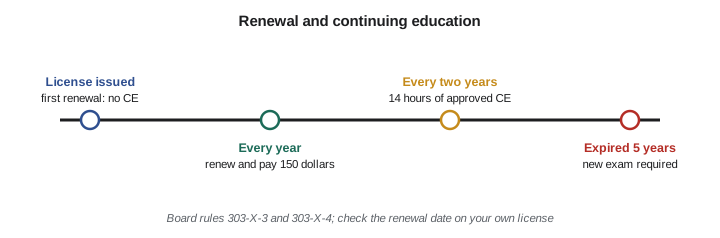
A license is not permanent. Alabama electrical contractor and journeyman certificates renew every year, and contractors must complete continuing education every two years. This lesson covers the renewal cycle, the continuing education requirement and its rules, inactive status, expiration and reinstatement, and how to build a renewal system for a company with several licensees.
Annual renewal
The board's rules make electrical contractor and journeyman certificates renewable annually. The renewal date is tied to the quarter of the year in which the certificate was first issued: a certificate must be renewed before the last day of that quarter each year. A certificate expires at 11:59 pm on its expiration date if it has not been renewed. The fee schedule effective January 2026 sets the annual renewal fee at 150 dollars for an electrical contractor and 35 dollars for a journeyman. Renewal is usually done online through the board's licensing system, with continuing education records checked as part of the process for contractors.
A certificate that is not renewed on time cannot be used. A contractor who keeps working after expiration is contracting without a license, and a company whose person in responsible charge has an expired license is in the same position as a company with no licensee at all. Late renewal is possible within limits, with restoration fees, but the work done in between is still unlicensed. Renew early.
Continuing education for contractors
The board's rules in Chapter 303-X-4 require electrical contractors to complete 14 hours of approved continuing education every two years. Journeymen are not required to complete continuing education for renewal. The board approves the providers and courses that count, and a provider must be approved, with its own fee, before its courses are accepted. An hour of continuing education is at least 50 minutes of instruction. A licensee may not repeat the same course within the same period and count it twice.
Contractors may carry over up to 7 hours completed beyond the requirement into the next two-year period. The first renewal year after a contractor is first licensed is exempt from the requirement, so a newly licensed contractor does not need continuing education for the first renewal. After that, the 14-hour requirement applies in each two-year period. The board's rules and its website explain which years the periods cover; many sources describe them as ending in odd-numbered years, but confirm the dates that apply to your own license with the board.
| Rule | Requirement |
|---|---|
| Who must complete continuing education | Electrical contractors; journeymen are not required to |
| Hours required | 14 hours every two years |
| Length of an hour | At least 50 minutes of instruction |
| Carryover | Up to 7 hours into the next period |
| Repeating a course | Not counted twice in the same period |
| First renewal year | Exempt |
| Providers | Approved by the board |
Choosing courses
Approved courses usually cover the NEC and its changes, electrical safety, business and law topics and specialty topics such as solar, generators or fire alarm systems. A contractor who works across many jurisdictions benefits from a code-change course each time a major city adopts a new edition. A contractor whose company is growing may get more value from business courses on estimating, contracts and project management. Keep certificates of completion for every course, even if the provider reports hours to the board, because the board may audit and ask for proof.
Monique's first renewal is exempt, but she plans to take a code-change course in her first full period anyway, because several of the cities where Cahaba River works are expected to adopt the 2023 NEC. Taking it early will help her train the foremen, and up to 7 of any extra hours can carry over.
# Tracking contractor continuing education across periods (simplified study aid)
REQUIRED = 14
CARRY_MAX = 7

def period(hours_taken, carried_in):
    total = hours_taken + carried_in
    met = total >= REQUIRED
    carry_out = min(max(total - REQUIRED, 0), CARRY_MAX)
    return total, met, carry_out

carry = 0
for name, taken in [("Period 1", 20), ("Period 2", 9), ("Period 3", 10)]:
    total, met, carry_next = period(taken, carry)
    print(name, "taken:", taken, "carried in:", carry, "total:", total,
          "met:", met, "carry out:", carry_next)
carry = carry_nextPeriod 1 taken: 20 carried in: 0 total: 20 met: True carry out: 6 Period 2 taken: 9 carried in: 6 total: 15 met: True carry out: 1 Period 3 taken: 10 carried in: 1 total: 11 met: False carry out: 0
The output shows the carryover at work. Twenty hours in the first period meets the requirement and carries 6 hours forward. In the second period, 9 new hours plus 6 carried in makes 15, which meets the requirement and carries 1 forward. In the third, 10 new hours plus 1 carried in is only 11, so the licensee is short and must take more before renewal.
Continuing education as a business tool
Continuing education is often treated as a box to check, but for a contractor it can pay for itself. Code-change courses help a company bid and install correctly when a city adopts a new edition. Business courses on estimating, cash flow and contracts can improve margins more than any single job. Safety courses on NFPA 70E and fall protection support the company's safety program and can reduce insurance costs over time. Monique asks each foreman to pick one course a year from the board's approved list, even though journeymen are not required to take any, and the company pays for it. She takes the same code-change course as her foremen so they share a common understanding of the new rules.
Choosing approved courses matters. A course from a provider that is not approved by the board does not count toward the 14 hours, no matter how good it is. Before registering, confirm that the provider and the course are approved and that the hours will be reported or documented in the way the board requires. Online and classroom courses can both qualify if they are approved, but each hour must still be at least 50 minutes of instruction.
Changes the board must hear about
Renewal is also the moment to confirm that the board has current information: home and business addresses, email, the company for which the licensee is the person in responsible charge and any changes in legal name. Some changes must be reported promptly, not only at renewal, such as a separation of the person in responsible charge, which requires notice within five days, as Lesson 7 explained. A licensee who moves and does not update the address may miss renewal notices and audit requests, and failing to respond to an audit is itself a problem.
Inactive status
A licensee who is not working in the trade may be able to place a certificate in inactive status instead of letting it expire. The fee schedule sets an inactive fee of 75 dollars for an electrical contractor and 15 dollars for a journeyman. An inactive licensee may not contract or work under the certificate, and must meet the board's requirements, which may include continuing education, to return to active status. Earl chose inactive status after retiring so that he could return to consulting work later without retaking the exam.
Expiration, restoration and reinstatement
A certificate that expires can be restored or reinstated within limits. The fee schedule includes a restoration fee of 50 dollars for each year the certificate was expired, along with the renewal fees that were missed. A contractor reinstating an expired certificate must also make up continuing education, up to a maximum set in the rules, which can reach 35 hours. A certificate that has been expired for five years, which the rules count as 1,825 days, cannot be reinstated; the person must reapply and pass the prelicensure exam again.
| Status | What it means | To return |
|---|---|---|
| Active | May work or contract under the certificate | Renew each year |
| Inactive | May not work or contract under the certificate | Meet board requirements and pay fees |
| Expired under five years | May not work or contract | Restoration fees, missed renewals and continuing education |
| Expired five years or more | Cannot be reinstated | Reapply and pass the exam again |
Audits
The board may audit continuing education records. An audited licensee must produce certificates of completion or other proof for the courses claimed. Hours that cannot be documented do not count, and a licensee who certified completion on a renewal without having done the hours faces discipline in addition to making up the hours. The simplest protection is to save every certificate in one folder, paper or digital, labeled by period, the day it is received.
Journeymen and the company's renewals
Although journeymen have no continuing education requirement, their certificates still renew every year, and a company that sends a journeyman with an expired certificate to a job is using an unlicensed worker. Each journeyman is responsible for renewing his or her own certificate, but a careful contractor checks. Beth Ann asks every journeyman for a copy of the renewed certificate each year and records the new expiration date. When Caleb passes his journeyman exam, his certificate will join the calendar with its own renewal quarter.
The same habit applies to the contractor certificate itself. Monique renews early in her renewal quarter rather than on the last day, so that a payment problem, a login problem or a question from the board office does not push the company past the 11:59 pm deadline.
A company renewal system
A company with several licensees needs a system. Beth Ann's spreadsheet lists every licensee, the certificate type and number, the issue quarter and the next renewal date, the continuing education period and hours completed, and any carryover. A reminder goes out ninety days before each renewal and again at sixty and thirty days. The person in responsible charge's certificate gets extra attention, because if it lapses the whole company stops contracting. Local business licenses, insurance and the company's other compliance dates sit on the same calendar, as Lesson 8 described.
The system also supports the board's records rule. If the board audits Monique's continuing education, Beth Ann can produce the certificates of completion from the company's files in minutes.
Worked problem
Planning a renewal
A contractor first licensed in June 2026 will renew in 2027 and every year after. He takes 18 hours of approved continuing education in 2027 and 2028. How should he think about his requirements?
Show solution
- His first renewal year is exempt, so continuing education is not required for that renewal.
- After that, he needs 14 hours in each two-year period, with each hour at least 50 minutes.
- If the 18 hours fall in a single two-year period, 14 meet the requirement and up to 4 carry over.
- He must not count a repeated course twice in the same period.
- He should keep certificates of completion and renew each year before the last day of his renewal quarter.
Answer: His first renewal is exempt; after that he needs 14 hours per two-year period, with extra hours carrying over up to 7, and he renews annually.
Common mistakes
MistakeAssuming journeymen need continuing education to renew.
InsteadThe board's continuing education requirement applies to electrical contractors, not journeymen.
MistakeRenewing every two years because continuing education runs on a two-year period.
InsteadCertificates renew every year; continuing education is measured over two years.
MistakeCounting a 30-minute webinar as one hour.
InsteadAn hour of continuing education is at least 50 minutes of instruction.
MistakeCarrying over every extra hour.
InsteadOnly up to 7 hours carry over into the next period.
MistakeLetting a certificate stay expired for years and expecting to reinstate it.
InsteadAfter five years of expiration, the person must pass the exam again.
Summary and key terms
- Electrical contractor and journeyman certificates renew every year, before the last day of the quarter tied to the issue date.
- Renewal costs 150 dollars for a contractor and 35 dollars for a journeyman under the 2026 schedule.
- Contractors complete 14 hours of approved continuing education every two years; journeymen do not need continuing education.
- Hours are at least 50 minutes, repeated courses do not count twice, up to 7 hours carry over and the first renewal year is exempt.
- Inactive status preserves a certificate for a licensee not working in the trade.
- An expired certificate can be restored within five years with fees and continuing education; after that, the exam must be retaken.
- Renewal quarter
- The quarter of the year tied to a certificate's original issue date, in which it renews.
- Carryover
- Extra continuing education hours, up to 7, applied to the next period.
- Inactive status
- A status that keeps a certificate without allowing work under it.
- Restoration
- Returning an expired certificate to active status with fees and continuing education.
- Approved provider
- A continuing education provider approved by the board.
Practice problems
Work each problem on paper first, then reveal the answer to check.
How often do Alabama electrical contractor certificates renew?
Show answer
Every year.
How many continuing education hours does a contractor need?
Show answer
14 hours every two years.
Do journeymen need continuing education to renew?
Show answer
No.
How long can a certificate be expired before the exam must be retaken?
Show answer
Five years.
Lesson quiz · 5 questions
Score 60% or more to complete this lesson.
Create a free account to save your progress, take quizzes and earn a certificate.