
MELU-201 · Lesson 2 of 12 · 19 min
Eligibility for the Electrical Contractor License
▶ Video coming soon A video version of this lesson is on the way.
Monique spent the first Saturday of March at her kitchen table with a stack of old pay stubs, three years of W-2 forms from Cahaba River, a binder from her apprenticeship program and the board's application for the electrical contractor exam. Earl had told her the hard part was not the exam itself. "The board wants to see that you have run work, not just done it," he said. "Your affidavit has to show the jobs where you laid out the work, ordered the material, scheduled the crew and answered to the inspector. Write it like the board has never heard of you." Beth Ann Pruitt, the company's office manager, had already printed a list of every job Monique had foremanned since 2019, with addresses, permit numbers and dates.
Eligibility is the first gate. A candidate who applies without enough documented, qualifying experience is turned away before the exam, and the fee and months of waiting are lost. This lesson covers the experience requirement for the Alabama electrical contractor exam, the substitutes the board allows for education and apprenticeship, the affidavit and proof the board asks for, and the other routes and requirements that can affect an application.
The experience requirement
The board's rules for the electrical contractor exam, in rule 303-X-3-.02, require 8,000 hours of experience, which the rules equate with four years of full-time work. The experience must be in the design, planning, layout and direct supervision of electrical work. That wording matters. Hours spent only installing, however skilled, are the foundation for the journeyman certificate. Hours that count toward the contractor exam show that the candidate decided how the work would be done and was responsible for seeing it done correctly. The rules and the application accept experience as a journeyman who was in charge of jobs, which is how most candidates qualify: a foreman or lead journeyman running crews for a licensed contractor builds exactly the experience the rule describes.
The application asks for four years of experience within the past eight years. A candidate who ran jobs from 2005 to 2009, then left the trade until 2024, would not meet that window, even though the total hours might be enough. The window keeps the experience recent enough to reflect current practice. A candidate whose experience is spread over several employers can combine it, as long as each employer's portion is documented.
Education and apprenticeship credit
The rules allow education and apprenticeship to substitute for part of the experience. Each year of approved electrical education or registered apprenticeship can count as 1,000 hours, up to a maximum of 2,000 hours. A long-term certificate in electrical technology from an Alabama community college can count as 2,000 hours. The cap means that at least 6,000 hours must come from documented work experience, no matter how much schooling a candidate has. The credit is for formal programs with records, not for weekend seminars or manufacturer training, and the board decides how a given program is counted.
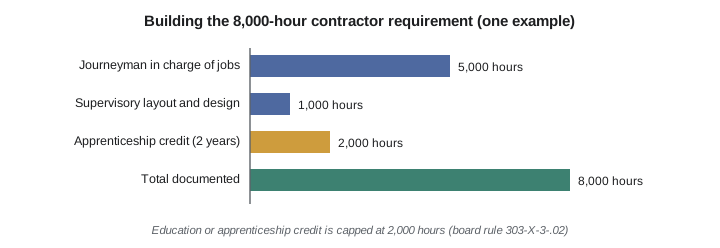
Monique's case is typical. Her four-year registered apprenticeship can supply the maximum 2,000 hours of credit. Since 2019 she has run crews as a foreman, which gives her well over 6,000 hours of documented supervisory work within the past eight years. She could likely qualify on her supervisory experience alone, but listing the apprenticeship credit gives the board a second support if any of her job descriptions are questioned.
| Source of hours | How it counts | Limit |
|---|---|---|
| Supervisory experience as a journeyman in charge of jobs | Hour for hour, documented by affidavit and payroll | No upper limit; must fall within the window |
| Design, planning and layout under a licensed contractor | Hour for hour, documented by affidavit | Same window |
| Approved electrical education | 1,000 hours per year of program | Combined education and apprenticeship credit up to 2,000 hours |
| Registered apprenticeship | 1,000 hours per year of program | Same 2,000-hour combined cap |
| Long-term certificate from an Alabama community college | 2,000 hours | Counts toward the same cap |
| Sales, marketing or estimating alone | Does not count | Not qualifying |
The affidavit of experience
The application includes an experience affidavit form that the candidate and a qualified signer complete and have notarized. The affidavit lists the employer, the dates of employment and the job duties performed. The board's form asks the signer to confirm at least four of the listed duties for each period claimed, such as designing systems, planning and laying out installations, directing and supervising electricians, coordinating with inspectors and ordering material. The form also states that sales, marketing and estimating, by themselves, do not count. A candidate who spent two years mostly estimating for a contractor cannot claim those years as supervisory experience, even if the work was valuable.
Not everyone can sign the affidavit. The application requires the signer to be a licensed electrical contractor, an electrical inspector, a building inspector or an electrical project manager with knowledge of the candidate's work. For Monique, Earl is the obvious signer, as the licensed contractor she has worked under for her whole career. A candidate whose former employer has closed or retired can look for another qualified person who directly observed the work, such as an inspector who inspected the candidate's jobs. A registered apprenticeship program's affidavit is an alternative for the apprenticeship portion.
The board also asks for proof of full-time employment for the years claimed, usually W-2 forms, or 1099 forms for a candidate who worked as an independent subcontractor under a licensed contractor. Payroll proof keeps the affidavit honest: a candidate who claims four years of full-time supervision but can show only part-time wages for two of those years will be asked to explain. Beth Ann pulled Monique's W-2 forms from the company's payroll service in an afternoon, but candidates who worked for several small companies sometimes need months to gather them, so this is a step to start early.
Other application pieces
The contractor exam application packet includes several forms. One lists every employer during the qualifying period. Another is the notarized experience affidavit. A third is a verification of citizenship or lawful presence, which Alabama law requires before a state license is issued. The packet also asks for identifying information, the exam fee and, depending on the candidate's history, explanations of past discipline or criminal convictions. Forms change, so download the current packet from the board's website rather than using a copy saved from a colleague's application a few years ago.
| Packet item | What it shows | Common problem |
|---|---|---|
| Employer list | Every employer during the qualifying years | Gaps between jobs not explained |
| Experience affidavit, notarized | Dates and at least four qualifying duties for each period | Signer is not a licensed contractor or inspector |
| Proof of full-time work | W-2 or 1099 forms for the years claimed | Missing years from closed employers |
| Citizenship or lawful presence form | Eligibility for a state license | Unsigned or missing documents |
| Exam fee | Payment to the board | Wrong amount from an old fee schedule |
A Professional Engineer route
The board's rules also allow a person who holds an Alabama Professional Engineer license to sit for the electrical contractor exam. An engineer who designs electrical systems for a living has a different kind of experience from a foreman, and the rule recognizes it. The engineer still must apply, be approved, pass the exam and meet the other requirements for licensure. Passing the exam is what turns an engineer's design knowledge into a contracting license.
Military applicants
Alabama, like many states, has provisions for service members, veterans and military spouses. The board's rules include a military provision that can waive the exam for qualifying applicants who hold a comparable license or have comparable military training and experience, subject to the board's review. A veteran who worked as an electrician in the service should ask the board office which documents it needs, such as discharge papers and training records, before deciding whether to apply for the waiver or sit for the exam.
Timing the application
The board approves exam applications at its meetings, and the rules require it to examine at least every three months. Applications must be received by 4:30 PM at least ten full working days before the board meeting at which they will be considered. An application that arrives a day late waits for the next meeting. An incomplete application is held, and if it stays incomplete for 12 months it is discarded and the candidate must start again. Once approved, a contractor candidate has one year to pass the exam before the approval expires. Lesson 3 covers the steps from approval to the exam.
# Does a candidate meet the 8,000-hour requirement? (simplified study aid)
CAP = 2000          # combined education and apprenticeship credit
NEEDED = 8000

def qualifies(supervisory_hours, school_years, apprentice_years):
    credit = min(1000 * (school_years + apprentice_years), CAP)
    total = supervisory_hours + credit
    return credit, total, total >= NEEDED

candidates = [("Monique, foreman since 2019", 11200, 0, 4),
              ("Darnell, two years of college", 5400, 2, 0),
              ("Paula, estimator and foreman", 4100, 0, 2)]
for name, hrs, school, app in candidates:
    credit, total, ok = qualifies(hrs, school, app)
    print(name)
print(" credit:", credit, " total:", total, " meets 8,000:", ok)Monique, foreman since 2019 credit: 2000 total: 13200 meets 8,000: True Darnell, two years of college credit: 2000 total: 7400 meets 8,000: False Paula, estimator and foreman credit: 2000 total: 6100 meets 8,000: False
The output shows how the cap works. Monique has more than enough even before credit. Darnell's two years of college add 2,000 hours, which brings him to 7,400, still short. Paula's apprenticeship adds 2,000, bringing her to 6,100, also short, and any of her hours that were only estimating would not count anyway.
Worked problem
Checking an application before it goes in
Caleb Moore, Cahaba River's senior apprentice, asks whether his cousin can apply for the contractor exam. The cousin finished a two-year electrical technology program at a community college, then worked five years for a contractor in Tuscaloosa, the last three as a foreman. His former employer has retired and moved to Florida. What should the cousin check?
Show solution
- Count the foreman years: about 6,000 hours of supervisory experience, within the past eight years.
- Add education credit: two years of program can give up to 2,000 hours, reaching 8,000.
- Confirm the foreman duties meet at least four qualifying items on the affidavit, not just installation.
- Find a qualified signer: the retired contractor if he still holds or held the license and can sign before a notary, or an inspector who knew the work.
- Gather W-2 forms for the five years and the college transcript.
Answer: He may qualify with 6,000 supervisory hours plus 2,000 hours of education credit, if the affidavit is signed by a qualified person and payroll proof supports full-time work.
Character, history and honesty
The application asks about prior discipline, license denials in other states and criminal history. A conviction does not automatically bar a candidate, but leaving it off the application can. The board weighs the nature of the offense, how long ago it happened and whether it relates to the trade. A false affidavit is a more serious problem than a thin one: signing or submitting an affidavit that overstates experience can lead to denial, discipline of the signer's own license and possible criminal charges for false swearing. Earl reminded Monique that the signer puts his own license behind every line of the affidavit.
Reciprocity is a separate path, covered in Lesson 3. A contractor licensed in another state with which the board has an agreement may be able to obtain an Alabama license without the full exam, but must still meet the agreement's terms and the board's requirements, which can include the business and law portion. A candidate from another state who has no reciprocal license applies the same way as an Alabama candidate, with experience from any state counted if it is documented.
Common mistakes
MistakeCounting years of installation work alone as contractor experience.
InsteadThe contractor exam requires experience in design, planning, layout and direct supervision; installation alone supports the journeyman certificate.
MistakeAssuming four years of college can replace four years of experience.
InsteadEducation and apprenticeship credit is capped at 2,000 hours; at least 6,000 hours must be documented experience.
MistakeHaving a coworker sign the experience affidavit.
InsteadThe signer must be a licensed electrical contractor, an electrical inspector, a building inspector or an electrical project manager.
MistakeListing estimating time as supervisory experience.
InsteadThe board's form states that sales, marketing and estimating alone do not count.
MistakeMailing the application the week before a board meeting.
InsteadApplications must arrive at least ten full working days before the meeting, by 4:30 PM.
Summary and key terms
- The contractor exam requires 8,000 hours, or four years, of experience in design, planning, layout and direct supervision of electrical work, within the past eight years.
- Experience as a journeyman in charge of jobs counts.
- Education or registered apprenticeship can substitute 1,000 hours per year, up to 2,000 hours in total.
- The notarized affidavit must show at least four qualifying duties and be signed by a licensed contractor, inspector or electrical project manager.
- Proof of full-time work, the employer list and the lawful presence form complete the packet.
- An Alabama PE license is an alternative route to sit for the exam, and military provisions may waive it.
- Qualifying experience
- Documented hours in design, planning, layout and direct supervision of electrical work.
- Education credit
- Up to 2,000 hours credited for approved electrical education or registered apprenticeship.
- Experience affidavit
- The notarized form in which a qualified signer confirms the candidate's dates and duties.
- Qualified signer
- A licensed electrical contractor, electrical inspector, building inspector or electrical project manager.
- Lawful presence form
- The application form verifying citizenship or lawful presence for a state license.
Practice problems
Work each problem on paper first, then reveal the answer to check.
How many hours of experience does the contractor exam require?
Show answer
8,000 hours, which the rules equate with four years.
What is the most education and apprenticeship credit the board allows?
Show answer
2,000 hours.
Can a candidate count two years spent mostly estimating?
Show answer
No. Sales, marketing and estimating alone do not count.
How long before a board meeting must the application arrive?
Show answer
At least ten full working days, by 4:30 PM.
Lesson quiz · 5 questions
Score 60% or more to complete this lesson.
Create a free account to save your progress, take quizzes and earn a certificate.