
MELU-201 · Lesson 3 of 12 · 19 min
Applying, approval and booking the exam
▶ Video coming soon A video version of this lesson is on the way.
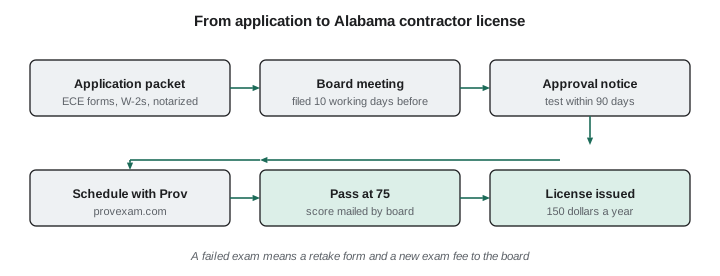
Monique's application went into a priority mail envelope on the last Monday of March, two and a half weeks before the board's April meeting. Beth Ann had checked the board's meeting calendar, counted ten full working days back from the meeting date and added a week for safety. Earl signed the affidavit in front of a notary at the bank on Highway 31, and Monique attached copies of her W-2 forms for 2019 through 2025, her apprenticeship completion certificate and the lawful presence form with a copy of her driver's license. The exam fee went in as a check made out to the board. "Now we wait," Earl said. "The board meets, they look at it, and if it's clean you get a letter. Then the clock starts."
This lesson follows an application from the mailbox to the license: how the board reviews and approves applications, what the approval letter means, how to schedule with Prov, what happens on exam day, how scores are reported, what a failed attempt costs and how the license is issued. It also covers the fees in the board's current schedule and the reciprocity and national exam routes.
Board review and approval
The board considers exam applications at its meetings, which the rules require at least every three months. Staff check each packet for completeness before the meeting: the employer list, the notarized affidavit, payroll proof, the lawful presence form and the fee. Complete applications go to the board, which decides whether the experience meets the rule. An application with a question, such as an affidavit that lists only installation duties or a signer whose license cannot be confirmed, may be held for more information. Incomplete applications wait, and after 12 months they are discarded.
When the board approves an application, the office sends the candidate an approval notice with instructions for scheduling. The approval is the candidate's permission to test. It is not a license and does not allow the candidate to contract for electrical work. For an electrical contractor candidate the approval lasts one year; if the candidate does not pass within that year, the approval expires and the candidate must reapply. For a journeyman candidate the approval lasts two years.
Scheduling with Prov
The board's exams are given by Prov, Inc. under the candidate information bulletin dated July 22, 2026. The bulletin tells approved candidates to schedule within 90 days of approval. Candidates schedule online at provexam.com/schedule or by phone at 801-733-4455. The bulletin lists the testing locations, the identification required and the rules for rescheduling. A candidate who needs to change an appointment must do so at least three business days before the scheduled date; missing that window or failing to appear can forfeit the exam fee paid for that sitting.
Monique scheduled for a Saturday morning in late May at a testing site in the Birmingham area, which gave her about seven weeks to finish her final review. She chose a morning slot because the contractor exam runs five hours and she wanted to start fresh. She put the confirmation email in a folder with the bulletin, her approval letter and a printed map to the site.
Fees
The board's fee schedule took effect in January 2026 and appears in rule 303-X-3-.10. The exam fees are paid to the board with the application; the separate business and law exam, where required, has a fee paid to Prov. License fees are paid when the license is issued and at each annual renewal. Restoration and inactive status have their own fees, covered in Lesson 11.
| Item | Fee in the 2026 schedule | Paid to |
|---|---|---|
| Electrical contractor exam | 165 dollars | The board, with the application |
| Journeyman exam | 115 dollars | The board, with the application |
| Business and law exam, where required | 86 dollars | Prov |
| Electrical contractor license and each annual renewal | 150 dollars | The board |
| Journeyman license and each annual renewal | 35 dollars | The board |
| Reciprocal contractor license | 315 dollars | The board |
Fees change, and an application sent with an old fee amount is returned or held. Before mailing a packet, confirm the current amount on the board's website. A card payment may carry a processing charge.
Exam day
The bulletin requires a current government-issued photo identification that matches the name on the approval. Candidates should arrive early enough to check in, store personal items and have their reference books inspected. The contractor exam is open book with specific references, and the bulletin limits how those books may be marked: permanent tabs and highlighting are allowed, but handwritten notes, loose papers and photocopied pages are not. Only a basic four-function calculator is allowed. Lesson 4 covers the format and references in detail.
Proctors inspect books at check-in. A book with handwritten notes in the margins, or with removable sticky notes, can be refused, leaving the candidate without that reference for the whole exam. Monique bought new copies of the references for the exam rather than bringing the marked-up code book she had used on job sites for ten years.
Scores and retakes
Prov reports results to the board, and the board mails the official score to the candidate. The passing score is 75 out of 100 scored questions; ten additional unscored questions on each exam are used to test new items and do not count. A candidate who fails receives information about the areas of weakness. To try again, the candidate submits the board's retake form with a new exam fee, and in some cases reapplies, then schedules again with Prov. Each attempt must fall within the one-year approval period for a contractor candidate.
# Key dates after an approval notice (simplified study aid)
from datetime import date, timedelta

approved = date(2026, 4, 14)
schedule_by = approved + timedelta(days=90)
approval_ends = date(approved.year + 1, approved.month, approved.day)
exam_day = date(2026, 5, 30)
latest_reschedule = exam_day - timedelta(days=5)   # three business days before a Saturday

print("Approval notice:      ", approved)
print("Test within 90 days:  ", schedule_by)
days = ["Monday", "Tuesday", "Wednesday", "Thursday", "Friday", "Saturday", "Sunday"]
print("Exam scheduled for:   ", exam_day, "(a " + days[exam_day.weekday()] + ")")
print("Reschedule by about:  ", latest_reschedule, "(three business days ahead)")
print("Approval expires: ", approval_ends)Approval notice: 2026-04-14 Test within 90 days: 2026-07-13 Exam scheduled for: 2026-05-30 (a Saturday) Reschedule by about: 2026-05-25 (three business days ahead) Approval expires: 2027-04-14
The output shows why candidates keep a calendar. The 90-day scheduling window, the three-business-day reschedule rule and the one-year approval period all run from different dates. Counting business days backward from a Saturday exam reaches the previous Monday or Tuesday, depending on how the testing company counts, so it is safest to change plans a full week ahead.
License issuance
After the board receives a passing score, the candidate completes any remaining forms and pays the license fee, and the board issues the certificate. For a candidate who will be the person in responsible charge of a company, the company's information is filed with the board at the same time or shortly after. The board's rules require the license to be displayed at the principal place of business. The license number goes on bids, contracts, advertising and permit applications as local rules require.
For Monique, issuance is also the start of Cahaba River's transition. Earl's retirement date, the board notice naming Monique as the person in responsible charge and the updates to the company's local business licenses and insurance certificates all have to line up. Lesson 7 covers that sequence.
Reciprocity and national exams
The board has reciprocity agreements with several other states, and the list changes as agreements are signed or end. A contractor licensed in a state with an agreement may apply for a reciprocal Alabama license, which carries its own fee, instead of sitting for the full Alabama exam. Each agreement has its own terms, such as how long the applicant must have held the other state's license and whether the original license was earned by exam. Check the current list on the board's website before relying on an agreement, because a state listed last year may no longer be included.
The Prov bulletin also lists the NASCLA Accredited Examination for Electrical Contractors, a national exam accepted by several states, including Alabama. A candidate who takes the NASCLA exam for Alabama must also pass the separate Alabama business and law exam, which covers Alabama-specific law and business practice. A candidate who expects to work in several states may find the NASCLA route useful, but should confirm which states accept it and on what terms.
Worked problem
Planning around the approval year
A candidate is approved on June 2, 2026. She schedules her contractor exam for August 15, fails by four points and wants to retake it. Her employer wants her licensed before a large job begins the following May. What should she watch?
Show solution
- Her approval lasts one year, until about June 2, 2027.
- She must submit the retake form and a new exam fee, then schedule again.
- If she fails again, she must pass on a later attempt before June 2, 2027, or reapply.
- After passing, the score goes to the board by mail, and she must pay the license fee before the certificate issues.
- Allowing several weeks for scoring and issuance, she should aim to pass by early spring.
Answer: She has until about June 2, 2027, to pass; to be licensed before May she should retake in the fall and leave time for scoring and issuance.
Testing accommodations
Candidates with a documented disability may request testing accommodations under the Americans with Disabilities Act, such as extra time, a separate room or a reader. The bulletin explains how to request them and what documentation is needed. Requests take time to review, so a candidate who needs an accommodation should ask well before scheduling rather than at check-in. An accommodation changes how the exam is given, not what it covers or the score needed to pass.
Keeping the paperwork in one place
Most delays in this process are paperwork delays. A missing page, an unsigned form or a check for the wrong amount sends the packet back or holds it for another meeting, and each meeting missed can add up to three months. Beth Ann keeps a single folder for each licensing candidate at Cahaba River with a checklist on the front: the current application packet downloaded on the date it is used, copies of every page sent, the tracking number for the envelope, the board meeting date, the approval notice, the Prov confirmation and the final score letter. When the board office calls with a question, she can answer it in minutes. When a future candidate at the company applies, the folder shows exactly what worked.
The same folder habit helps after licensure. The certificate number, issue date and renewal quarter go into the company's renewal calendar, along with the continuing education requirement that starts after the first renewal. Lesson 11 builds that calendar in detail. A candidate who treats the application as the first entry in a long compliance record, rather than a one-time hurdle, finds every later step easier.
If the board asks questions
Sometimes the board or its staff ask for more before approving an application. Common requests are a clearer description of supervisory duties, proof of employment for a year that has no W-2, a corrected notary block or confirmation that the signer was licensed during the period claimed. A candidate who receives a request should answer it completely and quickly, in writing, and keep a copy. Arguing that the request is unnecessary rarely helps; providing the document usually does. If the board denies an application, the denial letter explains the reason, and the candidate can gather more experience or documentation and apply again, or ask about the board's process for reconsideration.
Common mistakes
MistakeTreating the approval notice as permission to contract.
InsteadApproval allows the candidate to test; only the issued certificate allows contracting.
MistakeWaiting several months to schedule after approval.
InsteadThe bulletin tells candidates to schedule within 90 days of approval.
MistakeBringing a code book with handwritten margin notes.
InsteadOnly permanent tabs and highlighting are allowed; handwritten notes and photocopies are not.
MistakeRescheduling the day before the exam.
InsteadChanges must be made at least three business days before the appointment.
MistakeAssuming reciprocity covers every neighboring state.
InsteadAgreements change; check the board's current list and terms.
Summary and key terms
- The board reviews complete applications at its meetings and sends an approval notice to qualified candidates.
- A contractor candidate's approval lasts one year; a journeyman candidate's lasts two years.
- Prov runs the exams under the July 22, 2026 bulletin; schedule within 90 days and reschedule at least three business days ahead.
- Fees in the 2026 schedule include 165 dollars for the contractor exam and 150 dollars for the license and each renewal.
- The pass mark is 75 out of 100 scored questions; the board mails the score, and a retake needs a form and a new fee.
- Reciprocal licenses and the NASCLA exam, with the Alabama business and law exam, are alternative routes.
- Approval notice
- The board's letter allowing a candidate to schedule the exam.
- Candidate information bulletin
- Prov's document with exam content, references, scheduling and test-day rules.
- Retake form
- The board form a failing candidate files with a new fee to test again.
- Reciprocal license
- An Alabama license issued under an agreement with another state's licensing agency.
- NASCLA exam
- A national electrical contractor exam that Alabama accepts with its business and law exam.
Practice problems
Work each problem on paper first, then reveal the answer to check.
How soon after approval should a candidate schedule the exam?
Show answer
Within 90 days, according to the bulletin.
How long does a contractor candidate's approval last?
Show answer
One year.
Who reports the official score to the candidate?
Show answer
The board, by mail, after Prov sends the results.
What else must a NASCLA exam candidate pass for Alabama?
Show answer
The Alabama business and law exam.
Lesson quiz · 5 questions
Score 60% or more to complete this lesson.
Create a free account to save your progress, take quizzes and earn a certificate.