
MELU-201 · Lesson 8 of 12 · 19 min
Contractor licensing, insurance and bonding
▶ Video coming soon A video version of this lesson is on the way.
In July a property manager for a regional grocery chain called Cahaba River about a remodel at a store in Montgomery. Before she would send the bid documents, she asked for four things: a copy of the state electrical contractor license, the company's Montgomery business license, a certificate of insurance naming the chain as additional insured with general liability limits of at least one million dollars per occurrence and two million in aggregate, and proof of workers' compensation coverage. The bid package added a fifth: a bid bond, with performance and payment bonds for the winning bidder. Beth Ann had most of it in a folder. The bonds she had to order from the company's surety agent, who asked for the company's latest financial statements and a summary of its work in progress. "Licensing gets you in the door," Earl said. "Insurance and bonding keep you in the room."
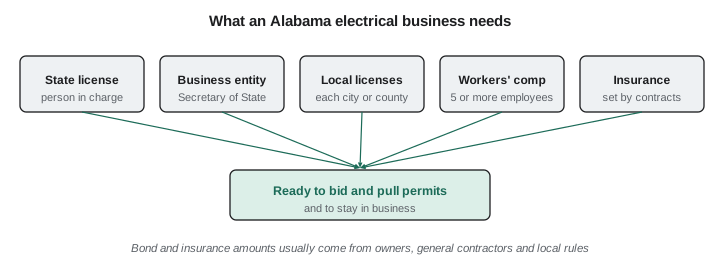
An Alabama electrical contracting business needs more than a state license. It needs a legal business entity, local business licenses in the places it works, tax registrations, workers' compensation coverage when it has enough employees, and the insurance and bonds that owners, general contractors and public agencies require. This lesson covers each of those pieces, how they relate to the state license and how a contractor keeps them current.
The license and the company
The state certificate belongs to a person. A company contracts for electrical work through its person in responsible charge, the licensed individual on file with the board. When Monique became the person in responsible charge, Cahaba River's paperwork with the board changed, but the company itself, an Alabama limited liability company, did not. A company that changes its name, its entity type or its ownership should check the board's forms, because some changes require a new filing or a new appearance before the board. A licensee who wants to serve as the person in responsible charge for a second company must appear before the board first.
Business entity and registrations
Most electrical contractors operate as limited liability companies or corporations registered with the Alabama Secretary of State, although sole proprietorships and partnerships are also possible. The entity choice affects liability, taxes and how ownership changes are handled, and it is a decision for the owners with their accountant and lawyer. A registered entity must keep its filings current with the Secretary of State and must file state business tax returns as required by the Alabama Department of Revenue. A company with employees registers for state income tax withholding and for state unemployment compensation through the Alabama Department of Labor, and obtains a federal employer identification number.
Local business licenses
Alabama cities and many counties require a business license from any business that works within their limits, and the electrical statute makes the local business license part of the condition for a state certificate holder to work statewide. Each city sets its own rules and fees; many base the fee on gross receipts from work in the city. A contractor that works in many places may need many business licenses, each renewed on its own schedule, often at the start of the calendar year. Some cities also ask for proof of the state electrical license and proof of insurance before they issue or renew a business license. Missing a renewal can stop permits until it is fixed.
| Item | Who issues or requires it | When it is checked |
|---|---|---|
| State electrical contractor license | The Alabama Electrical Contractors Board | Permits, bids, contracts, business license applications |
| Business entity registration | The Alabama Secretary of State | Contracts, banking, bonding |
| City or county business license | Each city or county where work is done | Permit applications, renewals each year |
| Workers' compensation coverage | Alabama law, for employers with five or more employees | Bids, certificates of insurance, audits |
| General liability insurance | Owners, general contractors and some local governments | Bids and contracts |
| Bid, performance and payment bonds | Public agencies and many private owners | Bid day and contract award |
General contractor licensing
Alabama licenses general contractors through a separate state board under its own law, and that law was amended in 2024. An electrical contractor that bids and performs electrical work under its own license is generally working within its trade. An electrical contractor that takes a prime contract for a larger project and performs or subcontracts work outside the electrical trade, such as framing, roofing or concrete, may need a general contractor license depending on the size and nature of the work. Before signing a contract that includes non-electrical work, check the general contractors board's current rules.
Workers' compensation
Alabama's workers' compensation law requires employers with five or more employees to carry workers' compensation insurance or to qualify as self-insured. The count includes full-time and part-time employees and, for this purpose, corporate officers and LLC members, but not independent contractors. Cahaba River, with fourteen employees, is well over the threshold. A company with fewer than five employees is not required to carry coverage, but many general contractors and owners require it anyway, and an injured worker can still sue an uninsured employer. Lesson 10 covers the injury reporting and claims side. For the business, the key points are that coverage must be in place before the fifth employee is hired and that the premium is based on payroll by job class, audited after each policy year.
Subcontractors are a common trap. A subcontractor without workers' compensation coverage may make the hiring contractor responsible for its workers' injuries under the law's rules on contractors and subcontractors. Cahaba River requires a current certificate of workers' compensation insurance from every subcontractor before work begins and tracks expiration dates.
Liability insurance
The board's license is not tied to a set insurance amount, but most work requires commercial general liability insurance, which covers property damage and bodily injury to others caused by the company's operations and completed work. Owners and general contractors usually set the limits in the contract; one million dollars per occurrence and two million in aggregate is common, with an umbrella or excess policy on larger jobs. Contracts often require the owner or general contractor to be named as an additional insured and require a waiver of subrogation. Commercial auto insurance covers the service vans. Inland marine or tools and equipment coverage protects tools and materials. Professional liability can matter for design-build work.
A certificate of insurance is a summary, not the policy. A careful general contractor reads the additional insured endorsement and checks the dates. A careful electrical contractor reads the contract's insurance clause before bidding, because an unusual requirement, such as primary and noncontributory coverage or a high umbrella limit, can cost money that belongs in the bid.
Bonds
A bond is a three-party promise: the surety guarantees to the owner, the obligee, that the contractor, the principal, will perform. A bid bond guarantees that the winning bidder will sign the contract and furnish the required performance and payment bonds. A performance bond guarantees that the work will be completed according to the contract. A payment bond guarantees that subcontractors, suppliers and workers will be paid. On public projects in Alabama, the public works law requires the prime contractor to furnish bonds, and the payment bond takes the place of a lien, as Lesson 9 explains. Private owners may require bonds as well, especially on larger commercial jobs.
Bonds are not insurance. If the surety pays a claim, it expects the contractor and usually its owners to repay it under an indemnity agreement signed when the bonding line was set up. Sureties set a bonding capacity based on the company's financial statements, work in progress, experience and character. A growing electrical contractor builds bonding capacity by keeping clean books, finishing jobs profitably and working with a good surety agent.
# Comparing insurance and bond needs on three bids (simplified study aid)
bids = [
    ("Grocery remodel, Montgomery", 640000, True, 1000000),
    ("Tenant finish, Hoover", 185000, False, 1000000),
    ("School gym lighting", 410000, True, 2000000),
]
for name, value, bonds, gl in bids:
    print(name)
    print("   contract value:", value, "dollars")
    print("   performance and payment bonds:", "required" if bonds else "not required")
    print("   general liability per occurrence:", gl, "dollars")
bonded = sum(v for _, v, b, _ in bids if b)
print("Total bonded work if all three are won:", bonded, "dollars")Grocery remodel, Montgomery contract value: 640000 dollars performance and payment bonds: required general liability per occurrence: 1000000 dollars Tenant finish, Hoover contract value: 185000 dollars performance and payment bonds: not required general liability per occurrence: 1000000 dollars School gym lighting contract value: 410000 dollars performance and payment bonds: required general liability per occurrence: 2000000 dollars Total bonded work if all three are won: 1050000 dollars
The output shows the kind of check Beth Ann runs before bid day. If the company wins both bonded jobs, its bonded work in progress rises by more than a million dollars, which the surety must approve. The school job's higher liability limit may also need an umbrella policy. Both affect the bid price.
Keeping it all current
Every item in this lesson expires on its own schedule. The state license renews each year in its renewal quarter. City and county business licenses usually renew at the start of the calendar year, though some run on other cycles. Insurance policies renew annually, often on different dates for liability, auto and workers' compensation. Bonds are issued job by job, but the bonding line is reviewed each year with new financial statements. Entity filings and tax returns follow their own calendars. A lapse in any one of them can stop a permit, delay a payment or void a bid.
Beth Ann keeps a compliance calendar for Cahaba River with every expiration date, the office or agent responsible and a reminder sixty days ahead. Each January she checks every city and county where the company expects to work that year and renews or applies for business licenses before the first permit is needed. Each spring the insurance agent and the surety agent receive the prior year's financial statements. Monique reviews the calendar monthly. It is not glamorous work, but it is the difference between a company that is always ready to bid and one that loses jobs to paperwork.
Pricing the business into the bid
Licenses, insurance, bonds and compliance staff are overhead, and overhead must be recovered in the price of every job. The NASCLA business guide, one of the exam references, explains how to calculate overhead and markup and how to price a bid so the company covers its costs and earns a profit. Insurance premiums based on payroll, bond premiums based on contract value and business license fees based on gross receipts all grow with the work, so they are best treated as costs that scale with each job rather than fixed amounts. A contractor who leaves them out of the bid pays for them out of profit.
Worked problem
Preparing a bid package
Cahaba River wants to bid the Montgomery grocery remodel. The bid documents require the state license, a Montgomery business license, general liability limits of one million per occurrence and two million aggregate with additional insured status, workers' compensation, and a bid bond. What should the company do before bid day?
Show solution
- Confirm the state license and the company's person in responsible charge are current with the board.
- Check that the Montgomery business license is current, or apply for it.
- Ask the insurance agent for a certificate naming the chain as additional insured, and confirm the limits and endorsements meet the contract.
- Confirm workers' compensation coverage and its expiration date.
- Request the bid bond from the surety, providing current financial statements and work in progress.
Answer: Assemble the license, local business license, insurance certificate, workers' compensation proof and bid bond, and price any special insurance requirements into the bid.
Common mistakes
MistakeTreating the state license as the only license needed.
InsteadCities and counties require local business licenses, and some work requires a general contractor license.
MistakeWaiting until the fifth employee is hired to look for workers' compensation coverage.
InsteadCoverage must be in place when the company has five or more employees.
MistakeHiring a subcontractor without checking its workers' compensation coverage.
InsteadGet a current certificate before work begins and track its expiration.
MistakeThinking a performance bond protects the contractor.
InsteadA bond protects the owner and claimants; the contractor must repay the surety for claims.
MistakeRelying on a certificate of insurance without reading the contract.
InsteadContract insurance clauses can require endorsements and limits that change the bid.
Summary and key terms
- The state license belongs to a person; the company contracts through its person in responsible charge.
- Businesses register with the Secretary of State and the Department of Revenue, and with the Department of Labor for unemployment compensation when they have employees.
- Each city or county where work is done may require a local business license.
- Workers' compensation is required for employers with five or more employees, counting part-time employees and officers.
- General liability, auto and equipment insurance are usually required by contracts; limits come from owners and general contractors.
- Bid, performance and payment bonds protect owners and claimants, and public projects require them.
- Business license
- A city or county license to do business there, often based on gross receipts.
- Additional insured
- A party added to the contractor's liability policy by endorsement.
- Performance bond
- A surety's guarantee that the contractor will complete the work.
- Payment bond
- A surety's guarantee that subcontractors, suppliers and workers will be paid.
- Bonding capacity
- The amount of bonded work a surety will support for a contractor.
Practice problems
Work each problem on paper first, then reveal the answer to check.
At how many employees does Alabama require workers' compensation coverage?
Show answer
Five or more, counting part-time employees and officers.
Who usually sets general liability limits for a job?
Show answer
The owner or general contractor, in the contract.
What does a payment bond guarantee?
Show answer
That subcontractors, suppliers and workers will be paid.
What must a state license holder have to work in a city?
Show answer
The local building permit and the local business license.
Lesson quiz · 5 questions
Score 60% or more to complete this lesson.
Create a free account to save your progress, take quizzes and earn a certificate.