
MELU-201 · Lesson 1 of 12 · 23 min
How electrical licensing works in Alabama
▶ Video coming soon A video version of this lesson is on the way.
Earl Tate wired his first house in Shelby County in 1986 and founded Cahaba River Electric, LLC, in Pelham in 1998 with one truck, a used trencher and the state electrical contractor certificate he had passed the year before. Twenty-eight years later the company has fourteen electricians and apprentices, six service vans and a small shop off Highway 31. Its work is a steady mix: tenant finishes in strip centers along the Highway 280 corridor, lake houses on Lay Lake, a church addition in Montgomery, service upgrades and generator transfer switches across the south side of Birmingham, and a growing number of poultry houses and farm shops in rural Cullman County. On a wet Tuesday in February, Earl asked his lead journeyman, Monique Harris, to stay after the morning safety meeting. "I turn sixty-five this year," he said. "This company contracts under my license. I am the person in responsible charge on our file with the board. When I step back, Cahaba River needs another licensed electrical contractor who works here and runs the electrical work. I want that to be you." He slid a printout of the board's exam application across the table, along with the candidate bulletin from the testing company.
Monique started as a helper with Cahaba River in 2012, finished a four-year apprenticeship program, earned her state journeyman certificate in 2016 and has run crews as a foreman since 2019. She has already worked through the master-level core courses on the National Electrical Code, load calculations, grounding and bonding, motors and transformers, special occupancies, and business and law. This course applies that preparation to Alabama: who licenses electrical contractors and journeymen, how the contractor exam works and which books are allowed in the room, how the NEC is adopted city by city, how permits and inspections are handled, and the Alabama law on responsibility, contracts, mechanics' liens, workplace safety, workers' compensation and renewal that an electrical contractor needs to know.
The board and its law
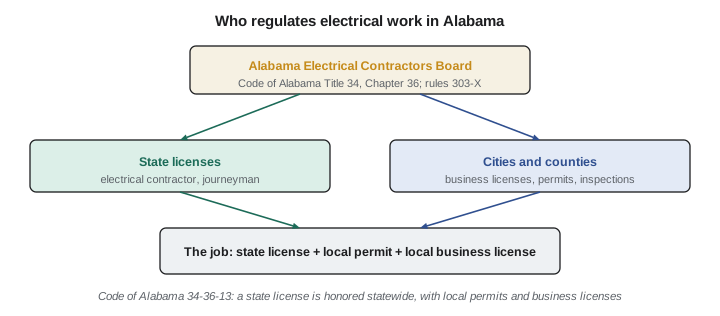
Alabama licenses electrical contractors and journeyman electricians through a single state board. The statute calls it the Alabama Board of Electrical Contractors, and the board's website and staff use the name Alabama Electrical Contractors Board, usually shortened to AECB. The board has an office in Montgomery with a small staff that processes applications, renewals, continuing education records and complaints. The board itself is a group of appointed members, most of them from the electrical trade, that adopts rules, approves applicants to sit for exams, sets fees within the limits of the statute, approves continuing education providers and hears disciplinary cases.
The licensing law is Chapter 36 of Title 34 of the Code of Alabama, written as Code of Alabama 34-36-1 and following sections. The statute defines electrical contracting, creates the board, sets the classes of certificates, authorizes examinations and renewals, lists the exemptions and leaves room for cities and counties to license and inspect locally. The board's rules in Chapter 303-X of the Alabama Administrative Code fill in the details: how experience is documented, what each exam requires, how a company names its person in responsible charge, what the fees are and how continuing education works. The rules were recertified and republished at the end of 2025, with the updated version taking effect in February 2026, and a new fee schedule took effect in January 2026. When you read an older study guide, check its dates against the current rules.
The license types
Alabama's state credentials form a short ladder. A person new to the trade works as a helper or apprentice under the supervision of licensed people; the state does not issue an apprentice license, although a registered apprenticeship program keeps its own records. After 8,000 hours of documented installation experience, or a combination of experience with approved education or apprenticeship credit, a worker can apply to sit for the journeyman exam and receive a state journeyman certificate. A journeyman works for, and under, a licensed electrical contractor. After 8,000 hours of experience in design, planning, layout and direct supervision of electrical work, or the allowed substitutes, a person can apply to sit for the electrical contractor exam. The contractor certificate is the license that allows a person, and the company that person is in responsible charge of, to offer and contract for electrical work.
| Credential | What it allows | Exam |
|---|---|---|
| Helper or apprentice | Electrical work under the supervision of licensed people; no state license | None from the board |
| Journeyman electrician | Electrical installation work while employed by a licensed electrical contractor | Yes, 80 questions through Prov |
| Electrical contractor | Contracting and offering electrical work, unlimited in voltage and bid amount, as the person in responsible charge | Yes, 110 questions through Prov |
| Restricted contractor | A narrower contractor credential described in the board's exam bulletin | Yes, 90 questions through Prov |
The board's rules describe the electrical contractor certificate as unlimited in voltage and in bid requirements. That differs from some states that license contractors by project size or split them into classes by voltage. In Alabama a licensed electrical contractor may bid a small service call or a large commercial project under the same certificate. The board's exam bulletin also lists a restricted contractor exam with fewer questions. Its scope is set in the board's rules and the application, so a candidate interested in it should read the current rules and ask the board office which work it covers before choosing it.
The journeyman certificate is a working license, not a business license. The statute defines a journeyman as a person who does electrical work while working for a licensed master or state-certified electrical contractor. A journeyman cannot use the journeyman certificate to contract directly with an owner, to advertise electrical services in his or her own name or, in most places, to obtain permits. That distinction comes up on the exam and on job sites: a homeowner who hires a journeyman directly for a weekend job is hiring someone who is not allowed to contract for that work.
The person in responsible charge
An Alabama electrical contracting company does business through a licensed individual. The board's rules define a person in responsible charge, the licensed electrical contractor whose certificate the company relies on and who is responsible for the electrical work the company does. Earl holds that role for Cahaba River today. When he leaves, the rules require the company to notify the board within five days and to stop contracting for new electrical work until a replacement is approved. If the person in responsible charge dies or becomes incapacitated, the board can issue an emergency certification for a limited time, no more than 90 days, so the company can finish work while it qualifies a replacement. Lesson 7 covers these duties in detail, and Lesson 8 covers how the company itself is organized.
Statewide license, local permits
Code of Alabama 34-36-13 leaves room for local government. Counties and municipalities may license electrical contractors and may require their own examination. The statute also says that a person holding a state certificate may work in any county or municipality in Alabama, provided the person obtains the local building permit and the local business license that the county or municipality requires. In practice, that means Monique's future state certificate will let Cahaba River work in Pelham, Birmingham, Montgomery and Cullman County without passing a separate city exam for each, as long as the company pulls each job's permit and keeps its business licenses current in each place it works.
Each city or county may also set its own electrical code edition, permit fees and inspection program. Some larger cities run full electrical inspection departments with their own staff. Some counties inspect in unincorporated areas; others do not inspect private work at all outside city limits. Lessons 5 and 6 explain how to find out which code and which inspector apply at a given address. For now, the core idea is simple: the state decides who may do and contract for electrical work, and local government decides how each job is permitted and inspected.
Exemptions
The statute lists work that does not require a state electrical certificate. The list includes work by electric utilities on their own systems, cable television and similar communications work, work by property owners and their regular employees on their own property, work at 25 volts or less, servicing of appliances by retail dealers and certain satellite installations. Each exemption has limits written in the statute, and local rules may still require a permit. An exemption for the property owner does not let the owner hire an unlicensed person to do the work, and it does not exempt the work from the local code. When a client says a job is exempt, read the exemption before relying on it.
Unlicensed work and discipline
Contracting for electrical work without a state certificate, or allowing an unlicensed person to use a certificate, violates the chapter and can lead to fines, injunctions and criminal charges, along with trouble collecting payment. The board can investigate complaints, hold hearings and suspend or revoke certificates for violations of the statute or rules. Earl tells new hires about a lake house on Lay Lake where a seller's handyman had added a boathouse feeder without a permit. When the buyer's inspector found it, the buyer paid Cahaba River to remove and replace it, and the seller faced a claim that cost far more than the work would have.
# Which Alabama credential covers each role? (simplified study aid)
roles = [
    ("Pull wire under a foreman on a commercial job", "helper or apprentice"),
    ("Install a 400 A service while working for a licensed contractor", "journeyman"),
    ("Sign a contract with an owner for a church addition", "electrical contractor"),
    ("Be named as the person in responsible charge for a company", "electrical contractor"),
    ("Run low-voltage thermostat wire at 24 V", "exempt (25 V or less)"),
]
exam = {"helper or apprentice": "no board exam", "journeyman": "80-question exam",
        "electrical contractor": "110-question exam", "exempt (25 V or less)": "no state certificate"}
for role, cred in roles:
    print(role)
print(" credential:", cred, "-", exam[cred])Pull wire under a foreman on a commercial job credential: helper or apprentice - no board exam Install a 400 A service while working for a licensed contractor credential: journeyman - 80-question exam Sign a contract with an owner for a church addition credential: electrical contractor - 110-question exam Be named as the person in responsible charge for a company credential: electrical contractor - 110-question exam Run low-voltage thermostat wire at 24 V credential: exempt (25 V or less) - no state certificate
The output shows the main point of the Alabama structure. The contractor certificate is the business license as well as the knowledge test: the company contracts through the person who passed the contractor exam. A journeyman certificate proves installation knowledge but does not let a person contract.
Worked problem
Mapping a company to the state rules
Two investors in Huntsville want to start a commercial electrical company. Neither holds an electrical certificate. They plan to hire a journeyman with fifteen years of experience as their only licensed person and start bidding next month. What problems does this plan have?
Show solution
- The investors do not need certificates themselves, but the company may contract for electrical work only through a licensed electrical contractor.
- A journeyman certificate allows installation work for a licensed contractor; it does not allow contracting.
- The company needs a person in responsible charge who holds an electrical contractor certificate.
- The journeyman may have enough experience to apply for the contractor exam, but must be approved, pass and be licensed first.
- Until then, the company cannot bid or contract for electrical work.
Answer: The plan fails because the company has no licensed electrical contractor; it must hire one or wait until its journeyman passes the contractor exam and is named as the person in responsible charge.
One career, several offices
Monique's own path shows how the pieces connect. Her apprenticeship program tracked her classroom hours and on-the-job hours and gave her a completion certificate. Cahaba River kept payroll records and W-2 forms that later proved she worked full time. The board approved her to take the journeyman exam, Prov ran the exam and the board issued her certificate. Since then she has worked under Earl's contractor license on jobs permitted by more than a dozen cities and counties, each with its own permit counter and inspector. Now she is preparing her contractor application, which needs four years of documented experience in design, planning, layout and supervision. When she passes, the company will file the paperwork to name her as the person in responsible charge. At every step a different office touched her file, and a licensed contractor is expected to understand that whole chain.
A licensed contractor also becomes the person others call. An owner's lender wants to know whether the company is licensed. A city clerk wants proof of the state certificate before issuing a business license. A general contractor wants a certificate of insurance and a copy of the license with the bid. A new apprentice wants to know how hours are counted. Monique will answer those questions for her own company, so she needs the structure clear in her head before she sits for the exam.
Where the rules live
Alabama electrical contractors work under several layers of law, and the exam and daily practice both expect a contractor to know which layer answers which question. Code of Alabama 34-36 and the board's rules set licensing, responsibility, renewal, continuing education and discipline. The NEC, as adopted by each city or county or by the state for its own buildings, sets installation requirements. The mechanics' lien statutes beginning at 35-11-210 govern liens on private property, and a separate statute governs payment bond claims on public projects. Federal OSHA standards cover workplace safety for private employers. The Alabama workers' compensation law covers injured workers. The Prov candidate bulletin explains exam logistics. When a question comes up, start by asking which layer it belongs to.
Those layers also tell you who to call. A question about whether your hours count goes to the board office. A question about whether a kitchen receptacle needs ground-fault protection goes to the inspector for that city. A question about whether you can still record a lien goes to a construction lawyer. Knowing the right office saves days of phone calls and keeps you from relying on a friend's guess.
Common mistakes
MistakeAssuming a journeyman certificate lets a person contract directly with owners.
InsteadA journeyman works for a licensed electrical contractor; contracting requires the contractor certificate.
MistakeBelieving a city exam is required everywhere in addition to the state exam.
InsteadCities and counties may license locally, but a state certificate holder may work statewide with the local permit and business license.
MistakeThinking the board issues permits and inspects jobs.
InsteadPermits and inspections are handled by cities, counties and the state for its own buildings; the board licenses people and companies.
MistakeAssuming every exemption applies to every owner job.
InsteadEach exemption in the statute has limits, and local permit and code rules may still apply.
MistakeTreating the contractor license as limited by voltage or job size.
InsteadThe board's rules describe the electrical contractor certificate as unlimited in voltage and bid requirements.
Summary and key terms
- The Alabama Electrical Contractors Board licenses electrical contractors and journeymen under Code of Alabama 34-36 and the rules in Chapter 303-X.
- The journeyman certificate allows installation work for a licensed contractor; the contractor certificate allows contracting and is unlimited in voltage and bid amount.
- Each company contracts through a licensed person in responsible charge, who must be replaced with board notice if he or she leaves.
- A state certificate holder may work in any county or city with the local permit and business license; local governments may also license locally.
- The statute lists exemptions, including utilities, owners on their own property and work at 25 volts or less, each with limits.
- Permits and inspections are local, and code editions vary by jurisdiction.
- AECB
- The Alabama Electrical Contractors Board, which licenses electrical contractors and journeymen.
- Person in responsible charge
- The licensed electrical contractor on whom a company's electrical contracting depends.
- Journeyman
- A certified electrician who installs electrical work while employed by a licensed contractor.
- Chapter 303-X
- The chapter of the Alabama Administrative Code that holds the board's rules.
- Prov
- Prov, Inc., the testing company that runs the board's exams under the current bulletin.
Practice problems
Work each problem on paper first, then reveal the answer to check.
Which state body licenses electrical contractors in Alabama?
Show answer
The Alabama Electrical Contractors Board, under Code of Alabama 34-36.
Can a state certificate holder work in a city that has its own electrical license?
Show answer
Yes. Under 34-36-13 the holder may work statewide with the local building permit and business license.
Can a journeyman contract directly with a homeowner?
Show answer
No. A journeyman works for a licensed electrical contractor.
What must a company do when its person in responsible charge leaves?
Show answer
Notify the board within five days and stop contracting for new work until a replacement is approved.
Lesson quiz · 5 questions
Score 60% or more to complete this lesson.
Create a free account to save your progress, take quizzes and earn a certificate.