
MELU-201 · Lesson 10 of 12 · 19 min
Workplace safety law and OSHA for electrical contractors
▶ Video coming soon A video version of this lesson is on the way.
In August a journeyman on the Montgomery church addition reached into a panel to tighten a neutral that a helper had left loose. The panel was supposed to be off. It was not: a second feeder from a temporary generator, installed by another trade, backfed the bus. The journeyman's insulated screwdriver slipped, and the resulting arc flash burned his forearm and singed his face shield. He was treated at the emergency room and released the same day, with a week of light duty. No one was hospitalized, but Monique stood in the church parking lot that afternoon thinking about what could have happened. "Nobody tested it," she told Earl on the phone. "We had a lockout on the main, and nobody tested for absence of voltage before touching the bus."
Electrical contractors face the hazards they work with every day: shock, arc flash and arc blast, falls from ladders and lifts, trenches, struck-by and caught-between injuries and heat. This lesson covers how workplace safety is regulated for Alabama electrical contractors, the main federal OSHA standards for electrical work, NFPA 70E and electrically safe work conditions, injury reporting, multi-employer job sites and workers' compensation claims.
Federal OSHA in Alabama
Alabama does not operate an OSHA-approved state plan for private employers, so private electrical contractors in Alabama are covered directly by federal OSHA under the Occupational Safety and Health Act of 1970. OSHA area offices serving Alabama inspect workplaces, investigate complaints and serious injuries and issue citations and penalties. OSHA's standards are in Title 29 of the Code of Federal Regulations: Part 1926 for construction and Part 1910 for general industry, which applies to maintenance and service work in existing facilities. The General Duty Clause of the Act requires every employer to keep the workplace free of recognized hazards likely to cause death or serious physical harm, even where no specific standard applies.
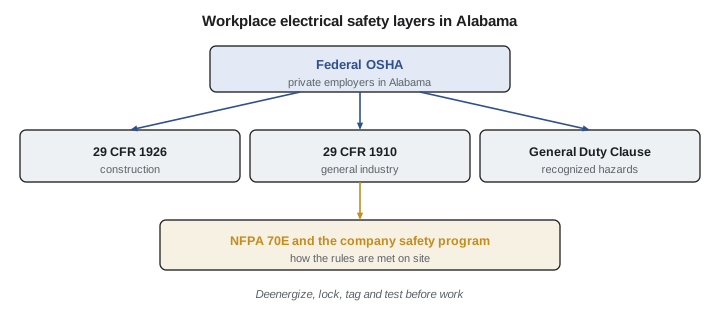
| Source | What it covers | Examples for electrical work |
|---|---|---|
| 29 CFR 1926, construction | New construction, alteration and repair | Electrical, ladders, fall protection, excavations, scaffolds |
| 29 CFR 1910, general industry | Maintenance and service in existing facilities | Electrical safety-related work practices, lockout and tagout |
| General Duty Clause | Recognized hazards without a specific standard | Arc flash hazards, heat illness |
| NFPA 70E | Consensus standard for electrical safety in the workplace | Electrically safe work condition, risk assessment, PPE |
| Company safety program | How the employer meets all of the above | Written procedures, training, audits |
Electrical safety standards
OSHA's construction standards in Subpart K of Part 1926 cover electrical installations and equipment used on construction sites, including ground-fault protection for temporary power through ground-fault circuit interrupters or an assured equipment grounding conductor program, and the safety of extension cords and portable tools. Subpart V covers power transmission and distribution work. In general industry, Subpart S of Part 1910 includes safety-related work practices that require employees to work on equipment in a deenergized state unless the employer can show that deenergizing introduces additional hazards or is infeasible, and the lockout and tagout standard governs control of hazardous energy during service and maintenance.
Other OSHA standards matter just as much on electrical jobs. Fall protection and ladder standards apply to work on roofs, lifts and ladders. Excavation standards apply to service trenches. Aerial lift rules apply to bucket trucks and scissor lifts. Hazard communication applies to chemicals such as cable lubricants and solvents. Many OSHA citations against electrical contractors involve ladders and falls rather than electricity itself.
NFPA 70E and an electrically safe work condition
NFPA 70E, Standard for Electrical Safety in the Workplace, is a consensus standard that OSHA often cites as evidence of recognized hazards and feasible means of protection. Its central idea is the electrically safe work condition: before work begins, the equipment is disconnected from all sources, the disconnects are locked and tagged, and a qualified person tests for absence of voltage with a properly rated meter, checking the meter on a known source before and after. Only then is the equipment treated as deenergized. The church incident broke at the last step: the main was locked, but a second source was not identified and no one tested.
When energized work is justified, NFPA 70E requires a risk assessment, an energized electrical work permit in most cases, shock and arc flash boundaries, and personal protective equipment selected by the incident energy analysis method or the PPE category method. Qualified persons must be trained to recognize and avoid electrical hazards, and the employer must audit the program and retrain when needed. A licensed contractor does not need to memorize the standard for the board exam, but the business and safety questions assume familiarity with these ideas.
# Steps to establish an electrically safe work condition (simplified study aid)
steps = [
    "Identify all possible sources of supply, including generators and backfeeds",
    "Interrupt the load current and open each disconnecting device",
    "Verify visually that blades are open or breakers are withdrawn where possible",
    "Release stored energy",
    "Apply lockout and tagout devices to every source",
    "Test the meter on a known source, test each phase for absence of voltage, retest the meter",
    "Ground the phase conductors where induced or stored voltage could occur",
]
church = [True, True, True, True, False, False, False]   # what was done before the incident
for n, (s, done) in enumerate(zip(steps, church), 1):
    print(n, "DONE   " if done else "MISSED ", s)
print("Safe to touch:", all(church))1 DONE Identify all possible sources of supply, including generators and backfeeds 2 DONE Interrupt the load current and open each disconnecting device 3 DONE Verify visually that blades are open or breakers are withdrawn where possible 4 DONE Release stored energy 5 MISSED Apply lockout and tagout devices to every source 6 MISSED Test the meter on a known source, test each phase for absence of voltage, retest the meter 7 MISSED Ground the phase conductors where induced or stored voltage could occur Safe to touch: False
The output shows what went wrong at the church. The crew identified only one source, locked only that source and skipped the test for absence of voltage. A single meter check would have found the backfeed. Monique made the test step a hard rule: no one touches a conductor until a qualified person has tested it, every time.
Reporting injuries
OSHA requires employers to report a work-related fatality to OSHA within 8 hours and a work-related inpatient hospitalization, amputation or loss of an eye within 24 hours. Most employers with more than ten employees in covered industries must also keep OSHA injury and illness records, including the log and annual summary, and post the summary each year. The church injury, treated and released the same day, did not require an OSHA report, but it was recordable on the log because it involved medical treatment beyond first aid and restricted duty.
Under Alabama's workers' compensation law, the employer must report workplace injuries to the Alabama Department of Labor's workers' compensation division and to its insurer, using the first report of injury, within the time the law and rules require. An employee must give the employer notice of an injury promptly, and a claim for compensation is generally subject to a two-year limit for filing suit. Cahaba River's procedure is simple: any injury is reported to the foreman at once, the foreman calls Monique, and Beth Ann files the first report with the insurer the same day.
Multi-employer job sites
On a construction site with several contractors, OSHA's multi-employer policy can hold more than one employer responsible for a hazard. The creating employer caused the hazard. The exposing employer's workers are exposed to it. The correcting employer is responsible for fixing it. The controlling employer has general supervisory authority over the site. At the church, the generator that backfed the panel was installed by another trade, but Cahaba River's employee was exposed, so Cahaba River could be cited as an exposing employer for failing to protect its worker. The general contractor, as the controlling employer, could also be cited if it failed to exercise reasonable care to prevent and detect the hazard.
The practical lesson is coordination. At the next weekly coordination meeting on the church job, Monique asked the general contractor to require every trade to report temporary power sources and to label every panel fed from more than one source. The general contractor added it to the site safety plan.
A company safety program
A written safety program is how a contractor turns these rules into daily practice. Cahaba River's program includes an electrical safety policy based on NFPA 70E, lockout and tagout procedures, a meter testing procedure, fall protection and ladder rules, trenching rules, heat illness prevention for Alabama summers, hazard communication, first aid and emergency procedures, and incident investigation. Foremen hold a short safety talk every Monday and before any new task. New hires train before they go to a site. Monique audits one job a week, and every incident and near miss is investigated and discussed.
Heat, trenches and ladders
Alabama summers make heat illness a serious hazard for electrical crews working in attics, on roofs and in poultry houses before the fans are running. OSHA has worked on a specific heat illness standard; check whether one is in force when you read this. Either way, OSHA can use the General Duty Clause to cite employers that ignore recognized heat hazards. Cahaba River's heat plan provides water, shade and rest, schedules attic work early in the day, acclimatizes new workers over their first week and trains foremen to recognize heat exhaustion and heat stroke. On the Cullman County poultry house in July, the crew started at five in the morning and was off the roof by noon.
Service trenches and ladder work cause many serious injuries in the trade. OSHA's excavation standard requires a competent person to inspect trenches and requires protective systems for trenches five feet deep or more unless the excavation is in stable rock. Ladders must be the right type and length, set at the proper angle, extended above the landing when used for access and never used as a work platform beyond their rating. Fiberglass ladders are the rule for electrical work because aluminum conducts. These are simple rules, and they are the rules most often broken.
OSHA inspections
OSHA inspections can follow a complaint, a reported injury, a referral or a targeted program. When a compliance officer arrives at a site, the foreman should ask for credentials, call the office and the person in responsible charge, and accompany the officer during the walkaround. Answer questions truthfully, take the same photos and notes the officer takes and correct any hazard that can be corrected on the spot. Citations come later in writing, with penalties and abatement dates. An employer may request an informal conference or contest a citation within the time stated, usually fifteen working days. A contractor with a written program, training records and incident investigations is in a much stronger position than one without them.
Worked problem
Responding to an incident
A helper on the Hoover tenant finish falls from a six-foot ladder and breaks his wrist. He is taken to the emergency room, treated with a cast and released the same day. What must the company do?
Show solution
- Provide first aid and get the helper to medical care; secure the area.
- Determine OSHA reporting: no fatality, no inpatient hospitalization, no amputation or eye loss, so no 8-hour or 24-hour report is required.
- Record the injury on the OSHA log if the company is required to keep one, since it involved medical treatment and likely restricted work.
- Report the injury to the workers' compensation insurer and file the first report of injury as the Alabama law requires.
- Investigate the cause, such as ladder choice or setup, and correct it before work resumes.
Answer: Treat, investigate and correct; no OSHA report is required for an outpatient fracture, but record it on the log and file the workers' compensation first report.
Common mistakes
MistakeAssuming Alabama has its own state OSHA program for private employers.
InsteadPrivate employers in Alabama are covered directly by federal OSHA.
MistakeTreating a locked disconnect as proof the equipment is dead.
InsteadTest for absence of voltage on every phase with a verified meter before touching conductors.
MistakeWaiting until the next day to report a work-related hospitalization.
InsteadInpatient hospitalizations must be reported to OSHA within 24 hours, and fatalities within 8 hours.
MistakeThinking only the trade that created a hazard can be cited.
InsteadUnder the multi-employer policy, exposing, correcting and controlling employers can also be cited.
MistakeSkipping the workers' compensation report for a minor injury.
InsteadReport injuries to the insurer and file the first report as Alabama law requires.
Summary and key terms
- Private employers in Alabama are covered by federal OSHA; there is no state plan for private employers.
- Construction work follows 29 CFR 1926; maintenance and service follow 29 CFR 1910; the General Duty Clause covers recognized hazards.
- NFPA 70E defines an electrically safe work condition: identify sources, open, lock and tag, and test for absence of voltage.
- Report fatalities to OSHA within 8 hours and inpatient hospitalizations, amputations and eye losses within 24 hours.
- Multi-employer job sites can make several contractors responsible for one hazard.
- Workers' compensation injuries are reported with a first report of injury; suits are generally subject to a two-year limit.
- Electrically safe work condition
- Equipment disconnected, locked, tagged and tested for absence of voltage.
- General Duty Clause
- The OSHA Act provision requiring a workplace free of recognized serious hazards.
- Multi-employer policy
- OSHA's policy for citing creating, exposing, correcting and controlling employers.
- First report of injury
- The form an employer files to report a workplace injury for workers' compensation.
- NFPA 70E
- The consensus standard for electrical safety in the workplace.
Practice problems
Work each problem on paper first, then reveal the answer to check.
Who enforces workplace safety for private Alabama contractors?
Show answer
Federal OSHA.
Within how many hours must a fatality be reported to OSHA?
Show answer
Eight hours.
What step makes equipment deenergized under NFPA 70E?
Show answer
Testing for absence of voltage after lockout and tagout.
Can an electrical contractor be cited for a hazard another trade created?
Show answer
Yes, as an exposing employer under the multi-employer policy.
Lesson quiz · 5 questions
Score 60% or more to complete this lesson.
Create a free account to save your progress, take quizzes and earn a certificate.