
MELU-201 · Lesson 5 of 12 · 20 min
The NEC as adopted in Alabama and local amendments
▶ Video coming soon A video version of this lesson is on the way.
In April Cahaba River had three jobs running in three jurisdictions, and Monique noticed for the first time how much of her day went to a question she had always answered by habit: which code book? The strip-center tenant finish in Hoover was permitted by the city. The church addition in Montgomery was permitted by that city, which had adopted a different edition of the NEC. The poultry house in an unincorporated part of Cullman County had no local electrical permit at all, but the farm's lender and insurer wanted the work done to the current NEC and inspected by a third party. Earl kept a list taped inside the office door with the code edition used in each city where the company worked regularly. "That list is the most important document in this building," he said. "And it is wrong about once a year, because somebody adopts a new edition and I find out at an inspection."
Alabama does not have a single statewide electrical code for private construction. The National Electrical Code is adopted by local governments for work in their jurisdictions and by the state for the buildings it regulates. The edition, the local amendments and the effective dates vary from place to place. This lesson explains how that patchwork works, how it differs from the code edition used on the board's exam, how local amendments are made, what the board's own rules say about code compliance and how a contractor keeps track of it all.
No statewide adoption for private work
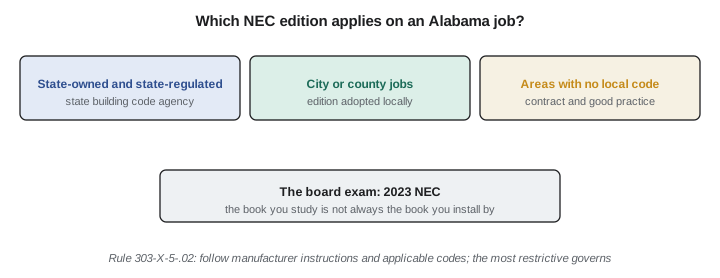
Many states adopt one edition of the NEC statewide and let local governments add amendments or adopt stricter rules. Alabama is different. The electrical licensing statute and the board's rules regulate who may do electrical work, but they do not adopt an electrical code for private buildings across the state. Instead, cities and counties that choose to regulate construction adopt building codes, including an electrical code, by ordinance. In a city that has done so, the adopted edition and its local amendments apply to work inside city limits. In a county that has adopted codes, they apply in the unincorporated areas the county regulates. Where no local government has adopted an electrical code, there may be no locally enforced electrical code at all for private work.
The state does adopt codes for its own purposes. A state building code agency, long known as the Alabama Building Commission and now part of the state's construction management office, adopts building codes, including an edition of the NEC, for state-owned buildings and for certain building types the state regulates, such as public schools. Work on those buildings follows the state's adopted edition and is reviewed and inspected under the state's program, regardless of what the surrounding city has adopted. The state's adopted edition is set by its own rulemaking, and it has historically lagged the newest NEC by one or more cycles, so check the current edition before bidding a state job.
Local adoption
A city council or county commission adopts the NEC by passing an ordinance that adopts the code by reference, usually along with the building, residential, plumbing, mechanical, fuel gas and energy codes. The ordinance names the edition and lists any local amendments. Adoption dates vary widely. Over the past decade some of Alabama's larger cities adopted new editions within a year or two of publication, while others kept an older edition for six years or more. At any given time, a contractor working across the Birmingham, Huntsville, Montgomery and Mobile areas may be working under three different editions of the NEC.
Published adoption tables from trade groups give a useful starting point, but they lag behind local action. The reliable source is the city or county building department, which can tell you the edition in force on the date the permit is issued. Many departments post their adopted codes and amendments online. When they do not, call the permit counter or the chief electrical inspector and write down the answer, the date and the person who gave it.
| Setting | Where the code edition comes from | Who to ask |
|---|---|---|
| Work inside a city with adopted codes | The city's adopting ordinance and amendments | The city building department or chief electrical inspector |
| Unincorporated area of a county with adopted codes | The county's adopting ordinance | The county building or inspection office |
| State-owned buildings and state-regulated building types | The state building code agency's adopted edition | The state agency's plan review and inspection staff |
| Area with no local electrical code | Contract terms, insurer and lender requirements, the utility's service rules and good practice | The owner, the design professional and the utility |
| The board's contractor exam | The edition listed in the Prov bulletin: the 2023 NEC | The bulletin |
Local amendments
A local government that adopts the NEC may amend it. Amendments can be stricter or, in some places, more permissive than the model code. They often reflect local experience or local preferences. Examples of the kinds of amendments some jurisdictions make include requiring metal raceway for certain commercial work, limiting the use of some cable types in commercial buildings, setting local rules for temporary power, adding requirements for service equipment location or labeling, or delaying the effective date of a new requirement, such as an expanded ground-fault or surge protection rule, while contractors and suppliers adjust. A few jurisdictions also adopt administrative amendments that change the permit and inspection chapters rather than the technical rules.
Amendments are part of the adopted code, and an inspector enforces them just as he enforces the model text. They are also easy to miss, because they are published in the ordinance or in a separate local document, not in the NEC book itself. Ray Dunaway, the chief electrical inspector in one of the cities where Cahaba River works often, keeps a one-page list of his city's amendments at the permit counter. He hands it to every contractor new to the city. "The book is the book," he told Monique once, "but this page is the part people fail on."
The exam edition is not the job edition
The board's contractor exam is written from the 2023 NEC, as listed in the Prov bulletin. That edition may be newer than the edition in force in many Alabama cities. A candidate who has worked for years under an older edition must learn the newer rules for the exam, and a newly licensed contractor must remember to apply the edition in force at each job, not the one studied for the exam. The two are separate questions: what the exam asks, and what the inspector enforces.
This matters most where the editions differ. Each NEC cycle adds and changes requirements. Recent cycles expanded ground-fault circuit-interrupter protection in dwellings and other occupancies, added surge protection for dwelling unit services, added emergency disconnects outside one- and two-family dwellings, expanded arc-fault protection and reorganized several articles. A candidate who studied the 2023 edition will look for requirements in places an older edition does not have them, and a contractor working under an older edition may install work that would not pass under a newer one. Keep the exam edition and the job editions separate in your head and on your shelf.
What the board's rules say
The board's rules in Chapter 303-X-5 set conduct standards for licensees. One rule requires licensed contractors and journeymen to install work according to the manufacturer's instructions and the applicable codes, and where requirements conflict, the most restrictive governs. Another requires licensees to provide records to the board on request. These rules mean that the absence of a local code does not leave a licensee free to install work any way he likes: the manufacturer's listing and instructions still apply, along with any applicable code, and the board can discipline a licensee for poor work. On a farm job in an area with no local electrical code, the NEC is still the standard of good practice that the owner, the insurer, a court and the board would look to.
# Tracking the code edition by jurisdiction (simplified study aid; editions are examples)
jobs = [
    ("Tenant finish", "City A", 2020),
    ("Church addition", "City B", 2023),
    ("Lake house", "County C (unincorporated)", 2017),
    ("Poultry house", "No local electrical code", None),
    ("State office remodel", "State building code agency", 2020),
]
exam_edition = 2023
for name, place, ed in jobs:
    if ed is None:
        note = "no local code: follow contract, insurer, utility and good practice (NEC)"
    elif ed == exam_edition:
        note = "same edition as the exam"
    else:
        note = "differs from the exam edition by " + str(exam_edition - ed) + " years"
    print(name, "-", place)
print(" edition:", ed if ed else "none", "|", note)Tenant finish - City A edition: 2020 | differs from the exam edition by 3 years Church addition - City B edition: 2023 | same edition as the exam Lake house - County C (unincorporated) edition: 2017 | differs from the exam edition by 6 years Poultry house - No local electrical code edition: none | no local code: follow contract, insurer, utility and good practice (NEC) State office remodel - State building code agency edition: 2020 | differs from the exam edition by 3 years
The output shows why the list on Earl's door matters. Each job has its own answer, and none of them depends on the exam edition. A contractor who records the edition with every permit, and checks it again when a new job starts, avoids most code-edition surprises.
Worked problem
Choosing the code for a job
Cahaba River is asked to bid three jobs in one week: a dental office inside a city that adopted the 2020 NEC with local amendments, a new classroom wing at a public school in the same city and a farm shop in a county that has not adopted building codes. Which code should the estimate assume for each?
Show solution
- Dental office: the city's adopted 2020 NEC with its local amendments, confirmed with the city building department.
- School classroom wing: the state's adopted edition and review process for public school construction, confirmed with the state agency, regardless of the city's adoption.
- Farm shop: no local electrical code, so follow the contract, the owner's insurer and lender, the utility's service requirements and the current NEC as good practice.
- In every case, follow manufacturers' instructions and, where requirements conflict, the most restrictive, as the board's rules require.
- Record the edition and source in each estimate file.
Answer: Each job uses a different source: the city's ordinance, the state agency's edition and, for the farm shop, the contract and good practice.
When a code changes mid-job
A jurisdiction sometimes adopts a new edition while a job is under way. Most adopting ordinances say that work permitted before the effective date may be completed under the edition in force when the permit was issued, and that permits issued after that date follow the new edition. The details vary, so read the ordinance or ask the building official. For a long project, record the permit date and the edition on the permit file, and check whether a revision or a new permit for added work will fall under the new edition. Owners and general contractors should hear about any cost effect before the work is done, not on the invoice.
Keeping the list current
Cahaba River's code list now lives in a shared spreadsheet rather than on the door. For each jurisdiction it records the NEC edition, the effective date, a link to the adopting ordinance and amendments, the permit office's phone number, the chief inspector's name and the date the entry was last confirmed. Beth Ann checks each entry every six months and whenever a city announces a code update. Monique added a column for notes from inspections, such as an amendment that caught a crew by surprise. The list costs a few hours a year and saves failed inspections, change orders and arguments with owners.
Code adoption also matters to estimating. A requirement that is in the adopted edition must be in the bid. A contractor who bids a dwelling to an older edition in a city that has moved to a newer one will end up paying for surge protection, emergency disconnects or expanded ground-fault protection that the bid did not include. Ask the code question before pricing the job, not after the rough-in inspection.
Common mistakes
MistakeAssuming Alabama has one statewide electrical code for all private work.
InsteadPrivate work follows the edition adopted by the city or county; the state adopts codes for its own buildings and certain regulated types.
MistakeInstalling to the exam edition on every job.
InsteadThe exam uses the 2023 NEC, but each job follows the edition adopted where the work is located.
MistakeIgnoring local amendments because they are not in the NEC book.
InsteadAmendments are part of the adopted code and are enforced by the inspector.
MistakeTreating an area with no local code as having no standards.
InsteadBoard rules require following manufacturers' instructions and applicable codes, and the NEC remains the standard of good practice.
MistakeRelying on a published adoption table as current.
InsteadTables lag behind local action; confirm with the building department.
Summary and key terms
- Alabama has no single statewide electrical code for private construction; cities and counties adopt the NEC by ordinance.
- The state adopts codes for state-owned buildings and certain building types it regulates, such as public schools.
- Editions and local amendments vary by jurisdiction and change over time.
- The board's exam uses the 2023 NEC, which may differ from the edition at a given job.
- Board rules require following manufacturers' instructions and applicable codes, with the most restrictive governing.
- Keep a confirmed list of editions and amendments for every jurisdiction where the company works.
- Adopting ordinance
- The local law that adopts a code edition by reference, often with amendments.
- Local amendment
- A change to the model code made by the adopting jurisdiction.
- State building code agency
- The state office that adopts codes for state-owned and certain state-regulated buildings.
- Exam edition
- The NEC edition listed in the Prov bulletin, the 2023 NEC.
- Most restrictive governs
- The board rule that, where requirements conflict, the stricter requirement applies.
Practice problems
Work each problem on paper first, then reveal the answer to check.
Does Alabama adopt one NEC edition statewide for private buildings?
Show answer
No. Cities and counties adopt editions locally.
Which edition is the board's contractor exam written from?
Show answer
The 2023 NEC, as listed in the Prov bulletin.
Who should you ask about the edition in force in a city?
Show answer
The city's building department or chief electrical inspector.
What does the board's rule say when requirements conflict?
Show answer
The most restrictive requirement governs.
Lesson quiz · 5 questions
Score 60% or more to complete this lesson.
Create a free account to save your progress, take quizzes and earn a certificate.