
MELU-201 · Lesson 12 of 12 · 19 min
Practice exam review and test-day strategy
▶ Video coming soon A video version of this lesson is on the way.
Six weeks before her exam date, Monique took her first full-length practice exam on a Saturday morning in the company's conference room, with the four references on the table, a four-function calculator and a kitchen timer set for five hours. Earl proctored, mostly by reading the newspaper. She finished with twelve minutes left and scored 71 out of 100 on the scored questions. "Close," Earl said. "What did you miss?" She sorted the missed questions into piles. Nine were business and law questions she had guessed at. Eight were calculations she had set up correctly but run out of patience on. Six were NEC lookups where she knew the rule but could not find it fast. Six were careless errors: a misread question, a wrong column, a unit she forgot to convert. "That's not a knowledge problem," Earl said. "That's a plan problem. You can fix that in six weeks."
This lesson pulls the course together into a plan for the last weeks before the Alabama electrical contractor exam and a routine for exam day. It covers diagnostic practice exams, a six-week study plan, how to review missed questions, lookup and calculation routines with the allowed references, time management with the two-pass method and what to do on the day itself and afterward.
Start with a diagnostic
A full-length practice exam under real conditions is the best starting point, because it shows where the time and points go. Use the same references, the same calculator and the same time limit as the real exam, and take it in one sitting. Then sort the missed questions by cause rather than by topic alone: knowledge gaps, lookup speed, calculation errors, misreading and running out of time. Each cause has a different fix. A knowledge gap needs study. A lookup problem needs better tabs and practice. A calculation error needs a written routine. Misreading needs slower first reading and underlining key words in the question on the screen, mentally if not physically.
| Cause of missed question | Fix |
|---|---|
| Knowledge gap in business and law | Read the NASCLA guide and Alabama supplement chapters; tab lists and deadlines |
| Slow NEC lookups | Improve tabs; practice finding articles and tables by the index and tabs |
| Calculation errors | Write a step routine for each calculation type and practice it |
| Misreading the question | Read the last sentence first; note words like minimum, maximum, not and except |
| Running out of time | Use the two-pass method; guess, mark and move on |
A six-week plan
Monique's plan spread about forty-three hours of study over six weeks, around a full-time job. The first two weeks went to her weakest areas, business and law and the calculation types she missed most. The third week focused on business and law again, with practice sets from the NASCLA guide. The fourth week mixed timed sets of twenty questions from all areas. The fifth week included two more full-length practice exams under exam conditions. The last week was light: review of tabs, formulas and missed questions, and plenty of sleep.
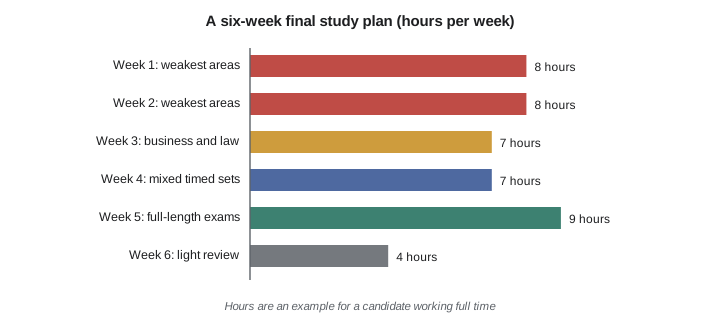
The plan matters more than the exact hours. Study at regular times, track the hours and practice scores, and adjust when a week shows no improvement. A candidate who scores consistently in the low eighties on full-length practice exams is usually ready; one who is still near 75 should consider rescheduling, within the approval period, rather than gambling.
Reviewing missed questions
Every missed practice question is a lesson. For each one, find the correct answer in the reference, note where it was and how long it took to find, and write a short note in a study notebook (not in the reference book, which must stay free of notes). If the miss was a lookup, check whether a tab would have helped and add one if it would, within the limits of the bulletin's rules. If the miss was a calculation, rewrite the steps. Review the notebook at the start of each study session. Patterns appear quickly: Monique found that most of her business misses came from three chapters of the NASCLA guide, which she then read twice.
Lookup routines
Speed in the references comes from knowing their structure. In the NEC, know the chapter layout, the location of the key articles and the most used tables, and the index's style. In the American Electrician's Handbook, know where motor, transformer and calculation sections are. In the NASCLA guide, know the chapters and their order. In the Alabama supplement, know where licensing, lien and workers' compensation material is. Practice by picking a random topic, timing how long it takes to find the rule in the right book and repeating until most lookups take under a minute.
Calculation routines
Write a step routine for each common calculation and practice it with the four-function calculator: dwelling and commercial service loads, feeder and branch-circuit sizing, conductor ampacity with adjustment and correction, voltage drop, motor full-load current and protection, transformer sizing and current, box fill and conduit fill. Each routine should name the reference and table for each step. On the exam, write the steps on any scratch material the testing center provides, fill in the numbers and check the units before choosing an answer.
# Reviewing a practice exam by cause of miss (simplified study aid)
misses = {"business and law": 9, "calculation": 8, "lookup speed": 6, "misreading": 6}
scored = 100
score = 71
print("Practice score:", score, "of", scored, "| needed: 75")
for cause, n in sorted(misses.items(), key=lambda kv: -kv[1]):
    print(cause.ljust(18), n, "missed")
# If half of each cause is fixed, the projected score is:
recovered = sum(n // 2 for n in misses.values())
print("Projected after fixing half of each cause:", score + recovered)

# Pacing check for the 5-hour, 110-question exam
minutes = 300
print("Minutes per question at full pace:", round(minutes / 110, 2))
print("Checkpoint at 2.5 hours: about question", 110 // 2)Practice score: 71 of 100 | needed: 75 business and law 9 missed calculation 8 missed lookup speed 6 missed misreading 6 missed Projected after fixing half of each cause: 85 Minutes per question at full pace: 2.73 Checkpoint at 2.5 hours: about question 55
The output shows why sorting by cause works. Fixing half of each kind of miss raises a 71 to 85, well above the passing mark, without learning a single new topic. It also gives a pacing checkpoint: at the halfway point of the exam, a candidate should be near question 55. A candidate who is far behind should speed up by marking long questions and moving on.
Time management on the day
Use the two-pass method from Lesson 4. On the first pass, answer every question that can be answered quickly, from knowledge or with a fast lookup. For any question that will take more than three or four minutes, make a best guess, mark it and move on. On the second pass, return to the marked questions in order and work them fully. Keep about thirty minutes at the end to review marked questions and confirm that every question has an answer. There is no penalty for a wrong answer, so never leave one blank.
Test-day routine
The night before, pack the references, the calculator, the photo identification and the confirmation, and check the books for anything that looks like a note. Sleep. In the morning, eat breakfast, leave early and plan for traffic. At the testing center, follow the check-in procedure, store personal items and let the proctor inspect the books. Take the software tutorial. During the exam, read each question carefully, watch for words like not and except, and keep track of time at checkpoints. If anxiety rises, stop for a few slow breaths; a minute spent calming down is cheaper than ten careless answers.
Practicing the business and law questions
The business and law content deserves its own practice sets. Questions on liens, payroll taxes, workers' compensation, contracts, insurance and business organization are usually answered from the NASCLA guide and the Alabama supplement. Make a list of the numbers that come up often, such as lien deadlines, the workers' compensation employee threshold, payroll withholding rules and bonding terms, and know where each appears in the references. Because the Alabama supplement is dated, compare its Alabama figures with current law, but study the supplement's version for the exam if the two differ, and be ready for questions written from it.
Practice sets of twenty business questions in thirty minutes are a good benchmark. Most candidates who read the guide once, tab it and work three or four of these sets find business questions become their fastest points on the exam. That speed buys time for the long NEC calculations.
Keeping calm under time pressure
Five hours is a long exam, and fatigue sets in for most people somewhere after the third hour. Plan for it. Take any break the testing rules allow, stretch, drink water and look away from the screen for a moment. If you notice yourself rereading the same question several times, mark it and move on. Do not let one hard question cost you three easy ones. Confidence on exam day comes from the practice exams: a candidate who has finished three full-length practice exams on time knows that the real one can be finished too.
Using the content outline
The Prov bulletin's content outline lists the subject areas on the exam and how many questions come from each. Use it to weight study time. If an area carries many questions, it deserves more practice, even if it feels familiar. If an area carries few, it still deserves a review, because a few points can decide a close score. Monique copied the outline into her study notebook and checked off each area as she reached practice scores she was comfortable with. When the checklist was complete and her full-length scores were steady above 80, she stopped adding new material and switched to review.
After the exam
The board mails the official score. A candidate who passes completes any remaining forms and pays the license fee, as Lesson 3 described, and, if the candidate will be a company's person in responsible charge, files the company paperwork. A candidate who falls short should study the score report's areas of weakness, file the retake form and fee and schedule again within the approval period. Many good contractors passed on a second attempt. The diagnostic method in this lesson works just as well the second time.
Monique took two more practice exams in her fifth week and scored 80 and 83. She passed the real exam with an 84. On her first Monday as the company's person in responsible charge, she held the safety meeting, signed three permit applications and asked Caleb when he planned to apply for the journeyman exam.
Worked problem
Rescuing a practice score
A candidate scores 68 on his first full-length practice exam, with 12 business misses, 10 calculation misses, 5 lookup misses and 5 misreadings. He has five weeks until his exam. What should his plan be?
Show solution
- Sort the misses by cause and fix the largest first: business and law, then calculations.
- Read the NASCLA guide and Alabama supplement chapters he missed, tab them and work practice questions from them.
- Write step routines for the calculation types he missed and practice them with a four-function calculator.
- Take two more full-length practice exams under exam conditions in weeks three and four.
- If he is not scoring consistently above 75 by week four, consider rescheduling within his approval period.
Answer: Fix the biggest causes first, practice under exam conditions and reschedule within the approval period if his scores do not rise enough.
Common mistakes
MistakeStudying only the NEC because it is the largest book.
InsteadBusiness and law questions are often the easiest points to gain with the NASCLA guide and Alabama supplement.
MistakeWriting study notes in the reference books.
InsteadThe bulletin allows only permanent tabs and highlighting; keep notes in a separate notebook.
MistakeWorking every question in order regardless of time.
InsteadUse the two-pass method: answer quick items first, mark the long ones and return.
MistakeLeaving hard questions blank.
InsteadThere is no penalty for a wrong answer; guess, mark and return.
MistakeCramming the night before.
InsteadThe last week should be light review and rest.
Summary and key terms
- Start with a full-length diagnostic practice exam under real conditions.
- Sort misses by cause: knowledge, lookup speed, calculation, misreading and time.
- Use a six-week plan that focuses first on the weakest areas and ends with light review.
- Build lookup and calculation routines with the allowed references and a four-function calculator.
- Use the two-pass method and pacing checkpoints, and answer every question.
- After the exam, complete licensing or plan a retake within the approval period.
- Diagnostic exam
- A full-length practice exam used to find weaknesses.
- Lookup routine
- A practiced way to find a rule quickly in a reference.
- Calculation routine
- Written steps, with references, for a common calculation.
- Pacing checkpoint
- A planned point in the exam to compare progress against time.
- Retake
- A second or later attempt after filing the retake form and fee.
Practice problems
Work each problem on paper first, then reveal the answer to check.
What should you do with a question that will take more than a few minutes?
Show answer
Guess, mark it and return on the second pass.
Where should study notes go?
Show answer
In a separate notebook, never in the reference books.
What practice score suggests a candidate is ready?
Show answer
Consistent scores in the low eighties on full-length practice exams.
Is there a penalty for wrong answers?
Show answer
No, so answer every question.
Lesson quiz · 5 questions
Score 60% or more to complete this lesson.
Create a free account to save your progress, take quizzes and earn a certificate.