
MELU-201 · Lesson 7 of 12 · 19 min
Duties and responsibilities of the Electrical Contractor License holder
▶ Video coming soon A video version of this lesson is on the way.
Monique passed the contractor exam on a Saturday in late May with a score of 84. The board's letter arrived in mid-June, and her certificate followed after she paid the license fee. Earl took her to lunch to celebrate and then handed her a single typed page titled "What you are signing up for." It listed twelve items, starting with "You are responsible for every circuit this company installs, whether you saw it or not" and ending with "If you leave, the board must hear about it within five days." "The license is the easy part," he said. "Being the person in responsible charge is the job. You don't just sign permits. You answer for the work, the people and the paperwork." Over the next three months, while Earl moved toward retirement, Monique took on those duties one at a time.
A licensed electrical contractor in Alabama carries duties that come from the statute, the board's rules, local permit ordinances and the law of contracts and negligence. This lesson focuses on the duties tied to the license: responsibility for the company's electrical work, supervision of journeymen and helpers, compliance with codes and manufacturers' instructions, display of the license, board notices, records and the special rules when the person in responsible charge leaves, dies or is incapacitated.
The person in responsible charge
The board's rules in Chapter 303-X-3 define the person in responsible charge as the licensed electrical contractor who is responsible for the electrical work of a company. A company that contracts for electrical work must have one on file with the board. The person in responsible charge is not just a name on a form. He or she is expected to direct and control the company's electrical work, to know what is being installed and how, and to make sure it is done by qualified people in compliance with the applicable codes. A company whose person in responsible charge lends a name but never sees the work is at risk of discipline, and so is the licensee.
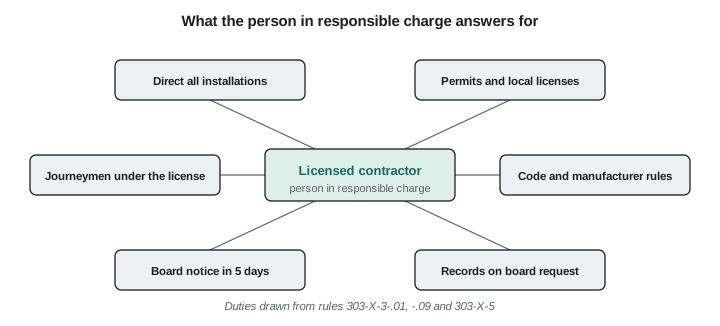
Most licensees meet this duty with systems rather than personal presence on every job. Monique cannot stand at every panel Cahaba River installs. She can review every job's scope and layout before work begins, assign a journeyman foreman she trusts to each job, visit each active job on a regular schedule, review inspection results, approve changes in design and train foremen on the adopted codes and company standards. Those steps are how a person in responsible charge actually controls the work, and they leave records that show it.
| Duty | Source | What it looks like in practice |
|---|---|---|
| Direct and control the electrical work | Board rules, 303-X-3 | Job reviews, foremen assignments, site visits |
| Use licensed journeymen and supervise helpers | Code of Alabama 34-36 and board rules | Crew lists, license copies, supervision plans |
| Follow manufacturers' instructions and applicable codes, most restrictive governing | Board rule 303-X-5-.02 | Code list by jurisdiction, cut sheets on site |
| Provide records to the board on request | Board rule 303-X-5-.03 | Permit files, payroll, inspection records |
| Display the license at the principal place of business | Board rule 303-X-5-.05 | Framed certificate in the office |
| Notify the board within five days of separation | Board rule 303-X-3-.09 | Written notice and a plan for a replacement |
Journeymen and helpers
The statute defines a journeyman as a person who does electrical work while working for a licensed master or state-certified electrical contractor. That puts the journeyman's work under the contractor's responsibility. A licensed contractor should keep a copy of each journeyman's current certificate, check renewal dates and make sure that helpers and apprentices work under the direction of licensed people. Some states set a numerical apprentice-to-journeyman ratio in their licensing law. Check the board's current rules and any local rules for supervision requirements; contract requirements and good practice also call for adequate supervision, and a registered apprenticeship program has its own ratio and supervision standards.
Caleb Moore is in the fourth year of his apprenticeship and will apply for the journeyman exam soon. Monique assigns him to a foreman on each job, checks that his work is reviewed before cover and makes sure his hours and duties are recorded the way the board will want to see them when he applies. That record-keeping protects Caleb's application and protects the company if anyone questions how the work was supervised.
Code compliance and the manufacturer's instructions
The board's conduct rule requires licensees to install work according to the manufacturer's instructions and the applicable codes, with the most restrictive requirement governing. That rule reaches beyond the inspector. Work that passed inspection but violates the manufacturer's instructions, such as a generator installed closer to a window than its instructions allow or a breaker used in a panel it is not listed for, can still be a violation of the board's rules. Monique requires foremen to keep cut sheets and installation instructions on site for major equipment and to check them before setting anything.
Displaying the license and identifying the company
The board's rules require a licensee to display the license at the principal place of business. Monique's certificate hangs in the front office at Cahaba River next to the company's local business license. Many local governments also require the state license number on permit applications and sometimes on vehicles or advertising. Check each jurisdiction's rules, and put the license number on bids and contracts so owners and general contractors can verify it.
Board notices and changes
The rules require the company to notify the board within five days when the person in responsible charge separates from it. Until the board approves a replacement, the company must stop contracting for new electrical work. If the person in responsible charge dies or becomes incapacitated, the board can issue an emergency certification for no more than 90 days so the company can finish existing work while a replacement is qualified. The rules also require a board appearance before a licensee may serve as the person in responsible charge for a second entity. Address changes, name changes and changes in company structure should be reported promptly as the rules and forms require.
For Cahaba River, the five-day rule shaped the transition. Earl and Monique did not wait for Earl's last day. They filed the forms to name Monique as the person in responsible charge while Earl was still at the company, so that there was never a day when the company had no qualified licensee on file. Beth Ann put the filing confirmation in the company's license binder.
# Board notice timing after a separation (simplified study aid)
from datetime import date, timedelta

def plan(event, day):
    if event == "separation":
        return [("Notify the board by", day + timedelta(days=5)),
                ("Stop new contracting until replacement approved", day)]
    if event == "death or incapacity":
        return [("Request emergency certification", day),
                ("Emergency certification ends no later than", day + timedelta(days=90))]

for event, day in [("separation", date(2026, 9, 30)), ("death or incapacity", date(2026, 9, 30))]:
    print(event.upper())
    for label, d in plan(event, day):
print(" ", label + ":", d)SEPARATION Notify the board by: 2026-10-05 Stop new contracting until replacement approved: 2026-09-30 DEATH OR INCAPACITY Request emergency certification: 2026-09-30 Emergency certification ends no later than: 2026-12-29
The output shows how short both windows are. Five days is less than a week, and 90 days is not long to qualify a replacement who may first need to be approved for and pass the contractor exam. A company with one licensee should have a succession plan long before it is needed.
Records
The board can ask a licensee to produce records, and a licensee must provide them. Which records matter most? Permit files and inspection results show what was installed and approved. Payroll records show who worked on each job. License copies show that journeymen were certified. Contracts and change orders show what was promised. Safety records and training rosters show how the work was done. Earl kept paper files in a back room. Monique moved them into a digital system with folders by job and by year, and set a rule that every job's folder must be complete before the job is marked closed.
Supervising foremen and the work they run
In a company of Cahaba River's size, the person in responsible charge supervises mostly through foremen. Monique built a short routine for each job. Before work starts, she reviews the scope, the drawings or sketch, the load calculation and the service and feeder sizes with the foreman, and they agree on the code edition and any local amendments. During rough-in, she or a senior foreman visits the site before the inspection and checks a sample of boxes, terminations, grounding and bonding and support. After each inspection, the foreman sends her the result, and any correction notice goes on her list until it is cleared. At closeout, she reviews the panel schedules and the final inspection before the invoice goes out.
That routine does several things at once. It catches mistakes before inspectors do. It trains foremen in the way Monique wants the work done. And it builds a written record that the person in responsible charge actually directed and controlled the work, which is what the rule requires and what the board will want to see if a complaint ever comes in. A licensee who cannot show how the work was supervised is in a weak position, even when the work itself was good.
Succession planning
Cahaba River's near miss, a company that for years depended on a single licensee, is common. If Earl had been injured in an accident before Monique was licensed, the company would have had at most 90 days of emergency certification to qualify a replacement, and a replacement who first needed board approval, an exam date and a passing score might not have made it in time. Monique's first project as person in responsible charge was to encourage a second foreman, who already meets the experience requirement, to apply for the contractor exam. A second licensee on staff does not replace the person in responsible charge, but it gives the company a qualified successor if one is ever needed.
Worked problem
A complaint about a past job
Two years after Cahaba River upgraded a service at a house in Alabaster, the new owner files a complaint with the board, saying the work was unpermitted and unsafe. Monique was not the person in responsible charge at the time of the job, but she is now. What should she do?
Show solution
- Pull the job file: the contract, permit, inspection records, crew list and any change orders.
- If the permit and final inspection are on file, provide copies to the board as requested.
- Identify the journeymen and foreman who did the work and confirm they were certified.
- If the file shows a problem, offer to inspect the work and correct any defects, documenting each step.
- Respond to the board in writing, on time, with copies of the records, and consult the company's lawyer and insurer if the claim involves damage.
Answer: Use the job file to answer the board, cooperate fully, correct any real defects and involve the company's lawyer and insurer if needed.
Beyond the license rules
A licensed contractor also carries duties from other areas of law, covered in other lessons. The contractor is responsible for workplace safety under federal OSHA, for workers' compensation coverage under Alabama law, for honest dealing under contract law and for reasonable care under negligence law. An owner injured by defective electrical work can sue the contractor regardless of whether the board takes action. Insurance, contracts and safety programs are how a licensed contractor manages those duties, and Lessons 8 to 10 cover them.
Common mistakes
MistakeLending a license to a company without directing the work.
InsteadThe person in responsible charge must actually direct and control the company's electrical work.
MistakeWaiting until after a separation to tell the board.
InsteadThe board must be notified within five days, and new contracting stops until a replacement is approved.
MistakeAssuming the emergency certification lasts until a replacement passes.
InsteadEmergency certification after death or incapacity lasts no more than 90 days.
MistakeTreating a passed inspection as proof of full compliance.
InsteadBoard rules also require following manufacturers' instructions, with the most restrictive requirement governing.
MistakeKeeping the license in a drawer.
InsteadThe license must be displayed at the principal place of business.
Summary and key terms
- The person in responsible charge directs and controls the company's electrical work and answers for it to the board.
- Journeymen work under the contractor's license; helpers and apprentices work under licensed supervision.
- Licensees must follow manufacturers' instructions and applicable codes, with the most restrictive governing, and provide records on request.
- The license must be displayed at the principal place of business.
- Notify the board within five days of a separation and stop new contracting until a replacement is approved; emergency certification lasts at most 90 days.
- Serving as the person in responsible charge for a second entity requires a board appearance.
- Person in responsible charge
- The licensed electrical contractor responsible for a company's electrical work.
- Emergency certification
- A temporary authorization of no more than 90 days after the death or incapacity of the person in responsible charge.
- Separation
- The person in responsible charge leaving the company, which triggers the five-day notice.
- Cut sheet
- A manufacturer's data sheet with ratings and installation information.
- Job file
- The record of a job's contract, permit, inspections, crew and changes.
Practice problems
Work each problem on paper first, then reveal the answer to check.
How soon must a company notify the board when its person in responsible charge leaves?
Show answer
Within five days.
What must the company do until a replacement is approved?
Show answer
Stop contracting for new electrical work.
How long can an emergency certification last?
Show answer
No more than 90 days.
Where must the license be displayed?
Show answer
At the principal place of business.
Lesson quiz · 5 questions
Score 60% or more to complete this lesson.
Create a free account to save your progress, take quizzes and earn a certificate.