
MELU-107 · Lesson 9 of 12 · 21 min
Supervising journeymen and apprentices
▶ Video coming soon A video version of this lesson is on the way.
By autumn, Brightwater had three jobs running at once: the second Copper Kettle, the townhouse punch list on Orchard Lane, and a 1,600-ampere switchgear replacement at Delgado Fabrication planned for a holiday weekend shutdown. Ray put Dana in charge of crew assignments for the first time. She had eight licensed electricians, two registered apprentices, a helper on probation and a dozen tasks a day to spread among them. On Monday she sent Kayla, a first-year apprentice, to the townhouses alone because the punch list looked simple. By ten o'clock Priya had a call from the general contractor's superintendent, who wanted to know why an apprentice was working without a journeyman, and Dana learned that supervision is not only good practice; in most states it is the law.
A master electrician is licensed to plan and supervise electrical work, and the licensing law makes the master and the contractor responsible for the people they put on a job. This lesson covers supervision ratios and apprenticeship rules, how work is assigned by license level, and the practical leadership skills that keep a crew safe, productive and on the right side of the inspector. Business and law exams test the legal rules; good contractors also learn the rest.
Who may do what
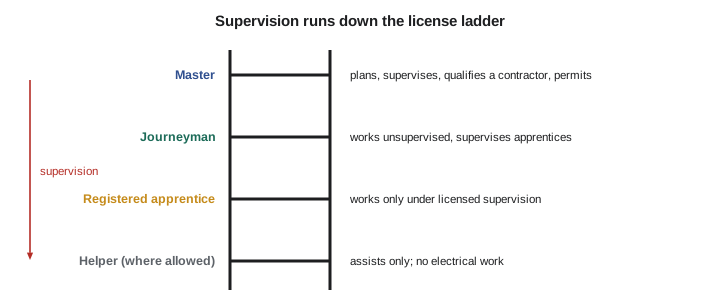
Most licensed states define a ladder of credentials with different rights. A registered apprentice or trainee may do electrical work only under the supervision of a licensed journeyman or master. A licensed journeyman may do electrical work without direct supervision, and may supervise apprentices, but generally may not contract for work or pull permits. A master may do and supervise electrical work, plan and lay out installations, and qualify a contractor. Some states add limited licenses, such as residential wireman, maintenance electrician or low-voltage technician, whose holders may work only within a defined scope. Unlicensed helpers, where allowed, may assist but not perform electrical work.
| Credential | May do electrical work? | May supervise apprentices? | May pull permits or contract? |
|---|---|---|---|
| Registered apprentice | Only under supervision | No | No |
| Journeyman | Yes | Yes, within the ratio | Usually no |
| Master | Yes | Yes | Yes, as or through a qualifier |
| Limited license (for example residential) | Yes, within its scope | Often, within its scope | Depends on the state |
| Unlicensed helper (where allowed) | No; assists only | No | No |
Supervision ratios
Many states limit the number of apprentices a journeyman or master may supervise at once. A common rule is one apprentice per licensed electrician on a job site, and some states allow two or three apprentices per journeyman for experienced apprentices or for certain kinds of work. Some rules count only people physically present on the same site, and some define supervision as being within sight or hearing distance. Ratios also appear in registered apprenticeship program standards and in prevailing wage rules, which allow apprentice wage rates only within the program's ratio. A contractor that exceeds the ratio can face citations against both the contractor and the supervising licensee, and on a prevailing wage job can owe journeyman wages for the excess apprentices.
Worked problem
Staffing within a ratio
Under an illustrative state rule, each licensed journeyman or master may supervise no more than two registered apprentices on the same job site. The Delgado shutdown needs a crew of 9. Dana wants as many apprentices as possible for training. What is the most apprentices she can use, and how many licensed electricians does that require?
Show solution
- With a ratio of 2 apprentices per licensed electrician, each licensed person plus apprentices forms a group of 3.
- 9 ÷ 3 = 3 groups, so 3 licensed electricians and 6 apprentices.
- Check: 6 apprentices ÷ 3 licensed = 2 per licensed electrician, within the limit.
Answer: Up to 6 apprentices with 3 licensed electricians. Brightwater had only 2 apprentices, so the real crew was 7 licensed electricians and 2 apprentices.
# Largest apprentice count a crew can include under a supervision ratio
def max_apprentices(crew_size, ratio):
    # each licensed electrician may supervise `ratio` apprentices
    licensed = -(-crew_size // (ratio + 1))      # ceiling division
    return crew_size - licensed, licensed

for crew, ratio in ((9, 2), (9, 1), (10, 3)):
    app, lic = max_apprentices(crew, ratio)
print(f"crew {crew}, ratio 1:{ratio} -> {app} apprentices, {lic} licensed")crew 9, ratio 1:2 -> 6 apprentices, 3 licensed crew 9, ratio 1:1 -> 4 apprentices, 5 licensed crew 10, ratio 1:3 -> 7 apprentices, 3 licensed
Registered apprenticeship
Most electrical apprentices train in a registered apprenticeship program approved by the U.S. Department of Labor's Office of Apprenticeship or by a state apprenticeship agency. Programs may be run jointly by unions and contractor associations, by open-shop contractor associations, or by individual employers. A typical electrical program lasts four or five years and combines about 2,000 hours a year of paid on-the-job training under supervision with a set amount of related classroom instruction, often around 144 hours a year or more. Apprentices advance through a wage schedule that rises as they complete hours and coursework, and the program sets the ratio of apprentices to journeymen. When they finish, apprentices receive a certificate of completion and, in licensed states, become eligible to sit the journeyman exam.
An employer that sponsors or participates in a program must register each apprentice, follow the program's work process schedule so the apprentice gets experience in all the required areas, keep records of hours by work process, pay according to the wage progression, and follow equal employment opportunity rules for apprenticeship. Kayla's program required her hours to be logged by category, such as residential, commercial, industrial, services and controls, so Dana's assignments had to rotate her through all of them rather than keeping her on the same kind of work all year.
| Item | Typical registered program requirement | Contractor's job |
|---|---|---|
| On-the-job training | About 2,000 hours per year over four or five years | Provide supervised work across all work processes |
| Related instruction | Often about 144 hours or more per year | Allow attendance; some programs require employer payment |
| Wage progression | Rising share of the journeyman rate | Pay the step earned |
| Ratio | Set in program standards | Staff jobs within it |
| Records | Hours by work process, evaluations | Log and submit as required |
Assigning work
Good assignments match the task to the license, the person's experience and the risk. Dana built her Monday plan around a few questions for each task. Does the task legally require a licensed electrician? Does it involve energized work or high-risk equipment that only a qualified person under NFPA 70E should touch? Who has done this before, and who needs to learn it under supervision? Is there enough supervision on each site to stay within the ratio? Does an apprentice need hours in this work process? The answers produced a simple board, updated daily, showing each person, site and task, which also became the basis for time tracking and job costing.
The townhouse problem had an easy fix once she saw it. Kayla could not legally work alone, so Dana paired her with Andre for the morning punch list and moved a second journeyman, who preferred working solo, to the Copper Kettle trim. The board made the ratio visible: every apprentice's name sat next to a licensed name on the same site.
Leading a crew
Business references treat supervision as more than legal compliance. The supervisor plans the work so materials and information arrive before the crew needs them, holds short safety meetings, often called toolbox talks, before the work starts, explains the day's goals, checks quality while work is in progress instead of after, and gives clear feedback. A good foreman spends part of every day walking the job with the drawings, comparing what has been installed with what should be, and finding problems while they are cheap to fix.
- Plan: confirm materials, drawings, lifts and access before the crew arrives.
- Brief: hold a short safety and task briefing each morning, and record attendance and topics.
- Check: inspect work in progress against drawings and the code, especially items an inspector will see at rough-in.
- Coach: show apprentices how and why, then let them do it while you watch; explain the code section behind the method.
- Record: log progress, problems, changes and instructions in the daily report (Lesson 10).
Productivity and job costing
Supervisors also manage labor productivity, because labor is usually the largest and most variable cost on an electrical job. The estimate in Lesson 3 converted quantities into labor hours using labor units. During the job, the foreman tracks hours spent by task and compares them with the hours earned, the estimated hours for the work actually installed. A productivity factor above 1 means the crew is ahead of the estimate; below 1 means it is behind, and the reasons need to be found early, such as material shortages, rework, access problems, changes or crew mix.
Worked problem
Earned hours on the Copper Kettle
The estimate allowed 620 hours. After three weeks, the work installed equals 45% of the estimate's quantities, and the crew has spent 310 hours. Find the earned hours, the productivity factor and the projected total hours if the trend continues.
Show solution
- Earned hours: 0.45 × 620 = 279.
- Productivity factor: 279 ÷ 310 = 0.90.
- Projected total: 620 ÷ 0.90 = 688.9 hours.
Answer: 279 earned hours, a factor of 0.90, and a projection of about 689 hours, about 69 hours over the estimate unless productivity improves.
Discipline, documentation and fairness
Supervising people sometimes means correcting them. Business references recommend consistent written policies, a clear explanation of expectations, prompt and private correction, documentation of each step, and equal treatment, which also protects the company against discrimination and retaliation claims under the laws in Lesson 7. A written warning should state the facts, the policy involved, the expected change and the consequence of not changing. Safety violations, such as working energized without a permit or removing a lock, usually call for immediate action under the safety program. Good supervisors also document good work, which matters for raises, apprentice evaluations and licensing affidavits.
Dana found that the hardest part of the job was not the legal rules but the conversations. Ray's advice was practical: correct the work, not the person; do it the same day; and write it down while it is fresh. By the end of the Delgado shutdown, which finished four hours ahead of schedule, she had written two short warnings, three apprentice evaluations and a note to Ray recommending a raise for Andre.
Training beyond the apprenticeship
Supervision includes keeping licensed electricians current. Most states require continuing education to renew journeyman and master licenses, usually including hours on NEC changes each code cycle, and some require hours on state law and safety. Manufacturers offer training on new equipment such as energy storage, EV charging and lighting controls, and NFPA 70E requires periodic retraining, as Lesson 8 explained. Dana built a simple training calendar for Brightwater that tracked each person's license renewal date, continuing education hours, 70E retraining date and first aid certification, so no one's license lapsed and every crew had a trained first responder. She also paired newer journeymen with experienced ones on unfamiliar work, such as the Delgado switchgear, so knowledge stayed in the company when Ray retired.
Mentoring apprentices pays the company back. An apprentice who understands why a rule exists works faster and makes fewer mistakes, and good apprentices become the journeymen and foremen a small contractor needs. Ray's view was that every journeyman at Brightwater was also a teacher, and he included training quality in their evaluations.
Common mistakes
MistakeSending an apprentice to work alone because the task seems simple.
InsteadApprentices must work under licensed supervision within the ratio, whatever the task.
MistakeCounting a supervisor on another site toward the ratio.
InsteadMany rules count only licensed electricians on the same site, or within sight or hearing.
MistakeKeeping an apprentice on one kind of work all year.
InsteadRotate apprentices through the program's work processes and log their hours.
MistakeFinding productivity problems at the end of the job.
InsteadCompare earned hours with spent hours weekly and act early.
MistakeCorrecting workers inconsistently and without records.
InsteadUse written policies, document each step and treat everyone the same.
Summary and key terms
- Apprentices work under licensed supervision; journeymen work and supervise; masters also plan, supervise and qualify contractors.
- States and programs set apprentice-to-journeyman ratios; exceeding them risks citations and prevailing wage liability.
- Registered programs combine about 2,000 hours a year of supervised work with related instruction and a wage progression.
- Assign tasks by license, qualification, experience, risk and training needs, and make supervision visible on a crew board.
- Track earned hours against spent hours to measure productivity; productivity factor = earned ÷ spent.
- Use consistent, documented discipline and record good work too.
- Supervision ratio
- The maximum number of apprentices one licensed electrician may supervise.
- Registered apprenticeship
- A training program approved by the Department of Labor or a state agency.
- Work process schedule
- The list of work areas and hours an apprentice must complete.
- Earned hours
- Estimated hours for the work actually installed.
- Toolbox talk
- A short safety and planning briefing at the start of a shift.
Practice problems
Work each problem on paper first, then reveal the answer to check.
A rule allows one apprentice per licensed electrician. What is the largest apprentice count in a crew of 7?
Show answer
3 apprentices with 4 licensed electricians (4 groups would need 8 people; 3 pairs plus 1 licensed).
The estimate allows 400 hours. The work installed is 60% complete and 260 hours are spent. Find the productivity factor.
Show answer
Earned 240 hours; 240 ÷ 260 = 0.92.
Which credential may usually pull permits and qualify a contractor?
Show answer
The master (or equivalent supervising) license.
About how many on-the-job hours a year does a typical registered electrical apprenticeship require?
Show answer
About 2,000 hours.
Lesson quiz · 5 questions
Score 60% or more to complete this lesson.
Create a free account to save your progress, take quizzes and earn a certificate.