
MELU-107 · Lesson 8 of 12 · 19 min
OSHA and NFPA 70E for electrical contractors
▶ Video coming soon A video version of this lesson is on the way.
The worst day in Brightwater's history had happened eleven years earlier, before Dana joined the company. A journeyman troubleshooting a 480-volt motor control center at a warehouse slipped a screwdriver between two phases. The arc burned his hands and face, and he spent nine days in a burn unit. He recovered and still worked in the trade, but the accident changed how Ray ran the company. OSHA investigated, cited the warehouse and Brightwater, and the fines were the smallest part of the cost. After that, Brightwater wrote a safety program, bought arc-rated clothing for every electrician, trained everyone on NFPA 70E, and adopted a rule Ray repeated so often that the apprentices could mimic his voice: "Dead is the default. Live work needs a reason and a permit."
The qualifier of an electrical contractor is responsible for the company's safety program as well as its code compliance. Business and law exams test OSHA's basic rules for construction, injury recordkeeping and reporting, and the role of NFPA 70E, the Standard for Electrical Safety in the Workplace. This lesson covers each from the contractor's side.
How OSHA applies to electrical contractors
The Occupational Safety and Health Act of 1970 requires employers to provide a workplace free of recognized hazards likely to cause death or serious harm, the general duty clause, and to comply with OSHA standards. Construction work falls under 29 CFR Part 1926, whose Subpart K covers electrical safety on construction sites, and maintenance and some other work falls under the general industry standards in Part 1910, whose Subpart S covers electrical work and whose lockout/tagout standard, 1910.147, covers servicing of machinery. Electrical contractors often work under both, depending on whether a task is construction or maintenance.
Some construction rules come up on almost every job. Temporary power for workers' cord-and-plug tools must be protected by ground-fault circuit interrupters or by an assured equipment grounding conductor program with regular testing. Workers must be protected from contact with energized parts, and circuits must be deenergized, locked and tagged before work when practical. Ladders used near energized parts must have nonconductive side rails. Fall protection, trenching, scaffold and hazard communication rules apply to electricians as much as to anyone else, and falls remain one of the leading causes of construction deaths.
| Rule area | Where it is | What it means on site |
|---|---|---|
| General duty clause | Section 5(a)(1) of the OSH Act | Protect workers from recognized serious hazards even without a specific standard |
| Construction electrical | 29 CFR 1926 Subpart K | GFCI or assured grounding program, guarding, deenergizing and tagging |
| General industry electrical | 29 CFR 1910 Subpart S | Safe work practices for maintenance and existing systems |
| Lockout/tagout | 29 CFR 1910.147 (and 1926 rules for construction) | Energy control procedures, locks and tags, verification |
| Hazard communication | 29 CFR 1910.1200, applied in construction | Safety data sheets, labels and training for chemicals |
| Fall protection | 29 CFR 1926 Subpart M | Protection at heights over set limits in construction |
On multi-employer construction sites, OSHA's multi-employer citation policy allows it to cite more than one employer for the same hazard: the employer that created it, the employer whose workers were exposed, the employer responsible for correcting it, and the controlling employer, often the general contractor, with authority over the site. An electrical contractor whose temporary panel lacks a cover can be cited even if only other trades walked past it, which is why Brightwater's foremen walked their temporary power every morning.
Recording injuries and illnesses
Most employers with more than 10 employees must keep OSHA injury and illness records: the OSHA 300 log, a line for each recordable case; the OSHA 301 incident report, or an equivalent form, completed within 7 calendar days of learning of a recordable case; and the OSHA 300A annual summary. The summary must be certified by a company executive and posted in the workplace from February 1 to April 30 of the following year, and the records must be kept for five years. Employers with 10 or fewer employees throughout the year are partially exempt from keeping the log, though they must still report serious injuries. Some establishments must also submit their data electronically to OSHA each year by March 2, depending on size and industry; construction is among the industries covered, so many electrical contractors with 20 or more employees file the 300A online.
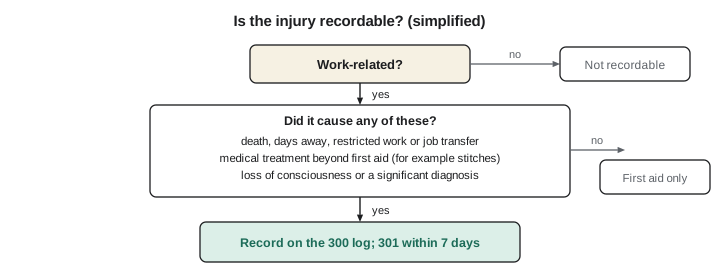
A case is recordable if it is work-related and results in death, days away from work, restricted work or transfer to another job, medical treatment beyond first aid, loss of consciousness, or a significant injury or illness diagnosed by a physician or licensed health care professional. First aid, defined by a specific list in the recordkeeping rule, such as cleaning a wound, using a nonprescription medication at nonprescription strength, applying a bandage or butterfly closure, or using hot or cold packs, does not by itself make a case recordable. Stitches, prescription medication and rigid splints for immobilization are medical treatment, so those cases are recordable.
| Event | Report to OSHA within | Notes |
|---|---|---|
| Work-related fatality | 8 hours | Report by phone, online or in person |
| In-patient hospitalization of one or more employees | 24 hours | Admission for treatment, not just observation |
| Amputation | 24 hours | Includes fingertip amputations with bone loss |
| Loss of an eye | 24 hours |
Measuring safety performance
Owners and general contractors often ask subcontractors for their total recordable incident rate, sometimes called the TRIR or recordable incident rate, and their DART rate, which counts only cases with days away, restricted work or transfer. Both are normalized to 200,000 hours, the hours worked by 100 full-time employees in a year, so companies of different sizes can be compared. Together with the EMR from Lesson 5, these numbers often decide whether a contractor is allowed to bid.
Worked problem
Brightwater's rates
Brightwater's employees worked 29,600 hours last year. The 300 log shows 2 recordable cases, one of which involved restricted duty. Find the total recordable rate and the DART rate.
Show solution
- Total recordable rate: 2 × 200,000 ÷ 29,600 = 13.5.
- DART rate: 1 × 200,000 ÷ 29,600 = 6.8.
Answer: A total recordable rate of about 13.5 and a DART rate of about 6.8. With so few hours, one case moves the rate a lot, which is why small contractors also show their EMR and safety program.
# OSHA incident rates normalized to 200,000 hours (example data)
hours = 29600
cases = {"recordable": 2, "dart": 1}
for name, n in cases.items():
    print(name, "rate:", round(n * 200000 / hours, 1))
# how many hours make one case equal a rate of 3.0?
print("hours for one case at rate 3.0:", round(200000 / 3.0))recordable rate: 13.5 dart rate: 6.8 hours for one case at rate 3.0: 66667
What NFPA 70E is and why OSHA uses it
OSHA's electrical rules say what employers must achieve: deenergize when feasible, use safe work practices, and provide protective equipment appropriate to the hazard. NFPA 70E explains how to do it in detail. It is a consensus standard, not a law by itself, but OSHA treats it as recognized industry practice, and inspectors use it as evidence of what a reasonable employer should do under the general duty clause and the electrical standards. Many owners also write it into their contracts. For an electrical contractor, following 70E is the practical way to meet OSHA's electrical requirements.
The standard's central idea matches Ray's rule. Work should be done in an electrically safe work condition, reached by a defined process: identify all sources, open the disconnecting devices, verify visually that contacts are open, apply locks and tags under a written procedure, test for absence of voltage with a properly rated tester verified before and after use, and ground the conductors where induced voltage or stored energy could be present. Energized work is justified only when deenergizing would create a greater hazard, or is infeasible because of equipment design or operational limits, or for tasks such as testing and troubleshooting that require power. Energized work above the standard's thresholds requires a written energized electrical work permit approved by management.
Risk assessments, boundaries and PPE
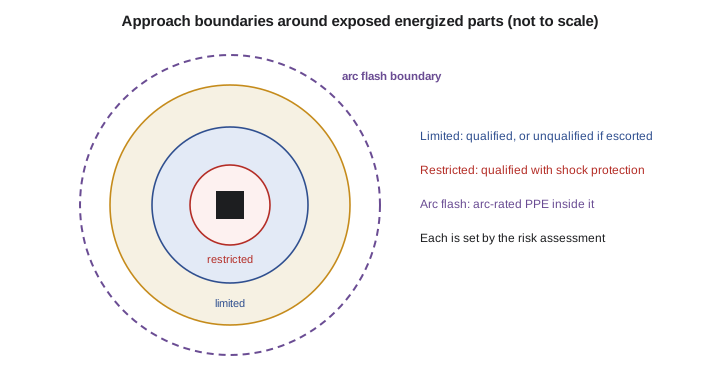
When work will be done near exposed energized parts, 70E requires two risk assessments. The shock risk assessment identifies shock hazards and sets two approach boundaries around exposed live parts: the limited approach boundary, inside which only qualified persons, or unqualified persons escorted by them, may go; and the restricted approach boundary, inside which only qualified persons with appropriate shock protection may work. The arc flash risk assessment determines whether an arc flash hazard exists, the arc flash boundary at which the incident energy would cause a second-degree burn, and the protective equipment needed, either from an incident energy analysis expressed in calories per square centimeter or from the standard's PPE category tables for common equipment.
Equipment that may be worked on while energized must carry a label with the information needed to choose protection, such as the nominal voltage, the arc flash boundary, and either the incident energy and working distance or the PPE category. Arc flash studies must be reviewed periodically and whenever the system changes. Arc-rated clothing, voltage-rated gloves with leather protectors, face shields or arc flash hoods, and insulated tools are selected from the assessment, and everyday clothing made of meltable synthetic fibers is prohibited under arc-rated layers because it can melt into the skin.
| Term | Meaning | Who may cross it |
|---|---|---|
| Limited approach boundary | Shock boundary farther from the live part | Qualified persons; unqualified only if escorted |
| Restricted approach boundary | Shock boundary close to the live part | Qualified persons with shock protection and a plan |
| Arc flash boundary | Distance where incident energy would cause a second-degree burn | Anyone inside needs arc flash PPE |
| Working distance | Distance from the arc source to the worker's face and chest | Used to calculate incident energy |
Training and the safety program
70E requires employers to train workers so they are qualified for the tasks they perform: able to recognize hazards, understand the equipment, select and use protection, and follow the employer's procedures. Training is documented, and retraining is required at regular intervals, at least every three years under the standard, and sooner when inspections show a worker is not following procedures or when equipment or procedures change. Employees exposed to shock hazards need emergency response training, including releasing victims from contact and first aid, CPR and AED use, refreshed on a regular schedule. The employer must have a written electrical safety program, audited periodically, and must audit field work to verify that procedures are followed.
Host employers and contract employers share information under the standard: the host tells the contractor about known hazards and the facility's electrical safety program, and the contractor tells the host about hazards its work creates. On Delgado Fabrication's shop floor, Dana met with Hector's maintenance lead before every energized task so both knew who would lock out what, an example of that coordination in practice.
Common mistakes
MistakeTreating NFPA 70E as optional because it is not a federal regulation.
InsteadOSHA uses it as recognized practice; following it is how contractors meet OSHA's electrical duties.
MistakeRecording only cases with days away from work.
InsteadRecord cases with medical treatment beyond first aid, restricted work, loss of consciousness or significant diagnosis too.
MistakeReporting a hospitalization the next week.
InsteadIn-patient hospitalization, amputation or loss of an eye must be reported within 24 hours; a fatality within 8 hours.
MistakeTesting for absence of voltage with an unverified meter.
InsteadVerify the tester on a known source before and after the test.
MistakeWorking energized because shutting down is inconvenient.
InsteadInconvenience does not justify energized work; use the electrically safe work condition or a justified, permitted exception.
Summary and key terms
- OSHA's construction rules (Part 1926, Subpart K) and general industry rules (Part 1910, Subpart S and 1910.147) both reach electrical contractors.
- Keep the 300 log and 301 reports, post the certified 300A from February 1 to April 30, and keep records five years; 10 or fewer employees are partially exempt.
- Report fatalities within 8 hours and in-patient hospitalization, amputation or loss of an eye within 24 hours.
- Incident rates are cases × 200,000 ÷ hours worked.
- NFPA 70E makes the electrically safe work condition the default and requires justification and a permit for energized work.
- Shock and arc flash risk assessments set boundaries and PPE; training must be documented and repeated.
- General duty clause
- The OSH Act requirement to protect workers from recognized serious hazards.
- Recordable case
- A work-related injury or illness meeting OSHA's recording criteria.
- Electrically safe work condition
- A state in which equipment is deenergized, locked out, tested and grounded as needed.
- Arc flash boundary
- The distance at which arc flash incident energy would cause a second-degree burn.
- Qualified person
- Someone trained and knowledgeable in the equipment and its hazards.
Practice problems
Work each problem on paper first, then reveal the answer to check.
A contractor's employees worked 52,000 hours with 3 recordable cases. Find the recordable rate.
Show answer
3 × 200,000 ÷ 52,000 = 11.5.
An apprentice gets four stitches after a cut. Is the case recordable?
Show answer
Yes. Stitches are medical treatment beyond first aid.
When must the 300A summary be posted?
Show answer
From February 1 to April 30 of the year after the year it covers.
Name three justifications 70E recognizes for energized work.
Show answer
Deenergizing creates a greater hazard; it is infeasible because of design or operational limits; or the task, such as testing or troubleshooting, requires the equipment energized.
Lesson quiz · 5 questions
Score 60% or more to complete this lesson.
Create a free account to save your progress, take quizzes and earn a certificate.