
MELU-107 · Lesson 11 of 12 · 21 min
Open-book exam technique and time management
▶ Video coming soon A video version of this lesson is on the way.
Three weeks before her exam date, Dana took a full practice test under real conditions: a timer, the approved books on the desk, a basic calculator and no phone. She knew the material. She still ran out of time with eleven questions unanswered, because she had spent fourteen minutes on a single motor feeder question and seven more hunting for a lien deadline in the wrong chapter of the business reference. Marcus, who had taken the same test the week before, had finished with twenty minutes to spare and scored lower. The two of them sat down with Ray that evening to work out why. "Open book doesn't mean the book does the work," Ray said. "It means the exam is a race between your reading and the clock."
Earlier courses in this core covered how to navigate the NEC itself. This lesson pulls together a strategy for both kinds of licensing exam, the code exam and the business and law exam: preparing the books, finding answers quickly, budgeting time, handling calculations, deciding when to guess, and managing the day of the exam. Most candidates who fail an open-book exam do not fail for lack of knowledge; they fail for lack of time.
Preparing the books
The approved references are your tools, and preparing them is part of studying. Buy the exact editions the bulletin lists, including any state supplement. Most bulletins allow permanent tabs, highlighting and underlining and forbid loose papers, sticky notes, written notes beyond simple marks and anything that can be removed. Tab in a consistent pattern: for the NEC, tab each chapter and the most used articles, tables and annex examples; for the business reference, tab each chapter and the pages you used most in practice, such as the lien timeline, bond types, payroll tax table, financial ratios and the state licensing law. Use one color for the tab label and another for highlighting key numbers, and stop adding tabs once they stop saving time; a book with two hundred tabs is as hard to search as a book with none.
| Book | Tab first | Tab second |
|---|---|---|
| NEC | Each chapter; Article 100; Articles 210, 220 (120 in 2026), 230, 240, 250, 310, 430 | Chapter 9 tables, Annex C and D, Articles 517, 680, 700 to 702 |
| Business and law reference | Each chapter; index; state supplement | Lien law, bonds, payroll tax tables, ratios, OSHA recordkeeping |
| State licensing law | Definitions; license classes; supervision; discipline | Renewal, continuing education, contractor requirements |
| OSHA or safety references (if allowed) | Subpart K; recordkeeping | Lockout, ladders, fall protection |
Finding answers fast
Every question has a few words that point to the right place. Train yourself to circle them mentally before opening any book. For a code question, decide the chapter first from the subject: wiring and protection in Chapter 2, wiring methods in Chapter 3, equipment in Chapter 4, special occupancies, equipment and conditions in Chapters 5 to 7, communications in Chapter 8 in editions that still have it, and tables in Chapter 9. Then go to the article and its section headings. Use the index when the subject could live in several places, and look up the most specific term in the question, not the general one. For a business question, the reference's index and chapter titles are usually enough; many answers are a single sentence or a row in a table.
Read the question once for its subject and once for its exact demand. Questions often ask for a minimum, a maximum, an exception, the one choice that is not permitted, or a value in particular units. Many wrong answers are correct statements that answer a different question. In business and law questions, words such as must, may, always, never, generally and usually matter as much as shall and shall be permitted do in the code.
- Identify the subject and the demand: minimum, maximum, permitted or not permitted, units.
- Choose the book and chapter from the subject before opening anything.
- Use section headings, then the index for terms that could live in several places.
- Confirm the answer in the text; do not answer from memory when the book is on the desk and time allows.
- Note the page or section in the margin of your scratch paper in case you revisit it.
Budgeting time
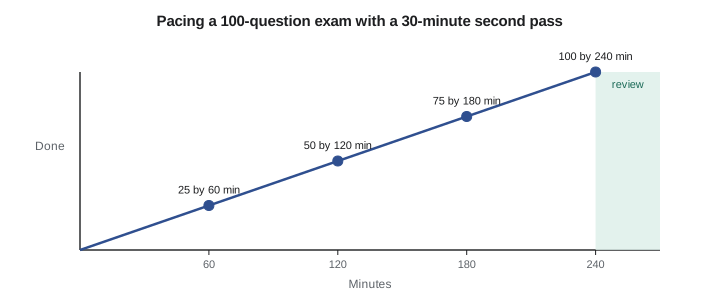
Divide the time by the number of questions to get an average, then plan to beat it. A common approach is the two-pass method. On the first pass, answer every question you can answer quickly, either from knowledge or with one look in the book, and mark the rest for review. Most computer-based exams let you flag questions and return to them. On the second pass, work the marked questions in order of how quickly you think you can solve them. Keep a running check against the clock: at one quarter of the time you should have completed at least a quarter of the questions, and so on. If a single question takes more than about twice the average, make your best guess, flag it and move on; one question is worth the same as any other.
Worked problem
A time plan for the code exam
Dana's trade exam has 100 questions in 270 minutes. She wants to keep 30 minutes for a second pass. What average time per question does that leave on the first pass, and how many questions should she have finished at the 2-hour mark?
Show solution
- Time for the first pass: 270 − 30 = 240 minutes.
- Average per question: 240 ÷ 100 = 2.4 minutes.
- At 120 minutes: 120 ÷ 2.4 = 50 questions.
Answer: 2.4 minutes per question, and at least 50 questions done by the 2-hour mark.
# Checkpoints for a two-pass exam plan (example: 100 questions, 270 minutes)
questions, total, review = 100, 270, 30
per_q = (total - review) / questions
for minute in (60, 120, 180, 240):
    target = min(questions, int(minute / per_q))
    print(f"at {minute:3d} min: at least {target} answered")
print("cut-off for any one question:", round(2 * per_q, 1), "minutes")at 60 min: at least 25 answered at 120 min: at least 50 answered at 180 min: at least 75 answered at 240 min: at least 100 answered cut-off for any one question: 4.8 minutes
Calculation questions
Calculation questions take the most time and offer the most traps. Before calculating, write down what is asked and which code rule or formula applies. Then work in a fixed order: find the base value from the table or nameplate, apply the multiplier, apply any adjustment or correction, and round only at the step the code says to round, and in the direction it says. Many exam distractors are the answer you would get by forgetting one factor, using the wrong table column, rounding too early, or applying 125% to the wrong item, so a choice that matches your first number is not proof you are right. When time allows, check the result by estimating: a feeder for a few motors should not come out at thousands of amperes.
Business and law calculations follow the same discipline: markup versus margin, retainage, payroll overtime, incident rates, ratios and lien deadlines. Write the formula first. For date problems, count carefully, noting whether the rule counts calendar days or business days and whether the first day counts. Know your calculator; many test centers provide or allow only a basic nonprogrammable model, so practice with that model, including its memory keys.
Guessing and changing answers
Most licensing exams score only correct answers, with no penalty for wrong ones, so a blank answer is always worse than a guess. Never leave a question unanswered. When you must guess, eliminate what you can first: answers that conflict with a rule you know, answers with values far from an estimate, and answers that use absolute words such as always or never where the rule has exceptions. On questions where two choices are close, the more specific one that matches the exact words of the question is more often correct. Change an answer on review only when you find a specific reason in the book, such as a misread word or a wrong table; changing answers on vague second thoughts tends to replace right answers with wrong ones.
| Situation | What to do |
|---|---|
| You know the answer and can confirm it in under a minute | Answer and move on |
| You know where to look but it will take time | Mark it; answer on the second pass |
| You have spent twice the average time | Best guess, flag, move on |
| Five minutes left with questions unanswered | Answer every remaining question, even by guessing |
| You doubt an answer on review | Change it only with a specific reason from the text |
Practice tests and error logs
Practice tests are most useful when you analyze them. After each timed practice exam, list every missed or guessed question with the cause: did not know the rule, could not find it, misread the question, arithmetic error, ran out of time, or changed a right answer. Patterns appear quickly. Dana's log showed that most of her misses came from two causes: slow searches in the business reference and misreading not permitted questions. She added six tabs to the business book and started underlining the demand in each question on her scratch paper, and her next practice score rose by nine points. Marcus's log showed the opposite problem: fast searches but careless reading, so he slowed down on the first read of each question.
Worked problem
Reading an error log
After a 100-question practice exam, Dana's log shows 9 misses from slow searches, 6 from misreading, 4 from arithmetic, 3 from not knowing the rule and 2 unanswered at the end. Which change should come first?
Show solution
- Total misses: 9 + 6 + 4 + 3 + 2 = 24, so the score was 76.
- Slow searches and unanswered questions are both time problems: 9 + 2 = 11.
- Misreading is the next largest cause at 6.
Answer: Speed up searching first (better tabs and chapter selection), then add a deliberate reading step. Learning new rules would gain the least.
The day of the exam
Logistics matter. Confirm the test center, time and identification requirements several days ahead, and plan to arrive early, because late arrivals may forfeit the seat and the fee. Pack the approved books, checked against the bulletin's rules, and expect them to be inspected. Eat beforehand and bring water if allowed. Use any tutorial time at the start to settle in and learn the testing software's flag and review screens. During the exam, keep breathing steadily, stick to the time plan, and do not let one hard question shake your confidence; everyone meets questions they cannot answer. Results for computer-based exams are often available as soon as you finish, with a score report showing performance by content area, which is valuable if a retake is needed.
Retakes and score reports
Not everyone passes the first time, and many good electricians need a second attempt. Most states allow retakes after a waiting period and a new fee, and some limit the number of attempts within a year before more study or a new application is required. The score report from a failed attempt usually shows performance by content area, which is the most useful study guide available: it says exactly where the points were lost. Dana's plan, had she needed it, was to schedule the retake as soon as the rules allowed, spend most of the time on the two weakest areas, and repeat the full simulation before the new date.
Common mistakes
MistakeTabbing every page that looked important.
InsteadTab chapters and the pages you used most in timed practice; too many tabs slow you down.
MistakeSpending ten minutes on one hard question early in the exam.
InsteadGuess, flag and move on after about twice the average time; return on the second pass.
MistakeLeaving questions blank at the end.
InsteadAnswer everything; most exams have no penalty for wrong answers.
MistakeRounding in the middle of a calculation.
InsteadRound only where the rule says, and in the direction it says.
MistakeChanging answers on review because of a vague feeling.
InsteadChange only with a specific reason found in the text.
Summary and key terms
- Prepare the exact approved books with permanent tabs and highlighting allowed by the bulletin.
- Find the subject and the exact demand of each question before opening a book; choose the chapter, then the section.
- Use a two-pass plan with time checkpoints; cut losses on any question taking more than about twice the average.
- Work calculations in a fixed order, round only as the rule directs, and sanity-check results.
- Never leave a blank; eliminate before guessing; change answers only for specific reasons.
- Analyze practice tests with an error log and fix the largest cause first.
- Two-pass method
- Answering quick questions first and returning to marked questions on a second pass.
- Checkpoint
- A planned count of answered questions at a set time.
- Distractor
- A wrong answer designed to look right, often the result of a common mistake.
- Error log
- A record of missed practice questions and their causes.
- Candidate bulletin
- The vendor's rules and content outline for the exam.
Practice problems
Work each problem on paper first, then reveal the answer to check.
An exam has 80 questions in 180 minutes, and you keep 20 minutes for review. What is the first-pass average per question?
Show answer
(180 − 20) ÷ 80 = 2.0 minutes.
With that plan, how many questions should be done at 90 minutes?
Show answer
90 ÷ 2.0 = 45 questions.
Your log shows 12 misses from slow searching and 3 from unknown rules. What should you work on first?
Show answer
Search speed: better tabs, chapter selection and index practice.
Five minutes remain and 6 questions are blank. What should you do?
Show answer
Answer all 6, guessing where necessary, because blanks score zero.
Lesson quiz · 5 questions
Score 60% or more to complete this lesson.
Create a free account to save your progress, take quizzes and earn a certificate.