
MELU-107 · Lesson 7 of 12 · 19 min
Employment law and payroll records
▶ Video coming soon A video version of this lesson is on the way.
Brightwater's busiest summer in years brought two hires and one headache. The hires were a journeyman named Andre Fields and a first-year apprentice, Kayla Moreno. The headache was a phone call from a former helper who had worked for Brightwater for three months the previous year as a "subcontractor", paid by the job with no taxes withheld. He had filed a claim with the state saying he was really an employee and was owed overtime. Ray had hired him in a hurry on another manager's advice, and now Priya was pulling every record she could find. "This is the part of running a shop nobody teaches electricians," Ray told Dana. "You can wire a hospital and still lose money because of a payroll mistake."
Every electrical contractor with employees is subject to federal and state employment laws: wage and hour rules, hiring documentation, anti-discrimination law, leave laws, and recordkeeping rules that decide what must be kept and for how long. Business and law exams test the main federal laws, the difference between employees and independent contractors, overtime arithmetic, and record retention periods. This lesson covers each in turn.
Employee or independent contractor
The first question in every employment law problem is whether a worker is an employee at all. Employees are covered by wage and hour laws, workers' compensation and unemployment insurance, and their employer withholds and pays payroll taxes. Independent contractors run their own businesses and are paid by invoice. Misclassifying an employee as a contractor can make the employer liable for unpaid overtime, back payroll taxes, penalties, workers' compensation premiums and unemployment contributions.
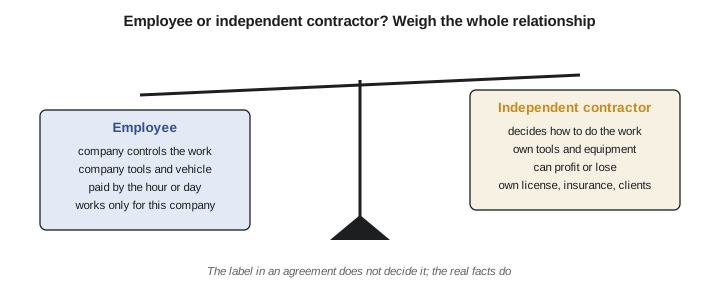
Agencies use several tests, and the details differ between the IRS, the Department of Labor and state agencies, but they ask similar questions. Who controls how, when and where the work is done? Does the worker use the company's tools and materials, or his own? Can the worker make or lose money through his own business decisions? Does the worker offer services to the public, with his own license and insurance? Is the relationship ongoing and the work part of the company's regular business? A helper who works Brightwater's hours, on Brightwater's jobs, under Brightwater's direction, with Brightwater's tools, is almost certainly an employee regardless of what anyone calls him. A licensed trenching company with its own equipment, insurance and other customers that bids a job is a subcontractor.
| Factor | Points toward employee | Points toward independent contractor |
|---|---|---|
| Control | Company sets hours, methods and sequence | Worker decides how to achieve the result |
| Tools and equipment | Company provides | Worker provides, often costly equipment |
| Profit or loss | Paid by the hour, no investment | Can profit or lose through pricing and management |
| Market | Works only for this company | Offers services to the public, has other clients |
| Licensing and insurance | Works under the company's license | Holds own license, insurance and business registration |
| Relationship | Ongoing, integral to the business | Defined project, separate trade |
Wage and hour rules
The federal Fair Labor Standards Act, or FLSA, sets a federal minimum wage, requires overtime pay of at least one and a half times the regular rate for hours worked over 40 in a workweek for nonexempt employees, restricts child labor, and requires employers to keep payroll records. Many states and cities set higher minimum wages, and a few require daily overtime, such as over 8 hours in a day. Electricians, apprentices and helpers are almost always nonexempt, which means they are entitled to overtime regardless of whether they are paid hourly, by salary or by the job. A workweek is a fixed period of 168 hours, seven consecutive 24-hour days; hours cannot be averaged across two weeks.
The regular rate includes most forms of pay, such as hourly wages, shift differentials and nondiscretionary bonuses, so overtime is calculated on the full regular rate, not just the base wage. Time spent working counts, including required travel between job sites during the day, required meetings and training, and time spent loading the truck at the shop before driving to the first job. Ordinary commuting from home to the first job usually does not count. These details are where many small contractors go wrong.
Worked problem
Overtime for a week
Andre's base rate is 38.00 dollars per hour. In one workweek he works 47 hours and earns a 94 dollar nondiscretionary production bonus. Find his gross pay under the federal rule.
Show solution
- Straight-time earnings: 47 × 38.00 = 1,786.00, plus the bonus 94.00 = 1,880.00.
- Regular rate: 1,880.00 ÷ 47 = 40.00 per hour.
- Overtime premium: 7 overtime hours × 0.5 × 40.00 = 140.00.
- Gross pay: 1,880.00 + 140.00 = 2,020.00.
Answer: 2,020.00 dollars. Leaving the bonus out of the regular rate would underpay overtime by 7 dollars.
# FLSA weekly overtime with a nondiscretionary bonus (example)
def gross_pay(hours, rate, bonus=0.0, threshold=40):
    straight = hours * rate + bonus
    regular_rate = straight / hours
    ot_hours = max(0, hours - threshold)
    return straight + ot_hours * 0.5 * regular_rate, regular_rate

for hours, bonus in ((40, 0), (47, 94), (52, 0)):
    pay, rr = gross_pay(hours, 38.00, bonus)
print(f"{hours} h, bonus {bonus}: regular rate {rr:.2f}, gross {pay:.2f}")40 h, bonus 0: regular rate 38.00, gross 1520.00 47 h, bonus 94: regular rate 40.00, gross 2020.00 52 h, bonus 0: regular rate 38.00, gross 2204.00
Prevailing wage work
On federally funded construction contracts above a threshold, the Davis-Bacon Act and related laws require contractors to pay laborers and mechanics at least the prevailing wage and fringe benefits that the Department of Labor determines for each trade and area, listed in a wage determination included in the contract. Contractors must submit certified payroll weekly, listing each worker, classification, hours, rates and deductions, and must keep the records for three years after the work. Many states have their own prevailing wage laws for state and local public works. Apprentices may be paid less than journeyman rates only if they are registered in an approved apprenticeship program and the ratio of apprentices to journeymen is within the program's limits, which ties directly to Lesson 9.
Brightwater's library lighting retrofit was a city project under the state's prevailing wage law. Priya filed certified payroll every week, and Ray made sure Kayla's registration card was in the file, because without it she would have had to be paid the full electrician rate.
Hiring documents
Federal law requires every employer to verify each new employee's identity and authorization to work in the United States on Form I-9. The employee completes Section 1 by the first day of work, and the employer examines the employee's original documents and completes Section 2 within three business days of the start date. The employer keeps the I-9 for three years after the date of hire or one year after employment ends, whichever is later, and must produce it for inspection when asked. Some states require employers to use the federal E-Verify system as well.
New employees complete Form W-4 so the employer can withhold federal income tax correctly, along with any state withholding form. Employers must report new hires to a state directory, generally within 20 days of hire, to help enforce child support orders. Many states also require written notice of pay rate and payday at hiring. Posters describing federal and state employment rights must be displayed where employees can see them, including at job site trailers in some states.
| Record | Typical retention (federal) | Source of the rule |
|---|---|---|
| Form I-9 | 3 years after hire or 1 year after termination, whichever is later | Immigration law |
| Payroll records (names, hours, wages) | At least 3 years | FLSA |
| Time cards and wage rate tables | At least 2 years | FLSA |
| Employment tax records | At least 4 years after the tax is due or paid | IRS guidance |
| Certified payroll on federal projects | 3 years after completion | Davis-Bacon rules |
| OSHA injury logs | 5 years | OSHA recordkeeping (Lesson 8) |
Anti-discrimination and leave laws
Federal law prohibits discrimination in hiring, pay, promotion, discipline and firing based on race, color, religion, sex (including pregnancy, sexual orientation and gender identity), national origin, age 40 and over, disability and genetic information, and prohibits retaliation against employees who complain or take part in investigations. Coverage depends on size: Title VII and the Americans with Disabilities Act apply to employers with 15 or more employees, the Age Discrimination in Employment Act to employers with 20 or more, and the Equal Pay Act to almost all employers. State laws often cover smaller employers and more categories. The ADA also requires reasonable accommodation of qualified employees with disabilities unless it would cause undue hardship, though an employer need not remove the essential functions of a job, such as climbing for an electrician.
The Family and Medical Leave Act requires employers with 50 or more employees within 75 miles to give eligible employees up to 12 weeks of unpaid, job-protected leave a year for specified family and medical reasons. Many states and cities add paid sick leave requirements that apply to much smaller employers. With its office staff, Brightwater had 12 employees, which put it under several state laws but below the federal Title VII and ADA thresholds; Priya followed the federal rules anyway because the state law mirrored them.
| Law | Main requirement | Employer size covered |
|---|---|---|
| Fair Labor Standards Act | Minimum wage, overtime, child labor, records | Almost all employers |
| Title VII of the Civil Rights Act | No discrimination on protected traits | 15 or more employees |
| Americans with Disabilities Act | No disability discrimination; reasonable accommodation | 15 or more employees |
| Age Discrimination in Employment Act | No discrimination against workers 40 and over | 20 or more employees |
| Family and Medical Leave Act | Up to 12 weeks job-protected unpaid leave | 50 or more employees |
| Equal Pay Act | Equal pay for equal work regardless of sex | Almost all employers |
How the misclassification claim ended
The former helper's claim turned on the factors in the first table. Brightwater had set his hours, given him tools, sent him to its own jobs and paid him by the day, and he had no license, insurance or other customers. The state agency found that he was an employee. Brightwater owed him 610 dollars in unpaid overtime, plus the employer's share of payroll taxes and unemployment contributions for the period, and a penalty. Ray paid it, and the company's rule after that was simple: everyone who works under Brightwater's direction goes on payroll, and every subcontractor provides a license, a certificate of insurance and a written subcontract.
Workplace posters, handbooks and termination
Federal and state laws require employers to display posters on minimum wage, safety rights, equal employment opportunity, family leave where covered, and other topics, in a place employees see, and some states require posters at remote job sites or electronic delivery. A written employee handbook is not usually required by law, but it helps employers apply policies consistently on hours, overtime approval, safety, vehicles, phones, drug and alcohol testing, leave and discipline. Most employment in the United States is at will, meaning either side may end it at any time for any lawful reason, but a termination may not be for a discriminatory or retaliatory reason, and many states set deadlines for paying final wages, sometimes on the last day of work. Documentation of performance and consistent treatment, discussed in Lesson 9, are the employer's best protection.
Common mistakes
MistakeCalling a helper a subcontractor to avoid payroll taxes.
InsteadClassification depends on the real relationship; workers under your control are usually employees.
MistakePaying straight time for hours over 40 to a salaried electrician.
InsteadElectricians are almost always nonexempt; overtime is owed whatever the pay method.
MistakeLeaving bonuses out of the overtime rate.
InsteadNondiscretionary bonuses go into the regular rate used for overtime.
MistakeCompleting Form I-9 weeks after hire.
InsteadSection 2 is due within three business days of the first day of work.
MistakeThrowing out time cards after one year.
InsteadKeep time cards at least 2 years and payroll records at least 3 years under federal rules; states may require more.
Summary and key terms
- Classification depends on control, tools, profit and loss, market and the relationship, not on labels.
- The FLSA requires overtime at one and a half times the regular rate over 40 hours in a fixed workweek for nonexempt employees.
- The regular rate includes nondiscretionary bonuses and differentials; required work time counts.
- Prevailing wage jobs require determined rates, certified payroll and registered apprentices within ratios.
- Form I-9 Section 2 within three business days; keep I-9s 3 years after hire or 1 year after termination, whichever is later.
- Federal anti-discrimination laws apply by employer size: 15 for Title VII and ADA, 20 for ADEA, 50 for FMLA.
- Nonexempt employee
- An employee entitled to minimum wage and overtime under the FLSA.
- Regular rate
- Total straight-time compensation divided by hours worked, used to compute overtime.
- Certified payroll
- A weekly sworn payroll report required on prevailing wage projects.
- Form I-9
- The federal form verifying identity and work authorization for each new employee.
- Misclassification
- Treating an employee as an independent contractor.
Practice problems
Work each problem on paper first, then reveal the answer to check.
An electrician earns 32 dollars per hour and works 45 hours with no bonus. Find gross pay.
Show answer
40 × 32 = 1,280; 5 × 48 = 240; total 1,520 dollars.
An apprentice works 44 hours at 20 dollars per hour and earns a 44 dollar nondiscretionary bonus. Find the regular rate and gross pay.
Show answer
Straight time 880 + 44 = 924; regular rate 21.00; overtime premium 4 × 10.50 = 42; gross 966 dollars.
An employee was hired March 1, 2020 and left June 30, 2025. Until when must the I-9 be kept?
Show answer
Later of March 1, 2023 and June 30, 2026: June 30, 2026.
How many employees bring an employer under Title VII?
Show answer
15 or more.
Lesson quiz · 5 questions
Score 60% or more to complete this lesson.
Create a free account to save your progress, take quizzes and earn a certificate.