
MELU-107 · Lesson 1 of 12 · 21 min
What master and contractor exams cover
▶ Video coming soon A video version of this lesson is on the way.
Ray Ochoa had been the master electrician of record for Brightwater Electric for twenty-six years. His license was the reason the company could pull permits, sign contracts for electrical work and advertise as an electrical contractor in Harlow. On a slow Friday in January he sat down with Dana Whitfield at the office table, slid a folder across to her and said the thing he had been hinting at for a year. "In two years I'm done. If you want this company to keep its name on the trucks, you need to be the license." Inside the folder were the state's candidate bulletin, a contractor license application and a sticky note in Priya Natarajan's handwriting: "Business and law exam too. Don't forget."
Dana had spent six courses preparing for the code part of the master electrician exam: navigating the NEC, load calculations, conductors and overcurrent protection, grounding, motors and transformers, and special occupancies. This last course covers the other half of the job, and in many states the other half of the testing. A master electrician or electrical contractor is not only the best code reader in the company. That person signs contracts, carries legal responsibility for permits and inspections, supervises other electricians, hires and pays people, keeps records that regulators can demand, and runs a business that has to stay solvent. Licensing exams reflect that, and this lesson maps what they test so the rest of the course can work through it in order.
Two kinds of license and two kinds of exam
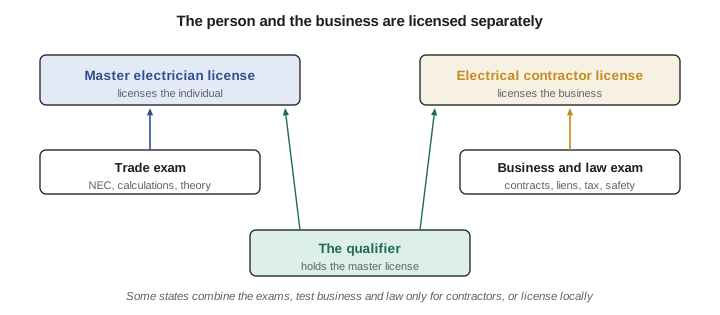
Most states separate the person from the business. The individual license, often called master electrician, supervising electrician or electrical administrator, shows that a person has the experience and code knowledge to plan and supervise electrical work. The business license, often called an electrical contractor license, allows a company to offer and contract for electrical work with the public. In many states the contractor license requires a qualifying individual, sometimes called the qualifier, responsible managing employee or license holder, who holds the master-level license and is responsible for the company's electrical work. That was Ray's role, and it is the role Dana was preparing to take over.
Because there are two licenses, there are often two exams. The trade exam tests the NEC and electrical theory: calculations, installation rules and code navigation, the material of the first six courses in this core. The business and law exam tests contracts, liens, insurance, taxes, employment law, safety regulation, project management and the state's own licensing law. Some states combine them into one sitting, some give business and law only to contractors and not to individual masters, and a few have no statewide license at all and leave licensing to cities and counties. The state courses in this program describe each jurisdiction's path.
| Exam | Who usually takes it | Typical content |
|---|---|---|
| Master or supervising electrician (trade) | The individual seeking the master-level license | NEC navigation and rules, load and motor calculations, theory, sometimes local amendments |
| Electrical contractor (trade) | The qualifier for a contracting business, in states that test it separately | Similar to the master exam, sometimes with more design and estimating questions |
| Business and law | The qualifier or owner of a contracting business | Licensing law, contracts, liens, insurance and bonds, taxes, payroll, safety records, project management |
Where business and law questions come from
Business and law exams are almost always open book, and the book defines the exam. Many states use a business and law reference published by NASCLA, the National Association of State Contractors Licensing Agencies, often called the NASCLA Contractor's Guide to Business, Law and Project Management. It comes in a basic edition and in state-specific editions that add the state's licensing law, lien law and tax rules. Other states list their own manuals, the state's licensing statute and rules, a federal publication such as the OSHA construction regulations, or a mix. The candidate bulletin from the testing vendor lists the exact titles and editions allowed, and that list is the most important page you will read while preparing.
The questions follow the chapters of the reference. A typical exam samples from business organization and planning, licensing requirements, estimating and bidding, contracts and contract management, project scheduling and management, risk management, insurance and bonds, accounting and financial statements, tax basics, payroll and employment law, safety and health regulation, environmental rules such as lead-safe work in older housing, and lien law. The trade content of electrical work rarely appears on the business and law exam at all, which surprises electricians who expect a few code questions to help them along.
| Topic area | What questions ask | Where this course covers it |
|---|---|---|
| Licensing law | Who must be licensed, qualifier duties, renewals, discipline, unlicensed work | Lessons 1, 5 |
| Permits and inspections | When permits are needed, inspection stages, the authority having jurisdiction | Lesson 2 |
| Contracts and bidding | Contract types, bid math, change orders, scope, dispute clauses | Lesson 3 |
| Liens | Who may lien, preliminary notices, deadlines, lien waivers | Lesson 4 |
| Insurance and bonds | Liability, workers' compensation, bid, performance and payment bonds | Lesson 5 |
| Business organization and tax | Sole proprietor, partnership, LLC, corporation, tax deposits | Lesson 6 |
| Employment and payroll | Wage and hour rules, I-9, withholding, record retention | Lesson 7 |
| Safety | OSHA recordkeeping and reporting, NFPA 70E, training | Lesson 8 |
| Supervision and records | Ratios, apprentices, daily logs, as-builts, closeout | Lessons 9, 10 |
| Exam technique | Tabbing, indexing, timing, two-pass strategy | Lesson 11 |
How the exams are delivered
Almost every state now gives these exams by computer at a testing center run by a vendor such as PSI, Prometric or Pearson VUE. You schedule a seat after the licensing board approves your application, and you bring the approved references. Rules about books are strict and vary. Many bulletins allow highlighting, underlining and permanently attached tabs, and forbid loose notes, removable sticky flags or pages added to the book. Some vendors inspect every page before you start. A book that fails inspection is taken away, and you sit the exam without it, so reading the bulletin's reference rules is as important as studying.
Exam length differs widely. As a general picture, trade exams run about 80 to 100 questions in about four to five hours, and business and law exams run about 50 to 120 questions in about two to four hours, with a passing score near 70 out of 100. A few states use larger examinations; the NASCLA accredited exam for commercial building contractors, for example, has 115 scored questions in a single long sitting. Treat these numbers as typical only. Your bulletin states the number of questions, the time limit, the passing score and whether unscored pretest questions are mixed in.
Worked problem
Planning around the bulletin
Dana's state bulletin says the business and law exam has 70 scored questions plus 5 unscored pretest questions, a time limit of 180 minutes, and a passing score of 70 out of 100. How many questions must she answer correctly, and how much time does she have per question if she spreads the time evenly over all the questions shown?
Show solution
- Questions she must get right: 70 out of 100 means 0.70 × 70 = 49 scored questions.
- Questions on screen: 70 + 5 = 75, and she cannot tell which are pretest items.
- Time per question: 180 minutes ÷ 75 questions = 2.4 minutes, about 2 minutes 24 seconds.
Answer: She needs 49 correct and has about 2.4 minutes per question, before saving time for review.
# Exam arithmetic: pass mark and time budget (example numbers; use your bulletin)
scored, pretest, minutes, pass_share = 70, 5, 180, 0.70
need = pass_share * scored
shown = scored + pretest
per_q = minutes / shown
review = 20                      # minutes kept back for a second pass
print("Correct answers needed:", round(need))
print("Questions on screen:", shown)
print("Minutes per question:", round(per_q, 2))
print("Minutes per question with review time kept:", round((minutes - review) / shown, 2))Correct answers needed: 49 Questions on screen: 75 Minutes per question: 2.4 Minutes per question with review time kept: 2.13
Qualifications before the exam
Licensing boards check experience before they let candidates test. Master-level licenses usually require several years as a licensed journeyman, often two to four, documented by employer affidavits, payroll records or apprenticeship transcripts, and some states accept engineering or technical degrees in place of part of the experience. Contractor licenses add business requirements such as proof of general liability insurance, workers' compensation coverage or a sworn exemption, a surety bond, a financial statement showing minimum net worth or working capital, registration of the business with the secretary of state, and sometimes a criminal background check. Dana's application packet listed all of these, and Priya had already started collecting the documents because some took weeks to arrive.
Exam questions test the qualifications themselves in the state-specific part of the business and law exam. Typical questions ask how many hours of experience a master needs, how long a license lasts, how many continuing education hours renewal requires, what happens when the qualifier leaves the company, and what penalties apply to unlicensed contracting. The general pattern is that the company must notify the board within a short time when a qualifier leaves, often 30 to 90 days, and must replace the qualifier or stop contracting. Ray planned his retirement so that Dana would be licensed and listed as qualifier well before he left.
| Requirement | Common pattern | What the candidate does |
|---|---|---|
| Experience | Several years as a journeyman, documented | Collect employer letters, pay records, transcripts |
| Exams | Trade exam, often a business and law exam | Schedule after board approval; bring approved books |
| Insurance | General liability, workers' compensation | Certificates sent to the board by the insurer |
| Bond | License or compliance bond in some states | Buy from a surety; keep it in force |
| Financial | Net worth or working capital minimum in some states | Financial statement, sometimes reviewed by an accountant |
| Renewal | Fixed term with continuing education | Track hours, especially code update courses |
Why the business side matters in the field
It is tempting to treat business and law as paperwork that stands between an electrician and the license. Ray saw it differently. In his years running Brightwater, he had seen more electrical contractors fail from bad contracts, unpaid invoices and payroll trouble than from bad installations. A contractor who forgets to send a preliminary lien notice can lose the right to collect for a job. A contractor who misclassifies workers as independent contractors can owe years of back taxes and penalties. A contractor who signs a contract with an unlimited indemnity clause can end up paying for someone else's mistake. The business and law exam tests exactly these traps.
The material also connects directly to code work. A permit is a legal application under the state's licensing law. An inspection correction notice is a legal order, and the contractor's response is part of the job record. Supervision ratios set how many apprentices one journeyman may oversee. NFPA 70E, which Lesson 8 covers, is the safety standard OSHA relies on when it cites electrical contractors for energized work. The master electrician of record is personally responsible for all of this, which is why the exam treats it seriously.
Building a study plan for this half
Dana had built a twelve-week plan for the code exam, and she added a separate plan for business and law. Her approach followed the same rules that worked for the NEC: get the exact reference editions, tab them the same way the exam will need them, read each chapter once for understanding, then switch to timed practice questions and record every miss with the page where the answer was. Business and law questions are often answered by a single sentence or table in the reference, so the skill is finding that sentence quickly, not memorizing every number.
- Weeks 1 and 2: read the candidate bulletin twice, buy the exact editions, and read the licensing law chapter and the business organization chapter.
- Weeks 3 and 4: contracts, bidding and estimating, with practice on bid and markup arithmetic.
- Weeks 5 and 6: liens, insurance and bonds, with the state's lien deadlines tabbed and highlighted.
- Weeks 7 and 8: accounting, tax and payroll, including the federal deposit and filing forms.
- Week 9: safety and health regulation, OSHA recordkeeping and NFPA 70E.
- Weeks 10 to 12: timed mixed exams, review of misses, and a full simulation under exam rules.
The plan ran alongside her code study rather than after it, because the state let candidates take the two exams in either order within a one-year approval window. Marcus Lee, her study partner from Lakeside Electric, was applying only for the individual master license, which in their state did not require the business and law exam, but he joined her practice sessions anyway. "If I ever want my own shop," he said, "I'll need this, and it's easier to learn now than when I'm panicking about a lien deadline."
Common mistakes
MistakeAssuming the business and law exam includes code questions you can count on.
InsteadExpect almost no electrical content; the reference book chapters define the questions.
MistakeStudying from whatever business book is cheapest.
InsteadUse the exact titles and editions in your candidate bulletin, including the state supplement.
MistakeAdding sticky notes and loose pages to the reference books.
InsteadFollow the bulletin's rules; many allow only permanent tabs and highlighting.
MistakeWaiting to apply until studying is finished.
InsteadStart the application early; experience letters, insurance certificates and bonds take time.
MistakeTreating the qualifier role as a formality.
InsteadThe qualifier is legally responsible for the company's electrical work and must notify the board when leaving.
Summary and key terms
- Master licenses the person; contractor licenses the business, usually through a qualifier who holds the master license.
- Many states test trade knowledge and business and law separately; some combine them and some license locally.
- Business and law exams are open book, and the approved reference, often a NASCLA guide with a state supplement, defines the content.
- Typical content: licensing law, permits, contracts, bidding, liens, insurance, bonds, business structure, tax, payroll, safety and project management.
- The candidate bulletin sets the question count, time, passing score and book rules; read it first.
- Qualifier
- The licensed individual who qualifies a contracting business and is responsible for its electrical work.
- Candidate bulletin
- The testing vendor's document listing exam content, length, passing score and approved references.
- NASCLA
- The National Association of State Contractors Licensing Agencies, publisher of a widely used business and law reference.
- Pretest question
- An unscored question mixed into an exam to trial it for future use.
- Business and law exam
- An open-book licensing exam on the legal and financial side of contracting.
Practice problems
Work each problem on paper first, then reveal the answer to check.
An exam has 100 scored questions and a passing score of 75 out of 100. How many correct answers are needed?
Show answer
0.75 × 100 = 75 correct answers.
A 240-minute exam shows 110 questions. How many minutes per question are available if 20 minutes are kept for review?
Show answer
(240 − 20) ÷ 110 = 2.0 minutes per question.
What usually happens when a company's qualifier leaves?
Show answer
The company must notify the board within the period the law sets and replace the qualifier, or stop contracting for electrical work.
Name three documents a contractor license application commonly needs besides exam results.
Show answer
Proof of liability insurance, workers' compensation coverage or exemption, and a surety bond; often also a business registration and financial statement.
Lesson quiz · 5 questions
Score 60% or more to complete this lesson.
Create a free account to save your progress, take quizzes and earn a certificate.