
MELU-107 · Lesson 6 of 12 · 21 min
Business organization and tax basics
▶ Video coming soon A video version of this lesson is on the way.
Ray had run Brightwater Electric as an S corporation for nineteen years, and before that as a sole proprietorship out of his garage. When he and Dana started planning the transition, the first question their accountant, Leonard Cho, asked was not about wiring at all. "Is Dana going to be an employee who qualifies the company, a part owner, or the buyer?" The answer would decide the company's legal structure, how profits were taxed, who was personally liable for its debts, and what had to be filed with the state. Leonard spent an hour drawing boxes on a whiteboard, and Dana realized that half of the business and law exam's questions about business organization were on that board.
This lesson covers the common legal forms of a contracting business, the registrations a business needs, the basic financial statements, and the federal tax obligations every contractor with employees has. The numbers in the exam questions are usually simple; the skill is knowing which form, rule or report applies.
The common business structures
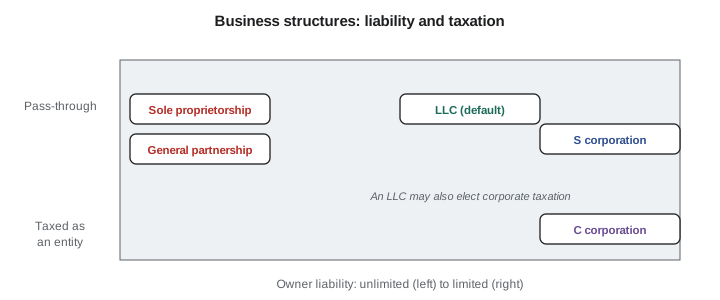
A sole proprietorship is one person doing business in his or her own name or under a trade name. It is the simplest form: no separate legal entity, no separate tax return, and profits reported on the owner's personal return. The owner is personally liable for every debt and judgment of the business, so a large lawsuit can reach the owner's house and savings. A general partnership is two or more people doing business together for profit, with each partner personally liable for the partnership's debts, including debts created by the other partners. Partnerships should have a written partnership agreement covering contributions, profit shares, decisions and what happens when a partner leaves or dies.
A corporation is a separate legal entity formed by filing articles of incorporation with the state. Its owners, the shareholders, are generally not personally liable for its debts beyond their investment, though courts can disregard the corporation, called piercing the corporate veil, when owners mix personal and business money or ignore corporate formalities. A regular C corporation pays its own income tax, and dividends paid to shareholders are taxed again, often called double taxation. An S corporation is a corporation that has elected under the tax code to pass its income through to its shareholders, avoiding the corporate-level tax, with limits on the number and type of shareholders. A limited liability company, or LLC, combines limited liability with flexible taxation: by default a single-member LLC is taxed like a sole proprietorship and a multi-member LLC like a partnership, but an LLC can elect to be taxed as a corporation or S corporation.
| Structure | Owner liability | How profits are taxed | Formation |
|---|---|---|---|
| Sole proprietorship | Unlimited personal liability | On the owner's personal return | No state filing required beyond trade name and licenses |
| General partnership | Each partner personally liable | Passed through to partners | Agreement recommended; few filings |
| Limited partnership | General partners liable; limited partners usually not | Passed through | State filing required |
| C corporation | Shareholders generally protected | Corporate tax, then tax on dividends | Articles of incorporation |
| S corporation | Shareholders generally protected | Passed through to shareholders | Corporation plus tax election |
| LLC | Members generally protected | Pass-through by default, or elect corporate taxation | Articles of organization |
Limited liability has limits of its own. It does not protect a person from liability for his or her own negligence, so an electrician who personally makes a dangerous installation can be sued personally regardless of the company's form. Banks and sureties usually require owners of small companies to sign personal guarantees, and many licensing laws hold the qualifier responsible for the company's code compliance. The protection is real but not complete, which is why insurance, covered in Lesson 5, still matters.
Registering and running the business
Starting a contracting business involves several registrations besides the contractor license. The business entity, if it is a corporation or LLC, is formed with the secretary of state and must usually file annual reports to stay in good standing. A business operating under a name other than its legal name registers an assumed name, trade name or doing business as filing. The business gets a federal employer identification number, or EIN, from the IRS, registers with the state for income tax withholding and unemployment insurance, and registers for sales or use tax where the state requires it. Many cities also require a local business license. Each of these has its own renewal cycle, and a lapse in entity status can affect the contractor license.
- Entity formation with the secretary of state (corporations, LLCs, limited partnerships) and annual reports.
- Trade name registration when doing business under another name.
- Employer identification number from the IRS.
- State withholding, unemployment insurance and, where required, sales and use tax accounts.
- Local business license and the state contractor license with its qualifier.
Financial statements
Business and law exams test basic accounting vocabulary. The balance sheet shows what a business owns and owes on a given date, built on the accounting equation: assets equal liabilities plus owner's equity. Current assets, such as cash, accounts receivable and inventory, can be turned into cash within a year; current liabilities, such as accounts payable and payroll taxes due, must be paid within a year. The income statement, or profit and loss statement, shows revenue, costs and profit over a period. The cash flow statement shows where cash came from and went. Contractors also prepare a work-in-progress schedule showing each job's contract value, costs to date, estimated costs to complete, and billings, which sureties and banks examine closely.
Several ratios appear often. Working capital is current assets minus current liabilities, the cushion available to pay bills while waiting for customers to pay. The current ratio is current assets divided by current liabilities; sureties typically want it well above 1. The debt-to-equity ratio compares total liabilities to owner's equity. Gross profit is revenue minus direct job costs, and net profit is what remains after overhead and taxes.
Worked problem
Reading Brightwater's balance sheet
Brightwater has current assets of 612,000 dollars (cash 140,000, receivables 410,000, inventory 62,000) and current liabilities of 268,000 dollars. Total liabilities are 395,000 dollars and owner's equity is 520,000 dollars. Find working capital, the current ratio, total assets and the debt-to-equity ratio.
Show solution
- Working capital: 612,000 − 268,000 = 344,000.
- Current ratio: 612,000 ÷ 268,000 = 2.28.
- Total assets: liabilities plus equity = 395,000 + 520,000 = 915,000.
- Debt to equity: 395,000 ÷ 520,000 = 0.76.
Answer: Working capital 344,000 dollars, current ratio about 2.28, total assets 915,000 dollars, debt to equity about 0.76.
# Basic contractor financial ratios (example figures)
current_assets, current_liabilities = 612000, 268000
total_liabilities, equity = 395000, 520000
revenue, direct_costs, overhead = 2_450_000, 1_930_000, 340_000
print("Working capital:", current_assets - current_liabilities)
print("Current ratio:", round(current_assets / current_liabilities, 2))
print("Total assets:", total_liabilities + equity)
print("Debt to equity:", round(total_liabilities / equity, 2))
gross = revenue - direct_costs
print("Gross profit:", gross, " net before tax:", gross - overhead)Working capital: 344000 Current ratio: 2.28 Total assets: 915000 Debt to equity: 0.76 Gross profit: 520000 net before tax: 180000
Accounting methods for contractors
Small businesses may use cash accounting, recording income when received and expenses when paid, while larger businesses generally use accrual accounting, recording income when earned and expenses when incurred. Contractors with long jobs face a further choice for income recognition: the completed-contract method recognizes all of a job's profit when the job is finished, while the cost-to-cost progress method, traditionally named for the share of the job completed, recognizes profit as the job progresses, in proportion to costs incurred. The progress method gives a more accurate picture of a growing company, and larger contractors are generally required to use it for tax purposes on long-term contracts. Job costing, tracking every cost to the job that caused it, is the foundation of all of this and the only way to know which jobs make money.
Worked problem
The cost-to-cost progress method
A 300,000 dollar contract has estimated total costs of 255,000 dollars. Costs to date are 102,000 dollars. How much revenue is earned to date under the cost-to-cost progress method?
Show solution
- Share complete: 102,000 ÷ 255,000 = 0.40.
- Revenue earned: 0.40 × 300,000 = 120,000.
- Gross profit to date: 120,000 − 102,000 = 18,000.
Answer: 120,000 dollars of revenue and 18,000 dollars of gross profit to date.
Federal tax obligations of an employer
An employer withholds federal income tax from employees' wages based on each employee's Form W-4, withholds the employee's share of Social Security and Medicare taxes (together called FICA), and pays a matching employer share. These withheld amounts are trust fund taxes: the employer holds them in trust for the government. Deposits are made electronically on a monthly or semiweekly schedule depending on the size of past tax liabilities, and the employer reports them quarterly on Form 941. The employer also pays federal unemployment tax (FUTA), reported annually on Form 940, and state unemployment tax. At year end, employees receive Form W-2 and independent contractors paid above a threshold receive a Form 1099 information return.
Failure to deposit trust fund taxes is treated severely. The IRS can hold responsible owners and officers personally liable for unpaid trust fund taxes through the trust fund recovery penalty, regardless of the company's structure, because the money belonged to employees and the government, not the company. Business and law references stress that a struggling contractor must never use withheld payroll taxes to pay suppliers or other bills.
| Tax or report | Who pays | Usual form or schedule |
|---|---|---|
| Federal income tax withholding | Employee, withheld by employer | Deposited monthly or semiweekly; Form 941 quarterly |
| Social Security and Medicare (FICA) | Employee and employer shares | Same deposits; Form 941 |
| Federal unemployment (FUTA) | Employer only | Form 940 annually, deposits as owed |
| State unemployment | Employer (employee too in a few states) | State quarterly reports |
| Wage statements | Employer issues | Form W-2 to employees, 1099 to qualifying contractors |
| Business income tax | Entity or owners | Depends on structure; estimated payments quarterly |
Sales and use tax adds one more layer for contractors. In many states a contractor is treated as the consumer of materials it installs in real property, so it pays sales tax when buying them, or use tax if it buys them tax-free from out of state, and does not charge sales tax to the customer for the installed work. Other states treat certain contracts differently, and some tax repair services. The state edition of the business and law reference explains the state's rule, and exam questions in this area are usually state-specific.
Cash flow and the line of credit
Profitable contractors still fail when cash runs out. Payroll is due every week, suppliers expect payment in 30 days, and customers often pay in 45 to 60 days with retainage held until the end. A growing contractor therefore needs working capital and usually a bank line of credit to bridge the gap. Banks and sureties look at the same statements described above and often require reviewed or audited financial statements from larger contractors. A simple cash flow forecast, listing expected receipts and payments week by week for the next three months, shows when the business will need to borrow. Brightwater's forecast showed a gap every spring, when jobs started faster than payments arrived, and Ray arranged the line of credit in January so it was ready.
Collection discipline helps as much as borrowing. Bill promptly and accurately, follow up on overdue invoices at set intervals, send lien notices on time, and do not let one slow customer absorb the company's working capital.
Common mistakes
MistakeBelieving an LLC or corporation protects the owner from everything.
InsteadLimited liability does not cover your own negligence, personal guarantees or unpaid trust fund taxes.
MistakeUsing withheld payroll taxes to pay suppliers in a tight month.
InsteadTrust fund taxes must be deposited on schedule; owners can be personally liable.
MistakeConfusing gross profit with net profit.
InsteadGross profit is revenue minus direct job costs; net profit is after overhead and taxes.
MistakeLetting the entity's annual report lapse.
InsteadFile state annual reports; loss of good standing can affect contracts and the license.
MistakeRecording a long job's profit only when finished in a growing company.
InsteadUnderstand the cost-to-cost progress method; sureties and larger contractors rely on it.
Summary and key terms
- Sole proprietors and general partners have unlimited personal liability; corporations and LLCs generally limit owner liability.
- C corporations pay their own tax; S corporations, partnerships and default LLCs pass income through to owners.
- Businesses register the entity, trade names, an EIN, state tax and unemployment accounts, local licenses and the contractor license.
- Assets equal liabilities plus equity; working capital and the current ratio measure short-term strength.
- Employers withhold income tax and FICA, pay the employer share and unemployment taxes, deposit on schedule and file quarterly and annual reports.
- Withheld taxes are trust fund taxes; responsible persons can be personally liable for them.
- S corporation
- A corporation that elects to pass its income through to shareholders for federal tax.
- Working capital
- Current assets minus current liabilities.
- Cost-to-cost progress method
- Recognizing a contract's revenue and profit as costs are incurred.
- Trust fund taxes
- Withheld employee income tax and the employee share of FICA, held for the government.
- EIN
- Employer identification number issued by the IRS.
Practice problems
Work each problem on paper first, then reveal the answer to check.
Current assets are 300,000 dollars and current liabilities 120,000 dollars. Find working capital and the current ratio.
Show answer
Working capital 180,000 dollars; current ratio 2.5.
Assets are 800,000 dollars and liabilities 350,000 dollars. What is owner's equity?
Show answer
450,000 dollars.
A 200,000 dollar job has estimated costs of 160,000 dollars and costs to date of 40,000 dollars. What revenue is earned to date?
Show answer
40,000 ÷ 160,000 = 0.25; 0.25 × 200,000 = 50,000 dollars.
Which structure exposes each owner to debts created by the other owners?
Show answer
A general partnership.
Lesson quiz · 5 questions
Score 60% or more to complete this lesson.
Create a free account to save your progress, take quizzes and earn a certificate.