
MELU-107 · Lesson 12 of 12 · 34 min
Full mixed review
▶ Video coming soon A video version of this lesson is on the way.
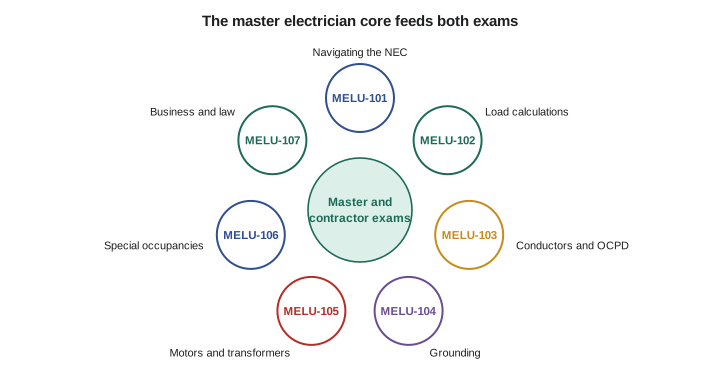
Ten days before her exams, Dana stopped learning new material. Ray's advice was to spend the last stretch on mixed practice, the way the real exams mix subjects, because the hardest part of a licensing exam is switching instantly from a feeder calculation to a lien deadline to a grounding question. She and Marcus built a set of problems covering the whole core, from navigating the NEC through load calculations, conductors, grounding, motors, special occupancies and the business and law topics of this course, and worked them under time pressure at the Brightwater office table in the evenings. This lesson walks through that review: a short summary of each course, worked problems that mix them, and the final checklist Dana used the night before each exam.
Work each example yourself before reading the solution, with your own code book and references open, and time yourself. The code values in this lesson are this course's illustrative values or are given in the problem; check every rule against your own adopted edition and amendments.
The core at a glance
| Course | Core skills | Favorite exam traps |
|---|---|---|
| MELU-101 Navigating the NEC | Structure, Article 100, 90.5, index, tables, 2026 changes | Shall versus shall be permitted; exceptions; wrong edition |
| MELU-102 Load calculations | Dwelling standard and optional methods, multifamily, commercial | Missing demand factors; wrong method; neutral reductions |
| MELU-103 Conductors and overcurrent | Ampacity, correction and adjustment, OCPD, fill, voltage drop | Termination temperature; rounding; next size up limits |
| MELU-104 Grounding and bonding | Electrodes, GEC and EGC sizing, bonding jumpers | Mixing up Table 250.66 and 250.122; neutral bonding downstream |
| MELU-105 Motors and transformers | Table FLC versus nameplate, 430.52, overloads, 450.3(B) | Using nameplate for conductors; rounding feeder protection up |
| MELU-106 Special occupancies | Hazardous, health care, pools, emergency systems | Classification errors; wrong article for the occupancy |
| MELU-107 Business and law | Contracts, liens, insurance, tax, payroll, OSHA, records | Markup versus margin; unconditional waivers; reporting deadlines |
Mixed problems: code
Worked problem
A dwelling service by the standard method
Using the result from the load calculation course, the Maple Street fourplex unit's standard calculation came to 33,327.5 VA at 120/240 V. Find the calculated current and choose the minimum standard service rating that is at least that large.
Show solution
- Current: 33,327.5 ÷ 240 = 138.9 A.
- The next standard rating at or above 138.9 A is 150 A.
Answer: 138.9 A; a 150 A service is the minimum standard size, though many contractors install 200 A for growth.
Worked problem
Ampacity with correction and adjustment
A feeder uses conductors with an illustrative 90 °C ampacity of 130 A. The ambient correction factor is 0.91 and there are 6 current-carrying conductors in the raceway, with an adjustment factor of 0.80. The terminations are rated 75 °C, where the same conductor's illustrative ampacity is 115 A. Find the usable ampacity.
Show solution
- Corrected and adjusted: 130 × 0.91 × 0.80 = 94.6 A.
- Termination limit: 115 A at 75 °C.
- Usable ampacity is the smaller: 94.6 A.
Answer: About 94.6 A, so the circuit's load and protection must suit 94.6 A, not 115 A or 130 A.
Worked problem
A motor branch circuit
Delgado's 25 hp, 480 V compressor has an illustrative table current of 34 A and a nameplate current of 32 A with a 1.15 service factor. Find the minimum conductor ampacity, the maximum inverse-time breaker before rounding at an illustrative 250%, and the maximum overload setting at 125%.
Show solution
- Conductors: 1.25 × 34 = 42.5 A (table current).
- Breaker: 2.50 × 34 = 85 A, so the next standard size, 90 A, is permitted.
- Overloads: 1.25 × 32 = 40 A (nameplate current).
Answer: 42.5 A conductors, a 90 A breaker, and overloads set at no more than 40 A.
Worked problem
A transformer secondary
A 75 kVA, 480 V delta to 208Y/120 V three-phase transformer feeds a panel. Find the rated secondary current.
Show solution
- Secondary current: 75,000 ÷ (1.732 × 208) = 208.2 A.
Answer: About 208 A, so a 225 A panel with a 225 A or smaller main protecting it is a common choice, subject to the secondary conductor rules.
# Mixed code review calculations (illustrative values, matching the examples)
import math
print("Dwelling service current:", round(33327.5 / 240, 1), "A")
print("Corrected and adjusted ampacity:", round(130 * 0.91 * 0.80, 1), "A")
flc, fla = 34, 32
print("Motor conductors:", 1.25 * flc, "A; breaker before rounding:", 2.5 * flc, "A; overloads:", 1.25 * fla, "A")
print("Transformer secondary:", round(75000 / (math.sqrt(3) * 208), 1), "A")Dwelling service current: 138.9 A Corrected and adjusted ampacity: 94.6 A Motor conductors: 42.5 A; breaker before rounding: 85.0 A; overloads: 40.0 A Transformer secondary: 208.2 A
Mixed problems: business and law
Worked problem
Bid, margin and retainage together
A job has direct costs of 64,000 dollars. Brightwater wants a 20% margin on the selling price. The contract has 10% retainage, and the first progress billing is for 30% of the contract. Find the bid and the first payment received.
Show solution
- Bid for a 20% margin: 64,000 ÷ 0.80 = 80,000.
- First billing: 0.30 × 80,000 = 24,000.
- Retainage: 0.10 × 24,000 = 2,400.
- Payment received: 24,000 − 2,400 = 21,600.
Answer: An 80,000 dollar bid and a first payment of 21,600 dollars.
Worked problem
Overtime and payroll records
Kayla, an apprentice at 21.50 dollars per hour, works 43 hours in a workweek with no bonus. Find her gross pay, and state how long the federal rules require her time cards and payroll records to be kept.
Show solution
- Straight time: 40 × 21.50 = 860.00.
- Overtime: 3 × 1.5 × 21.50 = 96.75.
- Gross: 860.00 + 96.75 = 956.75.
- Time cards at least 2 years; payroll records at least 3 years.
Answer: 956.75 dollars; time cards 2 years and payroll records 3 years under federal rules.
Worked problem
A lien deadline and a waiver
Under an illustrative rule, a lien must be recorded within 90 days of the last day of work. Brightwater's last day was October 3. The general contractor sends a payment with a request for an unconditional final waiver before the check clears. What is the recording deadline, and what waiver should Brightwater sign now?
Show solution
- October has 28 days after the 3rd; November adds 30 (58); December adds 31 (89); one more day is January 1 (90).
- Until funds clear, sign only a conditional final waiver.
Answer: January 1 under this example rule, and a conditional final waiver until the payment clears.
Worked problem
OSHA rate and reporting
A contractor's workers logged 46,000 hours with 2 recordable cases. Find the recordable rate. One case was an in-patient hospitalization. Within what time was it reportable?
Show solution
- Rate: 2 × 200,000 ÷ 46,000 = 8.7.
- In-patient hospitalization: report within 24 hours.
Answer: A rate of about 8.7, and the hospitalization was reportable within 24 hours.
Worked problem
A schedule question
Three paths through a job's schedule take 18, 21 and 16 days. An owner change adds 2 days to an activity on the 18-day path. Does the project finish later?
Show solution
- Critical path before the change: 21 days.
- The changed path becomes 18 + 2 = 20 days, still under 21.
- The changed activity had 3 days of float and used 2.
Answer: No. The project still takes 21 days, though the changed path now has only 1 day of float.
| Topic | Number to remember (general or federal pattern) |
|---|---|
| Overtime | Over 40 hours in a workweek at 1.5 × the regular rate |
| Form I-9 | Section 2 within 3 business days; keep 3 years after hire or 1 after termination, whichever is later |
| OSHA records | 300A posted February 1 to April 30; keep 5 years; 301 within 7 days |
| OSHA reporting | Death 8 hours; hospitalization, amputation, eye loss 24 hours |
| Incident rate base | 200,000 hours |
| Retainage | Commonly 5 or 10 in 100, subject to state limits |
| Bid bond | Often 5 to 10 in 100 of the bid; performance and payment bonds usually the full contract |
| Anti-discrimination coverage | Title VII and ADA at 15 employees, ADEA at 20, FMLA at 50 |
Working a mixed set under time
Dana's final practice routine combined everything in this course. She set the timer for the real exam's average time per question, worked a block of 25 mixed questions in a single pass, flagged anything that took more than twice the average, then worked the flagged ones and logged every miss by cause. She alternated code and business blocks so that switching subjects felt normal. In the last week she did one full simulation of each exam on the same day of the week and at the same time of day as her real appointments, with only the approved books and the approved calculator.
Marcus focused on the opposite weakness. His practice scores were good when he finished, but he had a habit of choosing the first answer that matched his calculation. He added a step to every calculation question: before choosing, he asked what mistake would produce each of the other choices. More often than not, two of the other choices matched a skipped factor or a rounding error, which confirmed his answer, and twice a week the exercise caught a mistake of his own.
The night before and the morning of
- Check each book against the bulletin list: titles, editions, state supplements, and only permitted tabs and marks.
- Pack the approved calculator with fresh batteries, and the identification the bulletin requires.
- Confirm the test center address, parking and arrival time; plan to arrive early.
- Write your time plan on a card in your head: average per question, checkpoints, and the cut-off for any single question.
- Stop studying early in the evening, eat normally and sleep.
- On arrival, use the tutorial to learn the flag and review screens, then follow your plan.
Dana passed both exams on her first attempt, the trade exam with a comfortable margin and the business and law exam by four points, which she attributed to the six extra tabs and to never leaving a question blank. Six weeks later the licensing board approved her as Brightwater's qualifier. Ray kept coming into the office two days a week, mostly to estimate and tell stories, and Kayla started her second year of apprenticeship with a new supervisor who knew exactly how many apprentices she could take to a job site.
Staying current after the license
Passing the exams is a beginning, not an end. The code changes every three years, states adopt new editions on their own schedules, and lien, tax, payroll and safety rules change even more often. A master electrician who qualifies a contractor needs a routine for staying current: continuing education every renewal cycle, a subscription to the state licensing board's notices, the inspection department's code adoption bulletins, updates from the insurance agent and accountant, and a quick reading of each new NFPA 70E edition. Dana set a reminder to review the company's contracts, safety program and lien procedures every January, the slowest month of the year, and to check that every license, insurance policy and bond renewal date was on the office calendar.
Ray's last piece of advice before he cut back his hours was the same one he had started with. "The license is your name on every job. Protect it with good work, good paper and good people."
Common mistakes
MistakeStudying only code in the last week because it feels harder.
InsteadMix code and business practice so switching subjects is normal on exam day.
MistakeUsing the first answer that matches your number.
InsteadCheck what mistake would produce the other choices; it confirms or catches your work.
MistakePacking books without checking them against the bulletin.
InsteadVerify editions and remove anything not allowed the night before.
MistakeCramming new topics the night before.
InsteadReview your error log and rest; new material the last night adds little.
MistakeLeaving blanks to save time for review.
InsteadAnswer everything; mark questions for review instead of leaving them blank.
Summary and key terms
- The master core covers NEC navigation, load calculations, conductors and overcurrent, grounding, motors and transformers, special occupancies, and business and law.
- Code calculations depend on the right current, factor, termination limit and rounding rule.
- Business calculations cover margin and markup, retainage, overtime, incident rates, lien deadlines and schedule float.
- Practice in mixed, timed blocks with an error log, and simulate each exam fully at least once.
- Check books, calculator, identification and route the night before, then follow the time plan.
- Mixed practice
- Practice that alternates topics the way a real exam does.
- Simulation
- A full practice exam under real time limits and book rules.
- Qualifier approval
- The licensing board's acceptance of a person as a contractor's qualifying license holder.
- Error log
- A list of missed practice questions and their causes.
- Cut-off time
- The maximum time you will spend on one question before guessing and flagging it.
Practice problems
Work each problem on paper first, then reveal the answer to check.
Direct cost is 72,000 dollars. What bid gives a 20% margin?
Show answer
72,000 ÷ 0.80 = 90,000 dollars.
A motor has a table current of 21 A and a nameplate current of 19.5 A with a 1.0 service factor. Find minimum conductor ampacity and maximum overload setting at 115%.
Show answer
Conductors 1.25 × 21 = 26.25 A; overloads 1.15 × 19.5 = 22.4 A.
Workers logged 25,000 hours with 1 recordable case. Find the rate.
Show answer
1 × 200,000 ÷ 25,000 = 8.0.
A worker earns 30 dollars per hour and works 50 hours. Find gross pay.
Show answer
1,200 + 10 × 45 = 1,650 dollars.
Lesson quiz · 5 questions
Score 60% or more to complete this lesson.
Create a free account to save your progress, take quizzes and earn a certificate.