
MELU-107 · Lesson 3 of 12 · 22 min
Contracts, bids and change orders
▶ Video coming soon A video version of this lesson is on the way.
The Copper Kettle restaurant had opened, and its owners liked Brightwater's work enough to ask for a bid on a second location across town. This time Ray handed the whole estimate to Dana and Priya. "Estimate it, write the proposal, and read every page of their contract before I sign it," he said. "The wiring is the easy part." Dana soon found out what he meant. The general contractor's subcontract ran to thirty pages, and the electrical scope was described in two paragraphs. The rest covered payment, retainage, schedule, change orders, insurance, indemnity, warranties, disputes and termination, and every one of those clauses decided how much money Brightwater would actually keep.
Business and law exams spend more questions on contracts and estimating than on almost any other topic. This lesson covers the elements of a valid contract, the common contract and pricing types, how electrical contractors build a bid from costs, overhead and profit, and how change orders and claims work. The arithmetic is simple, but the exam expects you to know which number goes where.
What makes a contract
A contract is an agreement the law will enforce. Business law references describe the same basic elements: an offer, acceptance of that offer, consideration (something of value exchanged by each side, such as work for payment), parties with legal capacity to contract, and a lawful purpose. Many states also require certain contracts to be in writing, such as contracts for the sale of real property, contracts that cannot be performed within a year, and, under many state licensing or consumer laws, home improvement contracts above a dollar threshold, which often must include specific terms and a notice of the homeowner's right to cancel within a few days.
A bid or proposal is usually an offer, and the owner's signature or a notice to proceed is the acceptance. A contractor's bid may say how long the offer stays open, and an offer can generally be withdrawn before it is accepted, though public bidding rules and bid bonds limit that right. Exam questions often describe a short exchange of letters or emails and ask whether a contract was formed, or ask which element is missing.
| Element | Meaning | Example on the Copper Kettle job |
|---|---|---|
| Offer | A definite proposal to do something on stated terms | Brightwater's proposal to wire the second location for a stated price |
| Acceptance | Unconditional agreement to the offer's terms | The general contractor signs the subcontract |
| Consideration | Something of value exchanged by each party | Electrical work in exchange for payment |
| Capacity | Legal ability to contract | Authorized officers of both companies sign |
| Lawful purpose | The contract's object is legal | Licensed work under a permit |
Contract types by who you contract with
Electrical contractors work under several arrangements. A prime contract is directly with the owner, as on Brightwater's service jobs for homeowners and on Delgado Fabrication's upgrade. A subcontract is with a general contractor or construction manager who holds the prime contract, as on most commercial building jobs. Under design-bid-build, the owner hires an engineer to design the project and then takes bids from contractors to build it. Under design-build, one entity both designs and builds, and an electrical contractor may provide design-build services for its own scope, which brings design responsibility and sometimes a need for an engineer's seal.
Subcontracts usually flow down the terms of the prime contract to the subcontractor, so a subcontractor can be bound by documents it has never seen unless it asks for them. Dana asked the general contractor for the owner's prime contract, the general conditions and the electrical drawings and specifications before pricing, and found a liquidated damages clause in the prime contract: the general contractor would owe the owner 500 dollars for each day the project finished late, and the subcontract let it pass a share of that to any subcontractor that caused the delay.
Contract types by how you are paid
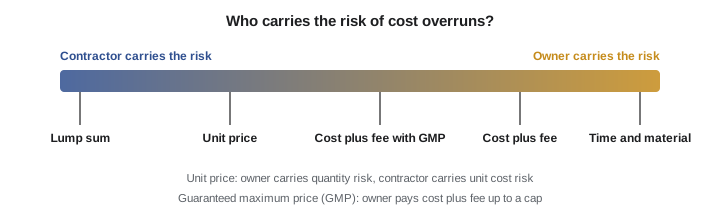
The pricing method decides who carries the risk of cost overruns. Under a lump-sum or stipulated-sum contract, the contractor agrees to do the defined work for a fixed price and carries the risk if costs run higher. Under a unit-price contract, the contractor is paid an agreed rate per unit, such as per device, per foot of conduit or per luminaire, and the final price depends on the quantities installed. Under a cost-plus contract, the contractor is paid its costs plus a fee, either a fixed share of cost or a fixed fee, sometimes with a guaranteed maximum price that caps the owner's exposure. Time-and-material work, common for service calls and small jobs, pays labor at hourly rates and materials at cost plus markup.
| Pricing method | Who carries cost risk | Typical use |
|---|---|---|
| Lump sum (stipulated sum) | Contractor | Well-defined commercial and residential jobs |
| Unit price | Shared: owner carries quantity risk, contractor carries unit cost risk | Site work, repetitive installations |
| Cost plus fee | Owner | Uncertain scope, fast-track work |
| Cost plus fee with guaranteed maximum price | Shared, with a cap | Negotiated commercial work |
| Time and material | Owner | Service calls, small repairs |
Building a bid
An estimate starts with a quantity takeoff from the drawings: every device, luminaire, panel, foot of conduit and wire, and piece of equipment. Each item is priced for material from supplier quotes and for labor from labor units, which are estimates of the hours needed to install each item. Labor hours times the labor rate gives labor cost. Then come direct job costs that are not material or labor, such as permits, equipment rental, lifts, temporary power and disposal. These together are the direct cost of the job.
On top of direct cost the contractor adds overhead, the cost of running the business that is not tied to any one job (office rent, office staff, trucks, insurance not charged to jobs, accounting, software), and profit, the return the owner of the business needs for taking the risk. Overhead and profit are often added together as a markup on direct cost. Business and law exams love the difference between markup and margin, because the same rate gives different prices.
- Markup is a share of cost: price = cost × (1 + markup).
- Margin is a share of selling price: price = cost ÷ (1 − margin).
- A 20% markup on 100,000 dollars of cost gives a price of 120,000 dollars, which is a margin of only 16.7%.
- To earn a 20% margin on the same cost, the price must be 100,000 ÷ 0.80 = 125,000 dollars.
Worked problem
Pricing the second Copper Kettle
Dana's takeoff gives material of 38,400 dollars and 620 labor hours. Brightwater's labor rate, including payroll taxes and benefits, is 68 dollars per hour. Other direct costs are 3,100 dollars. Brightwater adds 15% for overhead on direct cost and then 10% profit on the total of cost and overhead. Find the bid.
Show solution
- Labor: 620 × 68 = 42,160.
- Direct cost: 38,400 + 42,160 + 3,100 = 83,660.
- Overhead: 0.15 × 83,660 = 12,549.
- Cost plus overhead: 83,660 + 12,549 = 96,209.
- Profit: 0.10 × 96,209 = 9,620.90.
- Bid: 96,209 + 9,620.90 = 105,829.90, which Brightwater rounded to 105,830.
Answer: About 105,830 dollars.
# Bid builder: direct cost, overhead and profit (example values)
material, hours, rate, other = 38400, 620, 68, 3100
labor = hours * rate
direct = material + labor + other
overhead = 0.15 * direct
profit = 0.10 * (direct + overhead)
bid = direct + overhead + profit
print("Labor:", labor)
print("Direct cost:", direct)
print("Bid:", round(bid, 2))
print("Margin on the bid:", round((bid - direct) / bid * 100, 1), "in 100")
# markup versus margin on the same cost
cost = 100000
print("20 markup ->", cost * 1.20, " 20 margin ->", round(cost / 0.80, 2))Labor: 42160 Direct cost: 83660 Bid: 105829.9 Margin on the bid: 20.9 in 100 20 markup -> 120000.0 20 margin -> 125000.0
Reading the contract before signing
Several clauses deserve close reading in any electrical subcontract. Scope of work defines what is included; anything unclear invites a dispute later, so a proposal should list inclusions, exclusions and assumptions. Payment terms set when invoices are due, and many subcontracts include pay-when-paid or pay-if-paid clauses: pay-when-paid generally sets timing, while pay-if-paid tries to make the owner's payment a condition of the subcontractor being paid at all, and states treat these clauses differently. Retainage holds back part of each payment, commonly 5 or 10%, until completion; many states cap retainage or require its release within a set time.
Indemnity clauses require one party to protect another from claims. A broad form clause that makes the subcontractor indemnify the general contractor even for the general contractor's own negligence is prohibited or limited by anti-indemnity statutes in many states. Insurance clauses require specific coverage and additional insured status. Schedule clauses set completion dates and may impose liquidated damages. Dispute clauses decide whether disagreements go to mediation, arbitration or court and in which location. Termination clauses allow either party to end the contract for cause, and often allow the owner or general contractor to terminate for convenience with payment for work done.
| Clause | What to check | Why it matters |
|---|---|---|
| Scope | Inclusions, exclusions, drawings and specification sections | Unclear scope becomes unpaid work |
| Payment | Due dates, pay-when-paid or pay-if-paid wording | Determines cash flow and collection rights |
| Retainage | Amount and release terms | Can hold back a large share of profit for months |
| Indemnity | Whose negligence is covered | Broad clauses can make you pay for others' mistakes |
| Schedule and damages | Completion dates, liquidated damages | Delays can cost more than the job earns |
| Changes | Written change order procedure, notice deadlines | Missed notices can waive payment for extra work |
| Disputes | Mediation, arbitration, venue | Sets the cost and place of resolving claims |
Worked problem
Retainage and cash flow
The second Copper Kettle subcontract is 105,830 dollars with 10% retainage. After the first progress billing of 40,000 dollars, how much does Brightwater receive, and how much is held?
Show solution
- Retainage held: 0.10 × 40,000 = 4,000.
- Payment received: 40,000 − 4,000 = 36,000.
Answer: Brightwater receives 36,000 dollars and 4,000 dollars is held until the retainage is released.
Change orders
Construction projects change. Owners add equipment, engineers revise drawings, and field conditions differ from what the drawings showed. A change order is a written modification to the contract that changes the scope, price, time or all three, signed by both parties. Most contracts require that changes be authorized in writing before the work is done and that the contractor give written notice of a claim for extra cost or time within a short period, often 7 to 21 days. A contractor who does extra work on a verbal request and sends the bill later may find that the contract's notice and written-authorization clauses have waived its right to be paid.
Change orders are priced the same way as bids, often using unit prices or markups stated in the contract. When the parties cannot agree on price but the work must proceed, many contracts allow a construction change directive, in which the owner orders the work and the price is settled later, usually on a time-and-material basis with careful records. Brightwater's rule was simple: no extra work without a signed change order or written directive, and a daily log entry for every request, conversation and instruction, which Lesson 10 covers.
Bid day and bid mistakes
Commercial bids are usually due at a fixed time, and subcontractor prices often arrive at the general contractors in the last hour, which leaves little time to check them. Dana learned to finish the takeoff and pricing two days early and spend bid day only on supplier quotes and a final review. Her review asked a short list of questions: does the scope match the drawings and specification sections, are addenda acknowledged, are lifts, permits and temporary power included, are fire alarm and low-voltage systems in or out, and do the labor hours make sense compared with similar past jobs? A bid that is far below the others is not a victory; it usually means something was missed, and a contractor generally cannot withdraw a bid after acceptance simply because of its own error, except under limited rules for clear clerical mistakes.
Unbalanced bidding, where a contractor loads early line items or unit prices with extra profit to get paid sooner, is risky and may be prohibited on public work. Bid shopping, where a general contractor reveals one subcontractor's price to another to push prices down after the bid, is considered unethical and is restricted on some public projects. Exams ask about both terms.
Common mistakes
MistakeConfusing markup with margin.
InsteadMarkup is on cost; margin is on price. A 20% markup gives only about a 16.7% margin.
MistakeSigning a subcontract without reading the prime contract terms it incorporates.
InsteadAsk for the prime contract and general conditions; their terms flow down to you.
MistakeDoing extra work on a verbal request and billing it later.
InsteadGive written notice within the contract deadline and get a signed change order or directive first.
MistakeIgnoring retainage in cash flow planning.
InsteadExpect part of every progress payment to be held until completion.
MistakeLeaving exclusions out of the proposal.
InsteadList inclusions, exclusions and assumptions so the scope is clear.
Summary and key terms
- A contract needs offer, acceptance, consideration, capacity and a lawful purpose; some contracts must be in writing.
- Lump sum puts cost risk on the contractor; cost-plus and time-and-material put it on the owner; unit price and GMP share it.
- Bids build from takeoff: material, labor hours times rate, other direct costs, then overhead and profit.
- Markup is a share of cost and margin a share of price; they give different prices for the same rate.
- Read scope, payment, retainage, indemnity, schedule, change and dispute clauses; get change orders signed before doing extra work.
- Consideration
- Something of value each party gives in a contract.
- Lump sum
- A fixed price for a defined scope of work.
- Retainage
- A portion of each progress payment held back until completion.
- Change order
- A signed written modification of a contract's scope, price or time.
- Liquidated damages
- A daily amount agreed in advance as damages for late completion.
Practice problems
Work each problem on paper first, then reveal the answer to check.
Direct cost is 50,000 dollars. What price gives a 25% markup, and what margin does it represent?
Show answer
50,000 × 1.25 = 62,500 dollars; margin = 12,500 ÷ 62,500 = 20%.
What price on 50,000 dollars of cost gives a 25% margin?
Show answer
50,000 ÷ 0.75 = 66,666.67 dollars.
A progress billing of 18,000 dollars has 5% retainage. How much is paid now?
Show answer
18,000 − 900 = 17,100 dollars.
Under which pricing method does the contractor carry the risk that labor runs over the estimate?
Show answer
A lump-sum (stipulated-sum) contract.
Lesson quiz · 5 questions
Score 60% or more to complete this lesson.
Create a free account to save your progress, take quizzes and earn a certificate.