
MELU-107 · Lesson 10 of 12 · 20 min
Project records and documentation
▶ Video coming soon A video version of this lesson is on the way.
The Copper Kettle's second location finished three weeks late, and the general contractor's project manager sent Brightwater a letter blaming the electrical work and proposing to deduct 4,500 dollars of liquidated damages from the final payment. Dana's stomach dropped when she read it. Then Priya opened the job folder. It held thirty-one daily reports, eleven requests for information with dates sent and answered, a change order log showing four owner changes that had added nine working days, photos of the empty ceiling space the drywall crew had closed before the above-ceiling inspection, and an email from the general contractor's superintendent approving a new schedule. Ray read the folder for twenty minutes and then wrote a two-page reply. The deduction was withdrawn within a week. "On a job," Ray said, "the company with the best records usually wins the argument."
Project management and documentation make up a large share of business and law exams, and they are also the everyday work of a master electrician who runs jobs. This lesson covers the records an electrical contractor keeps from bid to closeout, schedules and the critical path, progress billing, and how long to keep everything.
The daily report
The daily report, also called a daily log or job diary, is the foundation of project records. Written every working day by the foreman or project lead, it records who was on site and for how many hours, the work performed and where, materials delivered, equipment used, weather, inspections, visitors, safety meetings and incidents, delays and their causes, instructions received and from whom, and any problems or changes. It should be factual, specific and written the same day; reports written weeks later carry little weight. Photos with dates and locations support it. In a dispute, daily reports often decide who caused a delay or whether extra work was directed.
| Daily report item | Example entry | Why it matters |
|---|---|---|
| Crew and hours | Andre 8, Kayla 8, Dana 4 | Job costing, payroll, certified payroll |
| Work performed | Pulled feeders to panels B and C, level 1 | Progress and earned hours |
| Deliveries | Switchboard delivered 2:15 pm, 2 days late | Delay claims, supplier back-charges |
| Instructions | GC superintendent directed relocation of 6 receptacles | Change orders and directives |
| Delays | Ceiling grid not ready; crew reassigned 3 hours | Schedule and cost claims |
| Safety | Toolbox talk on ladder use, 5 attended | Training records, OSHA defense |
| Inspections | Rough-in passed, inspector G. Haynes | Permit history |
Communication records
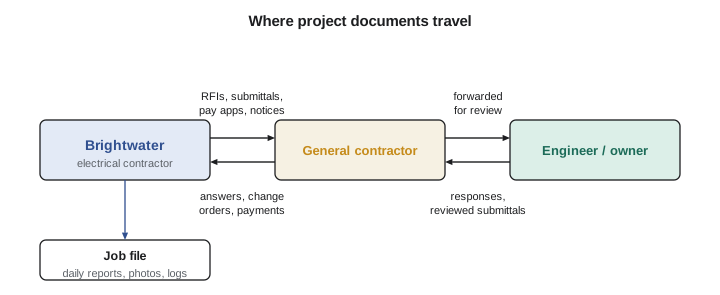
Several standard documents move information between the contractor, the design team and the owner. A request for information, or RFI, asks the architect or engineer to clarify drawings or specifications, such as a conflict between the electrical and mechanical drawings or a missing panel schedule. Each RFI is numbered, dated, sent through the channel the contract requires, and logged with the date answered, and an answer that changes scope or cost should lead to a change order. Submittals are shop drawings, product data and samples the contractor sends for review before ordering equipment such as switchboards, luminaires, generators and fire alarm devices; the engineer reviews them for conformance with the design, and the submittal log tracks each item through review, resubmittal and approval. Meeting minutes record decisions at job meetings and should be checked for accuracy, because unchallenged minutes are often treated as agreed.
Written notice letters are the most important communication of all. Most contracts require written notice within a set number of days of a claim for extra cost or time, a differing site condition, or a delay, as Lesson 3 described. A phone call or a conversation on site is not written notice. Brightwater used a simple template that named the contract clause, described the event, stated that cost and time impacts would follow, and was sent to the person and address the contract named.
Schedules and the critical path
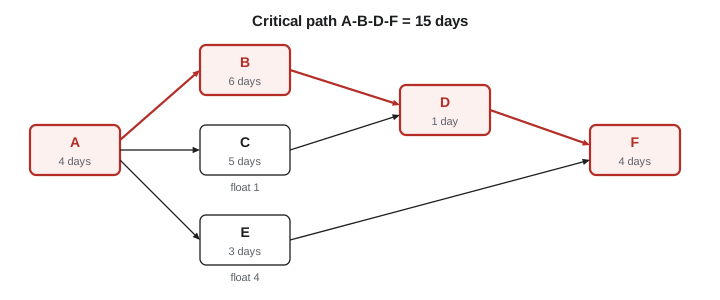
Construction schedules are usually built with the critical path method, or CPM. Each activity has a duration and depends on others: rough-in cannot start until framing is done, and wall covering cannot start until rough-in passes inspection. The critical path is the longest chain of dependent activities through the project; its total length is the shortest possible project duration, and any delay to a critical activity delays the whole project. Activities off the critical path have float, also called slack: the amount of time they can slip without delaying completion. Business and law exams often give a small network and ask for the critical path, the project duration or an activity's float.
Worked problem
Finding the critical path
The electrical part of the second Copper Kettle has these activities: A, underground and slab work, 4 days; B, wall rough-in, 6 days, after A; C, above-ceiling rough-in, 5 days, after A; D, rough-in inspection, 1 day, after B and C; E, switchboard set and feeders, 3 days, after A; F, trim and devices, 4 days, after D and E. Find the critical path, the duration and the float of activity E.
Show solution
- Path A-B-D-F: 4 + 6 + 1 + 4 = 15 days.
- Path A-C-D-F: 4 + 5 + 1 + 4 = 14 days.
- Path A-E-F: 4 + 3 + 4 = 11 days.
- The longest path is A-B-D-F at 15 days, so it is critical.
- Activity E must finish by day 11 (when F starts on the critical path) and can finish as early as day 7, so its float is 4 days.
Answer: Critical path A-B-D-F, 15 days; activity E has 4 days of float and activity C has 1 day.
# Critical path for a small activity network (durations in days)
acts = {"A": (4, []), "B": (6, ["A"]), "C": (5, ["A"]), "D": (1, ["B", "C"]),
        "E": (3, ["A"]), "F": (4, ["D", "E"])}
early = {}
for a in ["A", "B", "C", "D", "E", "F"]:              # listed in dependency order
    d, pre = acts[a]
    start = max((early[p][1] for p in pre), default=0)
    early[a] = (start, start + d)
finish = max(f for s, f in early.values())
late = {}
for a in reversed(["A", "B", "C", "D", "E", "F"]):
    d, _ = acts[a]
    succ = [b for b, (_, pre) in acts.items() if a in pre]
    lf = min((late[b][0] for b in succ), default=finish)
    late[a] = (lf - d, lf)
for a in acts:
    fl = late[a][0] - early[a][0]
    print(a, "early", early[a], "late", late[a], "float", fl, "CRITICAL" if fl == 0 else "")
print("Project duration:", finish, "days")A early (0, 4) late (0, 4) float 0 CRITICAL B early (4, 10) late (4, 10) float 0 CRITICAL C early (4, 9) late (5, 10) float 1 D early (10, 11) late (10, 11) float 0 CRITICAL E early (4, 7) late (8, 11) float 4 F early (11, 15) late (11, 15) float 0 CRITICAL Project duration: 15 days
Schedules change, and the records must show why. When an owner change or a late delivery delays a critical activity, the contractor gives written notice and requests a time extension supported by the daily reports and an updated schedule. Delays are often classified as excusable or not, and as compensable or not: a delay caused by the owner may earn both time and money, a delay caused by unusual weather may earn time only, and a delay caused by the contractor earns neither and may trigger liquidated damages. Concurrent delays, where both parties caused delay at the same time, are handled differently under different contracts and court decisions.
Progress billing
On most commercial jobs the contractor bills monthly using a schedule of values, a breakdown of the contract price into line items, such as service equipment, feeders, branch rough-in, lighting, fire alarm and closeout, that the general contractor or owner approves at the start. Each month the contractor reports the work completed and materials stored for each line, and the application for payment totals the earned value, subtracts retainage and previous payments, and shows the amount due. Standard forms are widely used, and payment applications are usually accompanied by lien waivers for the previous payment, as Lesson 4 described. Overbilling, claiming more work than is complete, creates cash early but hides losses and damages trust; underbilling starves the company of cash.
Worked problem
A payment application
The second Copper Kettle contract is 105,830 dollars with 10% retainage. Through the end of the third month, the schedule of values shows 71,400 dollars of work completed and 6,200 dollars of materials stored. Previous payments total 41,800 dollars. Find the amount due this period.
Show solution
- Total completed and stored: 71,400 + 6,200 = 77,600.
- Retainage: 0.10 × 77,600 = 7,760.
- Earned less retainage: 77,600 − 7,760 = 69,840.
- Less previous payments: 69,840 − 41,800 = 28,040.
Answer: 28,040 dollars due this period.
| Line | Scheduled value | Completed to date | Share complete |
|---|---|---|---|
| Service and switchboard | 18,500 | 16,000 | 86 in 100 |
| Feeders | 12,300 | 12,300 | 100 in 100 |
| Branch rough-in | 29,800 | 26,200 | 88 in 100 |
| Lighting and devices | 31,230 | 12,900 | 41 in 100 |
| Fire alarm | 9,000 | 4,000 | 44 in 100 |
| Closeout and as-builts | 5,000 | 0 | 0 in 100 |
| Total | 105,830 | 71,400 | 67 in 100 |
Closeout records
At the end of a job, the contract usually requires a closeout package before final payment and retainage release. For electrical work this typically includes as-built or record drawings showing the actual routing of feeders and the final panel circuits; accurate typed panel directories, which the NEC itself requires to be legible and specific; test reports such as insulation resistance, ground electrode resistance where specified, torque records for terminations and fire alarm acceptance tests; operation and maintenance manuals and warranties for equipment; spare parts and attic stock; the final inspection approval and certificate of occupancy support; training records for the owner's staff; and the final lien waivers. A punch list of incomplete or incorrect items is created near the end, and every item is checked off before closeout.
- Record drawings and panel directories.
- Test, startup and acceptance reports, including fire alarm and emergency systems.
- Operation and maintenance manuals, warranties and the warranty start date.
- Final inspection approvals and permit closure.
- Punch list completion and owner training.
- Final lien waivers and release of retainage.
Keeping records
Job files should be kept long after the job ends. Construction defect claims can be brought years later, within the state's statute of limitations and statute of repose, which in many states falls somewhere around six to twelve years after completion. Tax, payroll and safety records have their own periods, described in Lessons 6 to 8. Brightwater kept every job file electronically for at least ten years and kept the permit, inspection, as-built and test records indefinitely, because they cost almost nothing to store and could be worth thousands in a dispute.
Digital records and photos
Most contractors now keep project records electronically: daily reports on tablets, photos uploaded from phones with time and location data, RFIs and submittals in the general contractor's project management software, and drawings in cloud storage. Digital records are easier to search and harder to lose, but the same rules apply. Entries should be made the same day, photos should show enough context to identify the location, and files should follow a consistent naming pattern so anyone in the office can find them. Before covering work, crews photograph walls and ceilings with the circuit numbers and cable routes visible, which later helps both service calls and record drawings. Brightwater backed up its job files automatically every night and kept a copy off site, because the record that wins a dispute is worthless if the laptop holding it is stolen.
Common mistakes
MistakeWriting daily reports at the end of the week from memory.
InsteadWrite them the same day with specific facts, names and times.
MistakeTreating a site conversation as notice of a claim.
InsteadGive written notice to the named person within the contract's deadline.
MistakeAdding all activity durations to find project length.
InsteadProject length is the longest dependent path, the critical path.
MistakeBilling more than the work completed to improve cash flow.
InsteadBill earned value honestly; overbilling hides losses.
MistakeLeaving panel directories handwritten and vague.
InsteadProvide legible, specific directories and accurate record drawings at closeout.
Summary and key terms
- Daily reports record crew, work, deliveries, instructions, delays, safety and inspections, written the same day.
- RFIs, submittals, minutes and notice letters are numbered, logged and sent the way the contract requires.
- The critical path is the longest chain of dependent activities; float is the slack on other activities.
- Progress billing uses a schedule of values: earned value less retainage less previous payments.
- Closeout includes record drawings, directories, test reports, manuals, warranties, inspections, punch list and final waivers.
- Keep job records for years; defect claims can arrive long after completion.
- RFI
- A request for information asking the design team to clarify the contract documents.
- Submittal
- Shop drawings, product data or samples sent for review before ordering.
- Critical path
- The longest sequence of dependent activities, which sets the project duration.
- Float
- Time an activity can slip without delaying project completion.
- Schedule of values
- A breakdown of the contract price used for progress billing.
Practice problems
Work each problem on paper first, then reveal the answer to check.
Paths through a network take 12, 15 and 13 days. What is the project duration?
Show answer
15 days, the length of the critical path.
An activity has early start day 5 and late start day 9. What is its float?
Show answer
4 days.
Work completed and stored is 50,000 dollars, retainage is 5% and previous payments are 30,000 dollars. What is due?
Show answer
50,000 − 2,500 − 30,000 = 17,500 dollars.
Name four documents in a typical electrical closeout package.
Show answer
Record drawings, panel directories, test reports, O&M manuals and warranties, final inspection approval, final lien waivers.
Lesson quiz · 5 questions
Score 60% or more to complete this lesson.
Create a free account to save your progress, take quizzes and earn a certificate.