
MELU-107 · Lesson 4 of 12 · 20 min
Mechanics' liens and lien waivers
▶ Video coming soon A video version of this lesson is on the way.
In March, a developer named Curtis Vale hired Brightwater to wire six townhouses on Orchard Lane through a general contractor called Vale Homes Building. Brightwater finished its rough-in, trim and services on time and billed 92,000 dollars over four months. By September it had been paid 51,000 dollars, and the general contractor stopped returning calls. Ray did not panic. On the first day of the job Priya had sent the property owner a preliminary notice, as the state's lien law requires, and she had kept every invoice, delivery ticket and daily log. "This is why we send the notice," Ray told Dana. "Without it, that 41,000 dollars would be a lawsuit against a company with no money. With it, it's a claim against the buildings."
A mechanics' lien, sometimes called a construction lien, is a claim against real property for the value of labor, services or materials that improved it. It is one of the most powerful tools a contractor has for getting paid, and one of the most heavily tested topics on business and law exams, because lien rights depend on strict procedures and deadlines that differ from state to state. This lesson explains how liens work in general, the notices and deadlines that protect lien rights, and the lien waivers exchanged with every payment.
Why liens exist
In ordinary business, an unpaid creditor can only sue the party it contracted with. Construction is different, because the owner of a building receives the benefit of work by subcontractors and suppliers it never contracted with. If the general contractor fails to pay them, the owner has a building improved by unpaid work. Lien laws, which date back to the earliest years of the United States, give the people who improve real property a security interest in that property. If they are not paid, they can record a lien and, if necessary, ask a court to order the property sold to satisfy the debt.
That remedy gives owners a strong reason to make sure everyone down the chain is paid. It also puts owners at risk of paying twice: once to the general contractor, and again to an unpaid subcontractor who liens the property. Lien laws balance this with notice requirements that tell owners who is working on their property, and with lien waivers that owners collect as they pay. Many states also protect owner-occupants of homes by limiting liens when the owner has paid the general contractor in full.
Who may claim a lien
Lien laws generally protect those who furnish labor, services, equipment or materials to improve real property under a contract with the owner or with someone in the chain of contracts below the owner. That usually includes general contractors, subcontractors, sub-subcontractors, suppliers and equipment renters, and in many states design professionals. Most states limit how far down the chain lien rights extend; for example, a supplier to a supplier is often not protected. Many states also require the claimant to be licensed for the work, so an unlicensed electrical contractor may have no lien rights at all.
| Party | Usually has lien rights? | Notes |
|---|---|---|
| General contractor (contract with owner) | Yes | Often no preliminary notice needed because the owner knows them |
| Subcontractor such as Brightwater | Yes, if notices are given | Must usually serve a preliminary notice |
| Supplier to a subcontractor | Usually yes | Often must give notice early |
| Supplier to a supplier | Usually no | Too remote in most states |
| Unlicensed contractor | Often no | Many states bar liens by unlicensed contractors |
| Contractor on a public project | No lien on public property | Use a payment bond claim instead |
The notices that protect lien rights
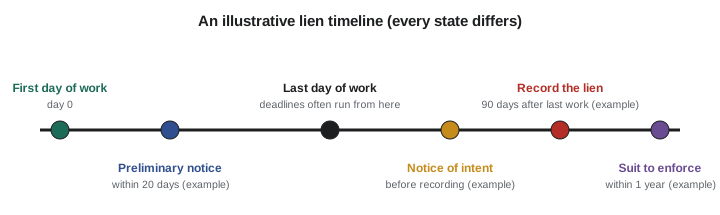
Most states require some combination of notices before a lien can be filed. A preliminary notice, also called a notice to owner, notice of furnishing or pre-lien notice, is sent near the start of the work by subcontractors and suppliers who do not contract directly with the owner. It tells the owner who is furnishing work, for whom and on what property. Some states require it within a fixed number of days after first furnishing labor or materials, and a late notice may protect only work done after it is sent. Some owners record a notice of commencement at the start of a project, identifying the owner, lender and contractor; later notices refer to it. Some states require a notice of intent to lien, a final warning sent a set number of days before the lien is recorded.
Priya's system at Brightwater was the same on every job that was not a direct contract with the owner: get the legal description and owner's name from the county records or the notice of commencement in the first week, send the preliminary notice by a method that produces proof of delivery, and file the proof in the job folder. On the Orchard Lane townhouses, that notice was sent on the fourth day of work.
Recording and enforcing a lien
If payment does not come, the claimant records a lien, usually called a claim of lien or lien statement, in the county where the property is located, within a deadline counted from the claimant's last day of furnishing labor or materials or from the completion of the project. Deadlines in many states fall somewhere between 60 and 120 days, but they vary, and they are strictly enforced: a lien recorded one day late is usually invalid. The lien must state the amount owed, describe the property, and name the owner and the party that hired the claimant, and most states require it to be sworn and served on the owner.
Recording a lien does not by itself produce payment. It creates a claim that stays on the property's title, which makes the property hard to sell or refinance and gives the owner a strong reason to settle. If the claim is not paid, the claimant must file a lawsuit to foreclose the lien within another deadline, often within six months to a year after recording, or the lien expires. Owners can often remove a lien from the property by posting a bond, which transfers the claim from the property to the bond. Claimants who file a lien for more than they are owed, knowingly, can lose the lien and face penalties.
Worked problem
Counting a lien deadline
Under an illustrative state law, a lien must be recorded within 90 days after the claimant's last day of furnishing labor or materials. Brightwater's last day on the Orchard Lane job was August 8. What is the last day to record?
Show solution
- Days remaining in August after the 8th: 31 − 8 = 23.
- September: 30 days, total 53.
- October: 31 days, total 84.
- Six more days into November: 84 + 6 = 90.
Answer: November 6, under this example rule. Real deadlines depend on the state's statute and how it counts days.
# Lien deadline calculator (illustrative rule: record within 90 days of last work)
from datetime import date, timedelta
last_work = date(2026, 8, 8)
record_by = last_work + timedelta(days=90)
foreclose_by = record_by + timedelta(days=365)    # example: suit within one year of recording
print("Last day of work:", last_work.isoformat())
print("Record lien by:", record_by.isoformat())
print("File suit to enforce by:", foreclose_by.isoformat())Last day of work: 2026-08-08 Record lien by: 2026-11-06 File suit to enforce by: 2027-11-06
Lien waivers
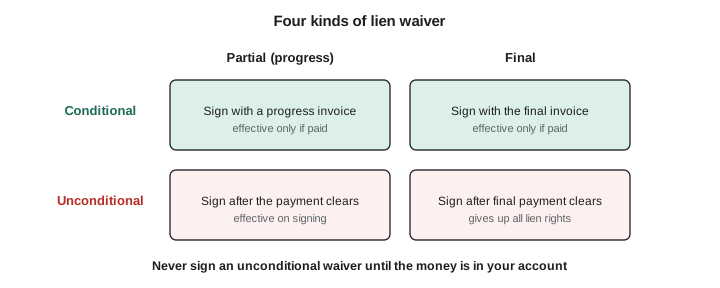
As owners and general contractors pay, they ask for lien waivers, also called lien releases: documents in which the claimant gives up lien rights for the work covered by a payment. Waivers protect owners from paying twice, and title companies and lenders require them before releasing construction loan draws. Waivers come in four general kinds, defined by two choices: partial (progress) or final, and conditional or unconditional.
| Waiver type | What it releases | When to sign it |
|---|---|---|
| Conditional partial | Lien rights through a stated date, but only if the stated payment is actually received | With a progress invoice, before payment |
| Unconditional partial | Lien rights through a stated date, whether or not payment clears | Only after the progress payment has cleared |
| Conditional final | All lien rights for the job, if the final payment is received | With the final invoice, before payment |
| Unconditional final | All lien rights for the job, unconditionally | Only after final payment has cleared |
The rule of thumb is to never sign an unconditional waiver until the money is in your account and the check has cleared. A conditional waiver protects the contractor because it becomes effective only on payment. Some states require statutory waiver forms with exact wording and make other forms unenforceable; others allow any form. A carelessly signed unconditional final waiver can give away the right to collect retainage or unpaid change orders, so the waiver should list any amounts that remain disputed or unpaid when the state's form allows exceptions.
Public projects and payment bonds
Public property such as schools, city buildings and roads cannot be liened. Instead, federal law (the Miller Act) and state laws often called little Miller Acts require general contractors on public projects above a dollar threshold to provide a payment bond, a surety bond that guarantees payment to subcontractors and suppliers. An unpaid subcontractor makes a claim against the bond instead of the property. Bond claims also have strict notice and filing deadlines; under the Miller Act, for example, second-tier claimants must give notice to the prime contractor within a set period after their last work, and suit must be brought within a year. Lesson 5 covers bonds in more detail.
Brightwater did a small amount of public work, such as a lighting retrofit at a Harlow library. On those jobs Priya requested a copy of the payment bond at the start, just as she sent preliminary notices on private work.
How the Orchard Lane claim ended
When the general contractor stopped paying, Priya sent a notice of intent to lien to Curtis Vale and to Vale Homes Building, as the state required, ten days before recording. She attached copies of the preliminary notice and the unpaid invoices. Within a week the developer, who was trying to sell the townhouses, called Ray. The developer had paid the general contractor for most of the electrical work, and was now facing a lien that would block every sale. The developer paid Brightwater directly in exchange for a conditional final waiver, and then pursued the general contractor for the money it had already paid. Brightwater recovered all but 2,000 dollars in disputed change orders, which it settled.
Ray's comment to Dana was short. "Send the notice at the start, paperwork every day, deadlines on the calendar, and never sign an unconditional waiver until the money clears. That's the whole lesson."
Stop notices, joint checks and trust funds
Several states add tools beyond the lien itself. Some allow a stop payment notice, served on the owner or construction lender, that requires them to hold back enough money to cover the claim. Some treat construction payments received by a contractor as trust funds for the benefit of the subcontractors and suppliers on that job, so a general contractor that diverts the money to other uses can face personal and even criminal liability. Owners and general contractors sometimes issue joint checks, payable to both a subcontractor and its supplier, to make sure the supplier is paid; the endorsement on a joint check can affect the parties' lien rights, so it should be handled carefully. The state edition of the business and law reference describes which of these tools the state uses.
Common mistakes
MistakeWaiting until payment problems start to send the preliminary notice.
InsteadSend it at the start of every job where the state requires it; late notices can protect only later work or nothing.
MistakeSigning an unconditional waiver with a progress invoice.
InsteadSign conditional waivers before payment and unconditional waivers only after funds clear.
MistakeCounting the lien deadline from the invoice date.
InsteadMost statutes count from the last day of furnishing labor or materials, or from completion; read your state's rule.
MistakeFiling a lien against a public school.
InsteadPublic property cannot be liened; make a payment bond claim.
MistakeRecording the lien but never filing suit.
InsteadLiens expire unless enforced by suit within the statutory period.
Summary and key terms
- A mechanics' lien is a claim against real property for unpaid labor, services or materials that improved it.
- Lien rights usually extend to contractors, subcontractors and suppliers, within limits, and often only to licensed contractors.
- Preliminary notices, notices of intent and recording deadlines are strict and state-specific.
- A recorded lien must be enforced by lawsuit within a deadline or it expires; owners may bond it off the property.
- Waivers are partial or final, conditional or unconditional; sign unconditional ones only after payment clears.
- Public projects use payment bond claims under the Miller Act and state equivalents instead of liens.
- Mechanics' lien
- A security interest in real property for the value of work or materials that improved it.
- Preliminary notice
- An early notice to the owner that a subcontractor or supplier is furnishing work.
- Conditional waiver
- A lien release that takes effect only when the stated payment is received.
- Unconditional waiver
- A lien release effective on signing, regardless of payment.
- Miller Act
- Federal law requiring payment and performance bonds on federal construction contracts above a threshold.
Practice problems
Work each problem on paper first, then reveal the answer to check.
Under a rule of 60 days from last work, the last day of work is June 20. What is the deadline?
Show answer
June has 10 days left, July 31 (41), and 19 days into August makes 60: August 19.
Which waiver should accompany a progress invoice before payment?
Show answer
A conditional partial waiver.
A subcontractor on a city fire station is unpaid. What remedy usually applies?
Show answer
A claim against the general contractor's payment bond.
Why do owners collect lien waivers?
Show answer
To avoid paying twice: waivers show that parties down the chain have been paid and give up lien rights for that work.
Lesson quiz · 5 questions
Score 60% or more to complete this lesson.
Create a free account to save your progress, take quizzes and earn a certificate.