
MELU-107 · Lesson 2 of 12 · 19 min
Permits, inspections and the authority having jurisdiction
▶ Video coming soon A video version of this lesson is on the way.
The first job Dana ran entirely on her own paperwork was a small one: a new 200-ampere service and a detached garage feeder for Helen Brandt, a client from the load calculation course. Ray let her do everything from the permit application to the final inspection while he watched. By the end of the week she had learned that a permit is not just a fee and a sticker. It is a legal application, signed by a licensed person, that puts the contractor's license on the line for the work it describes. It also starts a relationship with the authority having jurisdiction that can make the rest of the job smooth or miserable.
Business and law exams test permits and inspections from the contractor's side: when a permit is required, who may apply for it, what the inspection stages are, what happens after a failed inspection, and how disputes are settled. This lesson covers those rules in general terms, using the City of Harlow as an example, and connects them to the parts of the NEC that give the authority its power.
Who the authority having jurisdiction is
The NEC uses the term authority having jurisdiction, abbreviated AHJ, for the organization, office or individual responsible for enforcing the code and approving equipment, installations and procedures. Article 100 defines it, and Section 90.4 describes its role: the AHJ interprets the rules, decides on the approval of equipment and materials, and may grant special permission for alternative methods that give equivalent safety, among other powers. In practice, the AHJ for most electrical work is the electrical inspection department of a city, county or state agency. For Brightwater, that meant the City of Harlow Building Department and its chief electrical inspector, Gloria Haynes.
The AHJ is not always a government office. For work in some facilities, an insurance company's inspector, a fire marshal, a utility, a federal agency or the owner's own engineering department can act as an AHJ for particular requirements. Exam questions sometimes ask who the AHJ is in an unusual setting, and the right answer is usually the body that has legal responsibility for approving that installation. When more than one authority is involved, such as a city inspector and a state fire marshal, each enforces the requirements within its own authority.
| Setting | Usual AHJ for electrical work | Notes |
|---|---|---|
| Most buildings in a city | City building or electrical inspection department | Enforces the adopted NEC plus local amendments |
| Unincorporated areas | County or state electrical inspection | Some states inspect directly where no local program exists |
| State-owned buildings | A state agency | Often the state fire marshal or a facilities department |
| Utility-owned equipment | The utility and its regulators | The NEC generally does not cover utility installations (90.2) |
| Insured industrial plants | Local inspector plus insurer requirements | Insurers may require more than the code |
When a permit is required
Local ordinances, not the NEC, decide when a permit is needed. The general pattern is that a permit is required for new installations, alterations and extensions of electrical systems, and for most replacements of service equipment. Many jurisdictions exempt minor work, such as replacing a receptacle, switch or fixture with a like device on an existing circuit, or work on low-voltage systems below a threshold. Some require permits for everything, including fixture replacements, and some issue annual maintenance permits to facilities with in-house electricians. Exam questions usually ask about the general rule and its common exceptions, and the state-specific part of the exam may test your state's actual list.
Who may apply matters as much as when. In most licensed states, only a licensed electrical contractor, through its qualifier or master, may apply for permits for work done for others. Many jurisdictions allow a homeowner to pull a permit for work on a single-family dwelling the homeowner occupies, usually after signing an affidavit and sometimes after a short test. A homeowner permit does not let the owner hire an unlicensed person to do the work. Allowing someone else to use a contractor's license to pull permits, often called lending or renting a license, is a serious violation that can cost both parties their licenses.
- Work almost always needing a permit: new services, service upgrades, new circuits and feeders, generators and transfer switches, solar and storage systems, EV charging equipment, and remodel wiring.
- Work often exempt: like-for-like replacement of devices and luminaires, repairs on existing circuits, and some low-voltage work, depending on local rules.
- Applicant: a licensed contractor for work done for others; an owner-occupant for some single-family work.
What a permit application contains
A typical permit application identifies the property and owner, the contractor and license numbers, a description of the work, the value of the work, the service size and voltage, and counts of circuits, fixtures, devices or equipment that drive the fee. Larger projects add drawings, load calculations, panel schedules, one-line diagrams, fault current information and equipment cut sheets. For commercial work, the drawings are often prepared and sealed by a licensed engineer, and the electrical permit is tied to the building permit for the project. The fee is usually based on a schedule of items or on the value of the work.
Priya handled most of Brightwater's permit filing through Harlow's online portal. For the Brandt job, Dana filled in a residential service change application listing the existing 100-ampere service, the new 200-ampere service and the 60-ampere garage feeder, attached her load calculation, and paid a fee from the city's item schedule. The permit was issued the next day, with a card that had to be posted at the job and a list of required inspections.
Worked problem
Estimating a permit fee
Harlow's illustrative fee schedule charges a base fee of 75 dollars, 60 dollars for a service up to 200 A, 10 dollars per new circuit or feeder, and a technology surcharge of 4% of the subtotal. The Brandt job has one service and three new circuits including the garage feeder. Find the fee.
Show solution
- Base fee: 75.
- Service: 60.
- Circuits: 3 × 10 = 30.
- Subtotal: 75 + 60 + 30 = 165.
- Surcharge: 0.04 × 165 = 6.60.
- Total: 165 + 6.60 = 171.60.
Answer: 171.60 dollars under this illustrative schedule.
Inspection stages
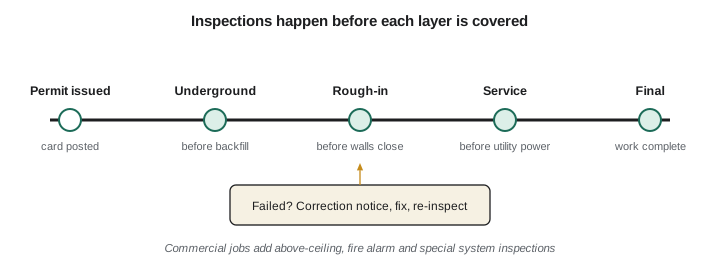
Inspections are scheduled at points where the work can still be seen. The common stages are a temporary service inspection for construction power, a rough-in inspection after boxes, raceways and cables are installed but before walls are covered, a service inspection before the utility connects permanent power, and a final inspection when the work is complete and devices and covers are in place. Commercial projects add underground or slab inspections before concrete is placed, above-ceiling inspections before ceiling tiles go in, and special inspections for fire alarm, emergency systems or generators. Covering work before it is inspected can force the contractor to open walls or ceilings at its own cost.
| Inspection | When | What the inspector looks for |
|---|---|---|
| Underground or slab | Before backfill or concrete | Burial depths, raceway types, grounding electrodes |
| Temporary service | Before construction power is energized | Pole or pedestal, GFCI protection, grounding |
| Rough-in | Before insulation and wall covering | Box fill, cable support, protection, conductor sizes |
| Service | Before the utility connects | Service equipment, bonding, electrode system, clearances |
| Final | Work complete | Devices, covers, labeling, GFCI and AFCI, panel directory |
Correction notices and re-inspection
When an inspector finds violations, the result is a correction notice, often called a red tag or correction list, that cites the code sections involved and requires the contractor to fix the work and request re-inspection. Many jurisdictions charge a re-inspection fee after the first failure, and some limit how long a permit stays open without progress. A professional response is simple: read the correction carefully, fix every item, document the fix with photos if the inspector allows it, and call for re-inspection. Arguing on the job site in front of the client rarely helps, and an inspector who sees the same mistakes repeatedly from one contractor tends to inspect that contractor's work more closely.
At the Brandt rough-in, Gloria Haynes wrote up one item: a cable in the garage was not protected where it ran along the face of a stud within the reach of a door. Dana fixed it the same afternoon with a protective plate and a short length of raceway, sent the city a photo through the portal, and the inspector approved the correction without a second visit. Ray told her afterward that the inspector's opinion of a contractor is built one correction notice at a time.
Disagreements and appeals
Sometimes a contractor honestly disagrees with an inspector's reading of the code. The first step is a polite conversation, citing the section and asking what the inspector sees in it; often the disagreement comes from a different understanding of the facts rather than the code. If that fails, most jurisdictions have a supervisor or chief inspector who can review the decision, and beyond that a board of appeals or building code board that hears formal appeals. Many states also have a state electrical board that issues formal interpretations. The NEC itself provides for the AHJ to interpret the rules, and its informational notes and the NFPA's formal interpretation process can help, but the local AHJ's decision governs the job unless it is overturned through the proper channel.
Exam questions in this area test the order of escalation and the principle that the AHJ has the authority to interpret and approve. They also test the meaning of special permission, defined in Article 100 as the written consent of the AHJ, and the idea that an AHJ may require evidence of compliance, such as listing, test reports or engineering calculations, before approving equipment or methods.
Permits and the contractor's legal exposure
A permit puts the contractor on record as responsible for the work. If the installation causes a fire, investigators will pull the permit file and inspection records, and work done without a permit leaves the contractor with no record of approval and possible violations of licensing law. Many contracts require the contractor to obtain all permits, and some owners ask contractors to skip permits to save money. A licensed contractor who agrees to do permit-required work without a permit risks fines, license discipline, insurance problems and personal liability, and many business and law exams include a question on exactly this situation.
Closing the permit matters too. A permit that is never finaled stays open on the property record, which can delay a later sale or refinancing and can be counted against the contractor by the licensing board. Brightwater's office kept a list of open permits, reviewed weekly, and Priya called for any final inspection that was overdue.
# Track open permits and flag any without an inspection in 60 days (example data)
from datetime import date
today = date(2026, 11, 2)
permits = [("E-26-1402", "Brandt service", date(2026, 9, 14), date(2026, 10, 30)),
           ("E-26-1188", "Copper Kettle fit-out", date(2026, 7, 6), date(2026, 8, 21)),
           ("E-26-0954", "Maple Street fourplex", date(2026, 5, 18), date(2026, 9, 2))]
for num, job, issued, last in permits:
    idle = (today - last).days
    flag = "CALL FOR INSPECTION" if idle > 60 else "ok"
print(f"{num} {job:<22} last inspection {idle:3d} days ago {flag}")E-26-1402 Brandt service last inspection 3 days ago ok E-26-1188 Copper Kettle fit-out last inspection 73 days ago CALL FOR INSPECTION E-26-0954 Maple Street fourplex last inspection 61 days ago CALL FOR INSPECTION
Common mistakes
MistakeStarting covered work before the rough-in inspection.
InsteadSchedule rough-in before insulation or wallboard; uninspected covered work may have to be opened.
MistakeLetting a client's unlicensed relative pull a permit under the contractor's license.
InsteadOnly the licensed contractor applies for work done for others; lending a license is a violation.
MistakeArguing with the inspector at the site in front of the client.
InsteadFix clear violations quickly; for real disagreements, discuss the code section, then use the supervisor and appeals process.
MistakeLeaving permits open after the job.
InsteadCall for final inspection and track open permits until they are closed.
MistakeAssuming the NEC says when a permit is required.
InsteadLocal ordinances and state law set permit requirements; the NEC sets installation rules.
Summary and key terms
- The AHJ enforces the code, interprets it, approves equipment and may grant special permission (Article 100, 90.4).
- State and local law decide when permits are required and who may apply; licensed contractors pull permits for work done for others.
- Inspections are staged so work is seen before it is covered: underground, rough-in, service and final are the usual stages.
- Correction notices require fixes and re-inspection; disagreements go to a supervisor, then a board of appeals or state board.
- Work without required permits, and lending a license, expose the contractor to fines, discipline and liability.
- AHJ
- The authority having jurisdiction: the body responsible for enforcing the code and approving installations.
- Special permission
- Written consent of the AHJ, as defined in Article 100.
- Rough-in inspection
- An inspection of wiring before it is concealed by wall or ceiling finishes.
- Correction notice
- An inspector's written list of violations that must be fixed before approval.
- Board of appeals
- A local or state body that hears formal appeals of code enforcement decisions.
Practice problems
Work each problem on paper first, then reveal the answer to check.
A fee schedule charges 75 dollars base, 60 dollars for a service and 10 dollars per circuit, plus 4% surcharge. Find the fee for a service and 5 circuits.
Show answer
75 + 60 + 50 = 185; 185 × 1.04 = 192.40 dollars.
Which inspection must be passed before insulation is installed?
Show answer
The rough-in inspection.
Who usually may pull a permit for electrical work on a rental duplex owned by a landlord who lives elsewhere?
Show answer
A licensed electrical contractor; owner permits usually apply only to an owner-occupied single-family dwelling.
What is the usual first step when you disagree with an inspector's code interpretation?
Show answer
Discuss the specific code section with the inspector; if unresolved, ask the supervisor or chief inspector, then appeal formally.
Lesson quiz · 5 questions
Score 60% or more to complete this lesson.
Create a free account to save your progress, take quizzes and earn a certificate.