
MELU-107 · Lesson 5 of 12 · 21 min
Insurance, bonding and licensing law
▶ Video coming soon A video version of this lesson is on the way.
Two weeks after Dana passed her code exam, a certificate of insurance request arrived from a property management company that wanted Brightwater to take over maintenance at four apartment buildings. The request listed general liability limits of 1,000,000 dollars per occurrence and 2,000,000 dollars aggregate, an umbrella policy of 2,000,000 dollars, workers' compensation at statutory limits, commercial auto, additional insured status for the owner and the management company, and a waiver of subrogation. Dana did not know what half of it meant. Priya forwarded it to the company's insurance agent and then sat Dana down to explain, because the qualifier of an electrical contractor is expected to understand the risks the company carries, and the business and law exam will ask about every item on that list.
This lesson covers the insurance policies electrical contractors carry, the surety bonds they buy, and the licensing law that ties both to the right to do business. The common thread is risk: insurance moves the cost of accidents to an insurer, bonds guarantee that the contractor will keep its promises, and licensing law protects the public by deciding who may offer electrical work at all.
Commercial general liability
Commercial general liability insurance, usually called CGL or general liability, pays for claims that the contractor's operations caused bodily injury or property damage to others. If a Brightwater electrician drops a ladder through a client's window, or a wiring mistake causes a fire that damages a building, the CGL policy responds, subject to its terms. Policies state an each-occurrence limit, the most paid for any one occurrence, and a general aggregate limit, the most paid for all claims in the policy period. Many also have a separate products-completed operations aggregate, which covers claims that arise after the work is finished, an important coverage for electrical contractors because many fires happen long after the job is done.
General liability does not cover everything. It usually excludes injuries to the contractor's own employees (covered by workers' compensation), damage to the contractor's own work in many cases, professional design errors (covered by professional liability), vehicle accidents (covered by auto insurance) and pollution, among others. Exam questions often ask which policy covers a described loss.
| Policy | What it covers | Example |
|---|---|---|
| Commercial general liability | Third-party bodily injury and property damage from operations and completed work | A fire caused by a loose termination months after the job |
| Workers' compensation | Employees' work injuries: medical care and lost wages | An apprentice falls from a ladder |
| Employer's liability | Employee injury lawsuits outside the workers' compensation system | Usually Part Two of the workers' compensation policy |
| Commercial auto | Accidents involving company vehicles | A service van rear-ends a car |
| Inland marine (tools and equipment) | Tools, equipment and materials in transit or on job sites | A trailer of wire is stolen from a site |
| Builder's risk | The building under construction | Usually bought by the owner or general contractor |
| Umbrella or excess liability | Limits above the underlying policies | A large fire claim that exceeds the CGL limit |
| Professional liability | Design errors and omissions | Design-build work with a design mistake |
Workers' compensation
Workers' compensation is a state-run system, required by law in almost every state for employers with employees, that pays medical bills and a share of lost wages for work-related injuries and illnesses regardless of fault. In exchange, employees generally cannot sue their employer for negligence, a trade-off often called the exclusive remedy. Premiums are based on payroll and on a classification code for the type of work, with electrical work in its own class, and are adjusted by an experience modification rate, or EMR, that compares the company's claims with the average for its class. An EMR below 1.0 lowers the premium, and above 1.0 raises it; many general contractors refuse to hire subcontractors with an EMR above a set value.
Because premiums follow payroll, misclassifying employees as independent contractors, or reporting electricians under a cheaper clerical class, is both a premium fraud risk and a violation that auditors look for. Insurers audit payroll at the end of each policy year and adjust the premium. A contractor that hires uninsured subcontractors may be charged premium for the subcontractor's workers, because the hiring contractor can be treated as their employer for workers' compensation purposes.
Worked problem
Estimating a workers' compensation premium
Brightwater's electrician payroll is 780,000 dollars a year. The illustrative rate for its electrical class is 3.10 dollars per 100 dollars of payroll, and its EMR is 0.86. Estimate the premium before discounts and fees.
Show solution
- Base premium: 780,000 ÷ 100 × 3.10 = 24,180.
- Apply the EMR: 24,180 × 0.86 = 20,794.80.
Answer: About 20,795 dollars; an EMR of 0.86 saves about 3,385 dollars compared with the base.
# Workers' compensation premium and the effect of the EMR (illustrative rate)
payroll = 780000
rate_per_100 = 3.10
for emr in (0.86, 1.00, 1.25):
    premium = payroll / 100 * rate_per_100 * emr
print(f"EMR {emr:.2f}: premium {premium:,.2f}")EMR 0.86: premium 20,794.80 EMR 1.00: premium 24,180.00 EMR 1.25: premium 30,225.00
Certificates and additional insured status
A certificate of insurance is a one-page summary, usually on a standard form, that lists the contractor's policies, insurers, policy numbers, dates and limits. It is evidence of coverage, not the coverage itself, and it does not change the policy. When a contract requires that the owner or general contractor be an additional insured, the contractor's insurer must add them to the CGL policy by endorsement, so they are covered for claims arising from the contractor's work. A waiver of subrogation means the contractor's insurer gives up its right to recover from the other party after paying a claim. Both require endorsements to the policy, and a certificate that merely says additional insured without the endorsement may not protect anyone.
Priya kept a spreadsheet of every certificate Brightwater issued and received. Before hiring a subcontractor such as a trenching company, she required a certificate showing general liability and workers' compensation, because an uninsured subcontractor's accident could land on Brightwater's policies.
Surety bonds
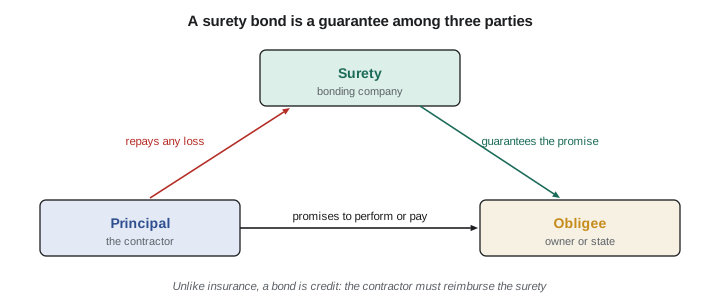
A surety bond is a three-party guarantee. The principal, the contractor, promises to do something; the obligee, usually the owner or the state, is protected by the promise; and the surety, an insurance or bonding company, guarantees it. If the principal fails, the surety pays the obligee up to the bond amount, and then seeks repayment from the principal. That last point is what separates a bond from insurance: bonds are credit, and the contractor and often its owners personally sign an indemnity agreement promising to repay the surety. Sureties therefore underwrite contractors on character, capacity and capital, examining financial statements, work in progress and experience before setting a bonding limit.
| Bond | Guarantees that | Usual amount |
|---|---|---|
| Bid bond | The bidder will sign the contract and provide the required bonds if awarded | Often 5 to 10% of the bid |
| Performance bond | The contractor will complete the work according to the contract | Usually 100% of the contract |
| Payment bond | The contractor will pay its subcontractors and suppliers | Usually 100% of the contract |
| License or permit bond | The contractor will follow licensing laws and permit rules | Set by the state or city |
| Maintenance or warranty bond | Defects found during a warranty period will be corrected | A share of the contract |
Worked problem
Bid and performance bonds
A school lighting retrofit is bid at 240,000 dollars. The bid documents require a 5% bid bond and 100% performance and payment bonds. The illustrative bond premium is 2.5% of the contract for the first 100,000 dollars and 1.5% for the next 400,000 dollars. Find the bid bond amount and the bond premium.
Show solution
- Bid bond amount: 0.05 × 240,000 = 12,000 (usually issued at no charge by the surety).
- Premium on the first 100,000: 0.025 × 100,000 = 2,500.
- Premium on the next 140,000: 0.015 × 140,000 = 2,100.
- Total premium: 2,500 + 2,100 = 4,600.
Answer: A 12,000 dollar bid bond, and about 4,600 dollars of premium for the performance and payment bonds.
Licensing law
Every state that licenses electrical work has a statute and rules that define who must be licensed, what each license allows, how licenses are obtained and renewed, and what conduct is prohibited. The common categories are apprentice registration, journeyman license, master or supervising license, and contractor license, and some states add limited licenses for residential work, low-voltage systems, signs, elevators or maintenance. The licensing board or department enforces the law, investigates complaints and disciplines licensees.
Business and law exams test the general structure and the state's specifics. Typical rules include the following, though each state writes its own: a contractor must display its license number on vehicles, advertising, bids and contracts; a license cannot be transferred or lent; the qualifier must actually supervise the company's electrical work and usually may qualify only one company at a time; changes of address, ownership or qualifier must be reported within a set time; and a license must be renewed on schedule, often every one to three years, with continuing education that includes NEC update hours. Unlicensed contracting is usually a misdemeanor or civil violation, and in many states an unlicensed contractor cannot enforce its contract or lien rights.
| Topic | Common rule | Consequence of breaking it |
|---|---|---|
| Advertising | License number on ads, vehicles, bids | Fines, citations |
| Lending a license | Prohibited | Suspension or revocation for both parties |
| Qualifier supervision | Qualifier must supervise; often one company only | Discipline of qualifier and company |
| Reporting changes | Report new address, owner or qualifier within a set time | Fines, license lapse |
| Renewal | Renew on schedule with continuing education | Lapsed license; working is then unlicensed |
| Unlicensed work | Prohibited for work requiring a license | Penalties; often loss of contract and lien rights |
Discipline follows a due-process path. A complaint is investigated, the licensee is notified and may respond, and the board may dismiss the complaint, settle it with a consent agreement, or hold a hearing. Penalties range from fines and required education to probation, suspension and revocation. Grounds commonly include gross negligence, fraud, abandonment of a job, failure to pay subcontractors, aiding unlicensed contracting, failing to obtain permits, and criminal convictions related to the work. Dana noted that the list read almost like a summary of every other lesson in this course.
Managing risk beyond insurance
Insurance is only one of four ways a business handles risk. It can avoid a risk by declining work it is not equipped for, such as a medium-voltage job far outside its experience. It can reduce a risk through training, safety programs, quality control and careful contracts. It can retain a risk by accepting it, often through deductibles that lower premiums. And it can transfer a risk to someone else through insurance, bonds, indemnity clauses or subcontracts. Business and law references present these four choices together, and exam questions sometimes ask which one a described action represents. Ray's decision to buy arc-rated clothing and train everyone after the warehouse accident was risk reduction; his choice of a 5,000 dollar deductible on the tools policy was risk retention.
Claims handling also matters. When an incident happens, the contractor should notify the insurer promptly as the policy requires, preserve evidence and photos, avoid admitting fault to the other party, and keep records of the response. Late notice can give an insurer grounds to deny coverage. Brightwater's office kept a one-page incident procedure in every truck with the agent's number and the steps to follow.
Common mistakes
MistakeTreating a certificate of insurance as the coverage itself.
InsteadThe certificate summarizes coverage; additional insured status and waivers need endorsements on the policy.
MistakeThinking a bond protects the contractor the way insurance does.
InsteadA bond protects the obligee; the contractor must repay the surety for any loss.
MistakeHiring uninsured subcontractors to save money.
InsteadTheir accidents and premiums can fall on your workers' compensation and liability policies.
MistakeLetting a license lapse while working.
InsteadRenew on time; work under a lapsed license is unlicensed work.
MistakeQualifying a second company informally.
InsteadMost states limit a qualifier to one company and require real supervision.
Summary and key terms
- General liability covers third-party injury and property damage, including completed operations; it excludes employee injuries, autos and design errors.
- Workers' compensation pays employee injuries regardless of fault; premiums follow payroll, class rate and the EMR.
- Certificates are evidence of insurance; additional insured status and waivers of subrogation require endorsements.
- Surety bonds guarantee bids, performance and payment among principal, obligee and surety, and the contractor repays the surety.
- Licensing law defines who may contract, requires license display and qualifier supervision, prohibits lending licenses, and sets renewal and discipline rules.
- Each-occurrence limit
- The most a policy pays for one occurrence.
- EMR
- Experience modification rate: a factor comparing a company's workers' compensation claims with its class average.
- Additional insured
- A party added to another's liability policy by endorsement.
- Surety
- The company that guarantees a principal's obligation in a bond.
- Performance bond
- A bond guaranteeing that the contractor will complete the contract.
Practice problems
Work each problem on paper first, then reveal the answer to check.
Payroll is 500,000 dollars, the rate is 2.80 per 100 dollars of payroll, and the EMR is 1.12. Estimate the premium.
Show answer
500,000 ÷ 100 × 2.80 = 14,000; × 1.12 = 15,680 dollars.
A bid is 180,000 dollars and requires a 10% bid bond. What is the bond amount?
Show answer
18,000 dollars.
Which policy covers a company van accident?
Show answer
Commercial auto insurance.
Who repays the surety after it pays a performance bond claim?
Show answer
The contractor (principal) and any indemnitors under the indemnity agreement.
Lesson quiz · 5 questions
Score 60% or more to complete this lesson.
Create a free account to save your progress, take quizzes and earn a certificate.