
MELU-106 · Lesson 9 of 12 · 23 min
Emergency, legally required and standby systems
▶ Video coming soon A video version of this lesson is on the way.
When the utility fails, some loads must keep running to protect lives, some must keep running because a law or code requires it for other reasons, and some keep running only because the owner wants them to. The NEC treats these three situations differently in Article 700 for emergency systems, Article 701 for legally required standby systems and Article 702 for optional standby systems, with Article 708 adding critical operations power systems for facilities vital to public safety and national security. Master exams almost always include questions that ask which article applies to a given load, how fast the alternate source must take over, and how the wiring must be separated. This lesson covers all three in turn, plus transfer equipment and generator sizing for optional standby. Sections are cited by number and explained in our own words; check your edition and the building and fire codes that decide which loads are emergency loads.
Three jobs, three articles
Dana has three standby projects at once. The Copper Kettle's new banquet room needs egress lighting and exit signs that work during an outage, as the building code requires for places of assembly. Delgado Fabrication's finishing line has an exhaust fan whose shutdown during an outage would let solvent vapors build up, and the owner's fire protection engineer says the fire code requires it to have standby power. And Luis Delgado also wants a generator for the whole machine shop so a power failure does not ruin parts in the middle of a machining run. 'Same generator family, three different articles,' Ray says. 'The article depends on why the load needs power, not what the load is.'
Which article applies?
The key is who requires the system and what it protects. Emergency systems under Article 700 are legally required by municipal, state, federal or other codes or by a governmental agency having jurisdiction, and are intended to automatically supply illumination, power or both to designated areas and equipment in the event of failure of the normal supply, essential for safety to human life. Egress lighting, exit signs, fire alarm systems in some cases, fire pumps' related controls, elevators used for evacuation, and similar loads fall here when a code requires them. Legally required standby systems under Article 701 are also required by codes or agencies, but to serve loads whose failure could create hazards or hamper rescue or firefighting, such as heating and refrigeration systems, communication systems, ventilation and smoke removal systems, sewage disposal and industrial processes whose stoppage could create hazards. Optional standby systems under Article 702 are not legally required and protect public or private facilities or property where life safety does not depend on them, such as a generator for a business, a farm or a home.
| Article | System | Required by | Purpose | Transfer time (commonly tested) |
|---|---|---|---|---|
| 700 | Emergency | Codes or agencies | Safety to human life | 10 seconds |
| 701 | Legally required standby | Codes or agencies | Avoid hazards or aid rescue and firefighting | 60 seconds |
| 702 | Optional standby | Owner choice | Protect property or business | No Code time limit |
| 708 | Critical operations power | Government designation | Continuity for public safety and security | Per design and the article |
For Dana's projects, the banquet room's egress lighting is an emergency system, the solvent exhaust fan is a legally required standby load, and the shop generator is an optional standby system. They can share a generator in some cases, but the wiring, transfer switches and priorities must keep each system's rules intact.
Emergency systems: performance
Article 700 sets demanding performance rules. Section 700.12 requires the emergency source to supply the emergency loads within 10 seconds after failure of the normal supply. Acceptable sources include storage batteries, generator sets, uninterruptible power supplies, a separate service where approved, fuel cell systems, and unit equipment. Generator sets must have on-site fuel for a stated minimum running time at full demand load, commonly 2 hours, unless the authority accepts other arrangements. Battery sources and unit equipment must carry the load for a stated duration, commonly 1-1/2 hours, without the voltage falling below a stated level, which matches the egress lighting duration required by the building and life safety codes.
Section 700.3 requires the system to be tested. The authority having jurisdiction must conduct or witness a test of the complete system on completion of the installation, and the system must be tested periodically on a schedule approved by the authority, with a written record kept. Where the emergency system relies on a single alternate source, a means to connect a portable or temporary source must be provided while the permanent source is out of service for maintenance, under rules that have expanded in recent editions.
Emergency systems: wiring separation
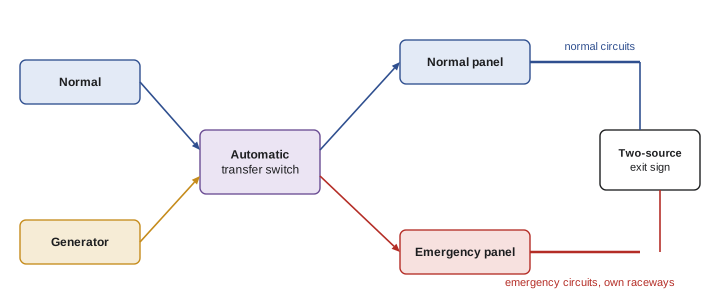
The most distinctive Article 700 rule is separation. Section 700.10(B) requires emergency system wiring, from the emergency source or the emergency side of the transfer switch to the emergency loads, to be kept entirely independent of all other wiring and equipment. It must not enter the same raceway, cable, box or cabinet as other wiring, except in transfer equipment, in exit or emergency luminaires supplied from two sources, in a common junction box attached to such luminaires, and in a few other listed cases. The idea is that a fault or fire involving ordinary wiring should not take out the emergency wiring with it.
In buildings with large occupant loads or high-rise buildings, section 700.10(D) adds fire protection for feeder-circuit wiring, which must be installed in spaces fully protected by an approved automatic fire suppression system, be a listed fire-resistive cable or electrical circuit protective system with a stated fire rating, commonly 2 hours, or be protected by a listed system with that rating. Emergency equipment such as transfer switches and generator controls in those buildings must also be in protected spaces. Exam questions on 700.10(D) test the triggering conditions and the rating.
Selective coordination and signs
Section 700.32 requires emergency system overcurrent devices to be selectively coordinated with all supply-side overcurrent protective devices, so that a fault on one emergency branch circuit opens only the device protecting that circuit and does not cascade up to the feeder or the transfer switch. Selective coordination must be selected by a licensed professional engineer or similarly qualified person, documented and made available to those authorized to design, install, inspect, maintain and operate the system. The same requirement appears in 701.32 for legally required standby and in Article 517 for health care essential electrical systems, and in 620 for elevators with more than one driving machine on a feeder. Signs are required by section 700.7 at the service entrance equipment indicating the type and location of each on-site emergency power source, and in some cases at the grounding location.
| Rule | Article 700 (emergency) | Article 701 (legally required) | Article 702 (optional) |
|---|---|---|---|
| Transfer time | 10 seconds | 60 seconds | None in the Code |
| Wiring separation | Entirely independent | May share with general wiring | May share with general wiring |
| Selective coordination | Required | Required | Not required |
| Witness test | Required | Required | Not required |
| Transfer equipment | Automatic, listed for emergency use | Automatic, listed | Manual or automatic, listed |
Unit equipment for egress lighting
Unit equipment, the battery-powered emergency lights found in many small buildings, is covered in 700.12. Each unit has a rechargeable battery, a charger, lamps and an automatic relay that turns on the lamps when normal power fails. The unit must be permanently fixed in place and its branch circuit must be the same branch circuit that serves the normal lighting in the area, connected ahead of any local switches, so that the unit operates when the normal lighting in that area loses power. Where the normal lighting is on several circuits, the unit can be supplied from a separate circuit originating from the same panelboard as the normal lighting circuits, with a lock-on feature. Emergency luminaires that receive power from unit equipment by remote heads must be wired in accordance with the separation rules.
For the Copper Kettle banquet room, Dana uses unit equipment with remote heads at the exits and two-source exit signs, each connected to the banquet room's normal lighting circuit ahead of the room's dimmer, which satisfies the building code's 1-1/2-hour egress lighting duration without a generator.
Legally required standby
Article 701 systems must take over within 60 seconds of normal power failure under section 701.12, and they use the same types of sources as emergency systems. Their wiring is permitted to occupy the same raceways, cables, boxes and cabinets as other general wiring, unlike emergency wiring, but selective coordination is required and the system must be witness-tested and periodically tested like an emergency system. Transfer equipment must be automatic and listed. Delgado's solvent exhaust fan qualifies: the fire code requires the ventilation to continue during an outage so vapors do not accumulate. Dana puts it on a separate automatic transfer switch that is fed from the shop generator but prioritized so that the exhaust fan is restored first.
Optional standby and generator sizing
Article 702 covers the generators most contractors install: whole-home standby units, business backup and farm generators. The two key rules are transfer equipment and capacity. Transfer equipment is required for all fixed or portable optional standby systems connected to premises wiring, under 702.5, so that the generator cannot backfeed the utility. It must be suitable for the intended use and listed, and it may be manual or automatic. Portable generators connected through a power inlet need a transfer switch or a listed interlock on the panelboard that prevents the main and generator breakers from being closed at the same time.
Capacity, in section 702.4, depends on how transfer happens. With manual transfer, the generator must have adequate capacity and rating to supply all the equipment intended to be operated at one time, and the user decides what to run. With automatic transfer, the generator must be able to supply the full load that is transferred, calculated under Article 220 or by another approved method, unless a load management system is used that automatically sheds load so the generator is not overloaded. This is why automatic whole-home generators are often paired with load management modules that disconnect the air conditioner or water heater when the generator nears its limit.
Worked problem
Sizing Delgado's shop generator
Delgado wants an automatic transfer generator for the whole shop. The calculated load of the transferred equipment is 112 kilowatts at 480Y/277 volts, three-phase. Generator sets are offered in 100, 125, 150 and 200 kilowatt sizes. With no load management, what size meets 702.4, and what is the load current?
Show solution
- With automatic transfer and no load management, the generator must carry the full transferred load, 112 kilowatts.
- The smallest size not less than 112 kilowatts is 125 kilowatts.
- Load current: 112,000 divided by (480 times 1.732) is about 135 amperes.
- Dana notes that motor starting may require a larger generator; the manufacturer's sizing software is used to check voltage dip when the largest motor starts.
Answer: 125 kilowatts minimum, carrying about 135 amperes at full calculated load.
import math
# Generator size for automatic transfer (illustrative sizes) and load current
sizes = [60, 80, 100, 125, 150, 200, 250]

def pick(load_kw, volts=480, phases=3):
    gen = next(s for s in sizes if s >= load_kw)
    amps = load_kw * 1000 / (volts * (math.sqrt(3) if phases == 3 else 1))
    return gen, amps

for name, kw, v, ph in [("Delgado shop", 112, 480, 3), ("Copper Kettle", 58, 208, 3), ("Helen's house", 26, 240, 1)]:
    gen, amps = pick(kw, v, ph)
print(f"{name}: {kw} kW calculated -> {gen} kW generator, about {amps:.0f} A at {v} V")Delgado shop: 112 kW calculated -> 125 kW generator, about 135 A at 480 V Copper Kettle: 58 kW calculated -> 60 kW generator, about 161 A at 208 V Helen's house: 26 kW calculated -> 60 kW generator, about 108 A at 240 V
Transfer switches and generator rules
Transfer switches must be listed for the application, and those used for emergency systems must be listed for emergency use and be automatic. A transfer switch must not be able to connect the normal and alternate sources together unless it is a closed-transition switch listed for that purpose. Transfer switches have their own short-circuit current ratings, which must be at least the available fault current at their location, as 110.10 requires for all equipment. Generators themselves are covered by Article 445, which requires overcurrent protection, conductors sized at not less than 115 out of 100 of the generator nameplate current from the generator terminals to the first overcurrent device in many cases, a disconnecting means, and, for one- and two-family dwellings, an emergency shutdown device located outside the dwelling at a readily accessible location so first responders can shut the generator down.
Generators also raise grounding questions, covered in MELU-104: whether the generator is a separately derived system, which depends on whether the transfer switch switches the neutral, determines whether the generator's neutral is bonded to its frame and whether a grounding electrode connection is needed at the generator.
Critical operations power systems
Article 708 covers critical operations power systems, or COPS, in facilities designated by a government authority or facility engineering documentation as vital to national security, the economy, public health or safety, such as some emergency operations centers and data centers. COPS rules include risk assessment, physical security, protection against flooding and other hazards, commissioning, documentation, and periodic testing. Exam questions on Article 708 are rare but usually test its scope and the requirement for a risk assessment.
2026 notes
The 2026 edition continues to refine the temporary source rules for emergency systems, the requirements for transfer switches and the coordination between Articles 700, 701, 702 and the new source and storage articles. The 10- and 60-second transfer times and the separation and coordination rules remain. Confirm the details in your edition.
Common mistakes
MistakeRunning emergency branch circuits in the same raceway as normal lighting circuits.
Instead700.10(B) requires emergency wiring to be kept entirely independent of other wiring, with limited exceptions.
MistakeAllowing an emergency source 30 seconds to pick up the load.
InsteadEmergency systems must supply the load within 10 seconds.
MistakeConnecting unit equipment to a separate circuit from the area's normal lighting.
InsteadUnit equipment is supplied from the same branch circuit as the normal lighting in the area, ahead of local switches.
MistakeSizing an automatic whole-home generator for only the loads the owner usually runs.
InsteadWith automatic transfer and no load management, the generator must carry the full transferred load.
MistakeConnecting a portable generator through a dryer receptacle with a double-ended cord.
InsteadOptional standby systems need listed transfer equipment or an interlock that prevents backfeeding.
Summary and key terms
- Article 700 covers legally required systems for life safety; Article 701 covers other legally required standby loads; Article 702 covers optional systems.
- Emergency loads must be supplied within 10 seconds; legally required standby within 60 seconds.
- Emergency wiring is kept entirely independent of other wiring; legally required and optional standby wiring may share.
- Emergency and legally required systems need selective coordination, witness testing and periodic testing.
- Unit equipment is supplied from the area's normal lighting circuit ahead of local switches and runs at least 1-1/2 hours.
- Optional standby needs listed transfer equipment; automatic transfer requires capacity for the full transferred load unless load management is used.
- Generators at dwellings need an outdoor emergency shutdown device.
- Emergency system
- A legally required system that automatically supplies power essential for safety to human life when normal power fails.
- Legally required standby system
- A legally required system that supplies loads whose failure could create hazards or hamper rescue or firefighting.
- Optional standby system
- A system installed by choice to protect property or business operations.
- Unit equipment
- A self-contained emergency light with battery, charger and automatic transfer.
- Selective coordination
- Arrangement of overcurrent devices so that only the device nearest a fault opens.
- Transfer equipment
- Equipment that transfers loads between the normal and alternate sources without connecting them together.
Practice problems
Work each problem on paper first, then reveal the answer to check.
Within how many seconds must a legally required standby system pick up its loads?
Show answer
60 seconds.
May emergency branch circuit conductors share a box with normal lighting conductors?
Show answer
Only in the limited cases allowed, such as transfer equipment and two-source luminaires.
For how long must unit equipment commonly operate on battery?
Show answer
1-1/2 hours.
An automatic transfer generator will carry a calculated 47 kilowatt load with no load management. Using sizes of 40, 48 and 60 kilowatts, which is the smallest acceptable?
Show answer
48 kilowatts.
Which article covers a generator a homeowner installs to keep the freezer and furnace running?
Show answer
Article 702, optional standby.
Lesson quiz · 5 questions
Score 60% or more to complete this lesson.
Create a free account to save your progress, take quizzes and earn a certificate.