
MELU-106 · Lesson 11 of 12 · 27 min
Signs, elevators and other special equipment
▶ Video coming soon A video version of this lesson is on the way.
Chapter 6 of the NEC covers special equipment: electric signs, elevators and escalators, welders, information technology equipment, industrial machinery, cranes, X-ray equipment, induction heating, fire pumps and more. Each article modifies the general rules for equipment whose use or construction creates particular needs. Master exams pick a handful of these, usually the ones with a distinctive calculation or a distinctive disconnect rule. This lesson covers signs in Article 600, elevators in Article 620, welders in Article 630, information technology equipment rooms in Article 645, industrial machinery in Article 670, and a quick tour of other Chapter 6 articles, with a calculation for each where the article has one. Sections are cited by number and explained in our own words; values in examples are illustrative.
A sign, a crane and a welding bay
Brightwater's projects are converging. The Copper Kettle wants an illuminated sign for the banquet room's new entrance. Delgado Fabrication is adding a welding bay with four transformer arc welders and a small overhead bridge crane over the steel rack. And the Maple Street fourplex owner is pricing an elevator so tenants on the third floor can move furniture more easily. 'Chapter 6 is where the equipment people live,' Ray says. 'Each article has one or two numbers you need to know cold, and the rest you look up.'
Electric signs under Article 600
Article 600 covers electric signs and outline lighting, including neon, LED and fluorescent signs and the sections of buildings outlined with lighting. All signs and outline lighting systems must be listed and installed in conformance with the listing, under 600.3, unless they are field-assembled from listed components following the manufacturer's instructions. The most frequently tested rule is the sign outlet in section 600.5: each commercial building and each commercial occupancy accessible to pedestrians must have at least one outlet in an accessible location at each entrance to each tenant space for sign or outline lighting system use. The outlet must be supplied by a branch circuit rated at least 20 amperes that supplies no other load. For load calculations, section 220.14(F), in the 2023 edition, requires each such sign outlet to be counted at a minimum of 1,200 volt-amperes, a number that appears on exams often.
Section 600.5(B) also limits the rating of branch circuits that supply signs: circuits supplying signs with incandescent and fluorescent forms of illumination are limited to a stated rating, commonly 20 amperes, and circuits supplying only neon tubing installations are limited to a higher rating, commonly 30 amperes. Section 600.6 requires each sign and outline lighting system, or feeder circuit or branch circuit supplying a sign, to be controlled by an externally operable switch or circuit breaker that opens all ungrounded conductors and controls no other load. The disconnect must be within sight of the sign, or capable of being locked in the open position. Metal parts of signs must be bonded, and signs in wet locations must be suitable for the location.
| Sign rule | Summary, in our words | Where |
|---|---|---|
| Listing | Signs and outline lighting are listed, or field-assembled from listed parts | 600.3 |
| Sign outlet | At each entrance to each tenant space accessible to pedestrians | 600.5(A) |
| Sign circuit | At least 20 A, supplying no other load | 600.5(A) |
| Load calculation | At least 1,200 VA per required sign outlet | 220.14(F) |
| Circuit rating limits | Commonly 20 A for incandescent and fluorescent, 30 A for neon | 600.5(B) |
| Disconnect | Opens all ungrounded conductors; within sight or lockable | 600.6 |
Worked problem
The banquet room sign
The banquet room's new entrance faces the Harlow Commons parking lot and is accessible to pedestrians. The owner's sign is a listed LED cabinet sign drawing 4.5 amperes at 120 volts. The sign is on the roof parapet, out of sight of the panelboard. What does Dana need to provide?
Show solution
- The banquet room is a commercial occupancy with an entrance accessible to pedestrians, so 600.5(A) requires a sign outlet at that entrance on a branch circuit of at least 20 amperes supplying no other load.
- The load calculation counts the sign outlet at not less than 1,200 volt-amperes, even though the actual sign draws 4.5 times 120, or 540 volt-amperes.
- A disconnect is required under 600.6. Because the panelboard is not within sight, Dana installs a listed switch at the sign or a breaker with a lockable provision.
- The sign is listed, so it is installed according to its listing and the manufacturer's instructions.
Answer: A dedicated 20-ampere sign circuit, counted at 1,200 VA, with a disconnect at the sign or a lockable breaker.
Elevators and escalators under Article 620
Article 620 covers elevators, dumbwaiters, escalators, moving walks, platform lifts and stairway chairlifts. It works closely with ASME A17.1, the safety code for elevators, and the building and fire codes. The main exam topics are disconnecting means, separate branch circuits for car and machine room lighting, GFCI protection, selective coordination and standby power.
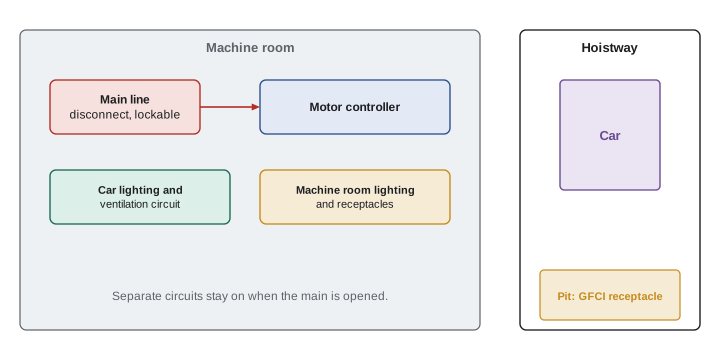
Section 620.51 requires a single means for disconnecting all ungrounded main power supply conductors for each elevator, located where it is readily accessible to qualified persons, and capable of being locked in the open position. The disconnect must be a fused motor circuit switch or a circuit breaker, it must not open the car lighting, receptacle and ventilation circuits, and it is commonly located inside the machine room or control room, within sight of the motor controller. Where sprinklers are installed in the hoistway, machine room or control room, a means is required to automatically disconnect the main power supply before the sprinklers discharge, commonly a shunt-trip breaker triggered by a heat detector, as the elevator code requires.
Separate branch circuits are required for the car lighting, receptacles, ventilation and accessories under 620.22; for the machine room and control room lighting and receptacles under 620.23; and for the hoistway pit lighting and receptacles under 620.24, so that a fault on the elevator power does not leave a technician in the dark. Section 620.85 requires GFCI protection for 125-volt, single-phase, 15- and 20-ampere receptacles in pits, in hoistways, on the cars of elevators and in escalator and moving walk wellways, and in machine rooms and control rooms in many cases. A dedicated receptacle for a sump pump in the pit is treated differently in some editions. Section 620.62 requires selective coordination where more than one driving machine disconnecting means is supplied by a single feeder, so that a fault in one elevator does not shut down all of them.
Welders under Article 630
Welders draw large currents for short periods, so Article 630 lets the supply conductors be sized for the welder's duty cycle rather than its full rated current. For individual transformer arc welders, section 630.11(A) requires the supply conductors to have an ampacity not less than the effective primary current marked on the nameplate, or, where that value is not given, the rated primary current multiplied by a factor from a table based on the duty cycle. The duty cycle is the share of a 10-minute period during which the welder can operate at its rated output. A lower duty cycle gives a lower multiplier. For a group of welders, section 630.11(B) permits the conductor ampacity to be based on the largest welders at full value and the rest at reduced values, because not all welders run at the same moment.
Overcurrent protection for transformer arc welders, under 630.12, is set at not more than a stated multiple, commonly 200 out of 100, of the maximum effective primary current or the rated primary current, and the conductors may be protected at not more than 200 out of 100 of their ampacity. A disconnect is required for each welder, with a rating not less than the conductor ampacity, under 630.13. Resistance welders have their own rules based on their duty cycle and demand. The multiplier values below are illustrative and match the pattern commonly found in the table; use your own book on the exam.
| Duty cycle | Multiplier (illustrative) |
|---|---|
| 100 | 1.00 |
| 90 | 0.95 |
| 80 | 0.89 |
| 70 | 0.84 |
| 60 | 0.78 |
| 50 | 0.71 |
| 40 | 0.63 |
| 30 | 0.55 |
| 20 | 0.45 |
Worked problem
Delgado's welding bay
Delgado's four transformer arc welders each have a rated primary current of 50 amperes at a 50 out of 100 duty cycle, with no effective primary current on the nameplate. Using the illustrative multiplier of 0.71, what minimum ampacity is needed for each welder's supply conductors? For the group, using an illustrative rule of 100 out of 100 of the two largest, 85 out of 100 of the third and 70 out of 100 of the fourth, what is the feeder ampacity?
Show solution
- Each welder: 50 times 0.71 is 35.5 amperes.
- Group: the two largest at full value, 35.5 plus 35.5, is 71 amperes; the third at 0.85 is 30.2 amperes; the fourth at 0.70 is 24.9 amperes.
- Total: 71 plus 30.2 plus 24.9 is about 126.0 amperes.
- Overcurrent protection for each welder may be up to 200 out of 100 of the rated primary current, 100 amperes, but Dana chooses the manufacturer's recommended 70-ampere breaker.
Answer: About 35.5 amperes per welder; about 126 amperes for the group feeder.
# Welder supply conductors from duty cycle (illustrative multipliers and group factors)
mult = {100: 1.00, 90: 0.95, 80: 0.89, 70: 0.84, 60: 0.78, 50: 0.71, 40: 0.63, 30: 0.55, 20: 0.45}
group = [1.00, 1.00, 0.85, 0.70]        # the rest at 0.60

def welder(i_primary, duty):
    return i_primary * mult[duty]

each = [welder(50, 50) for _ in range(4)]
each.sort(reverse=True)
total = sum(a * (group[i] if i < len(group) else 0.60) for i, a in enumerate(each))
print("Each welder:", ", ".join(f"{a:.1f} A" for a in each))
print(f"Group feeder: about {total:.1f} A")
print(f"Max breaker per welder at 200 out of 100: {2 * 50} A")Each welder: 35.5 A, 35.5 A, 35.5 A, 35.5 A Group feeder: about 126.0 A Max breaker per welder at 200 out of 100: 100 A
Information technology equipment rooms
Article 645 applies to information technology equipment rooms that meet all of its conditions, including a disconnecting means, a separate heating, ventilating and air-conditioning system or fire-resistant separation, listed equipment, and occupancy limited to the people needed to operate and maintain the equipment. It is an optional article: a designer may choose to meet its conditions to use its relaxed rules for cables under a raised floor, or may simply wire the room under Chapters 1 through 4. Where Article 645 is used, section 645.10 requires a disconnecting means to remove power to all electronic equipment in the room and to the dedicated HVAC system serving it, with controls at the principal exit doors, unless the room qualifies for an exception, such as an integrated electrical system or a critical operations data system with specific protections. Exam questions on Article 645 usually test whether it applies and what the disconnect must control.
Industrial machinery under Article 670
Article 670 covers industrial machinery, defined broadly as a power-driven machine or group of machines working together, not portable by hand, used to process material by cutting, forming, pressure, electrical, thermal or similar techniques. The machine's electrical equipment is built to NFPA 79, Electrical Standard for Industrial Machinery, and Article 670 covers the supply side. A nameplate on each machine must give the supply voltage, phase, frequency, full-load current, maximum overcurrent device rating, short-circuit current rating, and the largest motor's current. Section 670.4(A) sets the supply conductor ampacity at not less than 125 out of 100 of the full-load current rating of all resistance heating loads, plus 125 out of 100 of the full-load current of the highest rated motor, plus the sum of the full-load currents of all other connected motors and apparatus that may be in operation at the same time. A disconnecting means must be provided for each machine, and the overcurrent protection must not exceed the nameplate maximum.
Worked problem
A CNC machine's supply
The nameplate of Delgado's new CNC machining center lists, at 480 volts, a 10-ampere resistance heating load, a 22-ampere spindle motor and 18 amperes of other motors and controls. What minimum supply conductor ampacity does 670.4(A) require?
Show solution
- Resistance heating: 10 times 1.25 is 12.5 amperes.
- Largest motor: 22 times 1.25 is 27.5 amperes.
- Other motors and apparatus: 18 amperes.
- Total: 12.5 plus 27.5 plus 18 is 58 amperes. The overcurrent device must not exceed the nameplate maximum.
Answer: At least 58 amperes.
Other Chapter 6 articles at a glance
Several more Chapter 6 articles appear on exams from time to time. Article 610 covers cranes and hoists, with rules for runway conductors, disconnects at the runway and on the crane, and conductor sizing based on motor time ratings. Article 625, covered in lesson 8, is in Chapter 6. Article 640 covers audio signal processing, amplification and reproduction equipment. Article 660 covers X-ray equipment, with conductor sizing based on momentary and long-time ratings. Article 665 covers induction and dielectric heating equipment. Article 675 covers electrically driven or controlled irrigation machines. Article 690, 691, 692 and 694 cover PV, large-scale PV, fuel cells and wind, and Article 695 covers fire pumps, whose supply conductors and overcurrent protection follow unusual rules designed to keep the pump running until it destroys itself rather than trip in a fire.
| Article | Equipment | Distinctive rule, in our words |
|---|---|---|
| 610 | Cranes and hoists | Runway and crane disconnects; sizing from motor time ratings |
| 645 | IT equipment rooms | Optional article; disconnect for equipment and dedicated HVAC |
| 660 | X-ray equipment | Sizing from momentary and long-time ratings |
| 670 | Industrial machinery | Nameplate data; 125 out of 100 of heating and largest motor plus others |
| 675 | Irrigation machines | Equivalent current rating for the machine |
| 695 | Fire pumps | Overcurrent protection sized to carry locked-rotor current indefinitely |
Wrapping up the jobs
By the end of the week, Dana has three Chapter 6 checks in her job folder. The sign has its dedicated 20-ampere circuit, counted at 1,200 volt-amperes, with a disconnect at the parapet. The welding bay's feeder is sized at about 126 amperes using the duty cycle and group rules, with a disconnect at each welder. The crane has a runway disconnect and a crane disconnect as Article 610 requires. And the fourplex elevator, if the owner goes ahead, will need a lockable main line disconnect in the machine room, separate circuits for car lighting and pit lighting, and GFCI-protected receptacles in the pit. Ray reads the folder and nods. 'Now you know why Chapter 6 is worth tabbing article by article.'
2026 notes
In the 2026 edition, Chapter 6 is titled for specific equipment and some articles are reorganized, including the source articles that moved out of Chapter 6 into a group with storage and interconnection. Signs, elevators, welders and industrial machinery keep their article numbers, but check the section numbers and the values, such as the sign outlet load, in your own book.
Common mistakes
MistakeLeaving out the sign outlet at a tenant entrance because the owner has no sign yet.
Instead600.5(A) requires the sign outlet at each pedestrian-accessible tenant entrance regardless.
MistakeCounting a sign outlet at the sign's actual load in a load calculation.
Instead220.14(F) requires at least 1,200 VA for each required sign outlet.
MistakeInstalling an elevator main disconnect that also kills the car lighting.
Instead620.51 requires the car lighting, receptacle and ventilation circuits to stay energized.
MistakeSizing welder conductors at the full rated primary current regardless of duty cycle.
Instead630.11 allows the duty cycle multiplier or the effective primary current.
MistakeSizing industrial machinery supply conductors at 125 out of 100 of the total full-load current.
Instead670.4(A) uses 125 out of 100 of heating loads and the largest motor, plus the rest at 100 out of 100.
Summary and key terms
- Signs are listed and need a sign outlet at each pedestrian-accessible tenant entrance on a 20-ampere circuit supplying no other load.
- Each required sign outlet counts at least 1,200 VA; each sign needs a disconnect within sight or lockable.
- Elevators need a lockable main disconnect that does not open the car lighting, separate lighting circuits, GFCI in pits and machine rooms, and selective coordination for multiple cars.
- Welder conductors are sized from the effective primary current or the rated current times a duty cycle multiplier, with group reductions.
- Article 645 is optional and requires a disconnect for equipment and dedicated HVAC where used.
- Industrial machinery supply conductors are 125 out of 100 of heating and the largest motor plus all other loads.
- Sign outlet
- An outlet required at each pedestrian-accessible tenant entrance for sign use.
- Duty cycle
- The share of a 10-minute period during which a welder can operate at its rated output.
- Effective primary current
- A welder nameplate value used directly to size supply conductors.
- Industrial machinery
- A power-driven machine or group of machines, not portable by hand, used to process material.
- Machine room
- The enclosed space containing the elevator driving machine and controller.
- Shunt trip
- A breaker accessory that opens the breaker on a signal, used to disconnect elevator power before sprinklers discharge.
Practice problems
Work each problem on paper first, then reveal the answer to check.
What minimum load is counted for a required sign outlet in a 2023 load calculation?
Show answer
1,200 volt-amperes.
A welder has a rated primary current of 40 amperes at a 60 out of 100 duty cycle. Using the illustrative multiplier, what conductor ampacity is needed?
Show answer
40 times 0.78, which is 31.2 amperes.
Must the elevator main line disconnect open the car lighting circuit?
Show answer
No. The car lighting, receptacle and ventilation circuits must stay energized.
A machine has 8 amperes of heating, a 30-ampere largest motor and 12 amperes of other loads. What supply ampacity is required?
Show answer
10 plus 37.5 plus 12, which is 59.5 amperes.
Is Article 645 mandatory for every server room?
Show answer
No. It is optional; the room may be wired under Chapters 1 to 4 instead.
Lesson quiz · 5 questions
Score 60% or more to complete this lesson.
Create a free account to save your progress, take quizzes and earn a certificate.