
MELU-106 · Lesson 7 of 12 · 22 min
Energy storage and interconnected sources
▶ Video coming soon A video version of this lesson is on the way.
Lesson 6 stopped at the AC output of the PV inverters. This lesson follows that power to where it meets the building's other source, the utility, and adds the batteries that more and more customers are installing alongside PV. Article 705 covers interconnected electric power production sources: any source, such as PV, wind, a generator or an energy storage system, that operates in parallel with the utility or another primary source. Article 706 covers energy storage systems. Article 710 covers stand-alone systems that are not connected to the utility at all. Master exams favor Article 705's load-side connection calculations, especially the rule commonly called the 120 out of 100 rule, and Article 706's disconnect, location and listing rules. Sections are cited by number and explained in our own words; check your own edition and the fire and residential codes your state has adopted for storage.
Two projects at once
Brightwater has two interconnection jobs on its board. At Delgado Fabrication, the 60-kilowatt rooftop PV system from lesson 6 will use three 25-kilowatt, 480-volt, three-phase string inverters. And Helen Brandt, after finishing her pool, wants a 7.6-kilowatt PV system with a battery on her house, which now has a 200-ampere service panel with a 200-ampere main breaker and a 200-ampere-rated busbar. 'Two buildings, two ways to connect,' Ray says. 'Do the busbar math on both and tell me which one needs a supply-side tap.'
Where can a source connect?
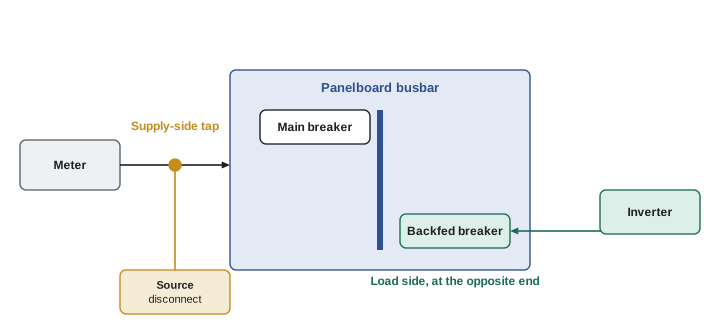
Section 705.11 and section 705.12 describe the two main places a power production source can connect to the premises wiring. A supply-side connection, under 705.11, connects on the line side of the service disconnecting means, between the service point and the service disconnect, for example with a tap in a service conductor enclosure or at the meter base where permitted. Because it is on the supply side, it is treated much like a second service: the conductors from the connection to the source's disconnect must be sized for the source, the disconnect must meet the service disconnect rules, and the connection must not exceed the rating of the service. A load-side connection, under 705.12, connects on the load side of the service disconnect, typically by a backfed breaker in a panelboard or by a connection to a feeder, and that is where the busbar and conductor limits come in.
The busbar problem
A panelboard busbar is rated for the current it can carry continuously. In a normal panel, all current enters through the main breaker, so the main breaker protects the busbar. When a PV inverter backfeeds the same busbar through a breaker, the bar can receive current from two directions, and the sum of the main breaker and the backfed breaker can exceed the bar's rating without either breaker tripping. Section 705.12(B) limits the backfed current with several alternative methods, and the designer may use whichever one fits.
The method most often tested is the one commonly called the 120 out of 100 rule. Where the backfed breaker is located at the opposite end of the busbar from the main breaker or main lug supply, the sum of 125 out of 100 of the power source's output circuit current and the rating of the overcurrent device protecting the busbar may not exceed 120 out of 100 of the busbar's ampacity. Putting the backfed breaker at the far end means the currents from the two sources flow toward the loads from opposite ends and do not add at any point on the bar. A permanent warning label must state that the inverter breaker is not to be relocated.
The other methods include the sum rule, where the sum of 125 out of 100 of the source output current and the ratings of all overcurrent devices supplying the busbar, excluding the main, does not exceed the busbar ampacity, so the bar can never be overloaded regardless of breaker location; the 100 out of 100 rule, where the sum of 125 out of 100 of the source current and the main breaker does not exceed the bar rating, which often means downsizing the main breaker; rules for center-fed panelboards in dwellings; and engineering supervision for complex installations. A power control system, under 705.13, can also limit the current a source delivers to a busbar or conductor, and the limit setting is then used in the calculations.
| Method in 705.12(B) | Condition, in our words |
|---|---|
| 100 out of 100 | 1.25 times source current plus main breaker is not more than busbar rating |
| 120 out of 100 | 1.25 times source current plus main breaker is not more than 1.2 times busbar rating, backfed breaker at opposite end |
| Sum rule | 1.25 times source current plus all breakers except the main is not more than busbar rating |
| Center-fed dwelling panel | The 120 out of 100 rule with the source at either end of the bar, under conditions |
| Power control system | A listed PCS limits the current used in the calculation |
Worked problem
Helen's 200-ampere panel
Helen's inverter has a rated maximum continuous output of 32 amperes at 240 volts. Her panelboard has a 200-ampere busbar and a 200-ampere main breaker at the top. Can a backfed breaker at the bottom of the bus satisfy the 120 out of 100 rule? What breaker size is needed?
Show solution
- Source output current: 32 amperes. Times 1.25: 40 amperes. The backfed breaker must be at least 40 amperes.
- Busbar limit: 200 times 1.2 is 240 amperes.
- Sum: 40 plus the 200-ampere main breaker is 240 amperes.
- 240 is not more than 240, so the rule is satisfied, exactly. The 40-ampere breaker goes at the opposite end of the bus from the main, with the required label.
Answer: Yes, with a 40-ampere backfed breaker at the far end of the bus. There is no margin left.
# 705.12(B) busbar checks for a load-side connection (illustrative values)
def check(busbar, main, inverter_amps, other_breakers=0):
    source = 1.25 * inverter_amps
    return {
        "100 out of 100": source + main <= busbar,
        "120 out of 100 (opposite end)": source + main <= 1.2 * busbar,
        "sum rule": source + other_breakers <= busbar,
    }, source

for name, bus, main, inv, others in [("Helen", 200, 200, 32, 260), ("Helen, 225 A bus", 225, 200, 32, 260), ("Larger system", 200, 200, 48, 260)]:
    result, source = check(bus, main, inv, others)
print(f"{name}: source {source:.0f} A ->", ", ".join(f"{k}: {'OK' if v else 'no'}" for k, v in result.items()))Helen: source 40 A -> 100 out of 100: no, 120 out of 100 (opposite end): OK, sum rule: no Helen, 225 A bus: source 40 A -> 100 out of 100: no, 120 out of 100 (opposite end): OK, sum rule: no Larger system: source 60 A -> 100 out of 100: no, 120 out of 100 (opposite end): no, sum rule: no
Delgado's switchboard
Delgado's 400-ampere, 480Y/277-volt switchboard has a 400-ampere main and a 400-ampere bus. Each 25-kilowatt inverter puts out about 30 amperes at 480 volts, three-phase, so three of them total about 90 amperes, and 125 out of 100 of that is about 113 amperes. With the 120 out of 100 rule, the bus can accept only 400 times 1.2 minus 400, which is 80 amperes of backfed breaker. That is not enough. The choices are to reduce the main breaker, which the shop's load will not allow, to use a power control system to limit the export, to connect to a feeder under the feeder rules, or to make a supply-side connection. Dana recommends a supply-side connection in a listed tap box between the meter and the main, with a fused disconnect rated for the full inverter output, after confirming with the utility that it accepts that arrangement.
import math
# Three-phase inverter output current and the switchboard limit (illustrative)
inverters = 3
kw_each = 25
volts = 480
amps_each = kw_each * 1000 / (math.sqrt(3) * volts)
total = inverters * amps_each
source = 1.25 * total
allowed = 1.2 * 400 - 400
print(f"Each inverter about {amps_each:.1f} A, total {total:.1f} A, times 1.25 = {source:.1f} A")
print(f"120 out of 100 rule allows {allowed:.0f} A on a 400 A bus with a 400 A main -> {'OK' if source <= allowed else 'not enough'}")Each inverter about 30.1 A, total 90.2 A, times 1.25 = 112.8 A 120 out of 100 rule allows 80 A on a 400 A bus with a 400 A main -> not enough
Feeder connections and taps
A source can also connect to a feeder on the load side of the service. Section 705.12 then protects the feeder conductors: where the connection is made at a point on the feeder that is not at the opposite end from the feeder's own overcurrent device, the portion of the feeder between the connection and the loads can receive current from both the feeder breaker and the source. The Code requires the feeder ampacity on that portion to be at least the feeder breaker rating plus 125 out of 100 of the source current, or an overcurrent device at the load end, or another listed method. Taps from a feeder to supply a source are sized using the tap rules of 240.21 with the source current included. These details are common in larger commercial projects and appear on exams as 'which portion of the feeder must be upsized' questions.
Energy storage systems under Article 706
An energy storage system, or ESS, is one or more components assembled together that can store energy for use at a future time, most commonly a lithium-ion battery system with an integrated inverter or charger. Article 706 applies to ESS with a stated minimum capacity, commonly 1 kilowatt-hour, connected to premises wiring. The key rules are listing, disconnecting means, location and working space, and circuit sizing. An ESS must be listed, and for most installations that means a system listing to the ESS safety standard, which evaluates the battery, the power conversion and the controls together. A disconnecting means is required for all ungrounded conductors from the ESS, readily accessible, within sight of the ESS or capable of being locked in the open position, and labeled. Where the disconnect is not within sight, a remote control or a label at the ESS stating where the disconnect is located is needed.
Location rules for ESS come partly from the NEC and largely from the fire code and residential code: the number and capacity of ESS units in a dwelling, the rooms where they may be installed, the separation from doors and windows, and protection from vehicle impact in garages. Exam questions in an electrical exam usually focus on the NEC side: working space under 110.26, which applies to ESS like any other equipment; the disconnect; the circuit conductors sized from the ESS's nameplate maximum current; and overcurrent protection at the ESS output. Many questions also test the fact that an ESS can be both a source and a load, so its circuits are evaluated both ways.
| ESS item | Rule, in our words |
|---|---|
| Listing | Listed as a system to the ESS safety standard |
| Disconnect | Readily accessible, opens all ungrounded conductors, labeled; within sight or lockable |
| Working space | Per 110.26, as for other equipment |
| Circuit sizing | From the nameplate maximum current, as a continuous load |
| Location limits | Mostly from the fire and residential codes for dwellings |
| Interconnection | An ESS that operates in parallel with the utility is a source under Article 705 |
Backup operation and islanding
Interactive inverters must stop exporting power when the utility is lost, a function called anti-islanding, so they do not energize a line that a utility worker believes is dead. A system with a battery can supply backup power during an outage only by first isolating the building, or part of it, from the utility with a transfer switch or a microgrid interconnect device, and then forming its own local system. That makes the system an optional standby source for the backed-up loads, which brings in the transfer equipment rules of Article 702 and, where applicable, Article 705's rules for microgrid systems. Helen's design uses a hybrid inverter with an internal transfer function that feeds a small backup loads panel for her refrigerator, furnace fan, well pump, pool pump and a few lighting and receptacle circuits.
Stand-alone systems
Article 710 covers stand-alone systems that operate independently of the utility, such as a cabin with PV and batteries and no utility service. The rules allow the system to be sized for the expected load rather than the full calculated load of Article 220, as long as the system meets the needs of the connected loads, and they address single 120-volt supplies to 120/240-volt equipment, which must not be used to supply multiwire branch circuits without precautions. Stand-alone questions are rarer on master exams but do appear.
Labels and identification
Interconnected systems need a lot of labels, and inspectors check them closely. A plaque or directory at the service equipment and at the location of each source disconnect must show the location of the other disconnects. Backfed breakers using the 120 out of 100 rule need a label warning not to relocate them. Equipment with both supply and load terminals energized when open needs a label. ESS disconnects need labels showing nominal voltage and maximum available current. Rapid shutdown labels, from lesson 6, also appear at the service. For Helen's house, Dana prepares a label schedule as part of the permit submittal, which Gloria appreciates.
2026 notes
The 2026 edition continues to merge and reorganize the source articles, with more of the shared interconnection, storage and microgrid material in Articles 705, 706 and related articles, and with refinements to power control systems. The 120 out of 100 concept remains, but check the exact wording and the conditions in your edition.
Common mistakes
MistakeAdding the full inverter breaker to the main without the 125 out of 100 factor.
InsteadThe source output current is multiplied by 1.25 in the 705.12(B) calculations.
MistakePlacing the backfed breaker right next to the main breaker while using the 120 out of 100 rule.
InsteadThe 120 out of 100 rule requires the backfed breaker at the opposite end of the bus from the supply.
MistakeAssuming a battery keeps the house powered during an outage without transfer equipment.
InsteadBackup operation requires isolating the building from the utility; interactive inverters must stop exporting.
MistakeTreating a supply-side connection as unlimited.
InsteadSupply-side connections must not exceed the service rating, and the connection and disconnect follow service-like rules.
MistakeForgetting labels at the service for the other sources.
InsteadDirectories and plaques must show the location of all source disconnects.
Summary and key terms
- Sources connect on the supply side under 705.11 or the load side under 705.12.
- Load-side connections protect busbars and feeders from current fed from two directions.
- The 120 out of 100 rule: 1.25 times source current plus the main breaker must not exceed 1.2 times the busbar rating, with the backfed breaker at the opposite end.
- Other options include the 100 out of 100 rule, the sum rule and power control systems.
- ESS must be listed, have a labeled disconnect and working space, and be sized from nameplate current.
- Backup operation needs transfer equipment; interactive inverters must stop exporting when the utility is lost.
- Interconnected source
- A power source that operates in parallel with the utility or another primary source.
- Supply-side connection
- A connection made between the service point and the service disconnect.
- Load-side connection
- A connection made on the load side of the service disconnect.
- Power control system
- A listed system that limits current from sources to busbars or conductors.
- Energy storage system
- Components assembled to store energy for later use, commonly batteries with power conversion.
- Anti-islanding
- The function that stops an interactive inverter from energizing the utility line when the utility is lost.
Practice problems
Work each problem on paper first, then reveal the answer to check.
A 225-ampere busbar has a 200-ampere main. What is the largest 125 out of 100 source current allowed under the 120 out of 100 rule?
Show answer
225 times 1.2 is 270, minus 200 is 70 amperes, so an inverter of up to 56 amperes output.
A 200-ampere bus has a 175-ampere main. Under the 100 out of 100 rule, what source current is allowed?
Show answer
200 minus 175 is 25 amperes of 1.25 times source current, so up to 20 amperes of inverter output.
Where must the backfed breaker be located when using the 120 out of 100 rule?
Show answer
At the opposite end of the busbar from the main breaker or main lug supply.
What must an ESS disconnect open?
Show answer
All ungrounded conductors from the ESS.
Why must interactive inverters stop exporting when the utility is lost?
Show answer
To avoid energizing utility lines that workers believe are de-energized.
Lesson quiz · 5 questions
Score 60% or more to complete this lesson.
Create a free account to save your progress, take quizzes and earn a certificate.