
MELU-106 · Lesson 2 of 12 · 22 min
Hazardous location wiring methods
▶ Video coming soon A video version of this lesson is on the way.
Lesson 1 ended with a classification drawing for Delgado's finishing line. This lesson turns that drawing into an installation: which wiring methods are allowed in each area, where conduit seals go and how they are made up, how equipment is protected, and how bonding works when the usual locknut connection is not trusted. Article 501 covers Class I locations under the division system, Article 502 covers Class II, and Article 503 covers Class III, with Article 505 and 506 doing the same for the zone system. Most exam questions come from Article 501, so that is where this lesson spends most of its time. As always, the Code is cited by number and explained in our own words; check your own book for the exact wording, the exceptions and your local amendments.
Protection techniques
Before choosing a raceway, decide how the equipment itself will be made safe, because the wiring method follows from it. The NEC recognizes several protection techniques in section 500.7. Explosionproof equipment is built to contain an internal explosion and cool the escaping gases through flame paths so they cannot ignite the surrounding atmosphere. Dust-ignitionproof equipment keeps dust out and limits surface temperature. Purged and pressurized enclosures keep the hazardous atmosphere out by maintaining a supply of clean air or inert gas at positive pressure. Intrinsically safe circuits, covered by Article 504, limit the energy available so that no spark or hot surface can ignite the material even under fault conditions. Nonincendive circuits and components limit energy in normal operation only, so they are suitable for Division 2. Oil immersion, hermetic sealing and similar techniques appear in specific applications.
| Technique | How it protects | Typical use |
|---|---|---|
| Explosionproof | Contains an internal explosion and cools escaping gas | Class I, Division 1 switches, boxes, motors |
| Dust-ignitionproof | Excludes dust and limits surface temperature | Class II, Division 1 equipment |
| Purged and pressurized | Keeps the atmosphere out with clean air or inert gas | Control panels and analyzers |
| Intrinsically safe | Limits energy under normal and fault conditions | Instruments and sensors in Division 1 or Zone 0 |
| Nonincendive | Limits energy in normal operation | Division 2 instrument circuits |
Intrinsically safe wiring is a special case worth knowing well. Because the energy is limited, Article 504 allows any wiring method suitable for unclassified locations, but intrinsically safe conductors must be separated from nonintrinsically safe conductors, identified, and installed so that the limiting barrier or associated apparatus is not bypassed. Seals are still needed where a raceway leaves a Division 1 or Division 2 location so the raceway does not carry vapor out.
Wiring methods for Class I, Division 1
Section 501.10(A) limits Division 1 to a short list of wiring methods. The core methods are threaded rigid metal conduit and threaded steel intermediate metal conduit, with explosionproof fittings and boxes. Type MI cable with termination fittings listed for the location is permitted, and in industrial establishments with restricted public access and qualified maintenance, the Code allows cable types specially built for hazardous locations, such as MC cable marked HL and instrumentation tray cable marked HL, with listed fittings. PVC and reinforced thermosetting resin conduit are permitted only where encased in a concrete envelope of stated thickness and buried at a stated depth, with threaded metal conduit used for the last stretch before emerging. Where flexibility is needed, for example at a motor that vibrates, flexible fittings listed for the location may be used.
Every threaded joint must be made up wrenchtight, with at least five full threads fully engaged, as section 500.8 requires for NPT threads. The threads carry the explosion-containing function and the fault current path, so loose or damaged threads are a serious defect. On an exam, any answer choice that relies on EMT with set-screw couplings, ordinary flexible metal conduit or ordinary cable in Division 1 is almost certainly wrong.
Wiring methods for Class I, Division 2
Division 2 allows more. Section 501.10(B) permits all the Division 1 methods, plus a wider range of methods for normal conditions, including enclosed gasketed busways and wireways, several types of cable such as MC, Type TC and PLTC under stated conditions, and, in many cases, other cables and raceways where the circuits involved are nonincendive. Flexible connections may use flexible metal conduit or liquidtight with listed fittings, with a bonding jumper where required. The idea is that the hazard is abnormal, so the wiring method only has to avoid creating an ignition source in normal operation, and the boxes and fittings need not be explosionproof unless they contain arcing or high-temperature devices.
| Wiring method | Division 1 | Division 2 |
|---|---|---|
| Threaded RMC or steel IMC | Permitted | Permitted |
| Type MI cable with listed fittings | Permitted | Permitted |
| MC-HL or ITC-HL, industrial conditions | Permitted | Permitted |
| Type MC, TC or PLTC cable | Not permitted | Permitted under stated conditions |
| Enclosed gasketed busway or wireway | Not permitted | Permitted |
| PVC or RTRC | Only concrete-encased underground | Underground with stated conditions |
| Flexible metal or liquidtight conduit | Only listed flexible fittings | Permitted with listed fittings and bonding |
Conduit seals: why and where
Seals are the heart of Article 501 and the most heavily tested topic in this area. A conduit seal is a fitting filled with a listed sealing compound that does two things: it stops an explosion inside an enclosure from traveling through the conduit and becoming a larger explosion, a process called pressure piling, and it stops flammable vapors from migrating through the raceway from a classified area into an unclassified one. Section 501.15 sets out where seals are required.
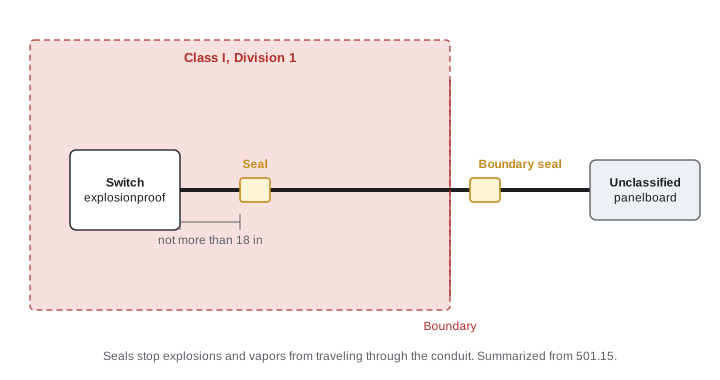
In Division 1, a seal is required in each conduit entering an explosionproof enclosure that contains devices that may produce arcs, sparks or high temperatures, such as switches, circuit breakers, relays and resistors. The seal must be as close as practicable to the enclosure and not more than 18 inches from it, and only listed explosionproof unions, couplings, reducers, elbows and capped elbows may be installed between the seal and the enclosure. A seal is also required in each conduit of trade size 2 or larger entering an enclosure that contains splices, taps or terminals. Where two or more explosionproof enclosures that require seals are connected by a nipple or run of conduit no more than 36 inches long, a single seal in the nipple or run can serve both, if it is within 18 inches of each.
A boundary seal is required where a conduit leaves a Division 1 location, and where it passes from a Division 2 location into an unclassified location, with the seal permitted on either side of the boundary within a stated distance, commonly 10 feet, and with no union, coupling, box or fitting other than listed reducers between the seal and the point where the conduit leaves the classified area. Unbroken runs of rigid conduit that pass completely through a classified area without fittings within a stated distance of the boundary are an exception that exam questions like to test.
Making up a seal
A seal does not work unless it is made up correctly, and inspectors check this closely. The sealing compound must be listed for the purpose, must not be affected by the surrounding atmosphere or liquids, and must not melt at less than a stated temperature. The compound must be at least as thick as the trade size of the conduit and never less than 5/8 inch. Fiber dam material is packed between and around the conductors so the compound can be poured without running out. Splices and taps must never be made in a sealing fitting. And the cross-sectional area of the conductors passing through the seal is limited, generally to 25 out of 100 of the area of the same trade size of rigid metal conduit, unless the fitting is identified for a higher fill. That fill limit is lower than the 40 out of 100 allowed in ordinary raceways, so a conduit that is legal everywhere else can be overfilled at the seal.
Worked problem
Checking the fill at a seal
Dana plans to run six 10 AWG THHN conductors through a 3/4-inch seal at the mixing room's explosionproof switch. Using illustrative values of 0.0211 square inch per 10 AWG THHN conductor and 0.549 square inch for the internal area of 3/4-inch rigid metal conduit, is the fill within the usual 25 out of 100 limit?
Show solution
- Total conductor area: 6 times 0.0211 is 0.1266 square inch.
- Allowed area at 25 out of 100: 0.549 times 0.25 is 0.1373 square inch.
- 0.1266 is less than 0.1373, so the fill is within the limit.
- Dana adds a note to check the actual fitting's marking, because some seals are identified for more fill and some for less.
Answer: Yes, about 23 out of 100 of the conduit area, within the limit.
# Seal fill check with illustrative areas (square inches)
rmc_area = {"1/2": 0.314, "3/4": 0.549, "1": 0.887, "1-1/4": 1.526}
thhn = {"14": 0.0097, "12": 0.0133, "10": 0.0211, "8": 0.0366}

def seal_fill(size, wires, limit=0.25):
    used = sum(n * thhn[g] for g, n in wires.items())
    share = used / rmc_area[size]
    return used, share, share <= limit

for size, wires in [("3/4", {"10": 6}), ("1/2", {"12": 7}), ("1", {"8": 4, "12": 4})]:
    used, share, ok = seal_fill(size, wires)
print(f"{size} in seal, {wires}: {used:.4f} sq in, {share*100:.0f} out of 100 -> {'OK' if ok else 'too full'}")3/4 in seal, {'10': 6}: 0.1266 sq in, 23 out of 100 -> OK
1/2 in seal, {'12': 7}: 0.0931 sq in, 30 out of 100 -> too full
1 in seal, {'8': 4, '12': 4}: 0.1996 sq in, 23 out of 100 -> OKSeals also create a trap for water. Where condensation or liquid can collect in an enclosure or a raceway, the Code requires drainage, and listed drain and breather fittings are used. A seal in a vertical run needs a fitting designed for vertical or horizontal mounting as the installation requires, and the compound must be poured with the fitting in the orientation it is listed for.
Equipment in Division 1 and Division 2
In Division 1, switches, circuit breakers, motor controllers, fuses, pushbuttons and relays must be in enclosures identified for the location, which in practice means explosionproof enclosures, or they must be protected by purging, intrinsic safety or another recognized technique. Motors must be identified for Class I, Division 1, or totally enclosed with positive-pressure ventilation, or of a type submerged or otherwise protected as described in the Code. Luminaires must be identified for the location, protected against physical damage by guards or location, and supported in a way that does not rely on the wiring alone. Flexible cords are permitted only for limited uses, such as portable equipment, and must be extra-hard usage type with listed fittings.
In Division 2, the question is whether the equipment produces arcs or high temperatures in normal operation. Switches, breakers and contacts that make and break current must still be in explosionproof enclosures, or be hermetically sealed, oil-immersed or of a nonincendive type. Squirrel-cage induction motors without brushes or switching mechanisms are permitted in general-purpose enclosures. Luminaires must be protected from damage and must not exceed the temperature code for the material.
Bonding in hazardous locations
Section 501.30 adds a bonding rule that catches many candidates. In classified locations, the locknut-bushing and double-locknut types of contact may not be relied on for bonding. Bonding jumpers with proper fittings, or other approved means of bonding, must be used, and this applies not only inside the classified area but all the way back to the point where the grounded conductor and the grounding electrode are connected, at the service or the separately derived system. Flexible metal conduit and liquidtight flexible metal conduit in classified locations need an internal or external bonding jumper, sized by the rules in Article 250, rather than relying on the flexible conduit itself.
| Item | Ordinary location | Classified location |
|---|---|---|
| Locknut-bushing bonding | Often acceptable | Not relied on |
| Bonding jumpers | Where required by 250 | Required back to the service or SDS |
| Flexible metal conduit as EGC | Permitted in limited cases | Needs a bonding jumper |
| Threaded joints | Normal workmanship | Five full threads, wrenchtight |
Class II and Class III in brief
Article 502 follows the same pattern for dust. Division 1 uses threaded metal conduit, MI cable and certain industrial cables, with dusttight boxes and fittings and dust-ignitionproof equipment where arcing devices are installed. Seals in Class II are required mainly where a raceway connects a dust-ignitionproof enclosure to one that is not, to keep dust out. Article 503 for fibers and flyings is the least demanding: dusttight enclosures and equipment that limits surface temperature so accumulated lint cannot ignite. Exam questions on Classes II and III usually test the difference between keeping dust out, keeping temperature down and containing an explosion.
Delgado's wiring plan
With the classification in hand, Dana marks up the plan. Inside the spray booth, which is Division 1, the luminaires are listed for the booth and installed behind sealed glass panels outside the booth's interior, an approach Article 516 allows. The mixing room's light switch and the exhaust fan starter go outside the room, in the unclassified corridor, so they need no explosionproof enclosures at all. The parts washer's motor is a listed explosionproof unit fed through threaded rigid conduit with a seal within 18 inches. Every conduit leaving the classified areas gets a boundary seal, and every flexible connection gets a bonding jumper. 'Moving the arcing devices out of the classified area is the cheapest seal there is,' Ray tells her. Gloria approves the plan with one comment: she wants the seal locations dimensioned on the drawing.
2026 notes
The 2026 edition keeps the seal concepts, the five-thread rule and the bonding rule. Some section numbers in Articles 501 through 506 shift as related material is grouped, and the edition continues to refine the cable types allowed in Division 2 and the zone-system equipment markings. Retab these articles from your own book.
Common mistakes
MistakeUsing EMT with set-screw fittings in a Class I, Division 1 area.
InsteadDivision 1 requires threaded RMC or IMC, MI cable or the HL cables allowed under industrial conditions.
MistakePlacing a seal 24 inches from an enclosure containing a switch.
InsteadThe seal must be within 18 inches of the arcing enclosure.
MistakeMaking a splice inside a sealing fitting.
InsteadSplices and taps are never permitted in a seal.
MistakeFilling a seal to 40 out of 100 because that is the conduit fill rule.
InsteadSeal fill is generally limited to 25 out of 100 unless the fitting is identified otherwise.
MistakeRelying on locknuts for bonding in a classified area.
Instead501.30 requires bonding jumpers or other approved means back to the service or SDS.
Summary and key terms
- Choose the protection technique first: explosionproof, dust-ignitionproof, purged, intrinsically safe or nonincendive.
- Class I, Division 1 allows threaded RMC or IMC, MI cable and HL cables under industrial conditions.
- Division 2 allows more methods because the hazard is abnormal.
- Seals go within 18 inches of arcing enclosures and at classified area boundaries.
- Seal compound is at least as thick as the trade size, never less than 5/8 inch, with no splices and limited fill.
- Bonding in classified locations does not rely on locknuts and extends back to the service or SDS.
- Moving arcing devices outside the classified area simplifies the installation.
- Explosionproof
- Built to withstand an internal explosion and prevent ignition of the surrounding atmosphere.
- Conduit seal
- A compound-filled fitting that limits explosion propagation and vapor migration through a raceway.
- Pressure piling
- A buildup of explosion pressure when an explosion travels through connected enclosures and raceways.
- Intrinsically safe circuit
- A circuit whose energy is too low to ignite the atmosphere under normal or fault conditions.
- Boundary seal
- A seal where a raceway leaves a classified area.
- Dust-ignitionproof
- Enclosed to exclude dust and to prevent internal arcs or heat from igniting dust outside.
Practice problems
Work each problem on paper first, then reveal the answer to check.
How far from an explosionproof enclosure containing a circuit breaker may the seal be?
Show answer
Not more than 18 inches.
What is the minimum thickness of sealing compound in a 1/2-inch seal?
Show answer
5/8 inch, because the minimum is the trade size but never less than 5/8 inch.
Five 12 AWG conductors at an illustrative 0.0133 square inch each pass through a 1/2-inch seal with an illustrative 0.314 square inch area. Is the 25 out of 100 limit met?
Show answer
0.0665 divided by 0.314 is about 21 out of 100, so yes.
Is a squirrel-cage motor without brushes permitted in a general-purpose enclosure in Class I, Division 2?
Show answer
Yes, under the conditions in the Code.
What must replace locknut-bushing contact for bonding in a classified area?
Show answer
Bonding jumpers with proper fittings or another approved means.
Lesson quiz · 5 questions
Score 60% or more to complete this lesson.
Create a free account to save your progress, take quizzes and earn a certificate.