
MELU-106 · Lesson 1 of 12 · 24 min
Hazardous locations: classes, divisions and zones
▶ Video coming soon A video version of this lesson is on the way.
MELU-103 and MELU-104 covered the general rules that apply almost everywhere: conductors, raceways, overcurrent protection, grounding and bonding. Chapters 5, 6 and 7 of the NEC are different. They modify or add to those general rules for particular places, particular equipment and particular conditions, and master exams draw on them heavily because they test whether a candidate knows when the ordinary rules are no longer enough. Section 90.3 explains the arrangement: Chapters 1 through 4 apply generally, and Chapters 5, 6 and 7 supplement or modify them for special occupancies, special equipment and special conditions. This course works through the articles that appear most often on master exams, starting with the one that carries the highest stakes: hazardous (classified) locations, where an ordinary spark can ignite the atmosphere.
This first lesson is about classification: how an area is assigned a class, a division or a zone, a material group and a temperature limit. Lesson 2 then covers the wiring methods, seals and equipment that the classification demands. Throughout this course, the NEC is cited by article, section and table number and explained in our own words. No Code text, tables or figures are reproduced, and any values in examples are illustrative. Check every rule against your own copy of the adopted edition and your state and local amendments.
Delgado Fabrication adds a finishing line
Delgado Fabrication, the machine shop where Brightwater installed the new 400-ampere, 480Y/277-volt service, has kept growing. Luis Delgado now wants a small finishing line at the back of the shop: a spray booth for painting brackets and enclosures, a mixing room where the paint and solvent are stored and blended, a parts washer that uses a flammable solvent, and a propane cylinder exchange cage for the forklifts by the loading door. Ray Ochoa sets the job folder on Dana Whitfield's desk. 'Before anybody prices a single fitting,' he says, 'we need to know what the classified areas are. The owner's fire protection engineer will do the formal classification, but you need to be able to read it, check it, and explain it to Gloria.' Gloria Haynes, the city's chief electrical inspector, has already told Ray she wants to see the area classification drawing with the permit application.
Dana's study partner Marcus Lee laughs when she shows him the folder. 'Article 500 is where people lose the most points,' he says. 'Not because it is hard, but because they mix up the two systems. Learn the vocabulary first.'
Who classifies and why it matters
The NEC does not classify a specific room for you. Article 500 sets out the definitions and the framework, and section 500.4 requires that classified areas be properly documented and that the documentation be available to those authorized to design, install, inspect, maintain or operate the electrical equipment. In practice, classification is done by a qualified person such as a fire protection or process safety engineer, using recognized practices: the NFPA standards on classifying flammable liquids, gases and vapors and on combustible dusts, the American Petroleum Institute recommended practices for petroleum facilities, and the specific occupancy articles of the NEC itself, such as Article 511 for commercial garages, Article 514 for motor fuel dispensing facilities and Article 516 for spray application. The electrician's job is to install equipment and wiring suitable for the classification that has been documented, and an exam question will usually give you the classification and ask what follows from it.
Classification is driven by three questions. What kind of hazardous material can be present? How likely is it to be present in an ignitable concentration? And how hot, or how energetic, can an ignition source be before it sets that material off? The answers become the class, the division or zone, the group and the temperature code that appear on equipment nameplates.
The three classes
Section 500.5 defines three classes by the type of material. Class I locations are those where flammable gases, flammable liquid-produced vapors or combustible liquid-produced vapors are or may be present in quantities sufficient to produce explosive or ignitable mixtures. Class II locations are hazardous because of combustible dust. Class III locations are hazardous because of easily ignitible fibers or flyings, such as cotton lint or sawdust in textile mills and woodworking shops, that are not likely to be suspended in the air in ignitable concentrations but can accumulate around equipment. A single facility can have all three: a grain elevator has Class II dust, a sawmill has Class III flyings and Class II dust, and a paint shop has Class I vapors.
| Class | Material | Typical example |
|---|---|---|
| Class I | Flammable gases and vapors | Spray booths, fuel dispensing, solvent rooms, propane storage |
| Class II | Combustible dust | Grain handling, flour mills, coal handling, metal powder processing |
| Class III | Ignitible fibers and flyings | Textile mills, cotton gins, woodworking shops with fine shavings |
Divisions: how often is it there?
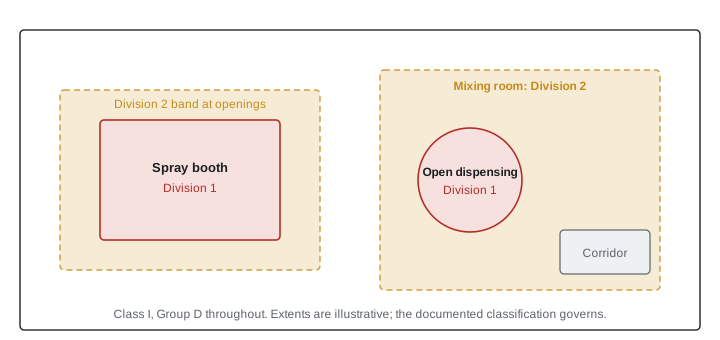
Each class is split into two divisions by likelihood. A Division 1 location is one where the hazardous material is present in ignitable concentrations under normal operating conditions, or frequently because of repair, maintenance or leakage, or where a breakdown of equipment could release the material and at the same time cause failure of electrical equipment. A Division 2 location is one where the material is handled, processed or used but is normally confined in closed containers or systems and would escape only by accidental rupture or abnormal operation, or where ignitable concentrations are normally prevented by positive mechanical ventilation that could fail, or an area adjacent to a Division 1 location into which the material might occasionally travel.
The practical difference is large. In Division 1, equipment must be safe even when the hazard is present during normal operation, so arcing parts are typically housed in explosionproof enclosures or protected by intrinsic safety or purging. In Division 2, the hazard is abnormal, so the Code allows general-purpose enclosures for equipment that does not produce arcs or high temperatures in normal operation, and some wiring methods not allowed in Division 1.
Material groups
Within each class, materials are grouped by how easily they ignite and how violently they burn, because an enclosure that safely contains an explosion of one gas may not contain another. Section 500.6 places Class I materials in Groups A through D: Group A is acetylene; Group B includes hydrogen and gases of similar behavior; Group C includes ethylene and similar materials; and Group D includes propane, gasoline, most solvents and many common hydrocarbons. Class II dusts are Groups E, F and G: Group E is combustible metal dusts such as aluminum and magnesium; Group F is carbonaceous dusts such as coal and coke; and Group G covers other combustible dusts such as flour, grain, wood, plastic and chemical dusts. Class III has no groups.
Equipment is listed and marked for the class, division and groups it is suitable for. A Class I, Division 1, Group D explosionproof junction box is not automatically suitable for Group B hydrogen. On an exam, if the question names a material, identify its group before you choose equipment, and remember that Group A and B ratings are harder to achieve and less common.
| Group | Class | Examples (illustrative) |
|---|---|---|
| A | I | Acetylene |
| B | I | Hydrogen and similar gases |
| C | I | Ethylene and similar materials |
| D | I | Propane, gasoline, most paint solvents |
| E | II | Aluminum and magnesium dust |
| F | II | Coal and coke dust |
| G | II | Grain, flour, wood and plastic dust |
Temperature codes
An ignition source does not have to be a spark. A surface that is hot enough will ignite a vapor or a dust layer on its own, so equipment in classified locations is marked with a temperature class, or T code, that tells you its maximum surface temperature. The codes run from T1, the hottest allowed surface at 450 degrees Celsius, down through T2, T3 and T4 to T6, the coolest at 85 degrees Celsius, with intermediate steps such as T2A and T3C in the division system. The rule, in section 500.8, is that the marked temperature must be less than the autoignition temperature of the specific material involved. Diethyl ether has a very low autoignition temperature, so it needs a cool T code, while many hydrocarbons are more forgiving. For dusts, the equipment temperature must also stay below the temperature at which a dust layer would char or ignite.
Worked problem
Choosing a T code for the mixing room
The fire protection engineer's report lists the solvent in Delgado's paint as having an autoignition temperature of 280 degrees Celsius (an illustrative value for this example). Which of these T codes would be acceptable for a luminaire in the mixing room: T2 (300 degrees), T3 (200 degrees) or T4 (135 degrees)?
Show solution
- The marked maximum surface temperature must be less than the autoignition temperature of the material.
- T2 allows surfaces up to 300 degrees Celsius, which is above 280, so T2 is not acceptable.
- T3 allows up to 200 degrees and T4 up to 135 degrees; both are below 280.
- Either T3 or T4 is acceptable, and the luminaire must also be suitable for the class, division and group.
Answer: T3 or T4, but not T2.
# Which temperature codes are cool enough? (maximum surface temperatures in degrees C)
tcodes = {"T1": 450, "T2": 300, "T2A": 280, "T2B": 260, "T2C": 230, "T2D": 215,
          "T3": 200, "T3A": 180, "T3B": 165, "T3C": 160, "T4": 135, "T4A": 120, "T5": 100, "T6": 85}

def acceptable(autoignition_c):
    return [code for code, t in tcodes.items() if t < autoignition_c]

for name, ait in [("Paint solvent (illustrative)", 280), ("Propane (illustrative)", 450), ("Low-ignition solvent (illustrative)", 160)]:
print(f"{name}, AIT {ait} C: {', '.join(acceptable(ait))}")Paint solvent (illustrative), AIT 280 C: T2B, T2C, T2D, T3, T3A, T3B, T3C, T4, T4A, T5, T6 Propane (illustrative), AIT 450 C: T2, T2A, T2B, T2C, T2D, T3, T3A, T3B, T3C, T4, T4A, T5, T6 Low-ignition solvent (illustrative), AIT 160 C: T4, T4A, T5, T6
The zone system
Since the 1990s the NEC has also allowed an international-style zone system, adapted from IEC practice. Article 505 covers Class I locations using zones and Article 506 covers combustible dusts and fibers using zones. In the zone system, Class I is divided into three zones instead of two divisions. Zone 0 is where ignitable concentrations are present continuously or for long periods, such as the vapor space inside a solvent tank. Zone 1 is where they are likely in normal operation. Zone 2 is where they are not likely in normal operation and, if they occur, exist only for a short time. For dusts, Article 506 uses Zones 20, 21 and 22 in the same pattern.
Roughly, Zone 0 and Zone 1 together correspond to Division 1, and Zone 2 corresponds to Division 2, but the match is not exact, and the systems use different protection techniques and markings. Zone-system gas groups are IIC, IIB and IIA, with IIC the most demanding: IIC includes acetylene and hydrogen, IIB includes ethylene, and IIA includes propane and most common solvents. Equipment in the zone system is marked with protection technique codes such as d for flameproof, e for increased safety, ia and ib for intrinsic safety, p for pressurization, m for encapsulation and n for nonincendive or nonsparking techniques. An exam may give you a nameplate string and ask what it permits; read it piece by piece.
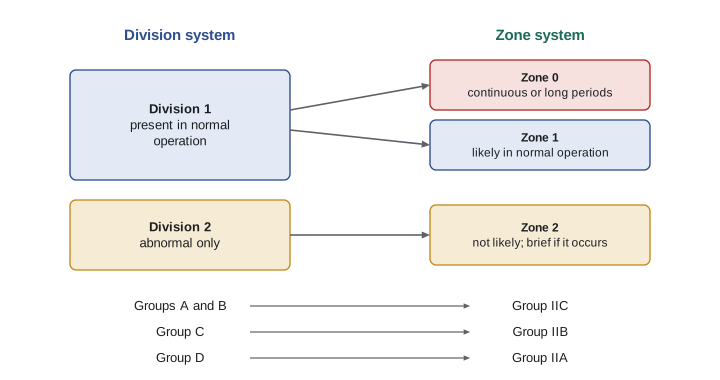
| Division system | Zone system | Meaning, in our words |
|---|---|---|
| Division 1 | Zone 0 | Present continuously or for long periods |
| Division 1 | Zone 1 | Likely in normal operation |
| Division 2 | Zone 2 | Not likely; brief if it occurs |
| Groups A and B | Group IIC | Most easily ignited gases |
| Group C | Group IIB | Ethylene-type gases |
| Group D | Group IIA | Propane and most solvents |
The two systems must not be mixed carelessly. Sections in Articles 500 and 505 allow equipment identified for one system to be used in the other only under stated conditions, and the classification of a given area must be documented in one system or the other. If an exam question mixes them, look for the rule that permits the substitution rather than assuming it.
Occupancy articles that classify for you
For several common occupancies, the NEC itself sets the extent of classified areas, and these articles are favorites on master exams because they combine classification with dimensions. Article 511 covers commercial garages used for repair and service, where the floor area up to a stated height above the floor is classified unless adequate ventilation is provided, and pits below floor level have their own rules. Article 513 covers aircraft hangars. Article 514 covers motor fuel dispensing facilities and uses a table to set the extent of classified areas around dispensers, fill pipes and vents. Article 515 covers bulk storage plants. Article 516 covers spray application, dipping, coating and printing processes, and it describes classified areas inside spray booths and in the space around booth openings. When an exam question names one of these occupancies, go to that article first, because its specific rules override the general framework.
For Delgado, the spray booth falls under Article 516, the mixing room and parts washer are classified by the engineer using the NFPA practices for flammable liquids, and the propane cylinder cage near the loading door is classified using the rules for LP-Gas storage referenced through the fire codes. Dana writes these on the inside cover of the job folder so she remembers where each extent came from.
Reading Delgado's classification drawing
When the engineer's drawing arrives, Dana checks it the way Gloria will. Is every classified area labeled with class, division or zone, and group? Is the documentation reference given? Are the boundaries dimensioned from fixed points? Are the unclassified areas, such as the office and the main machining floor, clearly outside the boundaries? And is there anything that changes the classification, such as mechanical ventilation that is credited for reducing the extent? Ventilation that the classification depends on must be interlocked or monitored, because if it fails, a Division 2 area can behave like Division 1.
| Area | Classification shown (illustrative) | Source |
|---|---|---|
| Inside the spray booth | Class I, Division 1, Group D | Article 516 |
| Band around booth openings | Class I, Division 2, Group D | Article 516 |
| Mixing room, near open dispensing | Class I, Division 1, Group D | Engineer, NFPA practice |
| Rest of the mixing room | Class I, Division 2, Group D | Engineer, NFPA practice |
| Propane cage, near cylinders | Class I, Division 2, Group D | Fire code LP-Gas rules |
| Office and machining floor | Unclassified | Engineer |
2026 notes
In the 2026 edition, Chapter 5 is titled for specific rather than special occupancies, and some hazardous location articles have been reorganized and renumbered as part of a broader effort to group related material. The class, division and zone concepts, the material groups and the temperature codes do not change. If your exam uses the 2026 edition, retab Articles 500 through 516 from your own book rather than relying on section numbers from an older study guide.
Common mistakes
MistakeTreating Class II as more dangerous than Class I because it comes second.
InsteadClasses describe the type of material, not the degree of hazard. Divisions and zones describe likelihood.
MistakeChoosing a T code with a temperature above the material's autoignition temperature.
InsteadThe marked surface temperature must be below the autoignition temperature.
MistakeAssuming Group D equipment is suitable for hydrogen.
InsteadHydrogen is Group B or IIC; equipment must be identified for the group.
MistakeEquating Zone 2 with Division 1 because both are ‘likely’.
InsteadZone 2 corresponds roughly to Division 2: not likely in normal operation.
MistakeIgnoring the occupancy article and applying only Article 500.
InsteadArticles 511, 514, 516 and similar set specific extents that override the general framework.
Summary and key terms
- Chapters 5 to 7 modify or supplement the general rules of Chapters 1 to 4.
- Class I is gases and vapors, Class II is combustible dust, and Class III is fibers and flyings.
- Division 1 means the hazard is present in normal operation; Division 2 means only in abnormal conditions.
- Groups A to D apply to gases and vapors, E to G to dusts; equipment must be identified for the group.
- Temperature codes T1 to T6 must be below the material's autoignition temperature.
- The zone system uses Zones 0, 1 and 2 for gases and 20, 21 and 22 for dusts, with groups IIC, IIB and IIA.
- Classification is documented by qualified persons and occupancy articles set specific extents.
- Classified location
- An area where fire or explosion hazards exist because of flammable gases or vapors, combustible dust or ignitible fibers.
- Division
- The division-system measure of how likely a hazardous material is to be present in ignitable concentration.
- Zone
- The zone-system measure of the same likelihood, with three levels for gases and three for dusts.
- Group
- A grouping of materials by ignition and explosion characteristics, used to choose suitable equipment.
- Temperature code
- A marking that states the maximum surface temperature of equipment.
- Autoignition temperature
- The lowest temperature at which a material ignites without a spark or flame.
Practice problems
Work each problem on paper first, then reveal the answer to check.
An area has propane present only if a cylinder valve leaks. What class and division is it, before any occupancy article is applied?
Show answer
Class I, Division 2, Group D.
A material has an autoignition temperature of 170 degrees Celsius. Is a T3 device (200 degrees) acceptable?
Show answer
No. 200 is above 170; T3A (180) is also too hot, so a T3B or cooler code is needed.
Which zone applies to the vapor space inside a solvent storage tank?
Show answer
Zone 0: present continuously or for long periods.
Which Class II group covers magnesium dust?
Show answer
Group E.
Name two occupancy articles that set the extent of classified areas.
Show answer
Any two of Articles 511, 513, 514, 515 and 516.
Lesson quiz · 5 questions
Score 60% or more to complete this lesson.
Create a free account to save your progress, take quizzes and earn a certificate.