
MELU-106 · Lesson 3 of 12 · 22 min
Health care facilities under Article 517
▶ Video coming soon A video version of this lesson is on the way.
Health care facilities appear on master exams because they combine ordinary building wiring with three extra concerns: patients who may be connected to equipment and unable to move away from a hazard, life-support equipment that must keep running when utility power fails, and the stricter fire and life safety codes that govern hospitals and clinics. Article 517 of the NEC handles the electrical side, working alongside NFPA 99, the Health Care Facilities Code, which sets the risk-based categories and performance requirements that Article 517 refers to. This lesson covers the structure of Article 517, patient care space categories, the redundant grounding rule, receptacle requirements, the essential electrical system and its branches, and isolated power. As always, sections are cited by number and explained in our own words; check your own edition and the adopted version of NFPA 99.
Brightwater bids a clinic
Priya Natarajan, Brightwater's estimator, has an invitation to bid on a fit-out in Harlow: the Northgate Family Health Clinic, a one-story outpatient clinic in a former retail space, with eight exam rooms, two procedure rooms, a small laboratory, a dental suite with three operatories, and a waiting room. 'Hospitals are out of our league,' Ray says, 'but clinics and dental offices are exactly our size. If you are going to be our master, you need to price these right.' Dana opens Article 517 and finds that it starts with definitions, then general requirements for all health care facilities, then the essential electrical system, and then parts for inhalation anesthetizing locations, X-ray installations, communication and signaling systems, and isolated power systems.
Patient care spaces: four categories
Since the 2017 edition, Article 517 has used risk categories taken from NFPA 99 instead of naming spaces by room type. The facility's governing body, not the electrician, designates the category of each space based on the risk to patients and staff. Category 1 spaces, called critical care spaces, are those where failure of equipment or a system is likely to cause major injury or death of patients, staff or visitors, such as operating rooms and intensive care units. Category 2 spaces, general care spaces, are those where failure is likely to cause minor injury, such as typical inpatient rooms. Category 3 spaces, basic care spaces, are those where failure is not likely to cause injury but may cause discomfort, such as many exam rooms. Category 4 spaces, support spaces, are those where failure would have no impact on patient care, such as offices and storage.
| Category | Name | Risk if equipment fails | Typical example |
|---|---|---|---|
| 1 | Critical care space | Major injury or death | Operating rooms, intensive care |
| 2 | General care space | Minor injury | Inpatient bedrooms, some procedure rooms |
| 3 | Basic care space | Not likely to cause injury | Many outpatient exam rooms |
| 4 | Support space | No impact on patient care | Offices, storage, staff lounges |
For the Northgate clinic, the owner's design documents designate the exam rooms and dental operatories as Category 3, the procedure rooms where moderate sedation is used as Category 2, and the office and storage as Category 4. Dana notes that the categories drive most of what follows: grounding, receptacle counts, the need for an essential electrical system, and whether isolated power or special ground-fault rules apply.
Wiring methods and redundant grounding
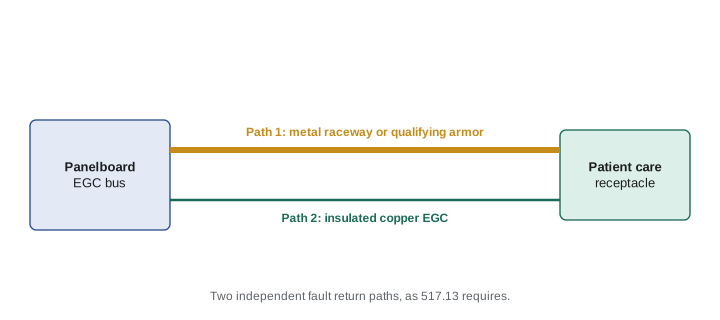
The most distinctive rule in Article 517 is redundant grounding, found in section 517.13. In patient care spaces, the branch circuits serving patient care areas must be installed in a wiring method that itself qualifies as an equipment grounding conductor under 250.118, such as metal raceway or a qualifying metal-armored cable, and in addition must contain an insulated copper equipment grounding conductor sized by Table 250.122. The receptacle grounding terminals and the non-current-carrying conductive surfaces of fixed equipment likely to become energized and subject to personal contact, operating above 100 volts, are connected to that insulated conductor. The result is two independent fault return paths, so that if one is damaged or loosened, the patient is still protected.
Type AC cable and Type MC cable qualify only where their armor or sheath is listed and identified as an equipment grounding conductor; ordinary MC cable with an aluminum interlocked armor that is not identified for grounding does not provide the first path by itself. Nonmetallic sheathed cable and PVC conduit are not permitted for these branch circuits in patient care spaces because they cannot supply the raceway or armor path. Exam questions often describe a cable type and ask whether it satisfies 517.13; check whether both paths exist.
Receptacles at the patient bed location
Patient bed locations have minimum receptacle counts and receptacle type rules. In Category 2 spaces, each patient bed location must have a stated minimum number of receptacles, commonly eight, which may be single, duplex or quadruplex types or any combination, all listed hospital grade and identified. In Category 1 spaces, the minimum is higher, commonly fourteen, with at least one connected to the normal system branch circuit or to a critical branch circuit supplied by a different transfer switch, so that a single transfer switch failure does not leave the bed without power. Receptacles at patient bed locations must be listed hospital grade, a rating that includes stronger contact retention and more robust construction. Psychiatric and pediatric spaces need tamper-resistant receptacles or listed covers.
| Space | Minimum receptacles per bed (typical edition) | Type |
|---|---|---|
| Category 1 (critical care) | 14 | Hospital grade; some on a second source |
| Category 2 (general care) | 8 | Hospital grade |
| Category 3 and 4 | No Article 517 minimum | General rules apply |
Ground-fault protection also differs. Article 517 does not require GFCI protection for receptacles in patient care spaces in the same way Article 210 does elsewhere, and in Category 1 spaces where interruption of power could not be tolerated, the Code requires isolated power or GFCI only for wet procedure locations, as described later. Outside patient care spaces, the ordinary GFCI rules of 210.8 apply, such as in staff restrooms and break room kitchens.
The essential electrical system
When utility power fails, a hospital cannot simply wait. The essential electrical system, or EES, is the set of systems that keeps critical loads running from an alternate source, usually an on-site generator. NFPA 99 decides which facilities need which type of EES based on the categories of space they contain, and Article 517 Part III sets the wiring and arrangement. A Type 1 EES serves facilities with Category 1 spaces, such as hospitals. A Type 2 EES serves facilities such as nursing homes with Category 2 spaces but no Category 1. Many outpatient clinics with only Category 3 and 4 spaces need no EES at all beyond the emergency lighting required by the building codes, which is one reason clinics are a common contractor market.
A Type 1 EES is divided into three branches. The life safety branch supplies egress lighting, exit signs, fire alarm, alarm and alerting systems, emergency communications, and a limited set of other loads needed for safe evacuation. The critical branch supplies task illumination, selected receptacles and equipment in patient care spaces, and other functions directly related to patient care. The equipment branch supplies major equipment needed for patient care and building operation, such as medical air compressors, vacuum pumps, ventilation and selected heating. Each branch is served by one or more transfer switches, and the alternate source must restore power to the life safety and critical branches within 10 seconds. The equipment branch may be restored with a delay, in a sequence arranged so the generator is not overloaded.
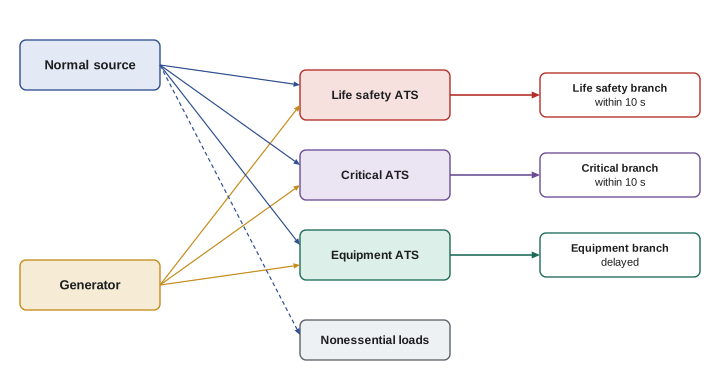
| Branch | What it supplies, in our words | Restoration |
|---|---|---|
| Life safety | Egress lighting, exit signs, fire alarm, alarms and emergency communications | Within 10 seconds |
| Critical | Task lighting and selected receptacles and equipment for patient care | Within 10 seconds |
| Equipment | Medical gas compressors and pumps, ventilation, selected heating and other major equipment | Delayed, in sequence |
Wiring for the life safety and critical branches must be kept independent of all other wiring and equipment and must not enter the same raceways, boxes or cabinets as other wiring, with exceptions such as transfer switches and certain common enclosures. Receptacles and cover plates on the critical branch, and often on the life safety branch, must be identified by a distinctive color or marking, commonly red, so staff know which outlets will stay energized. The branches must be installed in wiring methods that give mechanical protection, typically metal raceways or other methods listed in the article.
Wet procedure locations and isolated power
A wet procedure location is a space where standing fluids are normally present or where drenching of the patient or staff is routine, such as some operating rooms. The facility designates these spaces. In wet procedure locations, the Code requires protection against electric shock by either GFCI protection, where interruption of power under fault conditions can be tolerated, or an isolated power system, where it cannot. An operating room in the middle of a procedure cannot tolerate a GFCI tripping and shutting off equipment, so isolated power is common there.
An isolated power system uses an isolation transformer to supply circuits that have no direct connection to ground. A first fault from a conductor to ground does not draw dangerous current or trip anything, because there is no return path; instead, a line isolation monitor continuously measures the potential hazard current that would flow if a second fault occurred and sounds an alarm when it exceeds a set value, commonly 5 milliamperes in current practice. Isolated power circuit conductors are identified by color, commonly orange and brown for the two isolated conductors, with a striped variant used in some cases, and the wiring length is limited because long conductors add capacitance and leakage.
Worked problem
Is this clinic required to have an EES?
The Northgate clinic designates its exam rooms and dental operatories as Category 3, its two procedure rooms as Category 2 (moderate sedation, no general anesthesia), and its offices as Category 4. Using the general framework in this lesson, what type of EES, if any, will the governing standards most likely require?
Show solution
- Category 1 spaces would drive a Type 1 EES; there are none here.
- Category 2 spaces may require a Type 2 EES depending on the governing standard and the type of facility; the designer must confirm with NFPA 99 and the authority having jurisdiction.
- Category 3 and 4 spaces alone generally need no EES beyond the egress lighting the building code requires.
- Dana flags the procedure rooms as the item that decides the question and asks the designer to confirm in writing before Priya prices a generator.
Answer: Probably none or a limited system, depending on how NFPA 99 and the AHJ treat the procedure rooms. Confirm before pricing.
Dental offices and other outpatient spaces
Dental operatories are usually Category 3 spaces, but the equipment in them, such as dental chairs, delivery systems and X-ray heads, has its own installation instructions, and some dental procedures use moderate or deep sedation that can raise the category. X-ray equipment is covered by Part V of Article 517 and by Article 660, with rules on disconnecting means, conductor sizing based on the momentary and long-time ratings, and overcurrent protection. Nurse call and other communication systems are covered by Part VI. Medical gas alarms, where present, are on the life safety branch in facilities that have an EES.
# Patient bed receptacle check (counts are the common minimums; confirm in your edition)
minimum = {1: 14, 2: 8}

beds = [("ICU bed 1", 1, 16), ("ICU bed 2", 1, 12), ("Recovery bay A", 2, 8), ("Recovery bay B", 2, 6)]
for name, category, installed in beds:
    need = minimum.get(category)
    if need is None:
        print(f"{name}: no Article 517 minimum")
    else:
        status = "OK" if installed >= need else f"short by {need - installed}"
print(f"{name} (Category {category}): {installed} installed, {need} required -> {status}")ICU bed 1 (Category 1): 16 installed, 14 required -> OK ICU bed 2 (Category 1): 12 installed, 14 required -> short by 2 Recovery bay A (Category 2): 8 installed, 8 required -> OK Recovery bay B (Category 2): 6 installed, 8 required -> short by 2
Inspection points Gloria will check
When Gloria inspects a health care fit-out, she looks for the category designations on the drawings, the wiring method in patient care spaces and the insulated copper equipment grounding conductor terminated at every receptacle and qualifying fixed equipment, hospital grade receptacles where required, the identification of critical branch receptacles, separation of EES branch wiring, and the manufacturer's installation instructions for the medical equipment. Dana adds a step to her own checklist: a continuity test of both grounding paths at a sample of receptacles, because a loose locknut can quietly defeat the redundant path.
2026 notes
The 2026 edition continues to align Article 517 with the current NFPA 99, with refinements to the categories, the definitions of patient care vicinity and the wiring methods for the essential electrical system. The category framework, redundant grounding, the three EES branches and the 10-second restoration remain. Confirm which edition of NFPA 99 your state has adopted, because it affects which spaces need an EES.
Common mistakes
MistakeInstalling Type NM cable or PVC conduit for patient care space branch circuits.
Instead517.13 requires a metal wiring method that qualifies as an EGC plus an insulated copper EGC.
MistakeAssuming the electrician decides the patient care category.
InsteadThe governing body of the facility designates the category of each space.
MistakePutting critical branch conductors in the same raceway as normal power.
InsteadLife safety and critical branch wiring must be kept independent of other wiring.
MistakeExpecting a GFCI to protect an operating room where loss of power cannot be tolerated.
InsteadWhere interruption cannot be tolerated, an isolated power system with a line isolation monitor is used.
MistakeRestoring the critical branch from the generator in 30 seconds.
InsteadLife safety and critical branches must be restored within 10 seconds.
Summary and key terms
- Article 517 works with NFPA 99; the facility designates patient care space categories 1 to 4.
- Redundant grounding in patient care spaces uses a metal wiring method plus an insulated copper EGC.
- Patient bed locations need minimum numbers of hospital grade receptacles in Category 1 and 2 spaces.
- A Type 1 EES has life safety, critical and equipment branches; the first two restore within 10 seconds.
- EES branch wiring is kept independent of other wiring and critical receptacles are identified.
- Wet procedure locations need GFCI or, where power loss cannot be tolerated, isolated power with a line isolation monitor.
- Patient care space
- Any space of a health care facility where patients are intended to be examined or treated.
- Essential electrical system
- A system of alternate sources, transfer switches and branches that maintains power to critical functions during an outage.
- Life safety branch
- The EES branch serving egress lighting, exit signs, fire alarm and similar safety loads.
- Critical branch
- The EES branch serving task lighting and selected receptacles and equipment for patient care.
- Isolated power system
- An ungrounded system supplied through an isolation transformer and monitored for leakage.
- Line isolation monitor
- A device that continuously measures potential hazard current on an isolated system and alarms above a set value.
Practice problems
Work each problem on paper first, then reveal the answer to check.
Who designates the category of a patient care space?
Show answer
The governing body of the health care facility.
Name the two fault return paths required by 517.13.
Show answer
A metal wiring method that qualifies as an EGC and an insulated copper equipment grounding conductor.
Within how many seconds must the life safety and critical branches be restored?
Show answer
10 seconds.
What does a line isolation monitor measure?
Show answer
The potential hazard current that would flow on a second fault in an isolated power system.
A Category 2 bed location has 6 hospital grade receptacles. Using the common minimum of 8, how many more are needed?
Show answer
2 more.
Lesson quiz · 5 questions
Score 60% or more to complete this lesson.
Create a free account to save your progress, take quizzes and earn a certificate.