
MELU-106 · Lesson 8 of 12 · 23 min
Electric vehicle power transfer
▶ Video coming soon A video version of this lesson is on the way.
Electric vehicle charging has become one of the most common requests a contractor gets, from a single charger in a garage to dozens of stations in a parking lot. Article 625, now titled for electric vehicle power transfer systems, covers the equipment and wiring for charging electric vehicles, including conductive charging through a connector, wireless power transfer, and bidirectional systems that can send power from the vehicle back to a building or the grid. Master exams test the branch circuit and overcurrent sizing, the individual branch circuit rule, GFCI protection, disconnecting means, load calculations and energy management. This lesson covers each in turn, using the Brightwater crew's EV jobs. As always, sections are cited by number and explained in our own words; check your edition and any local amendments.
Chargers everywhere
Brightwater's phone has not stopped ringing about chargers. The Maple Street fourplex owner wants a Level 2 charger for each of the four garage stalls. Lakeview Outfitters, the retail tenant in Harlow Commons, wants two dual-port Level 2 stations in the parking lot for customers. And Helen Brandt's new electric pickup can power her house in an outage if the charger is bidirectional. Dana has three different designs on her desk and one article to apply to all of them.
Vocabulary
Article 625 uses specific terms. Electric vehicle supply equipment, or EVSE, is the equipment that delivers energy from the premises wiring to the vehicle, including the conductors, connectors, attachment plugs and the charging unit. An EV charger in everyday speech is usually EVSE in Code language; for AC charging, the actual charger that converts AC to DC is on board the vehicle. Level 1 charging uses a standard 120-volt receptacle. Level 2 uses 208 or 240 volts, commonly at 16 to 80 amperes. DC fast charging uses off-board equipment that supplies DC directly to the vehicle battery at high power. Wireless power transfer equipment charges through an inductive pad without a cable. Bidirectional equipment, covered in 625.48, can export power from the vehicle to the premises, making the vehicle an interconnected source under Article 705 or an optional standby source under Article 702.
| Type | Typical supply | Notes, in our words |
|---|---|---|
| Level 1 | 120 V, 15 or 20 A receptacle | Slow; uses a cord set with built-in protection |
| Level 2 | 208 or 240 V, 16 to 80 A | Most common for homes and workplaces |
| DC fast charging | 480 V three-phase and higher | Off-board charger supplies DC to the battery |
| Wireless (WPTE) | Varies | Inductive pad; listed as a system |
| Bidirectional | Varies | Can export power; also a source under 702 or 705 |
Listing and personnel protection
All EVSE must be listed, under 625.5. Listed EVSE includes a personnel protection system that monitors for ground faults and interrupts the circuit before a dangerous current can flow, which is why the Code does not generally require an additional GFCI on the branch circuit supplying hardwired EVSE. Receptacles are different. Section 625.54 requires GFCI protection for personnel on all receptacles installed for the connection of EV charging, so a 240-volt, 50-ampere receptacle installed in a garage for a plug-in charger needs GFCI protection, typically from a two-pole GFCI breaker. This rule surprises many electricians and is a frequent exam question.
Individual branch circuits
Section 625.40 requires that each outlet installed for the purpose of charging electric vehicles be supplied by an individual branch circuit with no other outlets. A garage receptacle for a Level 2 charger cannot share its circuit with a freezer, and the four fourplex chargers each need their own circuit, even though they can share a feeder and an energy management system. Level 1 receptacles installed specifically for EV charging also need individual circuits under this rule, which changes how some garage receptacle layouts are designed.
Sizing the branch circuit
EV charging is a continuous load, because a vehicle can draw full current for three hours or more. Section 625.41 requires the overcurrent protection for feeders and branch circuits supplying EVSE to be sized for continuous duty, with a rating of not less than 125 out of 100 of the maximum load of the EVSE. The conductors must also be sized at not less than 125 out of 100 of the load under 210.19 and 215.2. The maximum load is the EVSE's rated output, or the adjustable setting where the EVSE has restricted-access settings that limit its output under 625.42. A charger rated 48 amperes therefore needs a 60-ampere circuit, and a charger set by a qualified person to 32 amperes needs a 40-ampere circuit.
Worked problem
Sizing the fourplex chargers
Each fourplex garage charger is a hardwired Level 2 unit rated 40 amperes at 240 volts, with restricted-access settings. The owner wants to keep the circuits small, so Dana asks the installer to set each unit to 32 amperes. What branch circuit rating is needed for each, and what minimum conductor ampacity?
Show solution
- The maximum load is the restricted-access setting, 32 amperes, under 625.42.
- Overcurrent protection: 32 times 1.25 is 40 amperes, so a 40-ampere breaker.
- Conductor ampacity: at least 40 amperes, before any adjustment or correction, with the termination temperature column checked.
- If the owner later wants 40 amperes per car, each circuit would need 50 amperes and larger conductors.
Answer: A 40-ampere circuit with conductors of at least 40 amperes ampacity, for each charger.
# EV branch circuit sizing: 125 out of 100 of the EVSE load, next standard breaker
standard = [15, 20, 25, 30, 35, 40, 45, 50, 60, 70, 80, 90, 100, 110, 125]

def ev_circuit(evse_amps):
    need = 1.25 * evse_amps
    return need, next(r for r in standard if r >= need)

for name, amps in [("Fourplex unit set to 32 A", 32), ("Same unit at 40 A", 40), ("48 A home charger", 48), ("Level 1 at 12 A", 12)]:
    need, breaker = ev_circuit(amps)
print(f"{name}: at least {need:.0f} A -> {breaker} A circuit")Fourplex unit set to 32 A: at least 40 A -> 40 A circuit Same unit at 40 A: at least 50 A -> 50 A circuit 48 A home charger: at least 60 A -> 60 A circuit Level 1 at 12 A: at least 15 A -> 15 A circuit
Disconnecting means
Section 625.43 requires a disconnecting means for EVSE rated more than 60 amperes or more than 150 volts to ground. The disconnect must be installed in a readily accessible location and must be capable of being locked in the open position, with the locking provision remaining in place whether or not the lock is installed. A typical residential 240-volt, 48-ampere charger is 120 volts to ground and under 60 amperes, so it does not need a separate disconnect under 625.43, although the manufacturer or the owner may want one. A DC fast charger at 480 volts does. Exam questions often give a rating and ask whether a disconnect is required; test both conditions.
| EVSE | Above 60 A? | Above 150 V to ground? | Disconnect required under 625.43? |
|---|---|---|---|
| 240 V, 48 A residential | No | No (120 V to ground) | No |
| 240 V, 80 A residential | Yes | No | Yes |
| 208 V, 32 A commercial | No | No (120 V to ground) | No |
| 480 V DC fast charger | Yes | Yes (277 V to ground) | Yes |
Load calculations
When EVSE is added to a dwelling or a building, the service or feeder must be able to carry it. Section 220.57, in the 2023 edition, sets the load for EVSE in a load calculation at 7,200 volt-amperes or the nameplate rating of the equipment, whichever is larger. MELU-102 used that value in Helen Brandt's calculation. For multiple chargers, the full load of each counts unless an energy management system limits the total, as the next section explains. Demand factors for EV loads are limited, though some editions allow demand factors for multiple EVSE in specific occupancies with conditions. In the 2026 edition, the load calculation articles move from Article 220 to Article 120, so retab the EVSE load rule if your exam uses that edition.
Worked problem
Can Lakeview's tenant feeder take two stations?
Lakeview Outfitters' calculated load is 34,525 volt-amperes on a 100-ampere, 208Y/120-volt, three-phase tenant feeder, from MELU-102. Two dual-port Level 2 stations would each be rated 2 by 32 amperes at 208 volts single-phase. Without energy management, what load do the four ports add, and what happens to the feeder?
Show solution
- Each port: 208 times 32 is 6,656 volt-amperes; 220.57 uses the larger of that and 7,200, so 7,200 volt-amperes per port.
- Four ports: 4 times 7,200 is 28,800 volt-amperes.
- New total: 34,525 plus 28,800 is 63,325 volt-amperes. On a 208-volt, three-phase feeder, that is 63,325 divided by (208 times 1.732), about 176 amperes.
- The 100-ampere feeder cannot carry it. Dana proposes an energy management system that limits the four ports to a combined value the feeder can serve.
Answer: About 176 amperes without management, far over the 100-ampere feeder. Energy management or a feeder upgrade is needed.
import math
# Adding EV ports to a three-phase tenant feeder (values from the example)
existing_va = 34525
ports = 4
port_va = max(208 * 32, 7200)          # 220.57: larger of nameplate and 7,200 VA
total = existing_va + ports * port_va
amps = total / (208 * math.sqrt(3))
print(f"Each port counts {port_va} VA; total {total} VA, about {amps:.0f} A on 208Y/120 V")
for cap_amps in (100, 125, 150):
    room = cap_amps * 208 * math.sqrt(3) - existing_va
print(f"Feeder {cap_amps} A leaves {max(room, 0):.0f} VA for EV, about {max(room, 0) / 7200:.1f} ports at full load")Each port counts 7200 VA; total 63325 VA, about 176 A on 208Y/120 V Feeder 100 A leaves 1502 VA for EV, about 0.2 ports at full load Feeder 125 A leaves 10508 VA for EV, about 1.5 ports at full load Feeder 150 A leaves 19515 VA for EV, about 2.7 ports at full load
Energy management systems
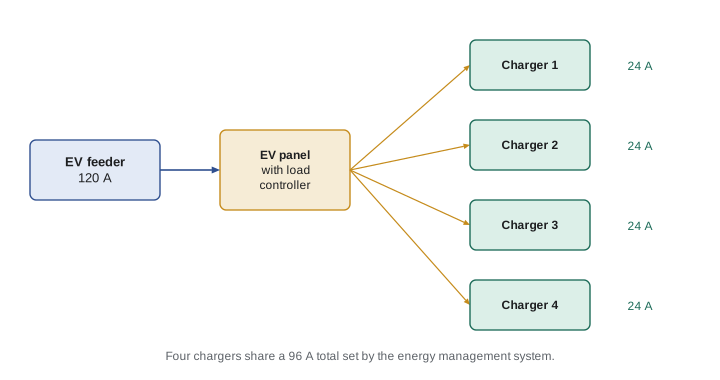
An energy management system, or EMS, monitors the load on a service or feeder and controls the EVSE so that the total stays within a set limit. Section 625.42 allows the service, feeder and branch circuit to be sized from the maximum load permitted by the EMS, and the load calculation rules in 220.70 and Article 750 allow the EMS setting to be used in place of the full connected load, where the EMS meets the listing and setting requirements. Typical setups share a fixed amount of current among several chargers, or reduce charging when the building's other loads rise. The EMS settings must be accessible only to qualified persons, and the limit must be marked. For the fourplex, Dana designs a 120-ampere EV feeder from the meter stack with a listed load-sharing system that keeps the four chargers within 96 amperes total, so all four cars charge overnight at a reduced rate, and none of the unit feeders changes.
Bidirectional charging
A bidirectional EVSE can send power from the vehicle battery to the premises. Section 625.48 requires that EVSE intended to be interconnected to a load or another source be listed and marked for that purpose, and when it operates as an interactive source, the rules of Article 705 apply, including the busbar calculations from lesson 7. When it supplies backup power to the premises with the utility disconnected, it is an optional standby source and Article 702's transfer equipment rules apply. Helen's pickup can supply her backup loads panel through a listed bidirectional charger and a transfer switch, so the system must meet both the EV and the standby rules. Dana reminds Helen that the system is only as good as its transfer equipment: the house must be isolated from the utility before the truck feeds it.
Location, ventilation and outdoor equipment
EVSE must be installed so that the coupling means is located at a height within a stated range above the floor or grade, unless it is part of equipment designed for a different height, and the cable management must keep the cable off the ground where people walk. Outdoor EVSE and receptacles must be suitable for the location, and outdoor receptacles need weather-resistant, in-use covers. Older vehicles that required ventilation during indoor charging led to ventilation rules in 625.52, which apply only where the vehicle or equipment requires ventilation; most modern lithium-ion vehicles do not, but the rule remains for equipment marked as needing it. Parking lot stations need protection from vehicle damage, such as bollards, which comes from both the NEC's protection rules and the manufacturer's instructions.
2026 notes
Article 625 has expanded in each recent edition to cover bidirectional and wireless systems, and the 2026 edition continues to refine power export, energy management and load calculation rules, with the load calculation moving to Article 120. Confirm the GFCI, disconnect and sizing rules in your own edition.
Common mistakes
MistakePutting a garage freezer on the EV charger circuit.
Instead625.40 requires an individual branch circuit for each EV outlet.
MistakeSizing a 48-ampere charger on a 50-ampere breaker.
InsteadEV load is continuous; 48 times 1.25 is 60 amperes.
MistakeInstalling a 240-volt EV receptacle without GFCI protection.
Instead625.54 requires GFCI protection for all receptacles installed for EV charging.
MistakeRequiring a separate disconnect for a 240-volt, 40-ampere residential charger.
Instead625.43 applies above 60 amperes or above 150 volts to ground.
MistakeCounting each EV port at less than 7,200 VA in a 2023 load calculation.
Instead220.57 uses the larger of 7,200 VA or the nameplate rating.
Summary and key terms
- Article 625 covers EVSE, wireless and bidirectional power transfer; all EVSE must be listed.
- Each EV outlet needs an individual branch circuit.
- EV load is continuous: overcurrent protection and conductors at 125 out of 100 of the EVSE load or restricted setting.
- Receptacles for EV charging need GFCI protection; hardwired EVSE has built-in personnel protection.
- A lockable, readily accessible disconnect is required above 60 amperes or above 150 volts to ground.
- Load calculations use the larger of 7,200 VA or nameplate per EVSE, unless an energy management system limits the load.
- Bidirectional EVSE is also a source under Articles 702 or 705.
- EVSE
- Electric vehicle supply equipment: the equipment that delivers energy from premises wiring to an EV.
- Personnel protection system
- A built-in system in listed EVSE that interrupts the circuit on a ground fault.
- Restricted-access setting
- An adjustable EVSE output limit that can be changed only by qualified persons.
- Energy management system
- A system that monitors and controls loads to keep the total within a set limit.
- Bidirectional EVSE
- EVSE that can send power from the vehicle to the premises or the grid.
- Level 2 charging
- AC charging at 208 or 240 volts, typically 16 to 80 amperes.
Practice problems
Work each problem on paper first, then reveal the answer to check.
What branch circuit rating is needed for an EVSE rated 40 amperes?
Show answer
40 times 1.25 is 50 amperes.
Does a 240-volt, 50-ampere EV receptacle in a garage need GFCI protection?
Show answer
Yes, under 625.54.
Is a disconnect required under 625.43 for an 80-ampere, 240-volt residential charger?
Show answer
Yes, because it is rated more than 60 amperes.
What load does 220.57 assign to a 30-ampere, 240-volt EVSE?
Show answer
The larger of 7,200 VA and 7,200 VA (30 times 240), so 7,200 VA.
Three chargers share a load management limit of 64 amperes. What load is used for the feeder calculation?
Show answer
The EMS limit, 64 amperes, if the system meets the listing and setting rules.
Lesson quiz · 5 questions
Score 60% or more to complete this lesson.
Create a free account to save your progress, take quizzes and earn a certificate.