
MELU-106 · Lesson 12 of 12 · 43 min
Special occupancies practice set
▶ Video coming soon A video version of this lesson is on the way.
This final lesson pulls the course together the way an exam does: mixed questions from all of Chapters 5, 6 and 7, with no warning about which article each one comes from. The skill being tested is not only knowing the rules but finding the right article quickly when a question describes a situation in everyday words. The lesson starts with a strategy for special occupancy questions, then works through twelve practice problems drawn from the Brightwater jobs, each with a worked solution and the article and section you would tab to find it. It ends with a timed drill plan and a checklist Dana uses in her final week of study. As always, sections are cited by number and explained in our own words, and values are illustrative; on the exam, use your own book.
Dana's last month
Dana's exam is four weeks away. She has finished the general chapters and passed her practice tests on calculations, but her scores on special occupancy questions are still uneven. Marcus has the same problem. 'The questions do not say ‘Article 680’,' he complains. 'They say ‘a homeowner wants a hot tub on the deck’.' Ray suggests they build a habit: read the question, name the article in the margin, then answer. They spend two evenings drilling only that first step until it is automatic.
A strategy for special occupancy questions
Special occupancy, equipment and condition questions reward a consistent routine. First, identify the trigger: the place, the equipment or the condition named in the question, such as a pool, a spray booth, an operating room, a fuel dispenser, a sign, an elevator, a solar array, a generator, a thermostat or a fire alarm. Second, go to the article for that trigger using your tabs or the index. Third, find the part of the article that matches the specific situation, for example Part IV of Article 680 for a spa. Fourth, look for the distinctive rule: the distance, the time, the multiplier, the separation or the disconnect that makes this article different. Fifth, check whether a general chapter rule still applies alongside it, because Chapters 5 to 7 modify the general rules rather than replace them entirely.
| Trigger in the question | Article to open |
|---|---|
| Gasoline, solvents, propane, dust, lint | 500 to 516 |
| Hospital, clinic, patient, operating room | 517 |
| 100 or more people, restaurant banquet room, auditorium | 518 (and 520 for stages) |
| Repair garage, fuel dispenser, aircraft hangar | 511, 514, 513 |
| Barn, livestock, poultry house | 547 |
| Pool, spa, hot tub, fountain, jetted tub | 680 |
| Solar panels, inverter, rapid shutdown | 690 (and 705) |
| Battery storage, backfed breaker, interconnection | 706, 705 |
| EV charger | 625 |
| Exit signs, egress lighting, generator, transfer switch | 700, 701, 702, 445 |
| Thermostat, doorbell, PoE, low-voltage cable | 722, 724, 725 |
| Fire alarm | 760 |
| Sign, elevator, welder, machine, crane | 600, 620, 630, 670, 610 |
Practice problems
Work each problem before reading the solution. Time yourself: on a typical master exam, you have about two to three minutes per question, and special occupancy questions should take less, because they are lookups rather than calculations.
Worked problem
Problem 1: the parts washer
Delgado's parts washer uses a flammable solvent that is present in ignitable concentrations at the open wash tank during normal operation. What class and division apply at the tank, and what is the maximum distance from the motor starter's explosionproof enclosure to its conduit seal?
Show solution
- The solvent is a flammable liquid producing vapor, so Class I.
- Present in normal operation, so Division 1.
- A seal is required within 18 inches of an enclosure containing arcing devices, under 501.15.
Answer: Class I, Division 1; the seal within 18 inches.
Worked problem
Problem 2: a T code
A vapor has an illustrative autoignition temperature of 190 degrees Celsius. May a luminaire marked T3 (200 degrees Celsius) be installed in the classified area?
Show solution
- The marked maximum surface temperature must be below the autoignition temperature, under 500.8.
- 200 is above 190, so T3 is not acceptable. T3B (165) or cooler would be.
Answer: No; choose T3B or a cooler code.
Worked problem
Problem 3: the clinic's exam room wiring
Northgate's procedure rooms are Category 2 patient care spaces. The electrician proposes MC cable whose armor is listed as an equipment grounding conductor, with an insulated copper equipment grounding conductor inside. Does this meet 517.13?
Show solution
- 517.13 requires a wiring method that qualifies as an EGC under 250.118, plus an insulated copper EGC.
- MC cable with a listed grounding armor provides the first path; the insulated copper conductor provides the second.
Answer: Yes.
Worked problem
Problem 4: the banquet room
A banquet room is designed for 150 people. Can it be wired in Type NM cable in a building where the building code requires fire-rated construction?
Show solution
- 150 or more persons is a place of assembly under Article 518.
- 518.4 permits NM only where fire-rated construction is not required.
Answer: No; use metal raceway or qualifying cable.
Worked problem
Problem 5: Helen's pool receptacle
Using the commonly tested values, where must the required general-purpose receptacle be located at Helen's in-ground pool, and must it be GFCI protected?
Show solution
- 680.22 requires a receptacle between 6 and 20 feet from the inside wall at a dwelling, using the commonly tested values.
- Receptacles within 20 feet need GFCI protection.
Answer: Between 6 and 20 feet, with GFCI protection.
Worked problem
Problem 6: the pool bonding conductor
What conductor is used for Helen's pool equipotential bonding grid, and does it have to connect to a ground rod?
Show solution
- 680.26 requires solid copper not smaller than 8 AWG.
- The bonding grid equalizes potential; it is not required to connect to a grounding electrode.
Answer: 8 AWG solid copper; no ground rod connection required.
Worked problem
Problem 7: string voltage
Modules have an illustrative open-circuit voltage of 41 volts at 25 degrees Celsius and a coefficient of minus 0.0029 per degree. The coldest expected temperature is minus 30 degrees Celsius. How many may be connected in series for a 600-volt dwelling limit?
Show solution
- Temperature difference: minus 55 degrees. Factor: 1 plus 0.0029 times 55, which is 1.1595.
- Cold voltage: 41 times 1.1595 is about 47.54 volts.
- 600 divided by 47.54 is about 12.6, so 12 modules.
Answer: 12 modules.
Worked problem
Problem 8: the busbar
A dwelling has a 225-ampere busbar and a 200-ampere main breaker. What is the largest inverter output current that may be backfed at the opposite end of the bus under the 120 out of 100 rule?
Show solution
- 225 times 1.2 is 270 amperes.
- 270 minus 200 is 70 amperes available for 1.25 times the source current.
- 70 divided by 1.25 is 56 amperes.
Answer: 56 amperes of inverter output, on a 70-ampere backfed breaker.
Worked problem
Problem 9: an EV charger
A homeowner wants a hardwired EVSE set to 40 amperes at 240 volts. What branch circuit rating is needed, is a separate disconnect required under 625.43, and is GFCI protection required on the branch circuit?
Show solution
- Continuous load: 40 times 1.25 is 50 amperes, so a 50-ampere circuit.
- 625.43 applies above 60 amperes or above 150 volts to ground; this is 40 amperes and 120 volts to ground, so no separate disconnect is required by that section.
- 625.54 requires GFCI for receptacles; a hardwired listed EVSE has built-in personnel protection.
Answer: 50-ampere circuit; no 625.43 disconnect required; no additional GFCI for hardwired listed EVSE.
Worked problem
Problem 10: the standby generator
A business owner installs an automatic transfer generator to keep refrigeration running during outages. Which article applies, is there a Code transfer time, and how must the generator be sized without load management?
Show solution
- The system is not legally required, so it is optional standby under Article 702.
- Article 702 sets no transfer time.
- With automatic transfer and no load management, 702.4 requires capacity for the full load transferred.
Answer: Article 702; no Code time; sized for the full transferred load.
Worked problem
Problem 11: the thermostat cable
A Class 2 thermostat cable marked CL2 is installed above a ceiling used for return air, in the same conduit as the rooftop unit's 208-volt supply for the last 10 feet. Find two violations.
Show solution
- 300.22 requires plenum-rated cable or a suitable raceway in spaces used for environmental air; CL2 is general purpose.
- Class 2 conductors may not share a raceway with power conductors unless a permitted condition applies.
Answer: The cable type in the plenum and the shared raceway with power conductors.
Worked problem
Problem 12: the welder group
Three transformer arc welders each have an effective primary current of 30 amperes on their nameplates. Using the illustrative group rule of 100 out of 100 of the two largest and 85 out of 100 of the third, what is the minimum feeder ampacity?
Show solution
- With the effective primary current given, it is used directly, with no duty cycle multiplier.
- 30 plus 30 plus 0.85 times 30 is 30 plus 30 plus 25.5, which is 85.5 amperes.
Answer: 85.5 amperes.
| Problem | Article and section to tab |
|---|---|
| 1 | 500.5, 501.15 |
| 2 | 500.8 |
| 3 | 517.13, 250.118 |
| 4 | 518.2, 518.4 |
| 5 | 680.22 |
| 6 | 680.26 |
| 7 | 690.7 |
| 8 | 705.12 |
| 9 | 625.41, 625.43, 625.54 |
| 10 | 702.4, 702.5 |
| 11 | 300.22, Article 725 Part III |
| 12 | 630.11 |
Calculations that recur
Most special occupancy questions are lookups, but a handful of calculations recur often enough to practice until they are automatic: seal fill, cold open-circuit voltage and string length, PV conductor current, the 120 out of 100 busbar rule, EV branch circuits, generator load current, welder conductors with duty cycle, and industrial machinery supply conductors. The script below runs each one with the values from this course so you can check your hand calculations and change the inputs to make new problems.
import math
# Quick checks for the recurring special-occupancy calculations (illustrative values)
def string_length(voc, coef, t_low, limit):
    return int(limit // (voc * (1 + coef * (t_low - 25))))

def pv_conductor(isc, strings=1):
    return isc * strings * 1.25 * 1.25

def busbar_120(bus, main):
    return (1.2 * bus - main) / 1.25

def ev_breaker(evse):
    need = 1.25 * evse
    return next(r for r in [15, 20, 25, 30, 35, 40, 45, 50, 60, 70, 80, 90, 100] if r >= need)

def welder_group(currents, factors=(1, 1, 0.85, 0.70)):
    cs = sorted(currents, reverse=True)
    return sum(c * (factors[i] if i < len(factors) else 0.60) for i, c in enumerate(cs))

print("String length (41 V, -0.0029, -30 C, 600 V):", string_length(41, -0.0029, -30, 600))
print(f"PV conductor for Isc 13.9 A: {pv_conductor(13.9):.2f} A")
print(f"Inverter output allowed, 225 A bus, 200 A main: {busbar_120(225, 200):.0f} A")
print("EV breaker for a 40 A EVSE:", ev_breaker(40), "A")
print(f"Welder group of three at 30 A: {welder_group([30, 30, 30]):.1f} A")
print(f"Generator current, 112 kW at 480 V three-phase: {112000 / (480 * math.sqrt(3)):.0f} A")String length (41 V, -0.0029, -30 C, 600 V): 12 PV conductor for Isc 13.9 A: 21.72 A Inverter output allowed, 225 A bus, 200 A main: 56 A EV breaker for a 40 A EVSE: 50 A Welder group of three at 30 A: 85.5 A Generator current, 112 kW at 480 V three-phase: 135 A
A timed drill plan
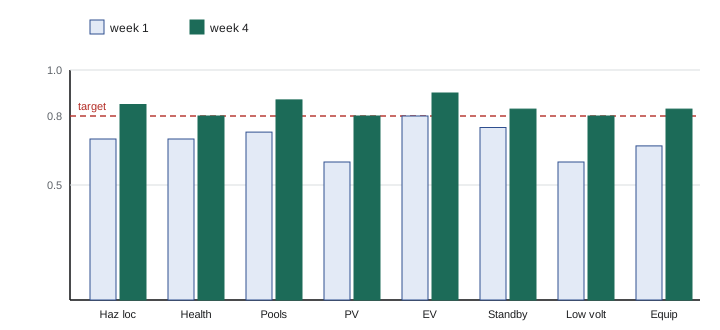
Dana's final four weeks follow a simple plan. Each weekday evening she does a 25-question timed drill mixing special occupancy questions with the general chapters, aiming for about two minutes per question, and then reviews every question she missed or guessed, writing the article and section next to it. On weekends she takes one full-length practice exam under exam conditions: the same time limit, only the books her state allows, and no phone. She tracks her score by topic, and when a topic stays below her target, she spends the next evening rereading that article and tabbing the sections she could not find.
# Track drill scores by topic and flag weak areas (illustrative results)
results = {
    "Hazardous locations": (17, 20),
    "Health care": (8, 10),
    "Pools and spas": (13, 15),
    "PV and storage": (11, 15),
    "EV charging": (9, 10),
    "Standby systems": (10, 12),
    "Limited-energy and fire alarm": (7, 10),
    "Signs, elevators, welders": (9, 12),
}
target = 0.80
for topic, (right, total) in results.items():
    share = right / total
    flag = "" if share >= target else "  <- review"
print(f"{topic:32s} {right:2d}/{total:<2d} = {share:.2f}{flag}")Hazardous locations 17/20 = 0.85 Health care 8/10 = 0.80 Pools and spas 13/15 = 0.87 PV and storage 11/15 = 0.73 <- review EV charging 9/10 = 0.90 Standby systems 10/12 = 0.83 Limited-energy and fire alarm 7/10 = 0.70 <- review Signs, elevators, welders 9/12 = 0.75 <- review
The final week checklist
In the last week, Dana stops learning new material and checks her tools instead. Her tabs are permanent and match the edition the exam uses. Her highlighting marks the distinctive numbers in each special article: the 18-inch seal, the 10- and 60-second transfer times, the 6- and 20-foot pool distances, the 5-foot spa shutoff, the 8 AWG bonding conductor, the 30-volt and 80-volt rapid shutdown limits, the 120 out of 100 rule, the 60-ampere and 150-volt EV disconnect thresholds, and the 1,200 volt-ampere sign outlet. She has a short list of articles she always forgets to check, such as 590 for temporary power and 547 for agricultural buildings. She knows the testing center's rules on books, calculators and identification from the candidate bulletin. And she has a plan for the exam itself: a first pass answering everything she knows in under a minute, a second pass for lookups, and a final pass for calculations and any remaining guesses, never leaving a question blank.
| Distinctive number | Topic | Where |
|---|---|---|
| 18 in | Seal from arcing enclosure | 501.15 |
| 10 s and 60 s | Emergency and legally required standby transfer | 700.12, 701.12 |
| 6 ft and 20 ft | Pool receptacle distances (commonly tested) | 680.22 |
| 5 ft | Spa emergency shutoff distance | 680.41 |
| 8 AWG solid copper | Pool and hydromassage bonding | 680.26, 680.74 |
| 30 V and 80 V in 30 s | Rapid shutdown limits (commonly tested) | 690.12 |
| 120 out of 100 | Backfed busbar limit | 705.12(B) |
| 60 A or 150 V to ground | EV disconnect threshold | 625.43 |
| 1,200 VA | Sign outlet load | 220.14(F) |
2026 notes
If your exam uses the 2026 edition, the biggest change for this lesson is navigation: chapters 5, 6 and 7 are retitled for specific occupancies, equipment and conditions, several source and storage articles are regrouped, Chapter 8 material is reorganized into Chapter 7, and load calculations move to Article 120. Rebuild your trigger table and your list of distinctive numbers from your own book, and do at least one practice exam with that edition before test day.
Common mistakes
MistakeAnswering a special occupancy question from the general chapters alone.
InsteadChapters 5 to 7 modify the general rules; find the specific article first.
MistakeSpending five minutes searching for one lookup on the exam.
InsteadMark it, move on, and come back on the second pass.
MistakeTabbing from an old study guide's section numbers.
InsteadTab from the edition your exam uses; numbers change between editions.
MistakeLeaving questions blank at the end of the exam.
InsteadUnanswered questions score nothing; make an informed guess.
MistakeIgnoring the candidate bulletin's rules on books and calculators.
InsteadRead the bulletin early so test day has no surprises.
Summary and key terms
- Identify the trigger in the question, open the matching article, find the part and the distinctive rule, and check general rules still apply.
- Most special occupancy questions are lookups; practice the recurring calculations until they are automatic.
- Keep a table of triggers and articles and a list of distinctive numbers, built from your own edition.
- Use timed drills and full practice exams, and track your scores by topic.
- Plan your exam passes: quick answers first, lookups second, calculations and guesses last.
- Trigger
- The place, equipment or condition named in a question that points to a specific article.
- Distinctive rule
- The rule that makes a special article different from the general chapters.
- Candidate bulletin
- The testing agency's document describing exam content, references allowed and test-day rules.
- First pass
- An exam strategy of answering known questions quickly before spending time on harder ones.
- Practice exam
- A full-length timed test taken under exam conditions to build speed and stamina.
Practice problems
Work each problem on paper first, then reveal the answer to check.
A question describes a carnival ride. Which article do you open?
Show answer
Article 525.
A question asks about the distance from a spa to its emergency shutoff. What is the commonly tested answer and the section?
Show answer
At least 5 feet, in 680.41.
Modules have a cold-corrected Voc of 50 volts. How many fit under a 1000-volt limit?
Show answer
20 modules.
An EVSE is set to 48 amperes. What breaker is needed?
Show answer
60 amperes.
Four welders have effective primary currents of 40, 40, 30 and 30 amperes. Using the illustrative group factors, what feeder ampacity is needed?
Show answer
40 plus 40 plus 25.5 plus 21, which is 126.5 amperes.
Lesson quiz · 5 questions
Score 60% or more to complete this lesson.
Create a free account to save your progress, take quizzes and earn a certificate.