
MELU-106 · Lesson 5 of 12 · 24 min
Swimming pools, spas and fountains
▶ Video coming soon A video version of this lesson is on the way.
Water and electricity are a deadly combination, and Article 680 is one of the most heavily tested articles on master exams. It covers permanently installed and storable swimming pools, spas and hot tubs, fountains, hydromassage bathtubs, and similar installations, and it sets distances, protection and bonding rules that differ from everywhere else in the Code. The risk is not only a person touching a live part; it is also voltage gradients in the water and on the deck that can cause electric shock drowning, where a swimmer is incapacitated by current passing through the body. This lesson works through Article 680's structure, receptacle and luminaire distances, overhead and underground clearances, GFCI requirements, equipotential bonding and the special rules for spas, hot tubs, fountains and hydromassage tubs. Sections are cited by number and explained in our own words. Dimensions given here are the commonly tested values in recent editions; confirm every distance in your own book.
Helen Brandt's backyard
Helen Brandt, whose Orchard Lane house Brightwater recalculated for a service upgrade in MELU-102, is back. She is installing an in-ground pool with a pump, heater and underwater LED lights, a separate outdoor hot tub on the patio, and a small decorative fountain by the front walk. The pool contractor will handle the shell and plumbing, but the electrical work, including the bonding, is Brightwater's. Ray assigns the job to Dana with a warning: 'Pool bonding is the single most common failed inspection in this city. Gloria will walk the deck with a meter.'
How Article 680 is organized
Article 680 is divided into parts. Part I has the general rules and definitions that apply to everything in the article, including the definitions of maximum water level and of the perimeter surfaces that must be bonded. Part II covers permanently installed pools. Part III covers storable pools and storable spas and hot tubs. Part IV covers spas and hot tubs. Part V covers fountains. Part VI covers pools and tubs for therapeutic use. Part VII covers hydromassage bathtubs. Part VIII covers electrically powered pool lifts. When you look up a rule, first find the part that matches the installation, then confirm that the general rules in Part I also apply.
| Part | Covers |
|---|---|
| I | General requirements and definitions for the whole article |
| II | Permanently installed pools |
| III | Storable pools, spas and hot tubs |
| IV | Spas and hot tubs |
| V | Fountains |
| VI | Pools and tubs for therapeutic use |
| VII | Hydromassage bathtubs |
| VIII | Electrically powered pool lifts |
Receptacle distances
Receptacles near pools follow a set of distance rules measured horizontally from the inside wall of the pool. Section 680.22 is where to find them. For permanently installed pools, receptacles that supply pool pump motors and similar equipment may be located closer to the pool than general receptacles, under stated conditions and with GFCI protection. Other receptacles must be located a minimum distance from the inside wall, commonly not less than 6 feet. All 15- and 20-ampere, single-phase, 125-volt through 250-volt receptacles within a larger distance of the inside wall, commonly 20 feet, must be GFCI protected. At dwelling units, at least one 125-volt, 15- or 20-ampere receptacle on a general-purpose branch circuit must be located within a set band from the pool, commonly not less than 6 feet and not more than 20 feet from the inside wall, and not more than a stated height above the level of the deck. The distance is measured as the shortest path a supply cord would take without piercing a floor, wall, ceiling, doorway or other permanent barrier.
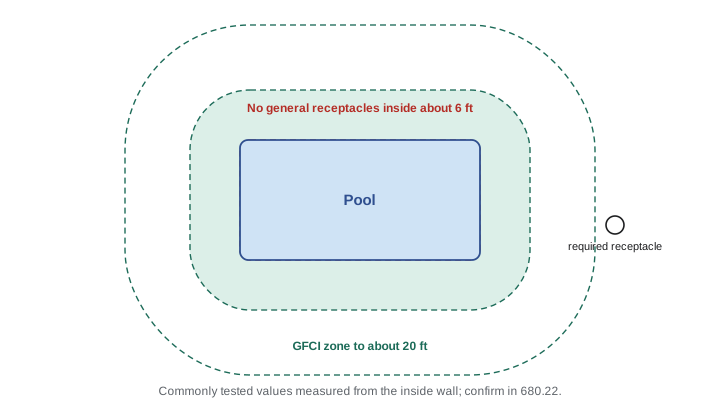
| Item near a permanently installed pool | Commonly tested rule (check your edition) |
|---|---|
| General receptacles | Not within 6 ft of the inside wall |
| Pump motor receptacle | May be closer, with GFCI and other conditions |
| GFCI for 15/20 A, 125 to 250 V receptacles | Within 20 ft of the inside wall |
| Required receptacle at a dwelling | Between 6 ft and 20 ft from the inside wall |
| Switching devices | At least 5 ft from the inside wall unless separated by a barrier |
Luminaires and ceiling fans
Luminaires, lighting outlets and ceiling-suspended paddle fans above or near pools are restricted by height and distance, also in 680.22. In the outdoor area over the pool and the area extending a few feet horizontally from the inside wall, luminaires and fans must be installed well above the maximum water level, commonly not less than 12 feet. Existing luminaires closer than that can remain only with GFCI protection and other conditions. In an indoor pool area, a lower height is allowed where the branch circuit is GFCI protected and the luminaire is of a totally enclosed type. Luminaires in the band between a few feet and a larger distance from the pool must be GFCI protected unless mounted above a stated height. Low-voltage luminaires listed for the purpose, supplied by listed power supplies that do not exceed the low-voltage contact limit, have more relaxed placement rules.
Underwater luminaires are covered in section 680.23. They must be installed so that the top of the lens is below the normal water level by a stated distance unless listed for a shallower depth. Luminaires operating at more than the low-voltage contact limit must have GFCI protection on the branch circuit, and wet-niche luminaires are installed in a forming shell with enough cord coiled behind them to allow the luminaire to be lifted onto the deck for service without disconnecting it. Luminaires operating at more than 150 volts between conductors are not permitted in the water. Most modern pool lights, including Helen's, are listed low-voltage LED units supplied through a listed transformer or power supply, which removes many of the GFCI and depth concerns, though the bonding rules still apply.
Overhead and underground clearances
Section 680.9 keeps overhead conductors away from pools. Utility-owned and premises overhead conductors may not pass over the pool, the diving structure, or observation stands, towers or platforms, or the area extending a stated distance horizontally from the inside wall, unless they are high enough. The clearances depend on the voltage and whether the conductors are insulated cables, and the commonly tested value for insulated cables of 0 to 750 volts to ground over the water is 22.5 feet above the maximum water level. Communication cables have a lower clearance. Underground wiring is restricted near the pool too: wiring may not be installed under the pool or within a stated distance of the inside wall unless it is necessary to supply pool equipment, and where it is permitted, the wiring method and burial depth are specified in 680.11.
| Clearance | Commonly tested value | Where |
|---|---|---|
| Insulated cables, 0 to 750 V to ground, above the water | 22.5 ft | 680.9 |
| Communication cables above the water | 10 ft | 680.9 |
| Underground wiring near the pool | Not within 5 ft of the inside wall unless supplying pool equipment | 680.11 |
Equipotential bonding
Equipotential bonding is the most important and most misunderstood part of Article 680. Its purpose, stated in section 680.26, is to reduce voltage gradients in the pool area by connecting all the conductive parts a swimmer or bather might touch into one common bonding grid, so that everything rises and falls in potential together. It is not the same as grounding, and the bonding grid is not required to be connected to a grounding electrode. It must be connected to the equipment grounding system only through the bonded equipment, such as the pump motor's grounding.
The bonding conductor is solid copper, insulated, covered or bare, not smaller than 8 AWG, or a rigid metal conduit of brass or other identified corrosion-resistant metal. The parts that must be bonded include the conductive pool shell, which for poured concrete and gunite pools usually means the structural reinforcing steel; the perimeter surfaces, extending a stated distance from the inside walls, commonly 3 feet, including unpaved areas, poured concrete and other surfaces; metallic components such as ladders, handrails and diving board supports; underwater lighting forming shells; metal fittings over a stated size; pool pump motors and other electrical equipment; metal-sheathed cables and raceways within a stated distance; and metal fences, awnings and similar parts within a stated distance unless separated by a barrier. The pool water itself must also be bonded, through a conductive surface of a stated minimum area in contact with the water, such as a listed water bonding fitting.
For the perimeter surfaces, the Code allows either structural reinforcing steel bonded together, or a copper ring: an 8 AWG bare solid copper conductor run around the pool at a stated distance from the inside wall and a stated depth below the subgrade, bonded to the pool shell at a number of points spaced evenly around the perimeter, commonly at least four. Where the shell is nonconductive, such as fiberglass or vinyl, there is no reinforcing steel to bond, but the perimeter surface still needs a bonding method and the metallic parts and water must still be bonded.
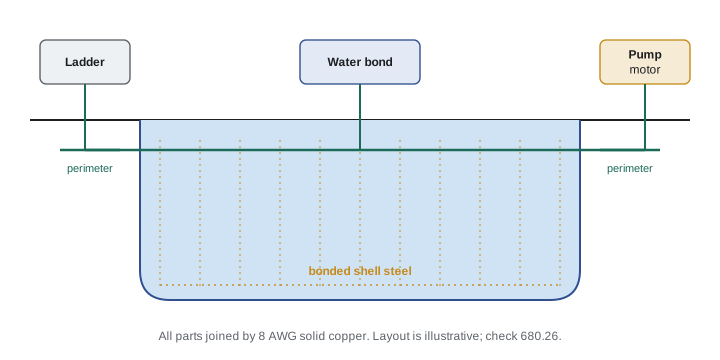
| Must be bonded (commonly tested) | Notes, in our words |
|---|---|
| Conductive pool shell | Reinforcing steel tied together or bonded |
| Perimeter surfaces | About 3 ft out from the inside wall; steel or a copper ring |
| Metal fittings and parts | Ladders, handrails, diving board supports, light niches |
| Electrical equipment | Pump motors, heaters, and their metal parts |
| Pool water | Through a conductive surface of minimum area in contact with the water |
| Nearby metal | Fences, awnings and raceways within a stated distance unless separated |
# Copper perimeter ring around a rectangular pool (illustrative layout)
import math

def ring(length_ft, width_ft, offset_in=21, points=4):
    off = offset_in / 12
    perimeter = 2 * (length_ft + 2 * off) + 2 * (width_ft + 2 * off)
    spacing = perimeter / points
    return perimeter, spacing

for name, l, w, n in [("Helen's pool", 32, 16, 4), ("Community pool", 75, 42, 8)]:
    p, s = ring(l, w, points=n)
print(f"{name}: ring about {math.ceil(p)} ft of 8 AWG solid copper, {n} bonds to the shell, one every {s:.0f} ft")Helen's pool: ring about 110 ft of 8 AWG solid copper, 4 bonds to the shell, one every 28 ft Community pool: ring about 248 ft of 8 AWG solid copper, 8 bonds to the shell, one every 31 ft
GFCI protection
Article 680 has its own GFCI rules in addition to those of 210.8. Outlets supplying pool pump motors on branch circuits rated 150 volts or less to ground and 60 amperes or less, single- or three-phase, must have GFCI protection, a rule found in 680.21 that expanded in recent editions to cover motors whether cord-and-plug connected or direct wired. Underwater luminaires above the low-voltage contact limit must be GFCI protected. Receptacles within the 20-foot zone need GFCI protection. Spas and hot tubs need GFCI protection for their outlets, and the emergency shutoff must be installed as described below. Pool covers that are electrically operated, and pool lifts, have their own rules. On an exam, a pump motor question almost always has GFCI protection as part of the answer.
Spas, hot tubs and the emergency shutoff
Part IV covers spas and hot tubs. For outdoor installations, section 680.42 allows flexible connections and cord-and-plug connection under stated conditions, and a self-contained spa or hot tub, or a packaged spa equipment assembly, listed as a unit, simplifies the installation. Bonding of a listed self-contained spa can rely on the manufacturer's internal bonding plus a bonding connection to the perimeter metal surfaces as required. The most tested rule is the emergency shutoff in section 680.41: a clearly labeled emergency shutoff or control switch must be installed for the purpose of stopping the motors that provide power to the recirculation system and jet system. It must be readily accessible to the users and located not less than a stated distance, commonly 5 feet, away from the spa or hot tub, adjacent to it and within sight of it. Single-family dwellings are exempt from the emergency shutoff in many editions, so read the exception.
Indoor installations have additional rules on receptacle distance, luminaire height and wall switch location, and the bonding of metal surfaces within a stated distance of the spa. Helen's hot tub is a listed self-contained unit on the patio. Dana plans a GFCI-protected 50-ampere circuit to a disconnect located in sight of the tub but at least 5 feet from its inside wall, with the bonding conductor run from the tub's external bonding lug to the copper perimeter grid.
Fountains and hydromassage tubs
Part V covers fountains, which are treated like pools in many ways because people, especially children, may wade in them. Luminaires, submersible pumps and other equipment in fountains must be GFCI protected if they operate above the low-voltage contact limit, must be listed for the use, and must be bonded together with the fountain's metal piping and fittings. Fountains that share water with a pool are subject to the pool rules. Helen's front walk fountain is a small self-contained unit with a cord-connected pump; Dana installs a GFCI-protected weather-resistant receptacle with an in-use cover nearby.
Part VII covers hydromassage bathtubs, the jetted tubs found in many bathrooms. They are not filled and drained between uses like a pool; they are filled for each use and drained afterward. Their outlets must be GFCI protected, the motor must be accessible for service without damaging the building finish, and all metal piping systems, metal parts of electrical equipment and pump motors associated with the hydromassage tub must be bonded together using an 8 AWG solid copper conductor. A hydromassage tub is not a spa, and exam questions often test whether you can tell the difference: a hydromassage tub is drained after each use.
Worked problem
Planning Helen's backyard
Helen's pool is 32 by 16 feet. Her patio receptacle is planned 4 feet from the pool's inside wall, her hot tub's disconnect 3 feet from the tub, and her pool light circuit is a listed 12-volt LED system. Using the commonly tested values in this lesson, which items need to change?
Show solution
- The patio receptacle at 4 feet is inside the 6-foot zone where general receptacles are not permitted; move it to between 6 and 20 feet, where it also satisfies the required dwelling receptacle and must be GFCI protected.
- The hot tub's emergency shutoff, where required, must be at least 5 feet away and in sight; at a single-family dwelling the shutoff exception may apply, but Dana places the disconnect at 6 feet anyway.
- The 12-volt LED pool light is below the low-voltage contact limit, so its luminaire does not need GFCI protection, but the listed power supply's primary circuit and the bonding of the niche still follow the article.
- The pump motor outlet must be GFCI protected, and everything goes on the bonding grid.
Answer: Move the patio receptacle and the hot tub disconnect; keep GFCI on the pump and bond everything.
2026 notes
Article 680 changes in almost every edition. Recent cycles have expanded GFCI protection for pool equipment, clarified the perimeter surface bonding options, added rules for pool lifts and for listed low-voltage lighting, and refined the distance measurements. The 2026 edition continues that trend. If your exam uses the 2026 edition, recheck every distance and GFCI rule in this lesson against your own book.
Common mistakes
MistakeThinking the bonding grid must be connected to a ground rod.
InsteadEquipotential bonding equalizes potential; it is not required to connect to a grounding electrode.
MistakeUsing 10 AWG stranded copper for the bonding grid.
InsteadThe bonding conductor is solid copper, not smaller than 8 AWG.
MistakeInstalling a general-purpose receptacle 4 feet from a permanently installed pool.
InsteadGeneral receptacles must be at least 6 feet from the inside wall.
MistakeLeaving the pool pump motor outlet without GFCI protection.
Instead680.21 requires GFCI protection for pool pump motor outlets within the stated voltage and current limits.
MistakeTreating a hydromassage bathtub as a spa.
InsteadA hydromassage tub is drained after each use and follows Part VII.
Summary and key terms
- Article 680 is divided into parts; find the part that matches the installation, then apply Part I.
- General receptacles are kept at least 6 feet from a pool, with GFCI protection out to 20 feet, using commonly tested values.
- Luminaires and fans over pools have height rules; underwater luminaires have depth, voltage and GFCI rules.
- Overhead conductors need large clearances over pools; underground wiring is kept away from the inside wall.
- Equipotential bonding uses 8 AWG solid copper to join the shell, perimeter surfaces, metal parts, equipment and water.
- Spas and hot tubs need an emergency shutoff at least 5 feet away and in sight, with dwelling exceptions.
- Hydromassage tubs need GFCI protection, an accessible motor and an 8 AWG bonding conductor.
- Maximum water level
- The highest level water can reach before it spills out.
- Perimeter surfaces
- The surfaces around a pool, out to a stated distance from the inside wall, that must be bonded.
- Equipotential bonding
- Connecting conductive parts so they stay at the same electrical potential.
- Low-voltage contact limit
- A voltage below which contact is not expected to cause shock under wet conditions, as defined in Article 680.
- Self-contained spa
- A factory-fabricated spa or hot tub with all equipment in one listed unit.
- Hydromassage bathtub
- A permanently installed tub with a recirculating pump, filled and drained for each use.
Practice problems
Work each problem on paper first, then reveal the answer to check.
What size and type of conductor is used for pool equipotential bonding?
Show answer
Solid copper, not smaller than 8 AWG.
Using the commonly tested values, how far from a permanently installed pool's inside wall must general receptacles be?
Show answer
At least 6 feet.
What clearance above the maximum water level is commonly required for insulated cables of 0 to 750 volts to ground?
Show answer
22.5 feet.
Where must a spa's emergency shutoff be located?
Show answer
Readily accessible, in sight of the spa and at least 5 feet away, unless an exception applies.
A ring around a 20 by 40 foot pool is placed 21 inches out. About how long is the ring?
Show answer
About 2 times (40 plus 3.5) plus 2 times (20 plus 3.5), roughly 134 feet.
Lesson quiz · 5 questions
Score 60% or more to complete this lesson.
Create a free account to save your progress, take quizzes and earn a certificate.