
MELU-106 · Lesson 4 of 12 · 21 min
Assembly and other special occupancies
▶ Video coming soon A video version of this lesson is on the way.
Chapter 5 contains many articles beyond hazardous locations and health care. Each one takes an ordinary building type with a particular risk, such as a crowd, a wet environment, livestock, temporary power or a structure that moves, and adds or changes rules for it. Master exams sample from this list, usually with a question that names the occupancy and asks for the one rule that is different. This lesson covers places of assembly in Article 518, theaters in Article 520, commercial garages in Article 511, motor fuel dispensing in Article 514, agricultural buildings in Article 547, temporary installations in Article 590, and several others at a glance. The habit to build is simple: when a question names an occupancy, find its article first.
The Copper Kettle grows
The Copper Kettle restaurant in the Harlow Commons strip mall, where Brightwater did the 120/208-volt fit-out, has leased the vacant unit next door for a banquet room. The owner wants 130 seats for wedding receptions and business dinners, a small stage for a band, and a dance floor with theatrical-style lighting. Priya has the architect's occupancy calculation on her desk: the room is designed for an occupant load of 140. 'That number matters,' Dana tells Tyler Brooks, the apprentice, 'because at 100 or more people, Article 518 kicks in.'
Places of assembly under Article 518
Article 518 applies to buildings or portions of buildings designed or intended for the gathering of 100 or more persons for purposes such as deliberation, worship, entertainment, eating, drinking, amusement or awaiting transportation. The list of examples in section 518.2 includes restaurants, dining facilities, auditoriums, conference rooms, gymnasiums, places of worship, museums and similar spaces. The occupant load is determined by the building code, not by the electrician. A restaurant with a dining room for 60 and a separate banquet room for 140 has a place of assembly in the banquet room.
The main effect of Article 518 is on wiring methods. Section 518.4 permits metal raceways, flexible metal raceways, nonmetallic raceways encased in at least 2 inches of concrete, Type MI, MC and AC cable that qualify as equipment grounding conductors, and certain other methods. Nonmetallic sheathed cable, ENT and PVC conduit are permitted only in portions of the building where the building code does not require fire-rated construction, under conditions spelled out in the section. The point is that a crowded room needs wiring that resists fire spread and physical damage, and that keeps its fault path intact. Article 518 also addresses portable switchboards and stage equipment where a place of assembly includes a stage, and refers to Article 520 for theaters.
| Wiring method | Place of assembly (simplified) |
|---|---|
| EMT, RMC, IMC and other metal raceways | Permitted |
| MC or AC cable that qualifies as an EGC | Permitted |
| Type MI cable | Permitted |
| Nonmetallic raceway in 2 in of concrete | Permitted |
| Type NM cable, ENT or PVC | Only where fire-rated construction is not required, with conditions |
| Flexible cords | Limited uses only |
Worked problem
Wiring the banquet room
The banquet room is in a Type II noncombustible building with a fire-rated demising wall between it and the restaurant. Dana's crew normally uses MC cable with an armor not identified as an equipment grounding conductor, plus a separate grounding conductor, above the restaurant ceiling. Can they use the same product in the banquet room?
Show solution
- The banquet room has an occupant load of 140, so it is a place of assembly under Article 518.
- 518.4 permits MC cable that qualifies as an equipment grounding conductor under 250.118.
- MC cable whose armor is not identified as an EGC does not qualify by itself, even with a separate grounding conductor inside, unless the section's conditions allow it.
- Dana switches to MC cable with an armor identified as an equipment grounding conductor, or to EMT, for the banquet room.
Answer: Not without checking; use MC cable listed with a qualifying armor, or a metal raceway.
Theaters and stages under Article 520
Article 520 applies to theaters, audience areas of motion picture and television studios, performance areas and similar locations, indoors or outdoors. It covers fixed stage switchboards, portable switchboards, stage lighting, border lights and drop lights, dressing rooms and the flexible cords used on stage. A small band stage in a restaurant banquet room is usually covered by Article 518 with the portions of Article 520 that apply to performance areas and portable equipment. On exams, Article 520 questions tend to test the rules for dressing rooms, such as switches and pilot lights for receptacles near mirrors, the protection of flexible cords, and the requirement that portable stage equipment be supplied from outlets identified for that purpose.
For the Copper Kettle, the band will plug portable lighting and sound gear into a dedicated set of receptacles beside the stage on circuits identified for stage use, and the theatrical lighting rig on the dance floor is supplied from a listed dimmer panel with its own feeder. Dana keeps the stage circuits off the general receptacle circuits so a band overloading its circuits does not darken the room's egress lighting.
Commercial garages and repair shops
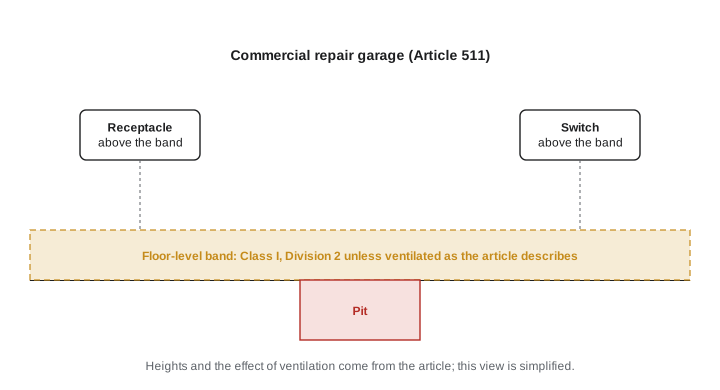
Article 511 covers locations used for service and repair of self-propelled vehicles that use volatile flammable liquids or gases for fuel. Its main job is classification: the floor area up to a stated height above the floor is Class I, Division 2 unless the area has adequate mechanical ventilation as the article describes, and any pit or depression below floor level is classified more strictly unless it is ventilated. Areas used only for parking, or used for repair of vehicles that do not use flammable fuels, are not classified under the article. Above the classified area, the article requires that equipment that could produce sparks, such as switches and receptacles, be located at a stated height above the floor or be suitable for the location. Garages also have GFCI requirements for receptacles in service areas where electrical diagnostic equipment, hand tools or portable lighting are used.
Motor fuel dispensing facilities
Article 514 applies to gasoline stations, marinas with fuel docks, fleet fueling yards and similar locations where fuel is transferred to vehicles. It uses a table to set the extent of Class I locations around dispensers, fill pipes, vent pipes, pits and the interior of dispensers, with the divisions and distances measured horizontally and vertically from each source. Underground wiring under classified areas must be in threaded rigid metal conduit, threaded steel IMC, or PVC or RTRC buried at specified depths with transitions to threaded metal conduit before emerging, and seals are required at the dispenser and at boundaries as in Article 501. Each circuit leading to or through dispensing equipment must have an emergency shutoff that disconnects all conductors, including the grounded conductor, and the emergency switch must be readily accessible and located at a stated distance from the dispensers. This emergency shutoff rule is a frequent exam question.
| Item | Article 514 requirement, in our words |
|---|---|
| Extent of classified areas | Set by a table measured from each fuel source |
| Wiring under classified areas | Threaded metal conduit or buried PVC/RTRC with metal transitions |
| Seals | At dispensers and where conduits leave classified areas |
| Emergency shutoff | Disconnects all conductors, including the grounded conductor, readily accessible within a stated distance |
| Attended and unattended stations | Different rules for the location of the emergency control |
Agricultural buildings
Article 547 covers agricultural buildings where excessive dust and dust with water may accumulate, such as poultry, livestock and fish confinement buildings, where litter dust or feed dust may be present, or where a corrosive atmosphere exists from animal excrement or where the building is washed down. These conditions corrode ordinary equipment and create shock hazards for animals, which are more sensitive to small voltages than people. The article permits wiring methods resistant to corrosion, such as Types UF, NMC and SE cables and jacketed MC, and requires that enclosures be dusttight, weatherproof and corrosion resistant. The defining rule is the equipotential plane: in livestock confinement areas with concrete floors, a wire mesh or other conductive elements are installed in the concrete and bonded to the electrical grounding system, so that animals standing where metallic equipment is located do not experience a voltage difference between their feet and the equipment. Section 547.44 sets out where equipotential planes are required and how they are bonded.
Agricultural sites also often have multiple buildings fed from a central distribution point, and Article 547 includes rules for the site-isolating device and for feeders to each building, which interact with Article 225. GFCI protection is required for receptacles in specified areas of agricultural buildings.
Temporary installations
Article 590 governs temporary power and lighting for construction, remodeling, maintenance, repair, demolition and emergencies, and for holiday decorative lighting and similar purposes, with time limits for each. On construction sites, temporary wiring may use methods not allowed in permanent work, such as NM cable in any type of building and open conductors supported on insulators under conditions, but receptacles have strict ground-fault rules: all 125-volt, single-phase, 15-, 20- and 30-ampere receptacle outlets used by personnel for construction must have GFCI protection, and other receptacles need GFCI or a written assured equipment grounding conductor program, depending on the edition. Temporary wiring must be removed when the construction or purpose is complete. For the banquet room project, Brightwater's temporary power on site comes from a spider box with GFCI-protected receptacles, which Dana checks every morning.
# Which occupancy article applies? A quick lookup for exam practice
articles = {
    "place of assembly (100 or more persons)": "518",
    "theater or performance area": "520",
    "repair garage": "511",
    "aircraft hangar": "513",
    "motor fuel dispensing": "514",
    "spray booth": "516",
    "carnival or fair ride": "525",
    "agricultural building": "547",
    "marina or boatyard": "555",
    "temporary power": "590",
}
for case in ["repair garage", "place of assembly (100 or more persons)", "temporary power", "marina or boatyard"]:
print(f"{case}: Article {articles[case]}")repair garage: Article 511 place of assembly (100 or more persons): Article 518 temporary power: Article 590 marina or boatyard: Article 555
Other occupancies at a glance
Several more articles appear on exams often enough to know by name. Article 513 covers aircraft hangars, with classified areas around the floor and pits. Article 525 covers carnivals, circuses and fairs, with rules for portable distribution, overhead clearances to rides and GFCI protection. Article 545 covers manufactured buildings and Article 550 covers mobile homes and manufactured homes, including the service equipment location, which must be outside and not mounted on the home in many cases, and the feeder assembly. Article 551 covers recreational vehicles and parks, and Article 555 covers marinas, boatyards and docking facilities, where shock hazards in the water have led to ground-fault protection requirements for feeders and branch circuits and to signs warning swimmers. Article 680 covers pools and fountains and is the subject of the next lesson.
| Article | Occupancy | One rule often tested, in our words |
|---|---|---|
| 513 | Aircraft hangars | Classified areas below wings and in pits |
| 525 | Carnivals and fairs | GFCI for receptacles and clearances to rides |
| 550 | Mobile and manufactured homes | Service equipment located outside, near the home |
| 551 | RVs and RV parks | Site supply equipment ratings and receptacle configurations |
| 555 | Marinas and docks | Ground-fault protection for feeders and branch circuits; shock warning signs |
| 590 | Temporary installations | GFCI for personnel receptacles; removal when complete |
Back to the banquet room
By the end of the week, Dana has a plan the inspector will accept. The banquet room is wired in EMT and qualifying MC cable, the stage receptacles are on dedicated circuits identified for portable stage equipment, the theatrical lighting has its own listed dimmer panel, egress lighting is on a separate circuit with unit equipment as the building code requires, and the temporary power on site is GFCI protected. Gloria's only question is about the dance floor's floor boxes: she wants to see that they are listed for the floor finish and the expected cleaning, which they are.
2026 notes
In the 2026 edition, Chapter 5 is retitled for specific occupancies and several articles are reorganized, with some marina and dock material consolidated and some temporary installation rules expanded. Article numbers for the common occupancies covered here are largely unchanged, but section numbers inside them can shift. Retab from your own book.
Common mistakes
MistakeTreating a 140-seat banquet room as an ordinary restaurant space.
InsteadAt 100 or more persons, Article 518 applies and limits wiring methods.
MistakeUsing NM cable throughout a place of assembly.
InsteadNM is permitted only where fire-rated construction is not required, under 518.4's conditions.
MistakeForgetting that a fuel dispenser's emergency shutoff must open the grounded conductor too.
InsteadArticle 514 requires disconnection of all conductors, including the grounded conductor.
MistakeOmitting the equipotential plane in a dairy barn's milking area.
Instead547.44 requires an equipotential plane where livestock stand near metallic equipment.
MistakeLeaving temporary wiring in place after the project is finished.
InsteadArticle 590 requires removal when the purpose is complete.
Summary and key terms
- When a question names an occupancy, start with its Chapter 5 article.
- Places of assembly are for 100 or more persons and limit wiring methods to fire-resistant, grounded methods.
- Article 520 covers theaters and performance areas, including portable stage equipment and dressing rooms.
- Articles 511 and 514 classify repair garages and fuel dispensing areas and require seals and emergency shutoffs.
- Article 547 requires corrosion-resistant wiring and equipotential planes in livestock buildings.
- Article 590 allows simpler temporary wiring but requires GFCI protection for personnel and removal afterward.
- Place of assembly
- A building or portion designed for 100 or more persons to gather.
- Equipotential plane
- A bonded conductive area in a floor that keeps animals or people at the same potential as nearby equipment.
- Emergency shutoff
- A readily accessible switch that disconnects all conductors to fuel dispensing equipment.
- Assured equipment grounding conductor program
- A written program of inspection and testing of cords and receptacles used on construction sites.
- Performance area
- A stage or similar area used for entertainment, covered by Article 520.
- Temporary installation
- Wiring for construction, repair, emergencies or seasonal events that is removed when no longer needed.
Practice problems
Work each problem on paper first, then reveal the answer to check.
A conference room is designed for 120 people. Which article applies to its wiring methods?
Show answer
Article 518, places of assembly.
What must a fuel dispenser's emergency shutoff disconnect?
Show answer
All conductors to the dispenser, including the grounded conductor.
What is the purpose of an equipotential plane in a livestock building?
Show answer
To keep animals at the same potential as the metallic equipment near them.
Name two wiring methods permitted in places of assembly.
Show answer
Any two of metal raceways, qualifying MC or AC cable, MI cable or nonmetallic raceway in 2 inches of concrete.
Which article covers marinas and docking facilities?
Show answer
Article 555.
Lesson quiz · 5 questions
Score 60% or more to complete this lesson.
Create a free account to save your progress, take quizzes and earn a certificate.