
MELU-105 · Lesson 9 of 12 · 25 min
Panelboards and switchboards
▶ Video coming soon A video version of this lesson is on the way.
The new 208Y/120-volt panel for Delgado's office arrived the same week as the generator quote, and with it a small argument. Tyler had read online that a panel can only hold 42 breakers. Marcus, visiting to study with Dana, insisted that every panel needs a main breaker. Both were repeating rules from older code editions. Article 408 has changed more than most articles over the years, and exam questions often test the current rules against the old ones that still circulate on job sites. The core of the article is simple: a panelboard must be protected at no more than its rating, its circuits must be identified, its phases arranged correctly, and its installation must give room to work safely.
This lesson covers Article 408 for panelboards and switchboards: definitions, overcurrent protection of panelboards under 408.36, ratings and the feeder relationship, circuit directories, phase arrangement and the high leg, bus and terminal rules, series ratings and available fault current, and working space and dedicated space around the equipment.
Panelboards, switchboards and switchgear
Article 100 defines the three. A panelboard is a single panel or a group of panel units designed for assembly as a single panel, including buses and overcurrent devices, placed in a cabinet or cutout box and accessible only from the front. A switchboard is a large single panel, frame or assembly with switches, buses and protective devices mounted on the face, back or both, generally accessible from the rear as well as the front. Switchgear is an assembly completely enclosed on all sides and top, with power circuit breakers or other heavy devices, often draw-out. The key distinction on exams is front-only access for a panelboard.
Protecting a panelboard
Section 408.36 requires each panelboard to be protected by an overcurrent protective device having a rating not greater than that of the panelboard. The device may be located within the panelboard or at any point on the supply side. In other words, a panel does not need its own main breaker if the feeder breaker upstream is no larger than the panel's bus rating; that panel is called a main-lug-only panel. This is the rule that corrects Marcus's claim.
Worked problem
Main breaker or main lugs?
Delgado's new office panel has a 225 A bus. It will be fed from the 200 A breaker, in its own enclosure beside the panel, at the end of the transformer's 18 ft secondary conductors. Does the panel need its own main breaker?
Show solution
- Section 408.36 requires protection not greater than the panel's 225 A rating.
- The 200 A secondary breaker on the supply side protects the panel.
- No main breaker is needed in the panel itself.
Answer: No; a main-lug-only 225 A panel protected by the 200 A upstream breaker complies.
Two related points are frequently tested. First, there are exceptions for panelboards used as service equipment with multiple disconnects, and for split-bus arrangements in older equipment; read them in your edition. Second, when a panelboard is supplied through a transformer, the protection must be on the secondary side, because a primary device does not protect a panel fed by a wye secondary. Section 408.36(B) states this, and it ties directly to Lesson 7's discussion of 240.4(F).
The 42-circuit rule is gone
Older editions limited a lighting and appliance branch-circuit panelboard to 42 overcurrent devices. The 2008 edition removed the classification and the limit. Today a panelboard may hold as many devices as it is listed and designed for, which is printed on its label. Tyler's information was simply out of date. Exam questions sometimes offer "42 circuits" as a distractor; the correct answer is the number the panelboard is designed and listed for.
Ratings and the feeder
A panelboard's bus rating must be at least the calculated load of the feeder supplying it, which follows from 408.30 and the feeder rules in Article 215. In practice, designers choose a standard bus rating at or above the feeder's overcurrent device, so the panel is protected by that device. A panel may be larger than its feeder: a 225-ampere panel on a 200-ampere feeder is common because it leaves spaces for growth and the bus is protected by the smaller device.
| Feeder device | Panel bus rating | Acceptable under 408.36? |
|---|---|---|
| 200 A | 225 A | Yes, the device is not larger than the bus |
| 225 A | 225 A | Yes |
| 250 A | 225 A | No, unless a 225 A or smaller main is added in the panel |
| 150 A | 400 A | Yes, though the panel is oversized |
Circuit directories
Section 408.4(A) requires every circuit and circuit modification to be legibly identified as to its clear, evident and specific purpose or use, on a circuit directory located on the face or inside the door of the panelboard. The identification must be specific enough to tell one circuit from another, and it must not depend on transient conditions of occupancy, such as a tenant's name or "Bob's office". Spare positions with unused overcurrent devices must be described as spares. Section 408.4(B) requires switchboards, switchgear and panelboards supplied by a feeder in other than one- or two-family dwellings to be marked with the identification and physical location of the power source. On exams, a question that offers "Office of the plant manager" or a person's name as acceptable identification is testing the transient-conditions rule.
Worked problem
Fixing a directory
Tyler's draft directory for the office panel lists circuit 7 as "Priya's desk" and circuit 9 as "misc". What should change?
Show solution
- "Priya's desk" depends on who occupies the space, a transient condition.
- "Misc" is not specific.
- Better: "Receptacles, office 102, north wall" and "Receptacles, break room counter, east".
Answer: Identify each circuit by location and use, not by person or with vague labels.
Phase arrangement and the high leg
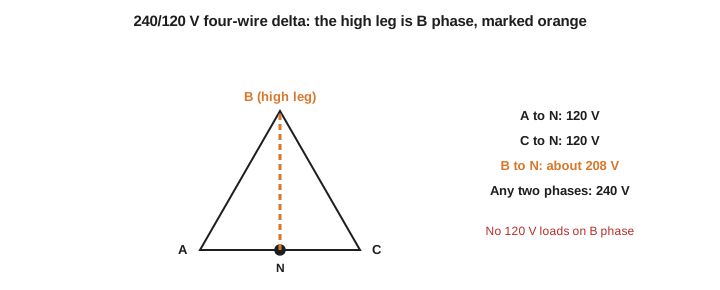
Section 408.3(E) requires the phase arrangement on three-phase buses to be A, B, C from front to back, top to bottom, or left to right, as viewed from the front of the panel. On a four-wire delta system with a high leg, the phase with the higher voltage to ground must be the B phase. Section 110.15 requires the high-leg conductor to be marked orange or otherwise identified, and 408.3(F) requires a field-applied label on the panel warning of the high leg. The high leg, about 208 volts to ground on a 240/120-volt delta system, cannot supply 120-volt loads, and an apprentice who lands a 120-volt circuit on it will destroy equipment. Exams test both the B-phase rule and the orange marking.
Worked problem
High-leg voltage
On a 240/120 V four-wire delta, find the voltage from the high leg to the neutral.
Show solution
- The high leg's voltage to ground is 120 × √3.
- 120 × 1.732 = 207.8 V.
Answer: About 208 V, which is why no 120 V loads may be connected to it.
Terminals, neutrals and grounds
Section 408.41 requires each grounded conductor (neutral) to terminate in an individual terminal that is not also used for another conductor, unless the terminal is identified for more than one conductor. Two neutrals under one screw on a neutral bar is a common violation found by inspectors. Section 408.40 requires equipment grounding conductors to terminate on a terminal bar bonded to the panelboard enclosure, not on the neutral bar, except where the panelboard is used as service equipment or for a separately derived system's first disconnect, where the neutral and grounding bars are bonded together. Gloria Haynes looks for both on every rough-in.
Series ratings and available fault current
Every panelboard and its breakers must be able to interrupt the available fault current, as 110.9 and 110.10 require. Section 110.24 requires service equipment in other than dwelling units to be marked with the maximum available fault current and the date of the calculation. When a panelboard's branch breakers have a lower interrupting rating than the available fault current, a series combination rating may be used under 240.86, where an upstream device and the downstream breakers are tested and listed together. A series-rated panel must be marked accordingly, and the series rating may not be used where motors connected between the devices contribute more fault current than a stated amount. On exams, questions about series ratings usually test the marking requirement or the motor-contribution limit.
Worked problem
Is a 10 kA breaker enough?
The transformer secondary of Delgado's 75 kVA unit can deliver an estimated 14,000 A of fault current at the panel. The panel's standard branch breakers are rated 10,000 A interrupting. What are the options?
Show solution
- 10,000 A is less than the available 14,000 A, so standard breakers alone do not comply with 110.9.
- Options: breakers with a higher interrupting rating, such as 22,000 A, or a listed series combination with the upstream device, marked on the panel.
Answer: Use higher-rated breakers or a listed series combination.
Working space and dedicated space
Panelboards and switchboards must have the working space required by 110.26: depth that depends on the voltage to ground and the conditions on the opposite side, a width of at least 30 inches or the width of the equipment, and a height of at least 6.5 feet, with clear access. Section 110.26(E) adds dedicated equipment space for switchboards and panelboards: the space equal to the width and depth of the equipment, extending from the floor to 6 feet above the equipment or to the structural ceiling, must be kept clear of piping, ducts and other foreign systems. Large equipment rated 1,200 amperes or more and over 6 feet wide needs an entrance to the working space at each end, and personnel doors within a stated distance must open outward with listed panic hardware. These rules turned the office panel location into a small negotiation with the plumber, who had planned a drain line across the wall.
| Space | Requirement (general terms) |
|---|---|
| Working space depth | 3 to 4 ft for 151 to 600 V to ground depending on conditions; 3 ft for 150 V or less |
| Working space width | 30 in or the equipment width, whichever is greater |
| Working space height | 6.5 ft or the equipment height |
| Dedicated equipment space | Equipment footprint, from the floor to 6 ft above the equipment, free of foreign systems |
def panel_ok(feeder_device, bus_rating):
    return feeder_device <= bus_rating

for dev, bus in [(200, 225), (225, 225), (250, 225), (150, 400)]:
    print(f"{dev} A device on a {bus} A panel:", "complies" if panel_ok(dev, bus) else "needs a main of not more than the bus rating")

print("High leg to neutral on a 240/120 V delta:", round(120 * 3 ** 0.5, 1), "V")

def directory_ok(text):
    vague = {"misc", "spare?", "stuff"}
    personal = any(w.endswith("'s") for w in text.split())
    return not personal and text.lower() not in vague

for label in ["Receptacles, office 102, north wall", "Priya's desk", "misc"]:
print(f"{label!r}:", "acceptable" if directory_ok(label) else "not acceptable")200 A device on a 225 A panel: complies 225 A device on a 225 A panel: complies 250 A device on a 225 A panel: needs a main of not more than the bus rating 150 A device on a 400 A panel: complies High leg to neutral on a 240/120 V delta: 207.8 V 'Receptacles, office 102, north wall': acceptable "Priya's desk": not acceptable 'misc': not acceptable
Spaces, enclosures and listing
A panelboard must be installed in a cabinet or cutout box that is listed for it, and the breakers must be the types listed for that panelboard, as the panel's label states. Installing breakers from another manufacturer that merely fit the bus is a violation of 110.3(B) unless they are classified for that panel. Gloria Haynes checks breaker brands during inspections for this reason. Unused openings in the dead front must be closed with listed filler plates under 408.7, so no one can reach live parts.
Designers usually leave spare spaces for growth. The code does not require a set number of spaces in commercial panels, but many specifications do, and the dwelling rules elsewhere in the code require space for future circuits in some cases. On Delgado's job, Ray specified a 42-space panel with 30 circuits used, leaving room for the future second shift's equipment.
Common mistakes
MistakeBelieving every panel needs its own main breaker.
InsteadA panel may be main-lug-only if an upstream device not larger than its rating protects it.
MistakeLimiting a panelboard to 42 circuits.
InsteadThe limit was removed in 2008; use the number the panel is listed for.
MistakePlacing the high leg on the A or C phase.
InsteadOn a four-wire delta, the high leg must be the B phase, marked orange.
MistakeLabeling circuits with people's names.
InsteadIdentification may not depend on transient conditions of occupancy.
Summary and key terms
- A panelboard must be protected at not more than its rating, by a device in the panel or on the supply side (408.36).
- A panelboard fed through a transformer is protected on the secondary side.
- The 42-circuit limit no longer exists; panels hold what they are listed for.
- Circuit directories must be specific and not depend on occupancy.
- The high leg of a four-wire delta is the B phase, marked orange, with a warning label.
- Interrupting ratings, series ratings, available fault current marking and 110.26 working and dedicated space all apply.
- Panelboard
- An assembly of buses and overcurrent devices in a cabinet, accessible only from the front.
- Switchboard
- A large panel or assembly of switches and protective devices, generally accessible from the rear too.
- Main-lug-only panel
- A panelboard with no main device, protected by an upstream overcurrent device.
- High leg
- The phase of a four-wire delta with a higher voltage to ground.
- Series combination rating
- A tested and listed interrupting rating for an upstream and downstream device together.
Practice problems
Work each problem on paper first, then reveal the answer to check.
Can a 400 A feeder breaker protect a 225 A panel with no main?
Show answer
No; the device must not exceed the panel's 225 A rating.
Which phase must be the high leg on a four-wire delta?
Show answer
The B phase.
Is "Plant manager's office" an acceptable circuit identification?
Show answer
No; it depends on who occupies the space. Use the room number and use.
What is the minimum width of working space in front of a 20-in-wide panel?
Show answer
30 in.
Lesson quiz · 5 questions
Score 60% or more to complete this lesson.
Create a free account to save your progress, take quizzes and earn a certificate.