
MELU-105 · Lesson 3 of 12 · 25 min
Motor short-circuit and ground-fault protection
▶ Video coming soon A video version of this lesson is on the way.
The breaker Dana chose for the compressor surprised Tyler. A 25-horsepower motor drawing 34 amperes, on conductors sized for 42.5 amperes, and Dana had written in a 90-ampere breaker. "Won't that let the wire burn?" he asked. It is the right question, and the answer is the heart of motor protection. A motor needs two different kinds of protection that the code keeps separate. The branch-circuit short-circuit and ground-fault protective device clears a fault quickly but must not trip on the motor's large starting current. The overload device, covered in Lesson 4, protects the motor and its conductors from sustained moderate overcurrent. Because the overload device protects the conductors against overload, the short-circuit device can be much larger than the conductor ampacity.
This lesson covers Part IV of Article 430: the purpose of the branch-circuit short-circuit and ground-fault protective device, Table 430.52 and its device types, how to round to standard sizes, the exception for motors that will not start, protection for several motors on one branch circuit, and feeder protection under 430.62.
Why starting current changes the rules
When an induction motor starts, it draws locked-rotor current, typically six to eight times its full-load current, for a second or more until it comes up to speed. An ordinary breaker or fuse sized close to the running current would trip every time the motor started. The code's solution is to divide the work. The overload relay in the controller, set close to the motor's running current, handles overloads with a time delay long enough to ride through a normal start. The branch-circuit device is sized well above running current and handles only short circuits and ground faults, which produce currents many times larger than starting current and must be cleared fast. Section 430.51 states the general purpose, and 430.52 sets the maximum ratings.
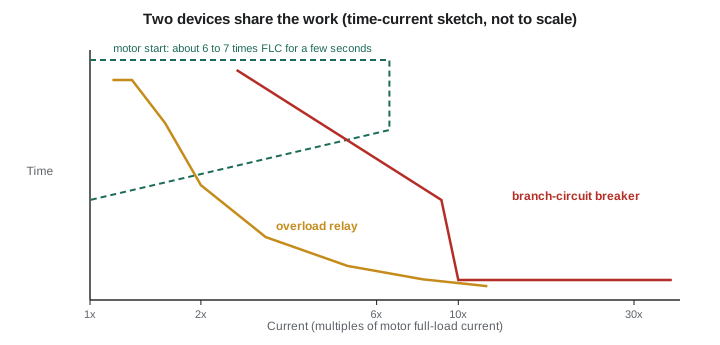
Table 430.52
Table 430.52 lists, for different motor types, the maximum rating or setting of each kind of short-circuit and ground-fault protective device as a percentage of the motor's full-load current from the table. The device types are a nontime-delay fuse, a dual-element or time-delay fuse, an instantaneous-trip breaker and an inverse-time breaker. For the common case of a single-phase or polyphase squirrel-cage motor other than a high-efficiency Design B motor, this course uses the following illustrative percentages, which are of the kind the table gives.
| Device type | Percentage of table FLC used in this course |
|---|---|
| Nontime-delay fuse | 300% |
| Dual-element (time-delay) fuse | 175% |
| Instantaneous-trip breaker | 800% |
| Inverse-time breaker | 250% |
The percentages differ because the devices respond to starting current differently. A time-delay fuse rides through inrush on its own, so it can be sized closest to running current. An inverse-time breaker, the ordinary thermal-magnetic breaker, needs more headroom. An instantaneous-trip breaker, sometimes called a motor circuit protector, has no thermal element and must be set above the inrush peak; it is permitted only as part of a listed combination controller. The table also has rows for wound-rotor, DC and synchronous motors, and for high-efficiency Design B motors, which draw a higher inrush and are allowed higher instantaneous settings.
Rounding to a standard size
The percentage seldom lands on a standard rating. Section 430.52(C)(1) handles this with an exception: where the calculated maximum does not correspond to a standard size or setting of a fuse or breaker, the next higher standard size, rating or setting is permitted. The standard sizes are listed in 240.6. This is opposite to most general-circuit rules, where you round down, and it is one of the most tested details in Article 430.
Worked problem
Breaker for the compressor
Size the inverse-time breaker for Delgado's 25 hp, 480 V compressor (34 A table current in this course's values).
Show solution
- Maximum: 2.50 × 34 = 85 A.
- 85 A is not a standard rating, so 430.52 permits the next higher standard size.
- Using the standard sizes of 240.6, the next size above 85 A is 90 A.
Answer: A 90 A inverse-time breaker.
Worked problem
Fuses for the same motor
Size dual-element time-delay fuses for the same compressor.
Show solution
- Maximum: 1.75 × 34 = 59.5 A.
- 59.5 A is not standard; the next higher standard size is 60 A.
Answer: 60 A time-delay fuses.
This is why Tyler's worry was unfounded. The 90-ampere breaker will not protect the 42.5-ampere conductors against a modest overload, but it does not have to. The overload relay in the starter, set near the motor's 32-ampere nameplate current, opens the circuit long before the conductors overheat. The breaker's job is to clear a short circuit or ground fault, where the current would be hundreds or thousands of amperes and the breaker trips almost instantly. Section 240.4(G) points to Article 430 for this reason: motor circuit conductors are protected according to the motor rules, not the general 240.4 rules.
When the motor will not start
Some motors with heavy starting loads, such as compressors that start against pressure, will trip a device sized at the table percentage. The code anticipates this in 430.52(C)(1) Exception No. 2, which permits a larger device, up to stated limits, when the value from the table is not sufficient for the starting current of the motor. In this course's illustrative values, the limit for a time-delay fuse is 225% of full-load current, and the limit for an inverse-time breaker is 400% for motors of 100 amperes or less and 300% for larger motors. A nontime-delay fuse may go up to a higher stated limit as well.
Two points matter on exams. First, the second exception is used only when the motor actually fails to start; a question that simply asks for the maximum rating wants the table percentage with next-size-up rounding, not the exception limit. Second, the exception limits are maximums that cannot be rounded up: if 400% gives 136 amperes, you must use a device of 136 amperes or less, which means 125 amperes.
Worked problem
The compressor that would not start
Suppose the 90 A breaker trips each time the compressor starts against a loaded receiver. What is the largest inverse-time breaker permitted under the exception?
Show solution
- Limit for a motor of 100 A or less: 4.00 × 34 = 136 A.
- This limit may not be rounded up.
- The largest standard size not exceeding 136 A is 125 A.
Answer: A breaker of up to 125 A, if the 90 A breaker truly will not carry the start.
Several motors on one branch circuit
Section 430.53 allows several motors on one branch circuit under specific conditions. The simplest case is small motors: motors of not more than 1 horsepower each, with full-load current of not more than 6 amperes, may share a branch circuit protected at not more than 20 amperes at 120 volts or 15 amperes at 600 volts or less, provided several other conditions are met. Larger groups are allowed when the smallest motor's overload and controller are listed for group installation and the branch-circuit device is sized so it protects the smallest motor's components. Group installations are common in packaged machinery; on exams they appear mostly as a question about the small-motor limits.
Feeder protection
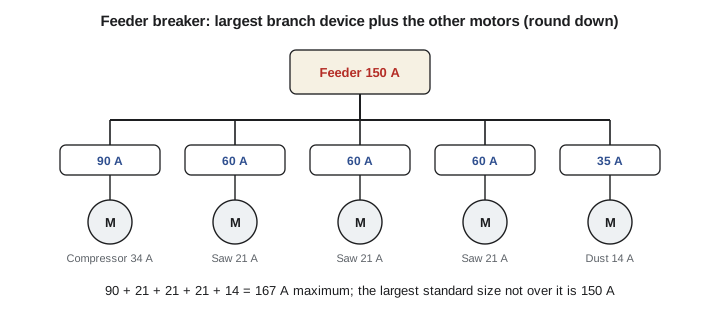
When a feeder supplies several motors, its short-circuit and ground-fault protection follows 430.62. In general terms, the feeder device may not be larger than the largest rating or setting of the branch-circuit device on any of the motors, plus the sum of the full-load currents of the other motors on the feeder. Unlike the branch circuit, the feeder rule has no next-size-up permission: the result is a maximum, so you round down to a standard size if it falls between ratings.
Worked problem
The Delgado motor feeder breaker
The feeder from Lesson 2 supplies the compressor (90 A breaker, 34 A), three saw motors (21 A each, each on a 60 A breaker) and the dust collector (14 A, on a 35 A breaker). Find the largest feeder breaker.
Show solution
- Largest branch-circuit device: the compressor's 90 A breaker.
- Other motors' table currents: 21 + 21 + 21 + 14 = 77 A.
- Maximum: 90 + 77 = 167 A.
- 167 A is not standard and the feeder rule does not permit rounding up, so the largest standard size not over 167 A is 150 A.
Answer: A feeder breaker of not more than 150 A.
Ray checked the result against the feeder conductor from Lesson 2. The conductors needed an ampacity of at least 119.5 amperes, or 133 amperes with the lighting. A 150-ampere breaker on conductors with an ampacity of, say, 130 amperes would look wrong under ordinary rules, but 430.62 and 240.4(G) permit it for motor feeders, because the motor overloads protect against overload and the feeder breaker only needs to clear faults. In practice Ray often sizes motor feeder conductors up to the breaker anyway, which leaves room for future motors.
When the feeder also supplies non-motor loads, 430.63 allows the device to be sized from the motor calculation above plus the non-motor loads. The same rule of not rounding up applies to the total.
STANDARD = [15, 20, 25, 30, 35, 40, 45, 50, 60, 70, 80, 90, 100, 110, 125,
            150, 175, 200, 225, 250, 300, 350, 400]

def next_up(x):
    return min(s for s in STANDARD if s >= x)

def round_down(x):
    return max(s for s in STANDARD if s <= x)

PCT = {"nontime-delay fuse": 3.00, "time-delay fuse": 1.75, "instantaneous breaker": 8.00, "inverse-time breaker": 2.50}
flc = 34
for device, pct in PCT.items():
    print(f"{device:22} {pct * flc:6.1f} A  ->  {next_up(pct * flc)} A" if pct < 8 else f"{device:22} {pct * flc:6.1f} A (adjustable setting)")

print("Exception limit for an inverse-time breaker:", 4 * flc, "A ->", round_down(4 * flc), "A")
print("Feeder breaker:", 90 + 21 * 3 + 14, "A ->", round_down(90 + 21 * 3 + 14), "A")nontime-delay fuse 102.0 A -> 110 A time-delay fuse 59.5 A -> 60 A instantaneous breaker 272.0 A (adjustable setting) inverse-time breaker 85.0 A -> 90 A Exception limit for an inverse-time breaker: 136 A -> 125 A Feeder breaker: 167 A -> 150 A
Exam strategy
Three questions sort out almost every motor protection problem. Is this a branch circuit or a feeder? For a branch circuit, use the Table 430.52 percentage for the stated device and round up to the next standard size; for a feeder, add the largest branch device to the other motors' currents and round down. Does the question say the motor will not start? Only then use the exception limits, and never round them up. Which current goes in? Always the table full-load current, never the nameplate. Keep the standard sizes from 240.6 tabbed, because nearly every answer depends on them.
Combination controllers and motor circuit protectors
Many modern motor circuits use a combination starter, a single listed assembly with a disconnect, short-circuit protection and a controller with overloads in one enclosure. When the short-circuit device is an instantaneous-trip breaker, often called a motor circuit protector, the code allows it only as part of a listed combination controller, because its setting must be coordinated with the overload relay and the contactor that the manufacturer tested with it. The instantaneous setting is adjustable, and Table 430.52 sets the maximum percentage. In practice the installer sets the dial just above the motor's inrush so it does not trip on start, following the manufacturer's selection table, and never above the table limit except under the specific exceptions for high-efficiency motors.
Self-protected combination controllers, sometimes called Type E or Type F starters, go a step further: one listed device provides short-circuit protection, overload protection, control and disconnecting means. On exams, the most common question about these devices asks whether an instantaneous-trip breaker may be used alone as branch-circuit protection. The answer is no; it must be part of a listed combination controller.
Common mistakes
MistakeSizing a motor branch breaker at 125% of the motor current, like the conductor.
InsteadUse the Table 430.52 percentage for the device type, usually much higher.
MistakeRounding a feeder device up to the next standard size.
InsteadFeeder protection under 430.62 is a maximum; round down.
MistakeUsing the 400% exception limit when the question simply asks for the maximum rating.
InsteadUse the table percentage with next-size-up rounding unless the motor will not start.
MistakeRounding up an exception limit.
InsteadException limits are maximums and cannot be exceeded.
Summary and key terms
- Branch-circuit short-circuit and ground-fault devices clear faults; overload devices protect against overload.
- Table 430.52 sets maximum device ratings as a percentage of table full-load current, by device type and motor type.
- Where the result is not a standard size, the next higher standard size is permitted.
- If the motor will not start, higher exception limits apply, and they may not be exceeded.
- Feeder protection: largest branch device plus the other motors' currents, rounded down (430.62).
- Motor conductors may be protected by devices larger than their ampacity because overloads protect them (240.4(G)).
- Branch-circuit short-circuit and ground-fault protective device
- The fuse or breaker that clears faults on a motor branch circuit.
- Inverse-time breaker
- A thermal-magnetic breaker whose trip time decreases as current increases.
- Instantaneous-trip breaker
- A breaker with only a magnetic trip, used as part of a listed combination controller.
- Dual-element fuse
- A time-delay fuse that can ride through motor inrush.
- Locked-rotor current
- The current a motor draws at standstill when first energized.
Practice problems
Work each problem on paper first, then reveal the answer to check.
Find the maximum inverse-time breaker for a motor with a 14 A table current, using 250%.
Show answer
2.50 × 14 = 35 A, a standard size, so 35 A.
Find the time-delay fuse for a motor with a 21 A table current, using 175%.
Show answer
1.75 × 21 = 36.75 A; next higher standard size 40 A.
A feeder serves motors with a largest branch breaker of 60 A and others of 21 and 14 A. Find the maximum feeder breaker.
Show answer
60 + 21 + 14 = 95 A; round down to 90 A.
Why may a 90 A breaker protect conductors sized for 42.5 A on a motor circuit?
Show answer
The overload relay protects the conductors from overload; the breaker only needs to clear faults (240.4(G)).
Lesson quiz · 5 questions
Score 60% or more to complete this lesson.
Create a free account to save your progress, take quizzes and earn a certificate.