
MELU-105 · Lesson 8 of 12 · 27 min
Generators under Article 445
▶ Video coming soon A video version of this lesson is on the way.
Two weeks after the transformer was energized, a summer storm knocked out power to the Harlow industrial park for nine hours. Delgado Fabrication lost a day's production, and Hector called Ray the next morning asking for a standby generator. Ray gave the job to Dana, with Priya Natarajan pricing the equipment. A generator job crosses several articles: Article 445 for the generator itself, Article 702 for an optional standby system, Article 700 or 701 if the system is required by law, Article 702 and 250.30 or 250.35 for grounding, and the transfer equipment rules. Exams focus on a handful of calculations and decisions within that group.
This lesson covers generator ratings and currents, conductor sizing from the generator terminals under 445.13, generator overcurrent protection and disconnects, the three classes of standby system and how to tell them apart, transfer equipment, how optional standby systems are sized under 702.4, and grounding of the generator system.
Generator ratings
A generator nameplate lists kilowatts, kilovolt-amperes, power factor, voltage, phase and current. Generators are usually rated at a power factor of 0.8, so a 100-kilowatt generator is a 125-kVA machine. The current on the nameplate is the full-load current at rated kVA. When the nameplate is missing from a question, you can calculate the current from the kilowatt rating if you know the power factor, or from the kVA rating directly.
Worked problem
Current for Delgado's generator
Ray's proposal is a 100 kW, 125 kVA, 480Y/277 V three-phase generator rated at 0.8 power factor. Find its rated current.
Show solution
- From kVA: 125,000 ÷ (1.732 × 480) = 150.4 A.
- From kW: 100,000 ÷ (1.732 × 480 × 0.8) = 150.4 A, the same answer.
Answer: About 150.4 A.
Exam questions sometimes give only the kilowatt rating at unity power factor, especially for small generators, and expect you to divide by the voltage and the square root of 3 without a power factor. If the question states a power factor, use it; if it gives kVA, use the kVA.
Conductors from the generator terminals
Section 445.13 sets the minimum ampacity of the phase conductors from the generator terminals to the first overcurrent device. In general terms, they must have an ampacity of not less than 115% of the nameplate current rating of the generator. The reason is that generators can deliver modestly more than rated current for a time, and the conductors from the terminals are not protected by a device ahead of them. Neutral conductors may be sized for the maximum unbalanced load under 220.61, and the section includes an exception for generator designs that prevent overloading, where 100% is permitted.
Worked problem
Generator output conductors
Find the minimum ampacity of the phase conductors from the generator terminals to the first overcurrent device.
Show solution
- Unrounded rated current: 150.35 A.
- Minimum: 1.15 × 150.35 = 172.9 A.
- Select conductors with at least 172.9 A of ampacity at the terminal temperature rating.
Answer: At least about 172.9 A.
Generator protection and the disconnect
Section 445.12 requires generators to be protected from overload by inherent design, circuit breakers, fuses, protective relays or other acceptable means. Most packaged generators come with a main output breaker mounted on the unit, sized by the manufacturer, which serves as the first overcurrent device and often as the disconnect. Section 445.18 requires a disconnect for generators, lockable in the open position, by which the generator and its protective devices can be disconnected from the circuits supplied, with stated exceptions. Since the 2020 edition, an emergency shutdown device has also been required for certain one- and two-family dwelling generators, located outside the dwelling; exams on commercial work focus on the disconnect itself.
Three kinds of standby system
Chapter 7 separates standby power into three articles according to who requires it and what it serves. Exam questions often describe a load and ask which article applies, so the distinctions matter.
| Article | System | Who requires it | Typical loads | Transfer time |
|---|---|---|---|---|
| 700 | Emergency systems | Required by a governmental code for life safety | Egress lighting, exit signs, fire alarm, fire pumps in some cases | Within 10 seconds |
| 701 | Legally required standby | Required by a governmental code, not mainly for life safety | Sewage pumping, smoke control, some communications | Within 60 seconds |
| 702 | Optional standby | Chosen by the owner | Production equipment, refrigeration, data, comfort | No time requirement |
Delgado's generator is optional standby: no code requires it, and its purpose is to keep production running. That puts it under Article 702, which has the lightest requirements. The building's existing emergency lighting is battery-powered unit equipment under Article 700 and is not part of this project.
Emergency systems have the strictest rules: wiring kept entirely independent of other wiring except at transfer equipment and a few other points, selective coordination of overcurrent devices, testing and maintenance records, and specific signage. Legally required standby systems fall between. Optional standby systems mainly require proper transfer equipment, capacity, signage and grounding.
Transfer equipment
A transfer switch moves the load from the utility to the generator and back. It must be listed for the purpose and must prevent the two sources from being connected together, which would backfeed the utility lines and endanger line workers. Sections 702.5 and 700.5 require transfer equipment suitable for the use, and automatic transfer switches for emergency systems must be listed for emergency use. Transfer switches can be open-transition, breaking one source before making the other, or closed-transition, briefly paralleling the sources under utility-approved conditions.
For an optional standby system, the transfer can be manual or automatic, and that choice changes how the generator must be sized.
Sizing an optional standby generator: 702.4
Section 702.4 requires the optional standby system to have adequate capacity for the load, and it distinguishes two cases. With manual transfer, the generator must have enough capacity for all equipment intended to be operated at one time, and the user chooses which loads to run. With automatic transfer, the generator must be sized for the full load that will be transferred, calculated under Article 220 or another approved method, unless an energy management system automatically limits the load to the generator's capacity. That rule is why homes with automatic standby generators often have load shedding modules on air conditioners and electric ranges.
Worked problem
Can 100 kW carry Delgado's shop?
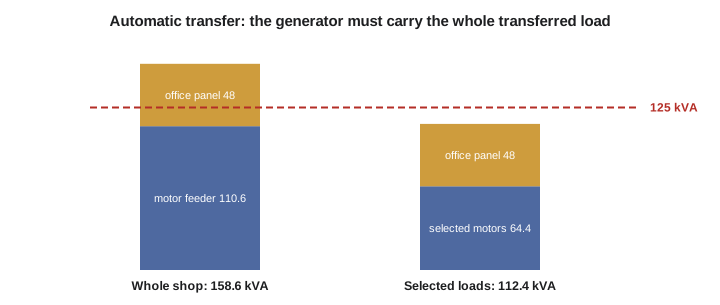
The automatic transfer switch will transfer the motor feeder (calculated at 133 A at 480 V from Lesson 2) and the 208Y/120 V transformer, whose panel load calculates at 48 kVA. Is the 125 kVA generator adequate without load management?
Show solution
- Motor feeder load: 1.732 × 480 × 133 = 110.6 kVA.
- Transformer panel load: 48 kVA.
- Total: 110.6 + 48 = 158.6 kVA, more than the 125 kVA generator.
Answer: No. With automatic transfer the generator must carry the full transferred load, so Delgado needs a larger generator, load shedding, or a smaller set of transferred loads.
Ray and Hector chose to transfer only the compressor, the dust collector, one saw and the office panel. The motor portion calculates at 1.25 × 34 + 21 + 14 = 77.5 amperes, or 1.732 × 480 × 77.5 = 64.4 kVA, and with the 48 kVA office panel the total is 112.4 kVA, under the generator's 125 kVA rating. Dana documented the choice in a load calculation for the permit, which is what Gloria Haynes will review.
Motor starting on a generator
Motors draw locked-rotor current when they start, and a generator is a much weaker source than the utility. A large motor starting on a generator can cause a voltage dip deep enough to drop out contactors or stall other motors. Generator sizing for motor loads therefore considers starting kVA, found from the motor's code letter in Table 430.7(B), not just running kVA. The code itself does not specify a starting calculation, but manufacturers' sizing software does, and exam questions occasionally ask you to estimate starting kVA from a code letter and horsepower.
Worked problem
Starting kVA from a code letter
The 25 hp compressor has code letter G. Using an illustrative value of 6.0 kVA per horsepower for that letter, estimate its starting kVA.
Show solution
- Starting kVA: 6.0 × 25 = 150 kVA.
- That exceeds the generator's 125 kVA rating for the moment of starting, so a soft starter or drive, or a larger generator, would be considered.
Answer: About 150 kVA at start, which is why the compressor got a drive.
Grounding the generator system
How a generator is grounded depends on whether it is a separately derived system. If the transfer switch switches the neutral, the generator's neutral is not solidly connected to the utility neutral, and the generator is a separately derived system that must be grounded under 250.30 with its own system bonding jumper at the generator. If the transfer switch does not switch the neutral, the generator's neutral is solidly connected to the service neutral, the generator is not separately derived, and its neutral must not be bonded to ground at the generator, because that would create a parallel path for neutral current. Section 250.35 covers the bonding of the generator in each case. On exams, the deciding question is whether the neutral is switched.
| Transfer switch | Generator system | Neutral-to-ground bond at the generator |
|---|---|---|
| Switches the neutral (four-pole on a three-phase four-wire system) | Separately derived | Yes, under 250.30 |
| Solid neutral (three-pole) | Not separately derived | No; the service bond serves |
import math
kva, volts = 125, 480
i = kva * 1000 / (math.sqrt(3) * volts)
print("Generator rated current:", round(i, 1), "A")
print("Output conductors (115%):", round(1.15 * i, 1), "A")

motor_kva = math.sqrt(3) * 480 * 133 / 1000
total = motor_kva + 48
print("Transferred load:", round(motor_kva, 1), "+ 48 =", round(total, 1), "kVA versus", kva, "kVA")
print("Compressor starting kVA at 6.0 kVA/hp:", 6.0 * 25)Generator rated current: 150.4 A Output conductors (115%): 172.9 A Transferred load: 110.6 + 48 = 158.6 kVA versus 125 kVA Compressor starting kVA at 6.0 kVA/hp: 150.0
Portable generators and interlocks
Small businesses and homes often use portable generators connected through a power inlet and a manual transfer switch, or through an interlock kit on the main panel that mechanically prevents the main breaker and the generator breaker from being on at the same time. A listed interlock is a form of transfer equipment, and it is acceptable when it is listed for the specific panel. A homemade double-male cord plugged into a receptacle, by contrast, is never acceptable: it energizes exposed prongs and can backfeed the utility. Section 702.12 covers outdoor generator sets and power inlets, including the requirement for a disconnect in sight of a permanently installed outdoor generator, which can be the generator's own breaker when it qualifies.
Worked problem
A portable generator for the Route 9 shop
Hector wants a 7,500 W, 120/240 V portable generator at the Route 9 shop to run the lathe's converter, lights and a few receptacles during outages. What equipment is needed?
Show solution
- A listed transfer means: a manual transfer switch or a listed interlock kit for the shop panel.
- A power inlet rated for the generator's cord connection, with the disconnect and grounding rules applied.
- Rated current: 7,500 ÷ 240 = 31.3 A, so the inlet and cord must suit a 30 A or larger connection.
Answer: A listed transfer switch or interlock, a power inlet, and wiring sized for about 31.3 A.
The generator's neutral handling matters here too. Most portable generators have the neutral bonded to the frame, which is correct when the generator is used alone with cords, but when it is connected through a transfer switch that does not switch the neutral, the bond must be removed or a switched-neutral transfer switch used, following the generator manufacturer's instructions.
Common mistakes
MistakeSizing generator output conductors at 125% like a continuous load.
InsteadSection 445.13 sizes them at 115% of the generator nameplate current.
MistakeSizing an automatic optional standby generator for only the loads the owner expects to run.
InsteadWith automatic transfer, size for the full transferred load unless an energy management system limits it.
MistakeBonding the neutral at the generator when the transfer switch does not switch the neutral.
InsteadA solid-neutral system is not separately derived; bond only at the service.
MistakeCalling a generator for production equipment an emergency system.
InsteadOwner-chosen standby for production is optional standby under Article 702.
Summary and key terms
- Generator current comes from kVA, or from kW and power factor.
- Conductors from the generator terminals to the first overcurrent device need at least 115% of nameplate current (445.13).
- Article 700 emergency, 701 legally required and 702 optional standby systems differ in who requires them and how strict the rules are.
- Optional standby with automatic transfer must carry the full transferred load, unless load management limits it.
- Motor starting kVA matters when sizing a generator for motor loads.
- A generator is separately derived when the transfer switch switches the neutral.
- Optional standby system
- A standby system the owner chooses to install, under Article 702.
- Emergency system
- A standby system required by a governmental code for life safety, under Article 700.
- Transfer equipment
- Equipment that moves the load between the normal and standby sources without paralleling them improperly.
- Separately derived system
- A system with no direct connection to the supply conductors of another system, including the neutral.
- Starting kVA
- The kilovolt-amperes a motor draws at locked rotor.
Practice problems
Work each problem on paper first, then reveal the answer to check.
Find the rated current of a 60 kVA, 208Y/120 V generator.
Show answer
60,000 ÷ (1.732 × 208) = 166.5 A.
Find the minimum ampacity of its output conductors.
Show answer
1.15 × 166.5 = 191.5 A.
Which article covers a generator required by code for exit lighting?
Show answer
Article 700, emergency systems.
A three-pole transfer switch with a solid neutral is used. Is the generator separately derived?
Show answer
No; its neutral is solidly connected to the service neutral.
Lesson quiz · 5 questions
Score 60% or more to complete this lesson.
Create a free account to save your progress, take quizzes and earn a certificate.