
MELU-105 · Lesson 1 of 12 · 24 min
Motor full-load current tables
▶ Video coming soon A video version of this lesson is on the way.
Delgado Fabrication's service upgrade was finished, and Hector Delgado was already planning the next step: a new air compressor, a second CNC mill and a rebuilt saw line. Ray Ochoa handed the motor list to Dana Whitfield with a warning that sounded almost like a riddle. "The motor nameplates are the last thing you look at," he said, "and the first thing the inspector checks." Dana knew what he meant only partly. Most of Article 430 runs on a number that is not printed on the motor at all: the full-load current from the tables at the back of the article. The nameplate current matters too, but for a different job. Getting that split right is the foundation for every other motor calculation, and it is one of the most tested ideas on master electrician exams.
This lesson explains why Article 430 uses table currents, which table applies to which motor, how to read them, the exceptions where the nameplate governs, and how exam questions try to trip you up. Later lessons use the table current to size conductors, short-circuit protection, disconnects and feeders, and use the nameplate current to size overloads.
Why the code does not trust the nameplate
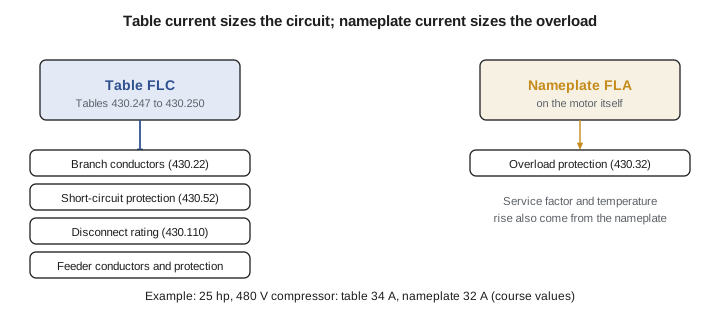
A motor nameplate reports the current that particular motor drew at rated load when it was tested. Two 15-horsepower motors from different manufacturers can carry different nameplate currents, and a motor that wears out may be replaced by one with a higher current. If conductors and short-circuit protection were sized to the nameplate, a routine replacement could leave an installation undersized. The code avoids that problem by assigning a standard current to each horsepower and voltage. Section 430.6(A)(1) directs you to use the table values, not the nameplate, when you determine the ampacity of conductors, the ampere ratings of switches, and the ratings of branch-circuit short-circuit and ground-fault protection. The tables are deliberately on the high side of real motors, so a circuit sized from them will carry almost any replacement motor of that size.
The same section then makes a separate rule for overload protection. Overloads protect the motor itself from overheating, so they must be matched to the motor actually installed. Section 430.6(A)(2) says separate motor overload protection is based on the nameplate full-load current rating. The words matter on exams: the tables give full-load current, or FLC, and the nameplate gives full-load amperes, often abbreviated FLA. Many study guides use FLC for the table number and FLA for the nameplate number, and this course does the same.
| Purpose | Value used | Where the rule is |
|---|---|---|
| Branch circuit conductor ampacity | Table FLC | 430.6(A)(1), 430.22 |
| Short-circuit and ground-fault protection | Table FLC | 430.6(A)(1), 430.52 |
| Disconnecting means rating | Table FLC | 430.6(A)(1), 430.110 |
| Feeder conductors and feeder protection | Table FLC | 430.24, 430.62 |
| Overload protection | Nameplate FLA | 430.6(A)(2), 430.32 |
The four tables
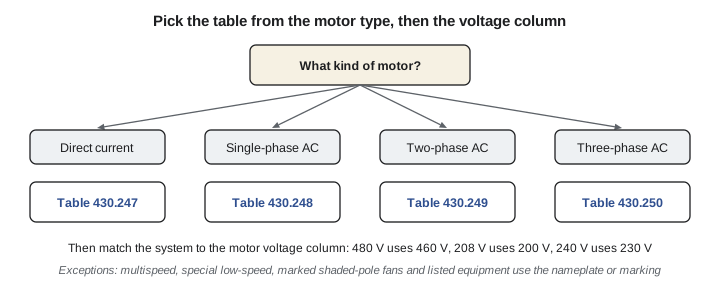
Article 430 Part XIV holds the full-load current tables. They are organized by the type of motor, and the first exam skill is picking the right one before you look up a number.
- Table 430.247 covers direct-current motors, listed by horsepower and armature voltage.
- Table 430.248 covers single-phase alternating-current motors, listed by horsepower at several voltages such as 115 and 230 volts.
- Table 430.249 covers two-phase motors, which are rare today and almost never appear on exams except as a distractor.
- Table 430.250 covers three-phase induction motors, both squirrel-cage and wound-rotor, listed by horsepower at voltages from about 115 up through 2,300 volts. It also has columns for synchronous motors run at unity power factor.
Each table has notes at the bottom. They tell you how to adjust for voltages between the listed columns, how to handle motors built for low speeds or high torques, and how the synchronous motor columns relate to power factor. Exam questions often hinge on a note, so read them at least once while you study and tab the page.
Choosing the voltage column
The tables list motor voltages, not system voltages, and the two are deliberately different. A motor built for a 480-volt system is rated 460 volts, because the motor sits at the end of a feeder and branch circuit and sees less than the nominal system voltage. Likewise a motor for a 240-volt single-phase system is rated 230 volts, a motor for a 208-volt system is rated 200 volts, and a motor for a 120-volt system is rated 115 volts. The notes to the tables tell you that the listed currents apply to the system voltages in a range around each motor voltage. For an exam, the rule of thumb is simple: find the motor voltage column that matches the system. A 480-volt system uses the 460-volt column; a 208-volt system uses the 200-volt column, and some tables list 208 volts separately.
This is the most common way exam questions trap candidates. The question says the motor is on a 480-volt system, and the candidate looks for a 480-volt column that does not exist, or uses a power formula with 480 volts instead of reading the table. The table is always the answer for a standard induction motor; never calculate full-load current from horsepower with a formula when the question is about Article 430 sizing.
| Nominal system | Motor voltage column to use |
|---|---|
| 120 V single-phase | 115 V |
| 240 V single-phase | 230 V |
| 208 V three-phase | 200 V (or 208 V where listed) |
| 240 V three-phase | 230 V |
| 480 V three-phase | 460 V |
| 600 V three-phase | 575 V |
Reading a value
Once you have the right table and column, reading the value is a matter of finding the horsepower row. The motors on Delgado's list give a good set of examples. This course uses the following illustrative full-load currents throughout, chosen to resemble the published values so the arithmetic in every lesson stays consistent. When you work real problems, read your own table.
| Motor | System | Illustrative FLC used in this course |
|---|---|---|
| Compressor, 25 hp, three-phase | 480 V | 34 A |
| Saw line, 15 hp each (three motors), three-phase | 480 V | 21 A each |
| Dust collector, 10 hp, three-phase | 480 V | 14 A |
| Exhaust fan, 5 hp, three-phase | 480 V | 7.6 A |
| Shop air handler, 10 hp, three-phase | 208 V | 30.8 A |
| Sump pump, 1 hp, single-phase | 230 V | 8 A |
| Hoist, 3 hp, single-phase | 230 V | 17 A |
Look at how much larger the current is for the same horsepower at a lower voltage. The 10-horsepower air handler at 208 volts carries more than twice the current of the 10-horsepower dust collector at 480 volts. That is why industrial plants distribute at 480 volts, and why the voltage column matters so much: picking the wrong column can change an answer by a factor of two.
Worked problem
Reading the right column
Hector's new 10 hp three-phase compressor will run on the shop's 208Y/120 V panel instead of the 480 V system. Using this course's illustrative values, what full-load current do you use for the branch circuit?
Show solution
- The motor is a three-phase induction motor, so use Table 430.250.
- The system is 208 V, so use the 200 V or 208 V column, not a column near 240 V.
- Read the 10 hp row: 30.8 A in this course's values.
Answer: 30.8 A, about 2.2 times the 14 A it would draw on the 480 V system.
When the nameplate governs instead
Section 430.6(A)(1) lists several exceptions where the table does not apply, and exam writers like them because they reverse the usual answer. The main ones, in general terms, are these.
- Multispeed motors. The tables assume a single speed, so for multispeed motors the conductors and protection are based on the highest current at any speed, taken from the nameplate, with specific rules in 430.22(B) and 430.52.
- Low-speed, high-torque and other special motors. Motors built for unusually low speeds or high torques draw more current than the tables show, so the nameplate current is used.
- Shaded-pole and permanent split-capacitor fan or blower motors. When these motors are marked with current, the marked current is used instead of the table for sizing the circuit.
- Torque motors, which are designed to stall. Their rated locked-rotor current from the nameplate is used.
- Motors in listed equipment. When a motor is part of listed equipment that is marked with its own ratings, such as an air conditioner under Article 440 or a machine under Article 670, the equipment marking governs. Lessons 6 and 11 cover those.
There is also a rule for motors rated in amperes rather than horsepower. When a motor is marked only in amperes, the marked current is used as the full-load current, and the horsepower is found from the table that corresponds to that current where a horsepower is needed, for example to choose a horsepower-rated disconnect.
Other information on the nameplate
Although the nameplate current is used only for overloads, the rest of the nameplate is essential, and Section 430.7 lists what must be on it. On exams you are expected to know what the main markings mean and where they are used.
- Service factor. A number such as 1.15 means the motor can carry 15% more than its rated load continuously without damage. Overload sizing in Lesson 4 depends on it.
- Temperature rise or insulation class. A motor marked with a temperature rise of 40 °C or less is treated like a motor with a high service factor when overloads are sized.
- Code letter. A letter from A to V indicates the locked-rotor kilovolt-amperes per horsepower, which tells you how hard the motor hits the system when it starts. Table 430.7(B) relates the letters to ranges. Locked-rotor current is used for sizing some disconnects and for checking voltage dip, not for the ordinary branch circuit calculation.
- Design letter. NEMA design letters such as B, C and D describe the speed-torque curve. Some short-circuit protection rules treat high-efficiency Design B motors differently.
- Duty. Most motors are continuous duty. Short-time or intermittent duty motors are sized with special factors in 430.22(E).
Ray's point about the inspector was practical. Gloria Haynes, Harlow's chief electrical inspector, checks overload heater or setting selections against the nameplate during a rough-in or final inspection, and she checks conductors and breakers against the table. A contractor who sizes everything from the nameplate will usually pass the overload check and fail the conductor check, and one who sizes everything from the table will set overloads too high and leave the motor unprotected.
Horsepower from current, and current from horsepower
Exam questions sometimes ask for a horsepower, for instance to select a horsepower-rated switch for a motor known only by its current. Read the table backwards: find the current in the right voltage column and take the horsepower of that row, moving to the next larger row when the current falls between rows. Another type of question asks you to compare the table current with a calculated current to show why the table is used. A calculation from horsepower needs efficiency and power factor, which vary by motor, and it always comes out below the table, which is one more reason the code uses the table.
Worked problem
Why not calculate the current?
A 15 hp motor runs at 460 V with an efficiency of 0.90 and a power factor of 0.88. Calculate its current and compare it with this course's illustrative table value of 21 A.
Show solution
- Output power: 15 × 746 = 11,190 W.
- Input apparent power: 11,190 ÷ (0.90 × 0.88) = 14,129 VA.
- Current: 14,129 ÷ (1.732 × 460) = 17.7 A.
Answer: About 17.7 A, well under the table's 21 A. The table builds in a margin for less efficient replacement motors, so it, not the formula, sizes the circuit.
# Illustrative motor currents used in this course (not NEC values; read your own table)
FLC = {("3ph", 460): {5: 7.6, 10: 14, 15: 21, 25: 34},
       ("3ph", 200): {10: 30.8},
       ("1ph", 230): {1: 8, 3: 17}}

def column(phase, system_volts):
    motor = {120: 115, 240: 230, 208: 200, 480: 460, 600: 575}[system_volts]
    return (phase, motor)

for name, phase, volts, hp in [("compressor", "3ph", 480, 25), ("saw motor", "3ph", 480, 15),
                               ("air handler", "3ph", 208, 10), ("hoist", "1ph", 240, 3)]:
    key = column(phase, volts)
    print(f"{name:12} {hp:>3} hp on {volts} V uses the {key[1]} V column: {FLC[key][hp]} A")

calc = 15 * 746 / (0.90 * 0.88) / (3 ** 0.5 * 460)
print("15 hp calculated from the formula:", round(calc, 1), "A versus 21 A from the table")compressor 25 hp on 480 V uses the 460 V column: 34 A saw motor 15 hp on 480 V uses the 460 V column: 21 A air handler 10 hp on 208 V uses the 200 V column: 30.8 A hoist 3 hp on 240 V uses the 230 V column: 17 A 15 hp calculated from the formula: 17.7 A versus 21 A from the table
How exam questions test this
Questions on motor currents fall into a few patterns, and recognizing them saves time on a timed exam.
- Table or nameplate. The question gives both a horsepower and a nameplate current and asks you to size a conductor, a breaker or overloads. Conductors and breakers use the table; overloads use the nameplate.
- Wrong voltage. The question names the system voltage, and you must pick the motor voltage column.
- Single-phase or three-phase. The table for a single-phase motor gives a very different value from the three-phase table at the same horsepower.
- An exception. The motor is multispeed, a shaded-pole fan with a marked current, or part of listed equipment, so the nameplate or equipment marking governs.
- Many motors. Several motors share a feeder, and you need each table current before you can apply 430.24 and 430.62 in Lessons 2 and 3.
Marcus Lee, Dana's study partner, kept a single card in his code book's tab for the motor tables: a list of the system voltages and their motor columns, and the words "table for wire and breakers, nameplate for heaters". It took ten seconds to read and prevented the most expensive mistakes.
Dana's motor schedule
Before the next site meeting Dana built a motor schedule for Delgado's new equipment, the standard tool for keeping motor calculations organized. Each row lists the load, horsepower, phase and voltage, the table full-load current, the nameplate full-load amperes when known, and columns for the results that later lessons fill in: conductor ampacity, short-circuit protection, overload setting and disconnect. A schedule like this is also how exam problems with several motors are best worked: one row at a time, with the table current entered first.
| Load | hp | Volts / phase | Table FLC (illustrative) | Nameplate FLA |
|---|---|---|---|---|
| Compressor | 25 | 480 / 3 | 34 A | 32 A, SF 1.15 |
| Saw motor 1, 2, 3 | 15 each | 480 / 3 | 21 A each | 19.5 A each, SF 1.0 |
| Dust collector | 10 | 480 / 3 | 14 A | 13.2 A, SF 1.15 |
| Exhaust fan | 5 | 480 / 3 | 7.6 A | 7.1 A, SF 1.15 |
Common mistakes
MistakeUsing a motor's nameplate current to size its branch circuit conductors and breaker.
InsteadUse the table full-load current for conductors, short-circuit protection and disconnects, and the nameplate current only for overloads.
MistakeLooking for a 480 V column in the three-phase table.
InsteadUse the 460 V motor column for a 480 V system, 200 V for 208 V, and 230 V for 240 V.
MistakeCalculating full-load current from horsepower with a power formula.
InsteadRead the table; the formula gives a smaller current that the code does not use.
MistakeApplying the table to a shaded-pole fan marked with its current, or to an air conditioner.
InsteadFor those, the marked current or the equipment ratings govern.
Summary and key terms
- Section 430.6(A)(1) requires the table full-load current for conductors, switches and short-circuit and ground-fault protection.
- Section 430.6(A)(2) requires the nameplate current for separate overload protection.
- Tables 430.247, 430.248, 430.249 and 430.250 cover DC, single-phase, two-phase and three-phase motors.
- Use the motor voltage column that matches the system: 460 V for 480 V, 200 V for 208 V, 230 V for 240 V.
- Multispeed, special low-speed, marked shaded-pole and listed-equipment motors are exceptions where the nameplate or marking governs.
- A motor schedule with table currents first is the reliable way to work multi-motor problems.
- Full-load current (FLC)
- The table value of motor current used to size circuits under Article 430.
- Full-load amperes (FLA)
- The current marked on the motor nameplate, used for overload sizing.
- Service factor
- A nameplate multiplier showing the continuous overload the motor can carry.
- Code letter
- A nameplate letter indicating locked-rotor kVA per horsepower.
- Motor voltage
- The voltage a motor is rated for, slightly below the nominal system voltage.
Practice problems
Work each problem on paper first, then reveal the answer to check.
A 25 hp three-phase motor on a 480 V system has a nameplate current of 32 A. Which current sizes its conductors in this course's values?
Show answer
The table value, 34 A in this course's illustrative values, not the 32 A nameplate.
Which voltage column do you use for a three-phase motor on a 208 V system?
Show answer
The 200 V column, or a 208 V column where the table lists one.
Which current sizes the overloads for the same 25 hp motor?
Show answer
The nameplate current, 32 A.
A motor is marked 6.5 A with no horsepower. What current do you use for the circuit?
Show answer
The marked 6.5 A; horsepower, where needed, comes from the table row matching that current.
Lesson quiz · 5 questions
Score 60% or more to complete this lesson.
Create a free account to save your progress, take quizzes and earn a certificate.