
MELU-105 · Lesson 7 of 12 · 28 min
Transformers under Article 450
▶ Video coming soon A video version of this lesson is on the way.
Delgado Fabrication's 480-volt service had one gap: the office, the break room and the shop's convenience receptacles all needed 120 volts. Ray's plan was a 75 kVA dry-type transformer, 480 volts delta to 208Y/120 volts, mounted on the shop wall and feeding a new 208Y/120-volt panel. Dana's job was to size the overcurrent protection and the conductors on both sides. Transformer questions are among the most feared on master exams because they combine three-phase arithmetic, a table of percentages, rules for rounding that change depending on the side of the transformer, and the feeder tap rules of 240.21. Taken one step at a time, they are manageable.
This lesson covers transformer currents, Article 450 overcurrent protection for transformers of 1,000 volts or less, the difference between primary-only and primary-and-secondary protection, the secondary conductor rules of 240.21(C), the special case of 240.4(F), grounding of the separately derived system, and installation rules for ventilation, accessibility and working space.
Transformer currents
Every transformer problem starts with the rated current on each side, found from the kVA rating and the voltage. For a three-phase transformer, divide the volt-amperes by the line-to-line voltage times the square root of 3; for a single-phase transformer, divide by the voltage alone.
Worked problem
Currents for Delgado's transformer
Find the rated primary and secondary currents of a 75 kVA, three-phase transformer, 480 V primary, 208Y/120 V secondary.
Show solution
- Primary: 75,000 ÷ (1.732 × 480) = 90.2 A.
- Secondary: 75,000 ÷ (1.732 × 208) = 208.2 A.
- The ratio of currents equals the inverse of the voltage ratio: 480 ÷ 208 = 2.31.
Answer: About 90.2 A on the primary and 208.2 A on the secondary.
Protecting the transformer: Table 450.3(B)
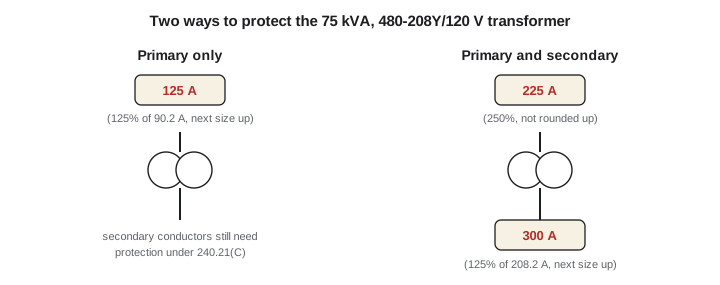
Section 450.3 requires overcurrent protection for transformers, and Table 450.3(B) gives the maximum ratings for transformers rated 1,000 volts or less as a percentage of rated current. The table offers two methods. With primary-only protection, the primary device protects the transformer by itself. With primary and secondary protection, a larger primary device is allowed because a secondary device also protects the transformer. In this course's illustrative values for currents of 9 amperes or more, the percentages are these.
| Method | Primary device (max) | Secondary device (max) |
|---|---|---|
| Primary only | 125% of rated primary current | Not required for the transformer (conductors still need protection) |
| Primary and secondary | 250% of rated primary current | 125% of rated secondary current |
The table's notes add the rounding rule that makes these problems tricky. Where 125% of the current does not correspond to a standard rating, the next higher standard rating is permitted. The 250% primary value in the second method is a maximum that may not be rounded up. Smaller transformers, with currents under 9 amperes or under 2 amperes, have higher percentages in the table, and exams sometimes test them with control-size transformers.
Worked problem
Primary-only protection
Size primary-only protection for Delgado's transformer.
Show solution
- Maximum: 1.25 × 90.2 = 112.8 A.
- Not a standard size, and the 125% rule permits the next higher standard rating.
- Next standard size above 112.8 A: 125 A.
Answer: A 125 A primary device.
Worked problem
Primary and secondary protection
Size the protection using the primary-and-secondary method.
Show solution
- Primary maximum: 2.50 × 90.2 = 225.5 A, a maximum that may not be rounded up, so the largest standard device is 225 A.
- Secondary: 1.25 × 208.2 = 260.2 A; the next higher standard rating, 300 A, is permitted.
- The secondary device must still protect the secondary conductors, so those conductors must be sized to suit it.
Answer: Up to 225 A on the primary and up to 300 A on the secondary.
Why choose the second method? A primary device at 125% sometimes trips on the transformer's magnetizing inrush when it is energized, which can be ten or more times rated current for a fraction of a second. The higher primary rating allowed with secondary protection avoids nuisance trips. Many designers use the second method for that reason, accepting the cost of a secondary main breaker in the new panel.
Protecting the conductors: 240.21(C)
Transformer protection under Article 450 protects the transformer. The conductors still need protection under Article 240, and the secondary conductors are the hard part, because the primary device is on the other side of the transformer. Section 240.21(C) lists the situations in which secondary conductors may be connected without overcurrent protection at the secondary terminals, each with conditions. The two most often tested are these.
- The 10-foot rule, 240.21(C)(2): secondary conductors not over 10 feet long, with an ampacity not less than the rating of the device they terminate in, enclosed in a raceway or otherwise protected, and ending in a single circuit breaker or set of fuses that limits the load to the conductor ampacity.
- The 25-foot rule for industrial installations and the general 25-foot rule, 240.21(C)(3) and (C)(6): secondary conductors not over 25 feet, where the ampacity of the secondary conductors, multiplied by the secondary-to-primary voltage ratio, is at least one-third of the rating of the primary device, and the conductors end in a single device rated not more than the conductor ampacity, with physical protection required.
Worked problem
Checking the 25-foot rule
The secondary conductors run 18 ft from the transformer to a 200 A breaker in its own enclosure beside the new panel. The primary is protected at 125 A. What minimum secondary conductor ampacity does the one-third rule require?
Show solution
- Primary device referred to the secondary side: 125 × (480 ÷ 208) = 288.5 A.
- One-third of that: 288.5 ÷ 3 = 96.2 A.
- The conductors must also have an ampacity at least equal to the 200 A breaker they terminate in.
Answer: The one-third rule needs only about 96.2 A, but the 200 A termination governs, so the conductors need at least 200 A of ampacity.
In practice, the termination requirement usually controls the size, and the one-third check matters only when the primary device is large compared with the secondary conductors. Exams like the one-third calculation because it combines the voltage ratio and the fraction, so practice it until it is automatic.
The 240.4(F) exception
Section 240.4(F) allows the conductors on the secondary of a single-phase transformer with a two-wire secondary, or a three-phase delta-delta transformer with a three-wire secondary, to be protected by the primary device, provided the primary device does not exceed the secondary conductor ampacity multiplied by the secondary-to-primary voltage ratio. It does not apply to wye secondaries like Delgado's 208Y/120 volts, because a four-wire secondary carries unbalanced loads and neutral current that the primary device cannot sense. On exams, the question usually describes the transformer, and the answer depends on whether the secondary is two-wire or delta three-wire.
| Secondary arrangement | Can the primary device protect the secondary conductors? |
|---|---|
| Single-phase, two-wire | Yes, with the voltage ratio applied (240.4(F)) |
| Three-phase delta-delta, three-wire | Yes, with the voltage ratio applied (240.4(F)) |
| Single-phase three-wire (120/240 V) | No |
| Three-phase wye, four-wire (208Y/120 V) | No |
Grounding the separately derived system
A transformer with no direct electrical connection between primary and secondary, like Delgado's delta-wye unit, creates a separately derived system. Section 250.30 requires the secondary to be grounded with a system bonding jumper connecting the neutral to the equipment grounding conductors and the enclosure at one point, a grounding electrode conductor to a grounding electrode, and a supply-side bonding jumper sized from the secondary conductors. MELU-104 covers the sizing in detail. On an Article 450 exam question, the key fact is that the neutral and ground are bonded at the transformer or at the first disconnect, not at both, and not again downstream.
Installation rules
Article 450 also covers where and how transformers are installed. The rules most often tested are these, in general terms.
- Ventilation, 450.9: transformers with ventilating openings must be installed so the openings are not blocked, with the clearances marked on the transformer.
- Accessibility, 450.13: transformers must be readily accessible to qualified personnel, with exceptions for dry-type units of 1,000 volts or less located in the open on walls, columns or structures, and for units in suspended ceiling spaces up to a stated size.
- Dry-type transformers installed indoors, 450.21: separation from combustible material and, above a stated size, installation in a transformer room of fire-resistant construction.
- Grounding of exposed non-current-carrying metal parts, 450.10, and guarding of live parts, 450.8.
- Working space around the transformer and its disconnects, under 110.26.
Worked problem
Will the transformer fit on the wall?
Ray plans to mount the 75 kVA dry-type unit on the shop wall 10 ft above the floor, in the open. Is it acceptable under the accessibility rule?
Show solution
- The accessibility exception for dry-type transformers of 1,000 volts or less located in the open on walls applies.
- The unit must still meet ventilation clearances and 450.21 separation, and its disconnect must have proper working space.
Answer: Yes, as a dry-type unit in the open on a wall, provided the other conditions are met.
import math
STANDARD = [90, 100, 110, 125, 150, 175, 200, 225, 250, 300, 350, 400]
next_up = lambda x: min(s for s in STANDARD if s >= x)
round_down = lambda x: max(s for s in STANDARD if s <= x)

kva, vp, vs = 75, 480, 208
ip, isec = kva * 1000 / (math.sqrt(3) * vp), kva * 1000 / (math.sqrt(3) * vs)
print(f"Primary {ip:.1f} A, secondary {isec:.1f} A")
print("Primary only: 125% =", round(1.25 * ip, 1), "A ->", next_up(1.25 * ip), "A")
print("Primary and secondary: primary 250% =", round(2.5 * ip, 1), "A ->", round_down(2.5 * ip), "A;",
      "secondary 125% =", round(1.25 * isec, 1), "A ->", next_up(1.25 * isec), "A")
third = 125 * vp / vs / 3
print("25 ft rule: one third of the 125 A primary device referred to the secondary =", round(third, 1), "A")Primary 90.2 A, secondary 208.2 A Primary only: 125% = 112.8 A -> 125 A Primary and secondary: primary 250% = 225.5 A -> 225 A; secondary 125% = 260.2 A -> 300 A 25 ft rule: one third of the 125 A primary device referred to the secondary = 96.2 A
Single-phase transformers and buck-boost units
Single-phase transformers follow the same Table 450.3(B) percentages, with the current found from the kVA divided by the voltage. They appear on exams most often as a small unit supplying 120/240-volt loads from a 480-volt system, or as a buck-boost transformer connected as an autotransformer to raise or lower a voltage slightly.
Worked problem
A single-phase transformer
A 25 kVA single-phase transformer has a 480 V primary and a 120/240 V secondary. Find the rated currents and the maximum primary device with primary-only protection, using 125%.
Show solution
- Primary: 25,000 ÷ 480 = 52.1 A.
- Secondary: 25,000 ÷ 240 = 104.2 A.
- Primary-only device: 1.25 × 52.1 = 65.1 A; the next higher standard size is 70 A.
Answer: 52.1 A primary, 104.2 A secondary, and a 70 A primary device.
A buck-boost transformer is a small dry-type transformer whose windings are connected so the secondary adds to or subtracts from the supply voltage, such as raising 208 volts to about 230 volts for equipment that runs poorly at 208. When connected this way it is an autotransformer, and 450.4 and the related rules for autotransformers apply: the overcurrent device is based on the input current, and the system grounding is not changed, because an autotransformer is not a separately derived system. On exams, the key facts are that an autotransformer does not create a new grounded system and that the kVA of the load it serves can be many times its nameplate kVA.
Common mistakes
MistakeRounding the 250% primary value up to the next standard size.
InsteadOnly the 125% values may be rounded up; 250% is a maximum.
MistakeApplying 240.4(F) to a 208Y/120 V secondary.
InsteadIt applies only to two-wire single-phase and three-wire delta-delta secondaries.
MistakeForgetting the voltage ratio in the 25-foot one-third rule.
InsteadRefer the primary device to the secondary side with the voltage ratio before taking one-third.
MistakeTreating transformer protection as conductor protection.
InsteadArticle 450 protects the transformer; Article 240 still governs the conductors.
Summary and key terms
- Find rated currents from kVA and voltage before anything else.
- Table 450.3(B): primary only at 125%, or primary at 250% with secondary at 125% (illustrative values for 9 A or more).
- The 125% values may be rounded to the next higher standard size; the 250% value may not.
- Secondary conductors follow 240.21(C): the 10-foot and 25-foot rules are the most tested.
- Section 240.4(F) lets the primary device protect two-wire and delta-delta three-wire secondaries, using the voltage ratio.
- A delta-wye transformer is a separately derived system grounded under 250.30.
- Rated current
- The current at the transformer's full kVA rating on a given side.
- Primary-only protection
- Transformer protection by a primary device alone.
- Separately derived system
- A system supplied by a source with no direct connection to the supply conductors of another system.
- Secondary conductors
- Conductors from a transformer secondary to the first overcurrent device.
- Magnetizing inrush
- The brief high current when a transformer is energized.
Practice problems
Work each problem on paper first, then reveal the answer to check.
Find the rated secondary current of a 45 kVA, 208Y/120 V transformer.
Show answer
45,000 ÷ (1.732 × 208) = 124.9 A.
With primary-only protection, find the maximum primary device for a transformer with a 54.1 A primary current.
Show answer
1.25 × 54.1 = 67.6 A; next standard size 70 A.
Find the maximum primary device with the primary-and-secondary method for the same transformer.
Show answer
2.50 × 54.1 = 135.3 A; may not round up, so 125 A.
Does 240.4(F) apply to a 120/240 V single-phase three-wire secondary?
Show answer
No; it applies only to two-wire single-phase and delta-delta three-wire secondaries.
Lesson quiz · 5 questions
Score 60% or more to complete this lesson.
Create a free account to save your progress, take quizzes and earn a certificate.