
MELU-105 · Lesson 2 of 12 · 26 min
Motor branch circuit conductors
▶ Video coming soon A video version of this lesson is on the way.
With the motor schedule finished, Dana turned to the first column of results: conductor ampacity. Tyler Brooks, Brightwater's second-year apprentice, asked the question every apprentice asks. "If the compressor draws 34 amps, why can't we run wire rated for 34 amps?" Dana gave him the short answer, that motors are treated as continuous loads and get a 25% margin, and then realized the full answer was longer. Article 430 has separate rules for a single motor, for motors that do not run continuously, for several motors on one feeder, and for motors fed through adjustable-speed drives. Each one appears on exams.
This lesson covers the conductor rules in Part II of Article 430: 430.22 for a single motor, the duty-cycle factors for intermittent and short-time motors, 430.24 for several motors and other loads on one set of conductors, the feeder demand allowance, and the rules for drives and wound-rotor secondaries. Lesson 3 then protects these conductors against short circuits and ground faults.
One motor: 125% of the table current
Section 430.22 sets the basic rule. Conductors supplying a single motor used in a continuous duty application must have an ampacity of not less than 125% of the motor's full-load current rating, as determined from the table under 430.6(A)(1). The extra 25% does two jobs: it keeps the conductor cool while the motor runs for hours, and it leaves a little margin for a motor that runs slightly above rated load within its service factor.
Worked problem
The compressor branch circuit
Delgado's 25 hp, 480 V three-phase compressor has a table current of 34 A in this course's values. Find the minimum conductor ampacity.
Show solution
- Use the table current, not the 32 A nameplate.
- Minimum ampacity: 1.25 × 34 = 42.5 A.
- Choose a conductor whose ampacity, after any correction and adjustment and within the terminal temperature limits of 110.14(C), is at least 42.5 A.
Answer: At least 42.5 A of conductor ampacity.
The conductor is then chosen from the ampacity table in Article 310 in the usual way. Terminal temperature limits still apply: motor controllers and breakers for small circuits are often rated for 75 °C terminations, but equipment marked only for 60 °C limits you to the 60 °C column. Ambient correction for a hot mechanical room or rooftop, and adjustment for more than three current-carrying conductors in a raceway, apply on top of the 125%. On exams, a question that says "minimum ampacity" wants the 125% figure, and a question that says "minimum conductor size" wants you to go one step further to the table in Article 310 with the stated insulation and terminal rating.
Conductors that leave the controller
A motor branch circuit usually runs from the panel to a disconnect, through a controller and overload device, and on to the motor terminals. The 125% rule applies to all of the conductors carrying the motor current, from the branch-circuit protective device to the motor. Where the motor has a separate terminal box or wye-delta starter, 430.22 includes specific rules for conductors between the controller and the motor, sized on a fraction of the full-load current because each set carries part of the current. Those details are less common on exams than the main rule, but read them once so the wye-delta question does not surprise you.
Motors that do not run continuously
Not every motor runs for hours. A hoist, a dock door, a valve actuator or an elevator may run for a minute and rest for ten. For these motors, 430.22(E) and its table allow the conductor ampacity to be based on a percentage of the nameplate current that depends on the duty classification and the motor's rating: short-time, intermittent, periodic or varying duty, with motors rated 5, 15, 30 to 60 minutes or continuous. The idea is that a conductor carrying current briefly with long rests can be smaller than one carrying it all day.
Two conditions make these factors less common in practice than they look in the table. The motor must be specifically designed and rated for the duty, and the application must truly be intermittent; a continuous-duty motor used intermittently is still sized at 125%. On exams, the factors appear in questions that state the duty classification and the motor's time rating outright. Read the right cell of the table and multiply by the nameplate current, because these factors apply to the nameplate rating, not to the table current.
| Application | Basis | Factor used |
|---|---|---|
| Continuous duty, single motor | Table FLC | 125% |
| Short-time, intermittent, periodic or varying duty | Nameplate current | Factor from the 430.22(E) table for the duty and motor rating |
| Multispeed motor | Highest nameplate current at any speed | 125% |
| Wye-start, delta-run, conductors from controller to motor | Fraction of FLC per 430.22(C) | See your edition |
Several motors on one set of conductors
Most installations have more than one motor on a feeder, and many have motors and other loads together. Section 430.24 sets the rule for conductors supplying several motors, or motors and other loads. In general terms, the ampacity must be at least the sum of three parts: 125% of the full-load current of the highest-rated motor; the full-load currents of all the other motors; and the other loads, with continuous non-motor loads at 125% and noncontinuous non-motor loads at 100%.
Only the largest motor gets the extra 25%. The reasoning is that the margin is there for one motor running a little over its rated load; it is very unlikely that all the motors on a feeder will be overloaded at once. When two motors tie for largest, apply the 125% to only one of them.
Worked problem
The Delgado motor feeder
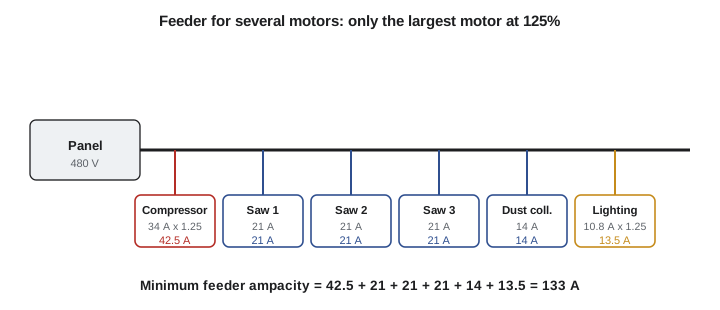
A new 480 V feeder will supply the 25 hp compressor (34 A), three 15 hp saw motors (21 A each) and the 10 hp dust collector (14 A). Find the minimum feeder ampacity.
Show solution
- Largest motor: the compressor, 1.25 × 34 = 42.5 A.
- Other motors: 21 + 21 + 21 + 14 = 77 A.
- Total: 42.5 + 77 = 119.5 A.
Answer: At least 119.5 A of feeder conductor ampacity.
Dana showed the calculation to Ray, who added one detail from experience. The new feeder would also feed 9 kVA of shop lighting that runs all day. At 480Y/277 volts three-phase, that lighting draws 9,000 ÷ (1.732 × 480) = 10.8 amperes, and as a continuous non-motor load it goes in at 125%, adding 13.5 amperes. The feeder minimum becomes 133 amperes.
Worked problem
Motors plus continuous lighting
Add 9 kVA of continuous three-phase lighting at 480 V to the Delgado motor feeder.
Show solution
- Lighting current: 9,000 ÷ (1.732 × 480) = 10.8 A.
- Continuous load at 125%: 1.25 × 10.8 = 13.5 A.
- Feeder: 119.5 + 13.5 = 133.0 A.
Answer: At least 133 A.
When motors cannot all run at once
Section 430.26 allows a demand factor for feeder conductors when the motors served are not all run at the same time, or run at reduced load. It is a permission that depends on the authority having jurisdiction: the feeder may have an ampacity less than 430.24 requires, provided the conductors still have enough ampacity for the maximum load determined by the nature of the operation, and only with the AHJ's approval. A machine shop where an interlock prevents two large saws from running at once is an example. On exams, a question about 430.26 will usually ask who must approve the reduced calculation, and the answer is the authority having jurisdiction.
Single-phase motors on three-phase systems
Shops often have single-phase motors fed line to line from a three-phase panel, such as the 3 hp, 230-volt hoist on Delgado's list. When you add them to a three-phase feeder calculation, the honest approach is to place each single-phase load on the phases it actually connects to and add currents phase by phase, taking the highest phase as the feeder load. Exam questions that mix single-phase and three-phase motors usually tell you which phases each motor uses, or they simplify by asking only for one phase. Work them phase by phase and you will not double-count.
Worked problem
Adding a single-phase hoist
The 3 hp, 230 V single-phase hoist (17 A in this course's values) is connected to phases A and B of the Delgado feeder. Which phases does it add to, and by how much?
Show solution
- A line-to-line single-phase load draws its current through both conductors it connects to.
- It adds 17 A to phase A and 17 A to phase B, and nothing to phase C.
- If the hoist were the largest motor on those phases, its 125% would apply; here the compressor is larger.
Answer: 17 A on phases A and B; phase C is unchanged.
Adjustable-speed drives
Variable-frequency drives are now common for pumps, fans and compressors, and Article 430 Part X covers them. For conductors supplying power conversion equipment, the rule in general terms is that the conductors must have an ampacity of at least 125% of the rated input current to the power conversion equipment. That input current is marked on the drive, and it can differ from the motor's table current. The output conductors between the drive and the motor follow the motor rules, and the drive's markings and instructions govern details such as the overload function, which many drives provide electronically.
Worked problem
A drive on the dust collector
The dust collector will be run through a drive marked with a rated input current of 16 A. Find the minimum ampacity of the supply conductors to the drive.
Show solution
- Use the drive's rated input current, as Part X directs.
- Minimum: 1.25 × 16 = 20 A.
Answer: At least 20 A on the supply side of the drive.
Conductors for wound-rotor secondaries and other special cases
Wound-rotor motors have secondary conductors running from the rotor slip rings to an external resistor bank, and 430.23 sizes them on a percentage of the full-load secondary current that depends on whether the motor is continuous or duty-rated. These motors are rare in new work, but older exam banks still include a question or two. Motors in listed equipment, including air-conditioning compressors and machine tools, follow their own articles, covered in Lessons 6 and 11.
def single_motor(flc):
    return 1.25 * flc

def several(motor_flcs, continuous=0.0, noncontinuous=0.0):
    largest = max(motor_flcs)
    others = sum(motor_flcs) - largest
    return 1.25 * largest + others + 1.25 * continuous + noncontinuous

lighting = 9000 / (3 ** 0.5 * 480)
print("Compressor branch circuit:", single_motor(34), "A")
print("Motor feeder:", several([34, 21, 21, 21, 14]), "A")
print("Lighting current:", round(lighting, 1), "A")
print("Motor feeder with lighting:", round(several([34, 21, 21, 21, 14], continuous=lighting), 1), "A")
print("Drive supply conductors:", 1.25 * 16, "A")Compressor branch circuit: 42.5 A Motor feeder: 119.5 A Lighting current: 10.8 A Motor feeder with lighting: 133.0 A Drive supply conductors: 20.0 A
Exam strategy for motor conductors
Motor conductor questions are some of the most reliable points on a master exam, provided you keep the steps in order. First, read the table current for each motor at the right voltage column. Second, decide which rule applies: 430.22 for one motor, 430.24 for several, Part X for a drive, 430.22(E) for duty-rated motors. Third, apply the 125% to the right figure and only that figure. Fourth, if the question asks for a conductor size, take the minimum ampacity to Article 310 with the stated conductor type, ambient and number of conductors, respecting the terminal temperature limits. Finally, check whether the answer choices include the minimum ampacity or a conductor size, because the distractors will include both.
Marcus once lost a practice question by applying 125% to every motor on a feeder. Dana's correction to his flashcard was short: "One motor gets the bonus. The biggest one."
Common mistakes
MistakeApplying 125% to every motor on a feeder.
InsteadApply 125% only to the largest motor; add the others at 100%.
MistakeUsing the nameplate current for conductor sizing.
InsteadUse the table current, except for duty-rated, multispeed and other listed exceptions.
MistakeUsing the motor's table current for the conductors supplying a drive.
InsteadUse 125% of the drive's rated input current.
MistakeForgetting continuous non-motor loads on a motor feeder.
InsteadAdd continuous lighting and similar loads at 125% and noncontinuous loads at 100%.
Summary and key terms
- Single continuous-duty motor conductors: at least 125% of the table full-load current (430.22).
- Duty-rated motors may use the 430.22(E) factors applied to the nameplate current, when the motor and application qualify.
- Several motors: 125% of the largest motor plus 100% of the others plus other loads (430.24).
- Continuous non-motor loads go in at 125%; noncontinuous at 100%.
- A feeder demand factor under 430.26 needs the authority having jurisdiction's approval.
- Drive supply conductors: at least 125% of the drive's rated input current.
- Continuous duty
- Operation at a substantially constant load for an indefinitely long time.
- Intermittent duty
- Operation for alternate intervals of load and rest, or load, no load and rest.
- Power conversion equipment
- A drive or similar device that changes frequency or voltage to control a motor.
- Largest motor
- The motor with the highest full-load current on a feeder; only it receives the 125% factor.
Practice problems
Work each problem on paper first, then reveal the answer to check.
Find the minimum branch circuit ampacity for a 10 hp, 480 V motor with a table current of 14 A.
Show answer
1.25 × 14 = 17.5 A.
Find the minimum feeder ampacity for motors of 34, 21 and 14 A.
Show answer
1.25 × 34 + 21 + 14 = 77.5 A.
A drive is marked with a rated input current of 40 A. What is the minimum supply conductor ampacity?
Show answer
1.25 × 40 = 50 A.
Who must approve a reduced feeder calculation under 430.26?
Show answer
The authority having jurisdiction.
Lesson quiz · 5 questions
Score 60% or more to complete this lesson.
Create a free account to save your progress, take quizzes and earn a certificate.